Weekly ecommerce tips, deals & news.
A price war is a cycle where competing stores keep cutting prices to undercut each other. Each cut wins a few sales for a short time. Then a rival answers with a deeper cut, and everyone’s profit shrinks until nobody can afford to keep going.
A price war works as a chain reaction of price cuts between stores selling the same or similar products. One store lowers its price to grab sales. A rival notices and goes lower, and the cycle repeats until margins are almost gone.
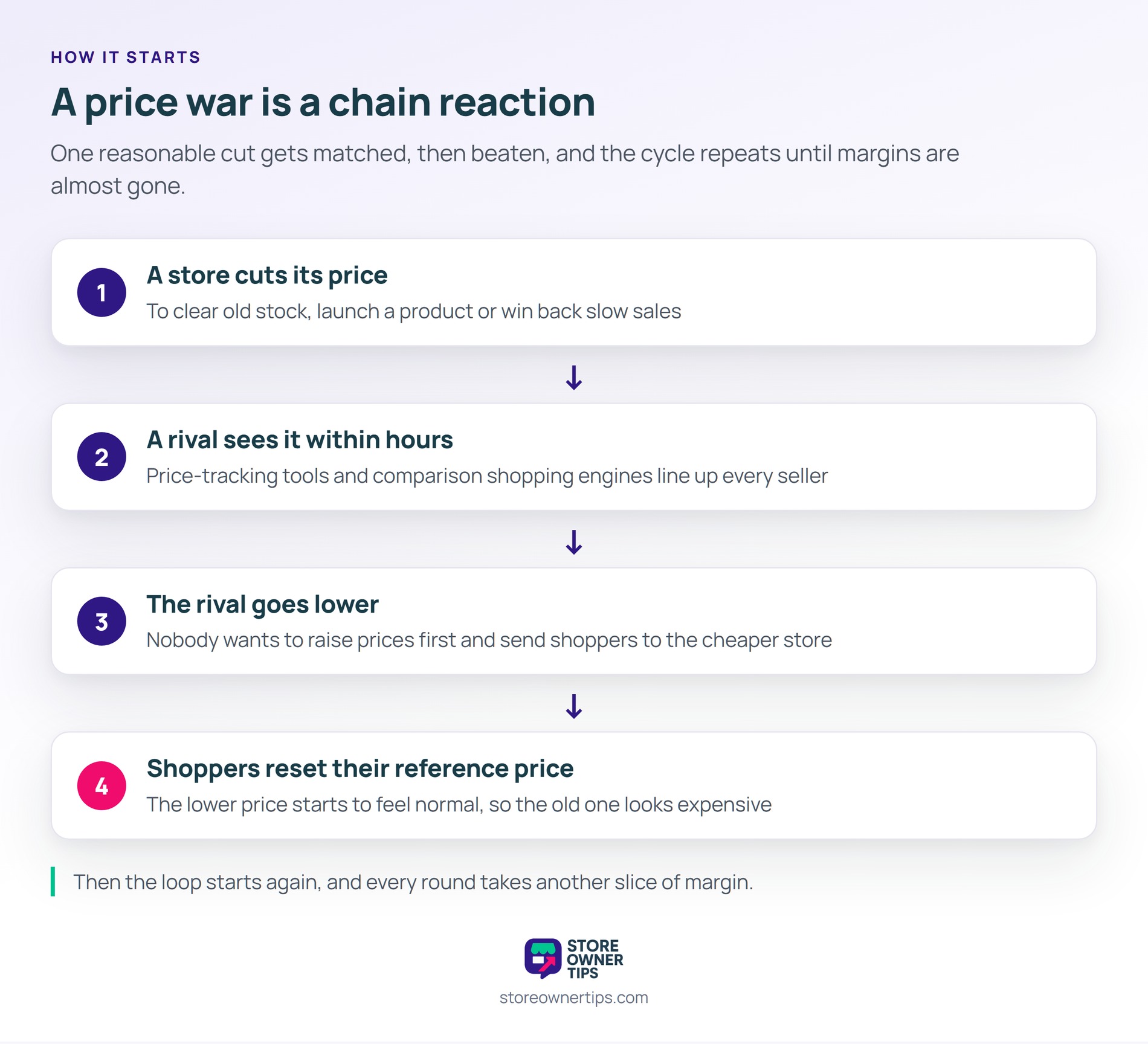
A price war usually starts with a reasonable move. A store wants to clear old stock, launch a product, or win back slow sales. So it drops the price, and the drop is easy to see.
Online, the cut shows up almost instantly. Shoppers compare prices across tabs, and comparison shopping engines line up every seller side by side. Many stores also watch rivals with price-tracking tools. As a result, a single cut can trigger replies within hours.
A price war is like two people in a crowd standing on tiptoe to see a stage. One rises up, so the person behind does too. Soon everyone is uncomfortable, and nobody can see any better than before.
Each store fears that raising its price first will send every shopper to the cheaper rival. That fear keeps prices low even when every seller is losing money. Meanwhile, shoppers get used to the lower price and start to treat it as normal.
A price war rewards whoever can survive the thinnest margin for the longest time. Large sellers often buy in bulk, pay lower shipping rates, and carry cash reserves. A small WooCommerce store usually has none of those cushions.
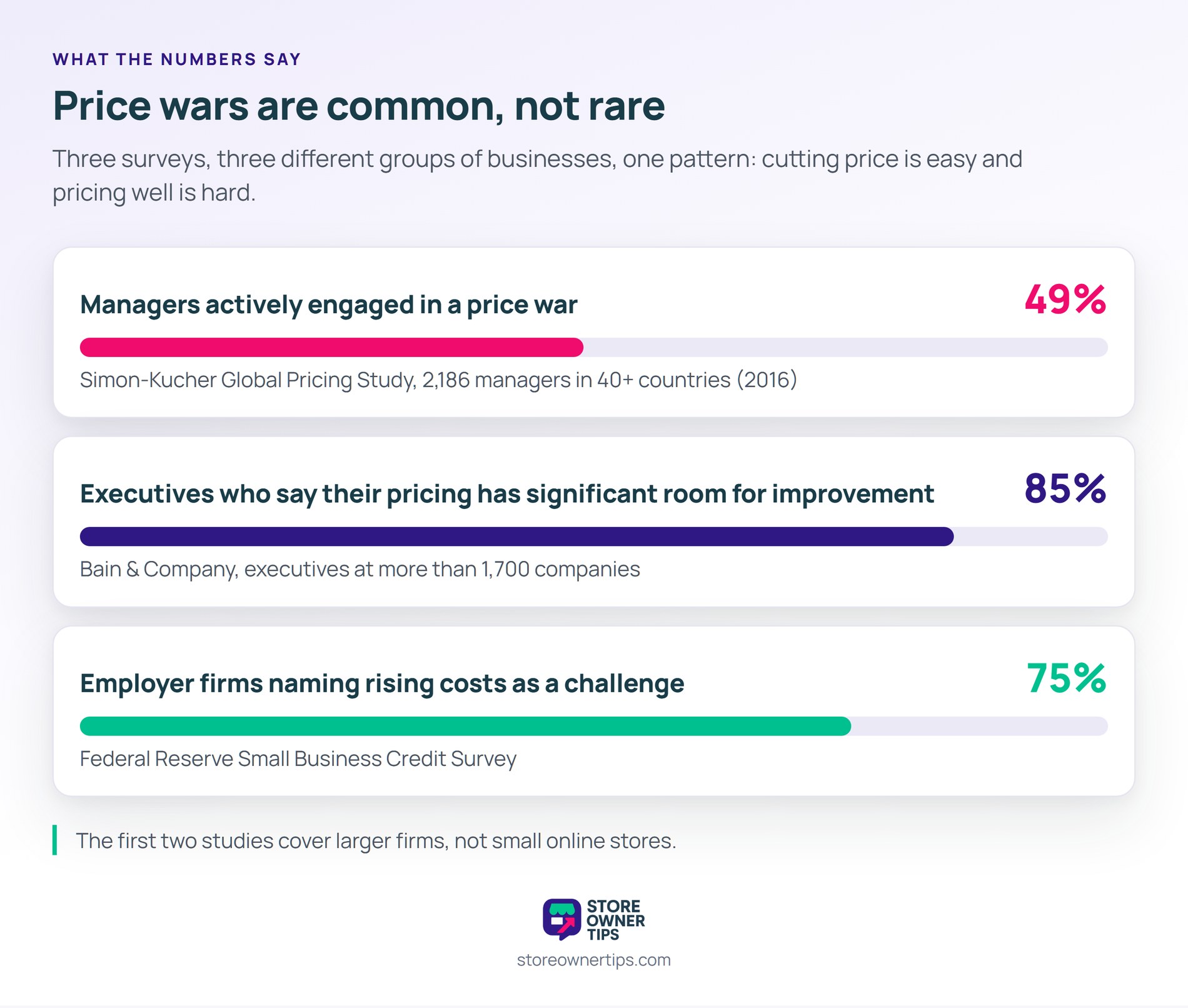
Costs make it harder still. The Federal Reserve runs a yearly Small Business Credit Survey. In it, 75% of employer firms named rising costs of goods, services, or wages as a challenge.
When costs go up while prices go down, the gap closes from both sides. That squeeze is a fast path to margin erosion.
A price war leaves damage even for the store that outlasts its rivals. Shoppers remember the lowest price they saw. That memory becomes their reference point, so the old price now looks expensive.
The buyers you won also tend to be the least loyal ones. They came for the price, and they’ll leave for the next cheaper offer. On top of that, a store with thin margins has less money for stock, ads, and support. So the “winner” often ends up weaker than before the fight began.
Price wars are common, not rare. Simon-Kucher’s Global Pricing Study surveyed 2,186 managers across more than 40 countries. In that 2016 study, 49 percent said they were actively engaged in a price war. Most respondents named low-cost competitors and stronger buyer bargaining as the main causes.
Weak pricing habits feed the problem. Bain & Company surveyed executives at more than 1,700 companies, and 85% said their pricing had significant room for improvement. That said, both studies cover larger firms, not small online stores. Even so, the lesson carries over: cutting price is easy, and pricing well is hard.
You get out of a price war by changing what shoppers compare. That way, price stops being the only number that matters. A rival can match a price in seconds. It’s much harder to match a full offer.
A coupon plugin like Advanced Coupons can run most of these offers in WooCommerce. For example, you can set up BOGO deals or bundle discounts. You can also add a loyalty points program on top. In short, the shelf price holds while the offer gets stronger.
Track the change with profit per order, not just sales. Compare the weeks before and after you stop matching prices. If volume dips a little but each order keeps more, the move is working.
A price war in practice looks like a store selling more and keeping far less. Here’s a hypothetical example. Imagine a small coffee gear shop called Bloom & Brew, selling a pour-over kettle through WooCommerce.
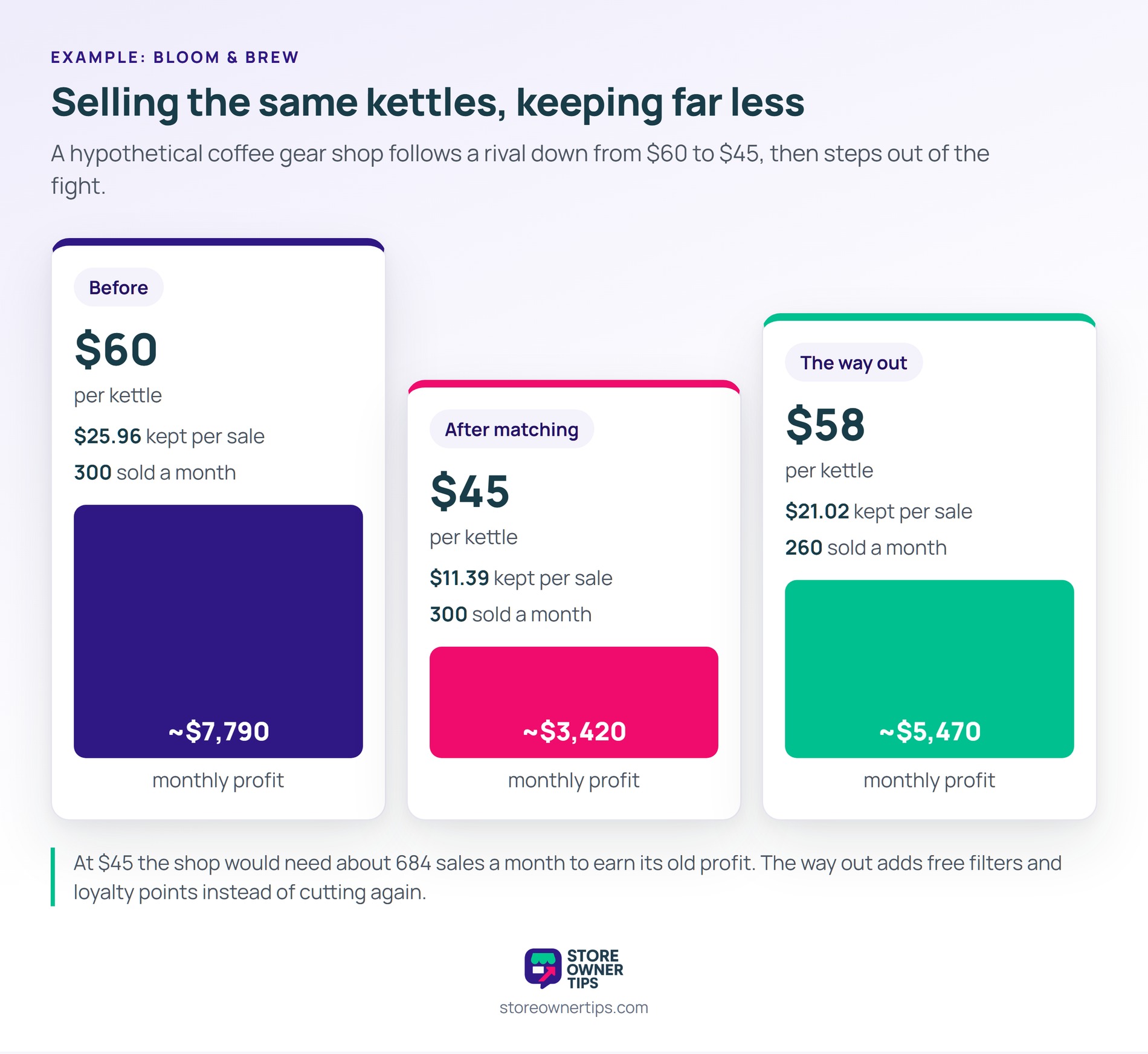
Bloom & Brew sells the kettle for $60, and each one costs $32 to buy in. The card processor charges 2.9% plus 30 cents per payment, a common standard rate. So each sale pays a $2.04 fee and keeps about $25.96.
The shop sells 300 kettles a month at that price. That works out to roughly $7,790 in monthly profit before overheads. It’s a healthy product, and it pays for a lot of the business.
A rival lists the same kettle for $54, and Bloom & Brew matches it. Then the rival drops to $49, and later to $45. Each time, the owner follows to avoid losing the sale.
At $45, the fee falls to $1.61, and each kettle keeps just $11.39. Sales hold at 300 a month, but profit drops to about $3,420. That’s a loss of roughly $4,370 every month. To earn the old profit at the new price, the shop would need to sell about 684 kettles.
The owner stops matching and resets the price to $58. Next, every kettle ships with a free pack of paper filters that costs $3. Repeat buyers also earn loyalty points toward their next order.
Each kettle now keeps about $21.02 after the fee and the free filters. Sales slip to 260 a month, because some bargain hunters leave. Still, profit climbs back to about $5,470, which beats the $45 price by over $2,000.
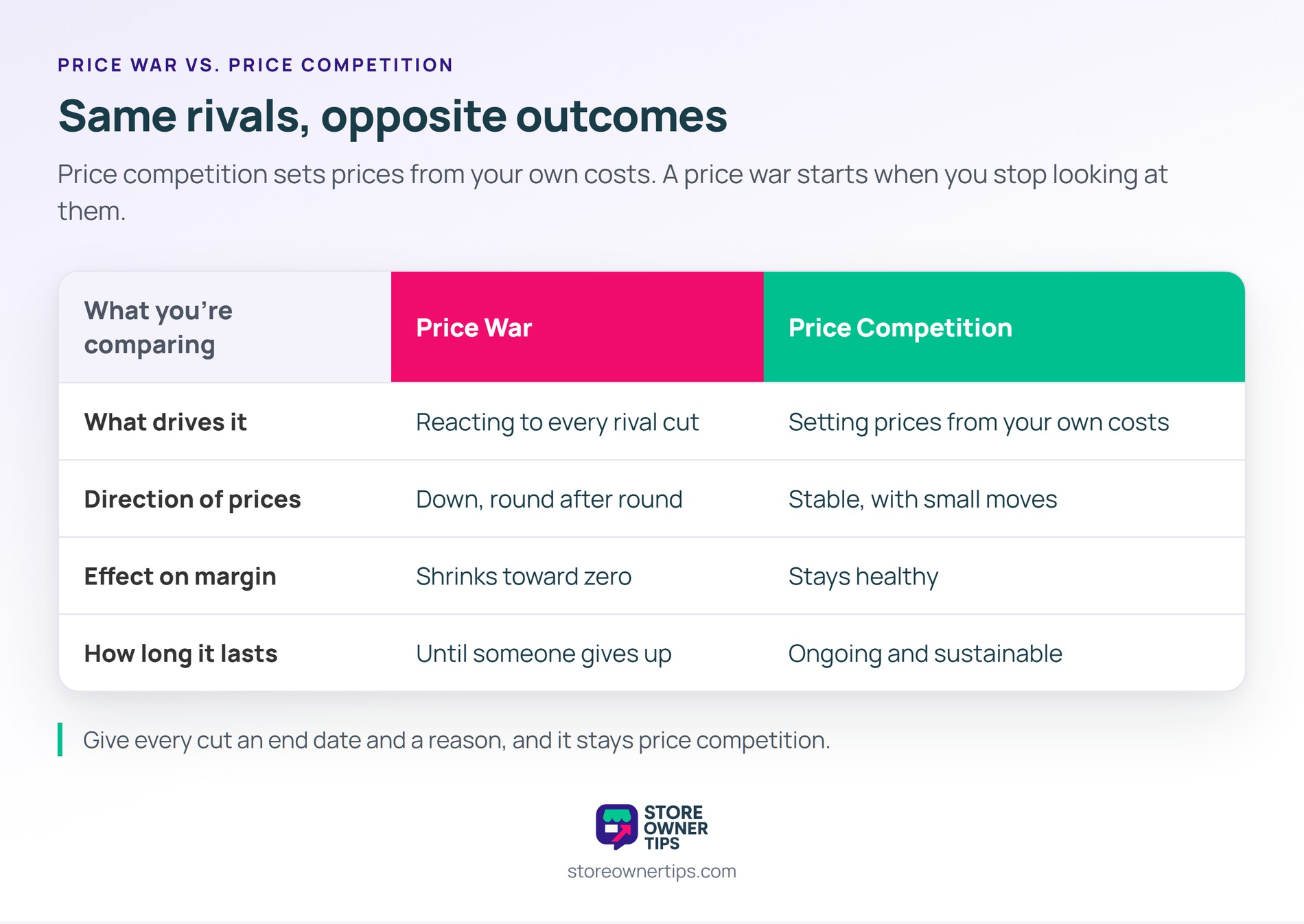
A price war is a spiral of cuts that destroys profit, while price competition is normal pricing against rivals.
| What you’re comparing | Price War | Price Competition |
|---|---|---|
| What drives it | Reacting to every rival cut | Setting prices from your own costs |
| Direction of prices | Down, round after round | Stable, with small moves |
| Effect on margin | Shrinks toward zero | Stays healthy |
| How long it lasts | Until someone gives up | Ongoing and sustainable |
Price competition is healthy, and every store does it. You check what rivals charge and set a fair price you can sustain. By contrast, a price war begins when you stop looking at your own costs.
A planned loss leader can look similar, but it has a limit and a goal. Pick price competition, and give every cut an end date and a reason.
You’re likely in a price war if you’ve cut the same product’s price several times to match one rival. Watch for falling profit per order while sales volume stays flat. Another sign is shoppers who only buy when your price is the lowest.
Only match a lower price if you can still make a profit at that price. First, work out your cost, fees, and shipping per order. If the match leaves little or nothing, compete with added value instead, such as a gift or a bundle.
A small business survives a price war by refusing to fight on price alone. Focus on what larger rivals do poorly, like personal service and niche expertise. Then use bundles and loyalty rewards so shoppers compare your whole offer, not one number.
A price war matters because it trades long-term profit for a short-term sales bump. Prices that fall are hard to raise again, and thin margins leave no room for growth. Stores that compete on value keep both their customers and their customer lifetime value.
Copyright © StoreOwnerTips.com. All Rights Reserved.
