Weekly ecommerce tips, deals & news.
Queue management is a digital waiting room that protects your online store from crashing during massive traffic spikes. It intercepts shoppers before they reach your website and places them in a fair, first-come, first-served line. By controlling exactly how fast people enter your store, it ensures your servers, databases, and checkout systems run smoothly, even during a viral flash sale.
Running a massive online sale is thrilling until thousands of shoppers try to buy the exact same item at the exact same second. Regular websites expect a steady, predictable flow of visitors. When too many people hit the database at once, they overwhelm the system, creating a digital traffic jam that results in site crashes, generic 503 error pages, and furious customers.
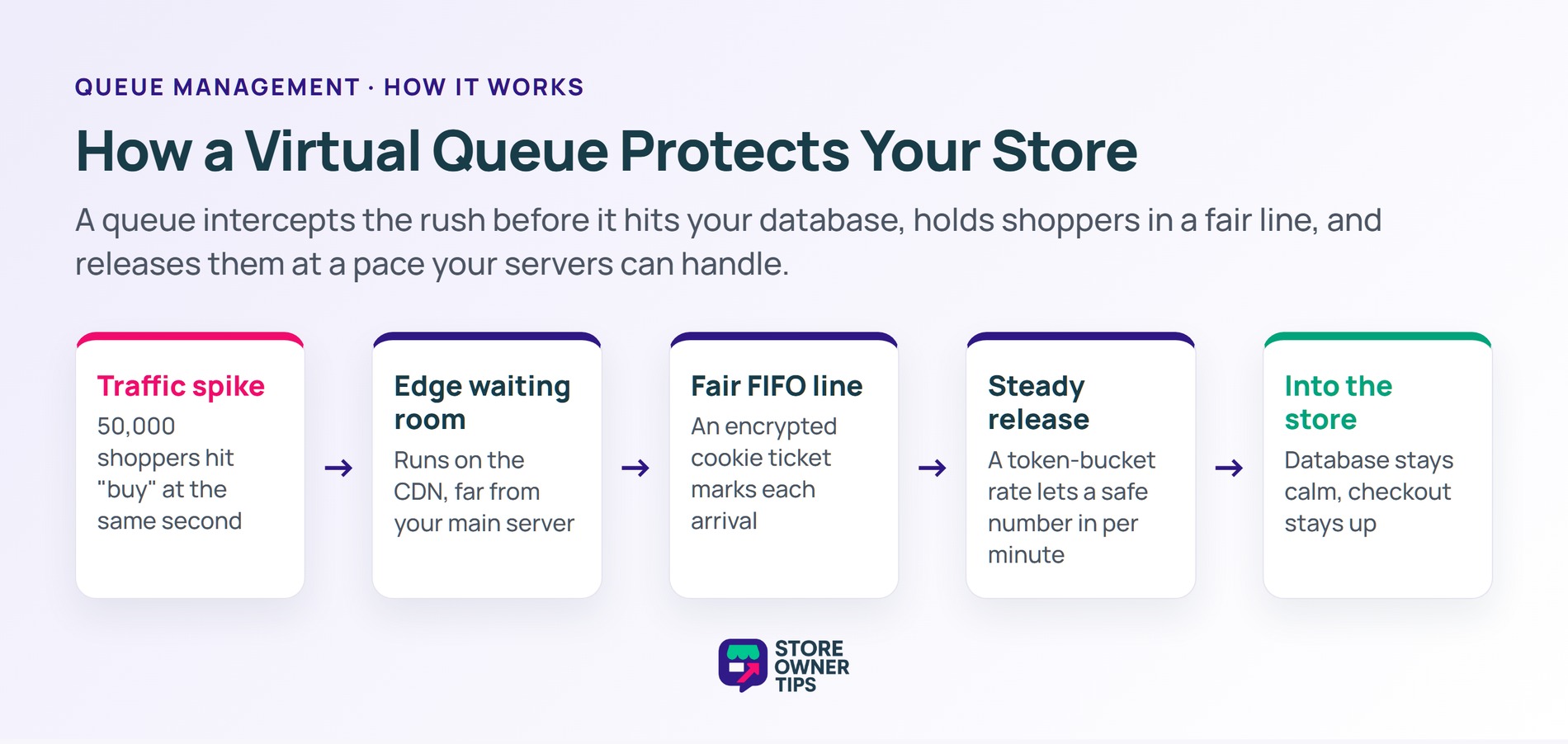
To stop this, modern e-commerce systems use what experts call Edge Computing on a Content Delivery Network (CDN).
Real-world analogy: Imagine hiring hundreds of security guards and placing them blocks away from your physical retail store. Just like crowd control manages physical lines down the street, this software prevents crowds from mobbing your actual front door.
Instead of running the waiting room on your main website server (which would just crash the server anyway), the queue runs on these global edge networks. These networks use tools like Durable Objects.
Real-world analogy: A Durable Object is like a super-fast, temporary notepad that a bouncer uses to instantly tally how many people have entered, without having to radio the main office for every single person.
Tracking millions of people perfectly is too hard for computers to do instantly. To solve this, systems use Time Bucketing.
Real-world analogy: Instead of giving a million people individual, tracked name tags, the system loads people like a rollercoaster. It packs everyone who arrives during the exact same minute into a single “train car” and dispatches them together.
The system gives each user an encrypted cookie. This digital ticket tracks the exact second they arrived and their spot in line. The system uses a strict First-In-First-Out (FIFO) rule, letting people into the store chronologically.
To keep the flow of traffic smooth once people are inside, the software uses a Token Bucket Algorithm.
Real-world analogy: Imagine every shopper holds a bucket of water. Every time they click a button on your site, they pour out a cup. A hose slowly refills the bucket. If they click too fast and empty the bucket, they have to wait for it to refill before clicking again.
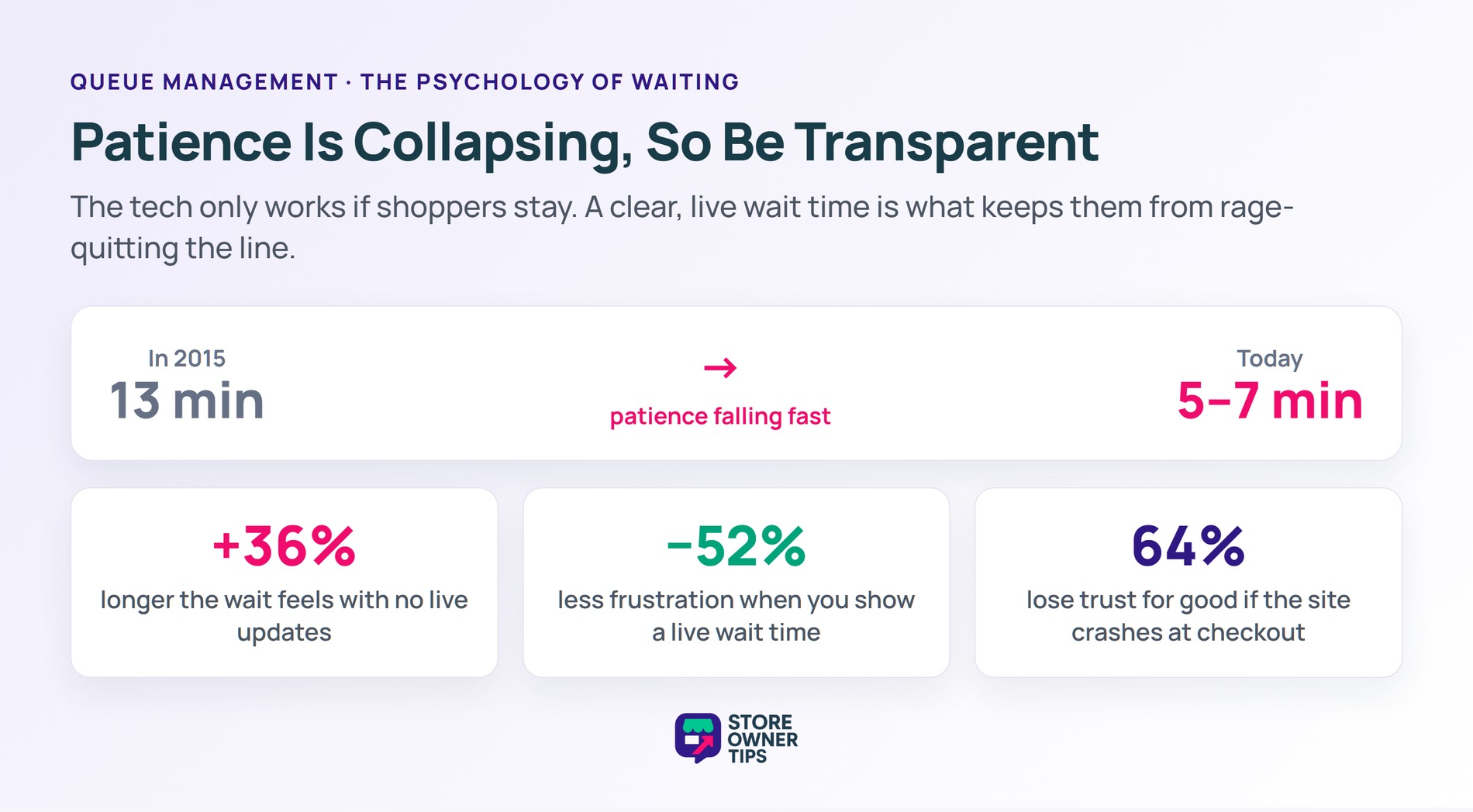
The technology doesn’t matter if the customer gets bored and leaves. Over the past decade, human patience has collapsed. In 2015, shoppers would wait 13 minutes. Today, that tolerance has dropped to just 5 to 7 minutes. Consumer frustration with waiting has surged by 126% in a single year.
Psychological studies show that if you do not give a shopper updates, their wait feels 36% longer than it actually is. By showing a live estimated wait time, a transparent virtual queue management system cuts frustration by 52%. Consumers are practical; 87% say they prefer a short, informed wait over getting immediate access to a broken, laggy website. 64% of shoppers will permanently lose trust in your brand if the site crashes during checkout.
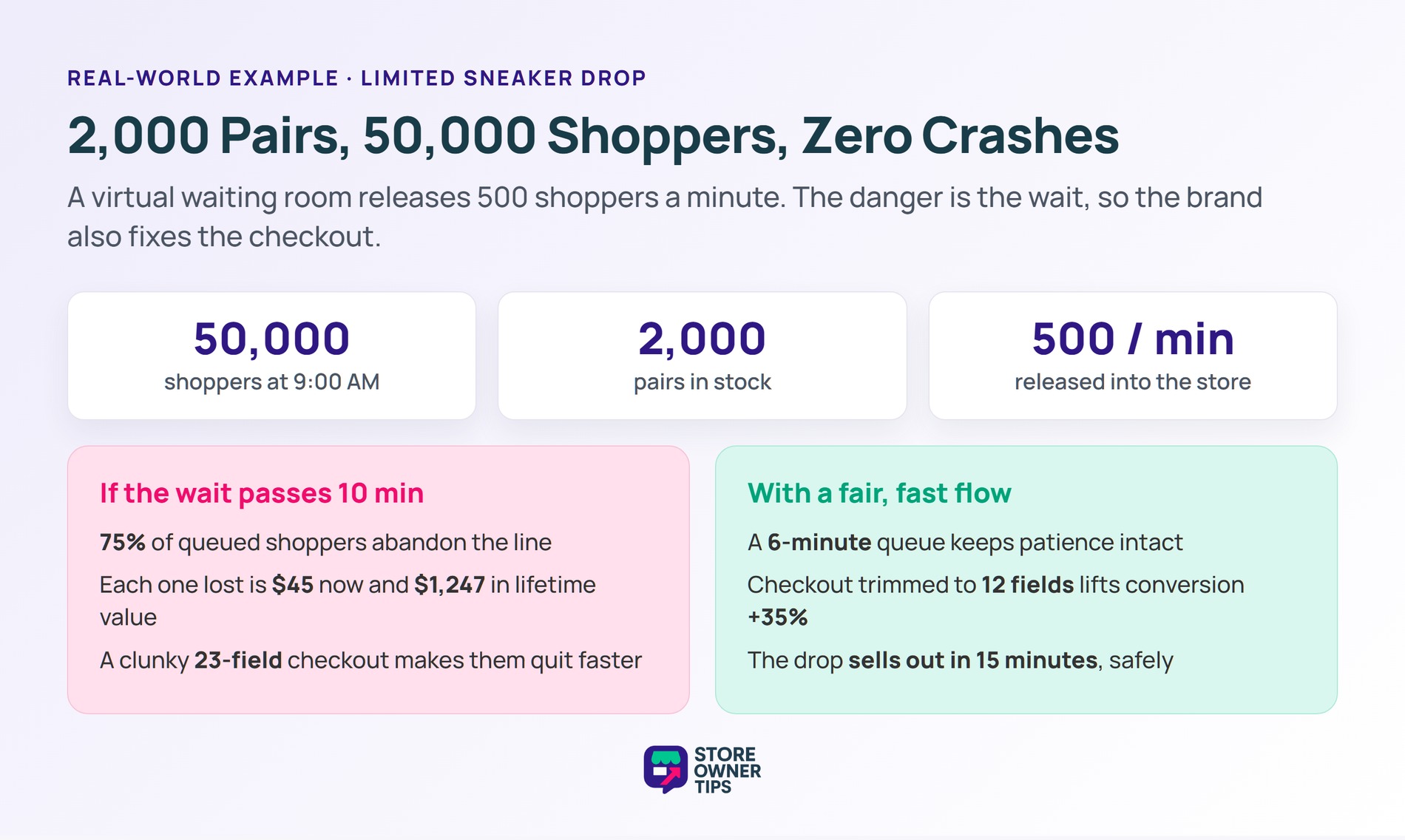
Imagine a mid-sized apparel brand launching a highly anticipated, limited-edition sneaker. They have exactly 2,000 pairs, but they expect 50,000 people to hit the website at 9:00 AM.
If they do not use a queue, all 50,000 people hit the database simultaneously. The database tries to write thousands of orders for the exact same pair of shoes. The system locks up, the site crashes, and the brand oversells the shoe, leading to angry refunds.
Instead, the brand activates a virtual waiting room. At 8:30 AM, eager shoppers are placed into a “pre-queue” holding pen. At exactly 9:00 AM, the queue shuffles everyone to stop fast bots, and begins letting 500 people into the store every minute.
However, the brand must carefully monitor and reduce wait times wherever possible. Let’s say their server can only handle letting people in very slowly, pushing the wait time past 10 minutes. The data is clear: 75% of the remaining queued shoppers will abandon the line. For every single person who leaves, the brand loses $45 in immediate revenue and a staggering $1,247 in lifetime customer value.
Because the queue uses up the customer’s patience, the brand realizes they must aggressively optimize the actual checkout. The global average cart abandonment rate is a massive 70.22%. If a tired shopper passes the queue only to face the average checkout process (which features a clunky 23.48 form elements), they will quit.
To capture a potential 35% increase in conversion rates, the brand strips their checkout down to just 12 forms. They remove “Address Line 2” (which confuses 80% of users) and ensure shoppers don’t get stuck in password-reset loops (which alone causes a 19% abandonment rate). By pairing a fair, 6-minute queue with a lightning-fast checkout, they sell out of the sneakers safely in 15 minutes.
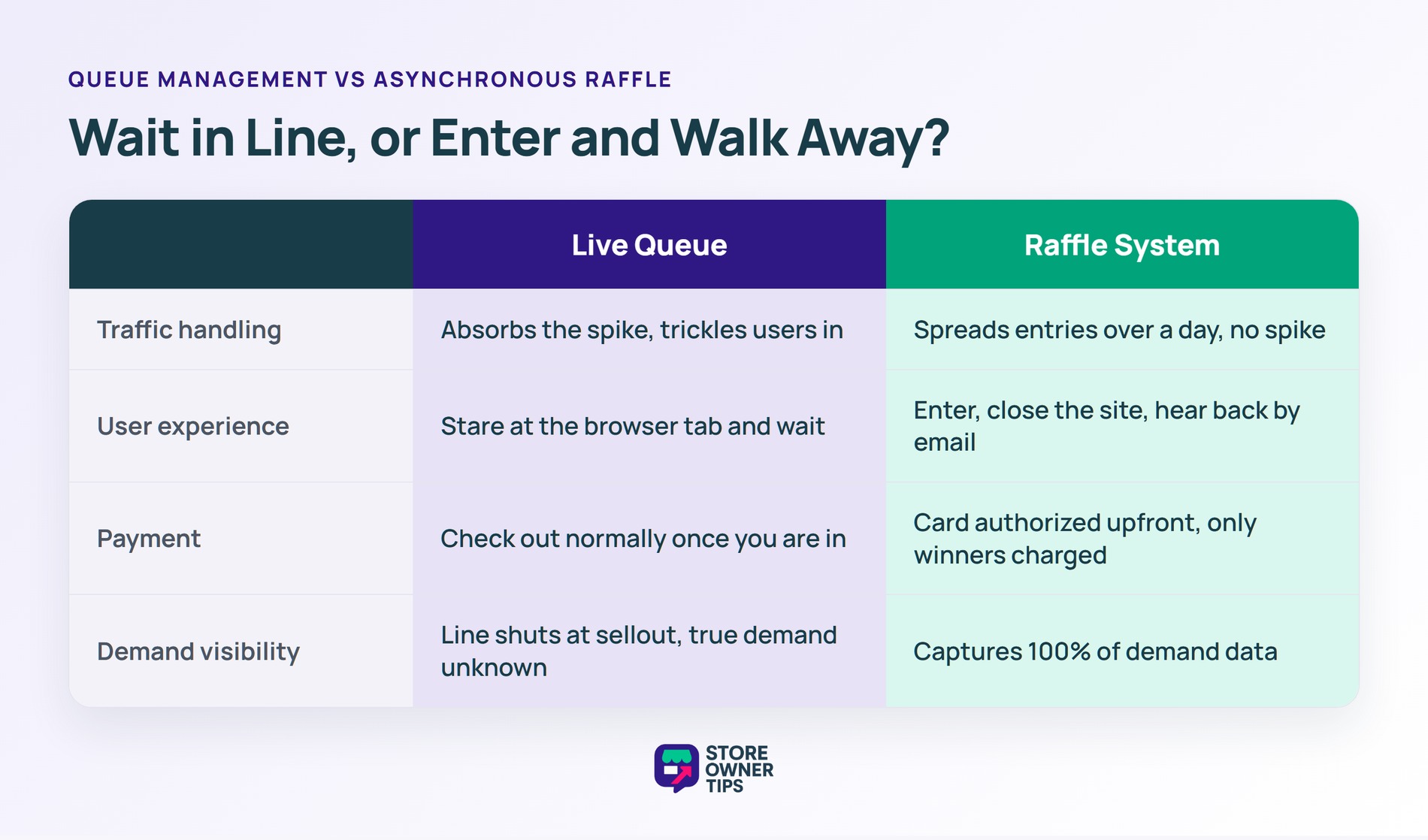
Sometimes, forcing everyone to wait in line at the same time is not the best strategy. The main alternative to a live queue is an asynchronous raffle system (like EQL). For a normal store, a wishlist waitlist captures that same demand for sold-out drops.
Adding a waiting room changes how your entire website operates. It is a powerful tool, but it comes with real risks.
OrderItemUpdate. If your checkout APIs aren’t secured with cryptographic tokens, the queue is useless.Standard servers and databases are built for steady traffic. A sudden surge overwhelms the system’s limits, causing crashes. Platforms survive this by deploying a virtual waiting room at the edge of their network. This acts as a shock absorber. It intercepts the massive request load before it hits the database, calculates exactly how many transactions the system can handle, and funnels users in safely.
Yes, but only if the retailer sets it up poorly. If a queue relies on basic website scripts, a bot can simply manipulate the browser to skip it. However, if the queue is securely integrated at the edge network, bots cannot bypass the browser. They can only skip the line if developers forget to secure the final checkout systems, allowing bots to spoof active shopping sessions.
This is almost always caused by a default WooCommerce feature called “AJAX Cart Fragments.” This feature constantly pings your server in the background to update the shopping cart total. During a big sale, these automated background requests multiply rapidly. This sudden flood completely overwhelms your server as it tries to process the queue. To fix this, you must disable Cart Fragments before a big sale.
Using a secure virtual queue management system is a mandatory technical safeguard for any e-commerce brand that runs viral sales or high-demand product drops. By transforming chaotic traffic spikes into an orderly, transparent line, you protect your server infrastructure while actively preserving consumer trust and lifetime customer value.
Copyright © StoreOwnerTips.com. All Rights Reserved.
