Weekly ecommerce tips, deals & news.
Real-time shipping rates are delivery prices pulled live from the carrier at the moment of checkout. The store sends the cart’s weight, size, and destination to the carrier. The carrier sends back the exact shipping cost for that order. The buyer then pays the true price, not a rough estimate.
Real-time rates are also called live or calculated rates. The store asks the carrier for a price during checkout. The carrier replies with the exact cost in seconds. The buyer sees that number before they pay.
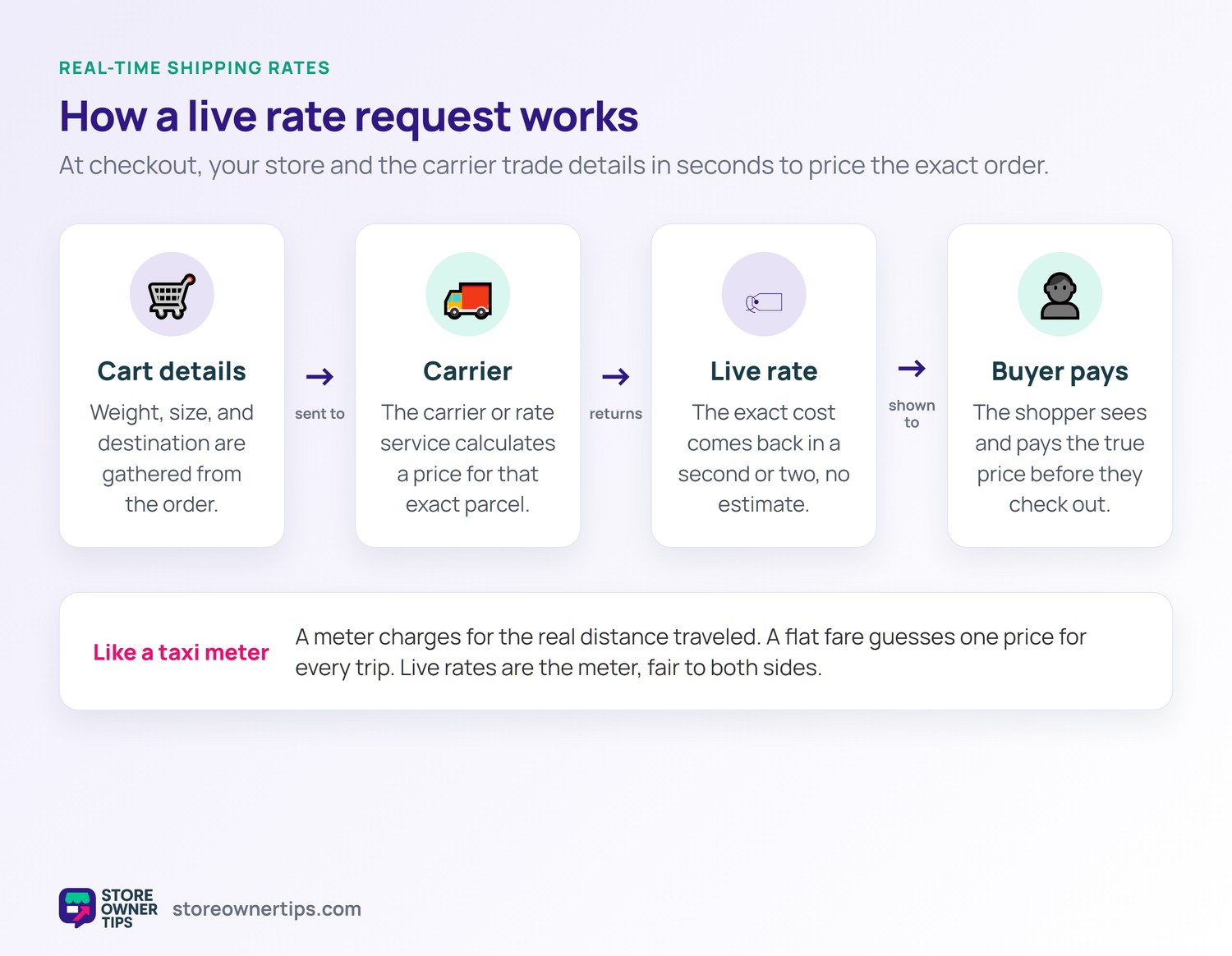
Think of it like a taxi meter instead of a flat fare. A meter charges you for the real distance you travel. A flat fare guesses one price for every trip. Real-time rates are the meter, fair to both sides.
This means the fee always fits the actual order. A tiny order ships cheap, and a heavy one costs more. You never eat a loss or overcharge a buyer.
This honesty also builds trust at checkout. Buyers see the same rate the carrier would charge. There is no hidden markup to second-guess.
On WooCommerce, real-time rates come from carrier integrations. You connect your store to carriers or a rate service. The store then requests a live quote during checkout.
The quote depends on the cart and the shipping address. The carrier weighs all the details and returns a price. WooCommerce and Shopify both support live rates, though the setup differs.
Most carrier plugins are quick to install today. You log in, link the account, and pick your services. The whole setup often takes under an hour.
You can also cache quotes briefly to stay fast. That trick avoids a fresh call on every click. The buyer still sees an accurate, current price.
The main reason is cost accuracy on every order. You never lose money on a heavy or distant package. The buyer simply pays what the carrier charges.
Real-time rates also offer choice at checkout. Buyers can pick a fast option or a cheap one. That control can lift trust and conversion.
Accuracy matters because surprise fees scare buyers off. In fact, 48% of shoppers abandon carts over high extra costs. Showing the true rate avoids a worse surprise later.
Live rates also scale as you grow. New products price themselves the moment you add weights. So you spend less time editing shipping tables.
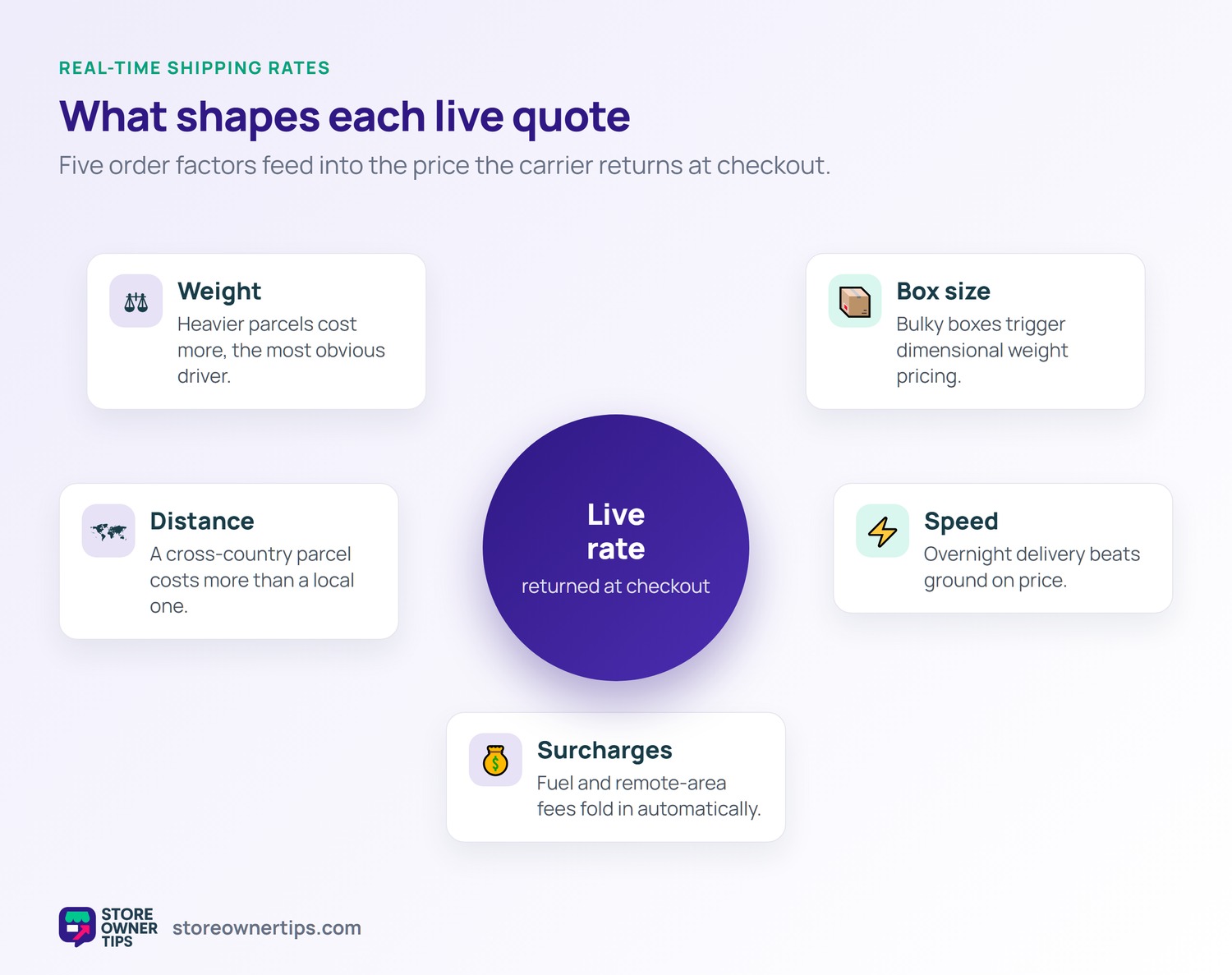
Several factors shape each live quote. Weight is the most obvious one, since heavier costs more. Box size also counts through dimensional weight rules.
Distance plays a big role as well. A cross-country parcel costs more than a local one. Speed matters too, as overnight beats ground on price.
Carrier surcharges can nudge rates as well. Fuel fees and remote-area charges add small amounts. Live quotes fold those in so you do not absorb them.
Good product data keeps these quotes accurate. Wrong weights or sizes lead to wrong rates. So keep your product details clean and current.
Live rates also help you meet delivery expectations. About 63% of consumers now expect delivery within two days. Real-time options let buyers pay for that speed when they want it.
Offering a range of speeds covers more shoppers. Some want the cheapest rate and will wait. Others happily pay more to get it fast.
Clear speed labels help buyers decide fast. Show the days and the price side by side. That clarity turns choice into a quick, easy pick.
Live rates can sit beside a free shipping offer. You might show free shipping above a cart value and live rates below. That free shipping threshold still nudges bigger carts.
This mix can lift your average order value too. Buyers add an item to reach the free line. So accuracy and incentives can live together.
Live rates shine for mixed or heavy catalogs. Furniture, equipment, and bulky goods vary wildly in cost. One flat fee simply cannot fit them all.
They matter less for small, uniform products. A store of stickers ships everything for about the same. There, a simple flat rate is easier to run.
The deciding factor is how varied your orders are. Wide weight ranges call for live rates. Tight, uniform ranges fit a flat fee fine.
Start by connecting your main carrier account. Then enter accurate weights for every product. Test a few sample carts before going live.
Keep a simple flat rate as a backup. It saves checkout if the carrier feed hiccups. A little safety net prevents lost sales.
The first mistake is bad product weights and sizes. Wrong data gives wrong quotes every time. Audit your catalog to keep rates honest.
Another trap is showing too many shipping choices. A wall of options can freeze a buyer. Trim the list to a few clear picks.
A third slip is no fallback rate. If the carrier feed fails, checkout can break. Always set a backup flat rate just in case.
Imagine a furniture brand called OakRoot on WooCommerce. It sells items of wildly different weights. A flat rate keeps losing money on heavy pieces.
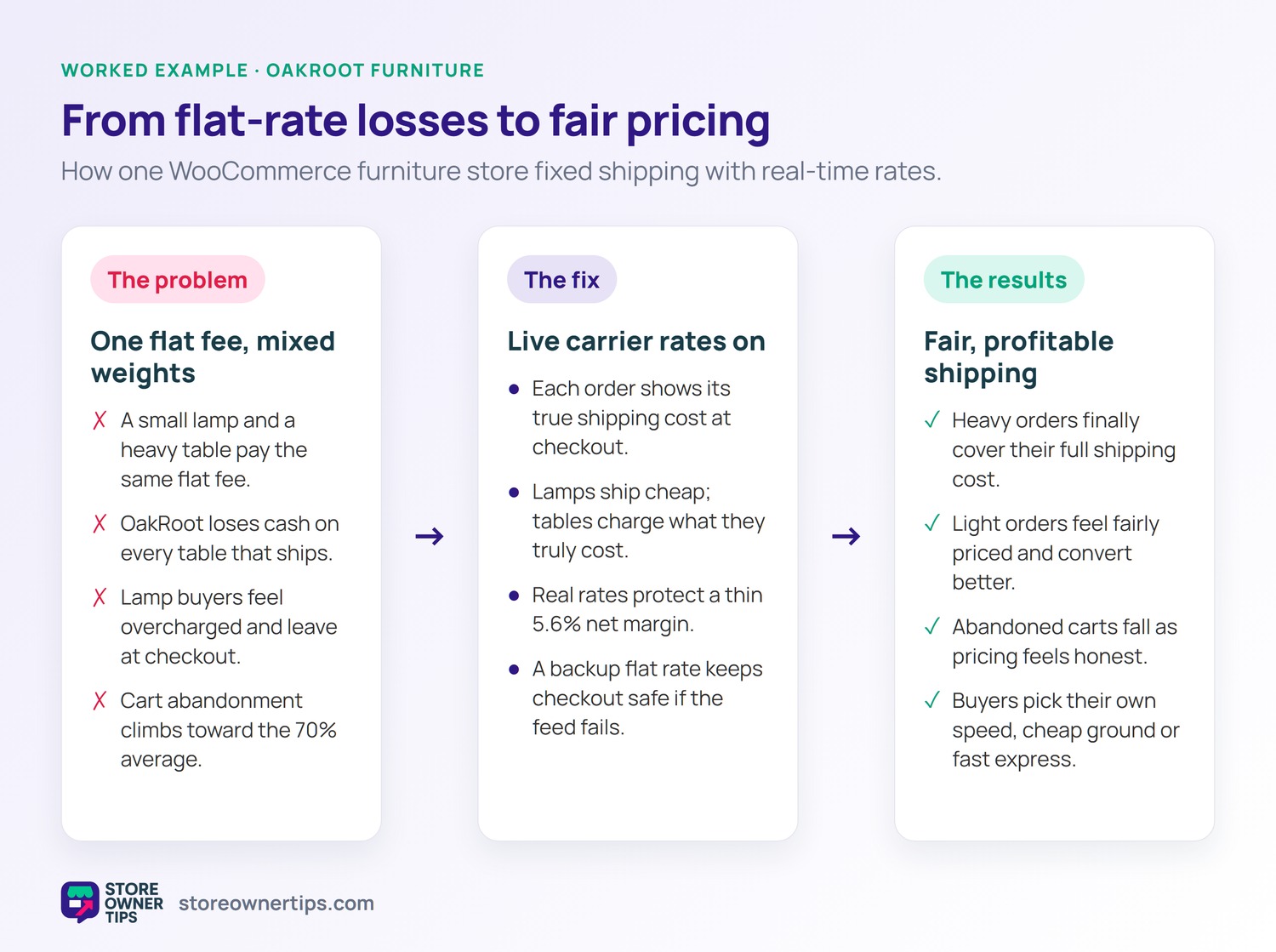
A small lamp and a heavy table cost the same flat fee. OakRoot loses cash every time a table ships. Yet it overcharges buyers who only want a lamp.
Those overcharged buyers often leave at checkout. OakRoot watches its cart abandonment climb toward the 70.22% industry average. The flat fee clearly does not fit its mixed catalog.
OakRoot turns on real-time carrier rates at checkout. Now each order shows its true shipping cost. Lamps ship cheap, and tables charge what they truly cost.
Thin margins make this accuracy vital. General retailers average a net margin of just 5.61%. Charging the real rate stops heavy orders from draining profit.
Heavy orders finally cover their full shipping cost. Light orders feel fairly priced and convert better. Abandoned carts fall as the pricing feels honest.
Buyers also enjoy choosing their own speed. Some grab the cheap ground rate to save. Others pay for express when they need it fast.
OakRoot also sets a backup flat rate for safety. If the carrier feed ever fails, checkout still works. The lesson is clear: live rates fit stores with varied products.
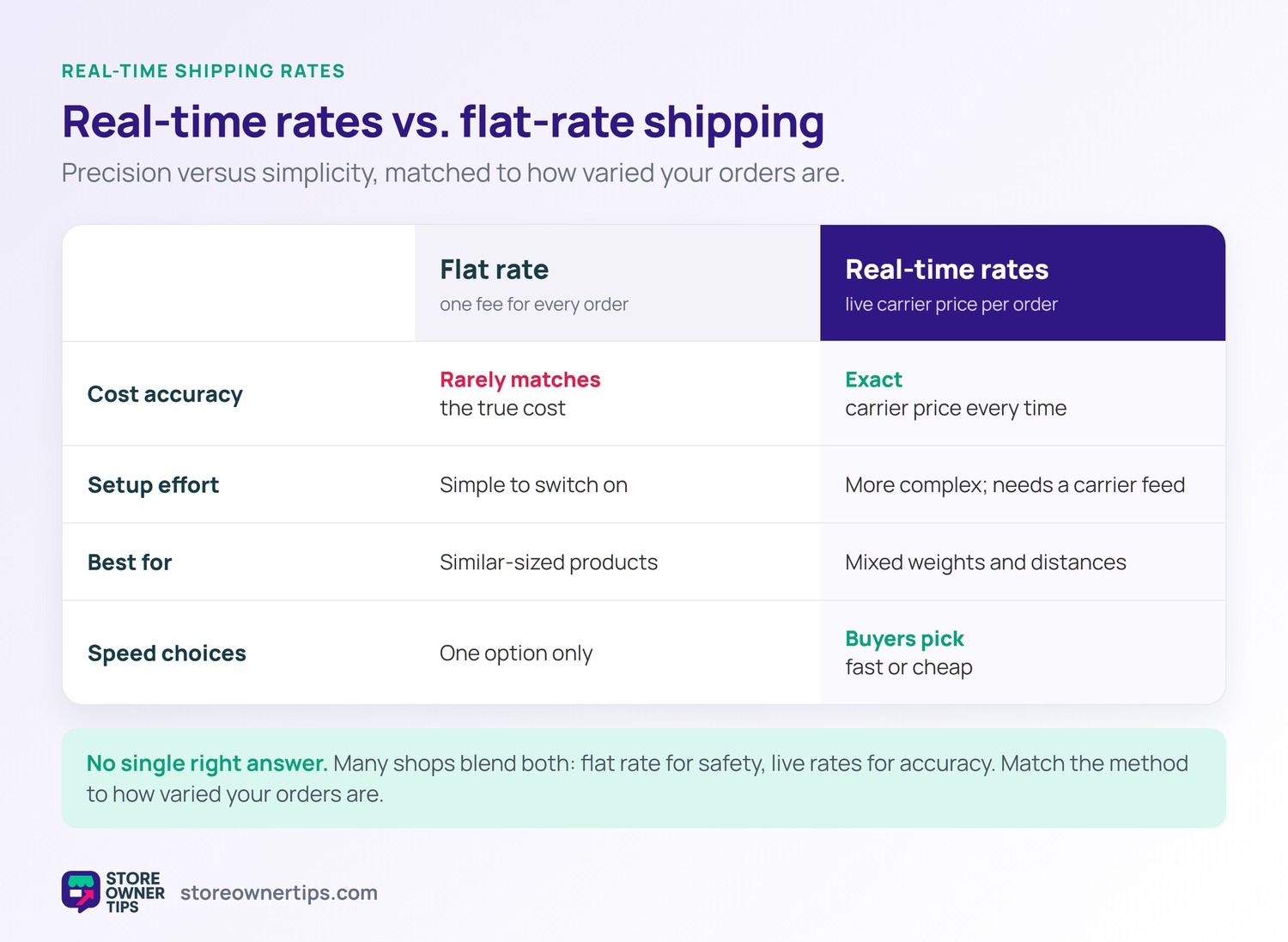
The main alternative is a single flat rate. Flat rate charges one fee no matter the order. It is simple but rarely matches the true cost.
Real-time rates trade simplicity for precision. Each order pays its exact carrier price. However, the setup is more complex and depends on a feed.
Flat rates suit stores with similar-sized products. Real-time rates suit stores with mixed weights and distances. Many shops blend both to balance ease and accuracy.
There is no single right answer here. The best fit depends on your catalog and your reach. So match the method to how varied your orders are.
They are, if your products vary a lot in weight or size. Accurate rates protect your margin on heavy orders. For uniform products, a flat rate may be simpler.
Usually no, since quotes return in a second or two. A good connection keeps the process smooth. Always add a fallback rate for the rare outage.
You need a link to carrier accounts or a rate service. You also need accurate product weights and sizes. Clean data keeps every live quote correct.
Real-time shipping rates charge each buyer the true cost of delivery. They protect your margin on heavy orders and offer speed choices at checkout. For stores with varied products, live rates keep shipping fair and profitable. Pair them with a fallback rate, and checkout stays solid.
Copyright © StoreOwnerTips.com. All Rights Reserved.
