Weekly ecommerce tips, deals & news.
Repeat Purchase Rate (RPR) is the share of your customers who buy from you more than once. You take the number of returning customers, divide it by your total customers, then multiply by 100. It shows how well your store turns first-time buyers into loyal regulars. A high rate means people love your products enough to come back.
Think of your favorite coffee shop. You go back not because of an ad, but because the coffee is great and they know your name. Repeat purchase rate measures that same pull for your online store. It tells you how many shoppers liked you enough to return.
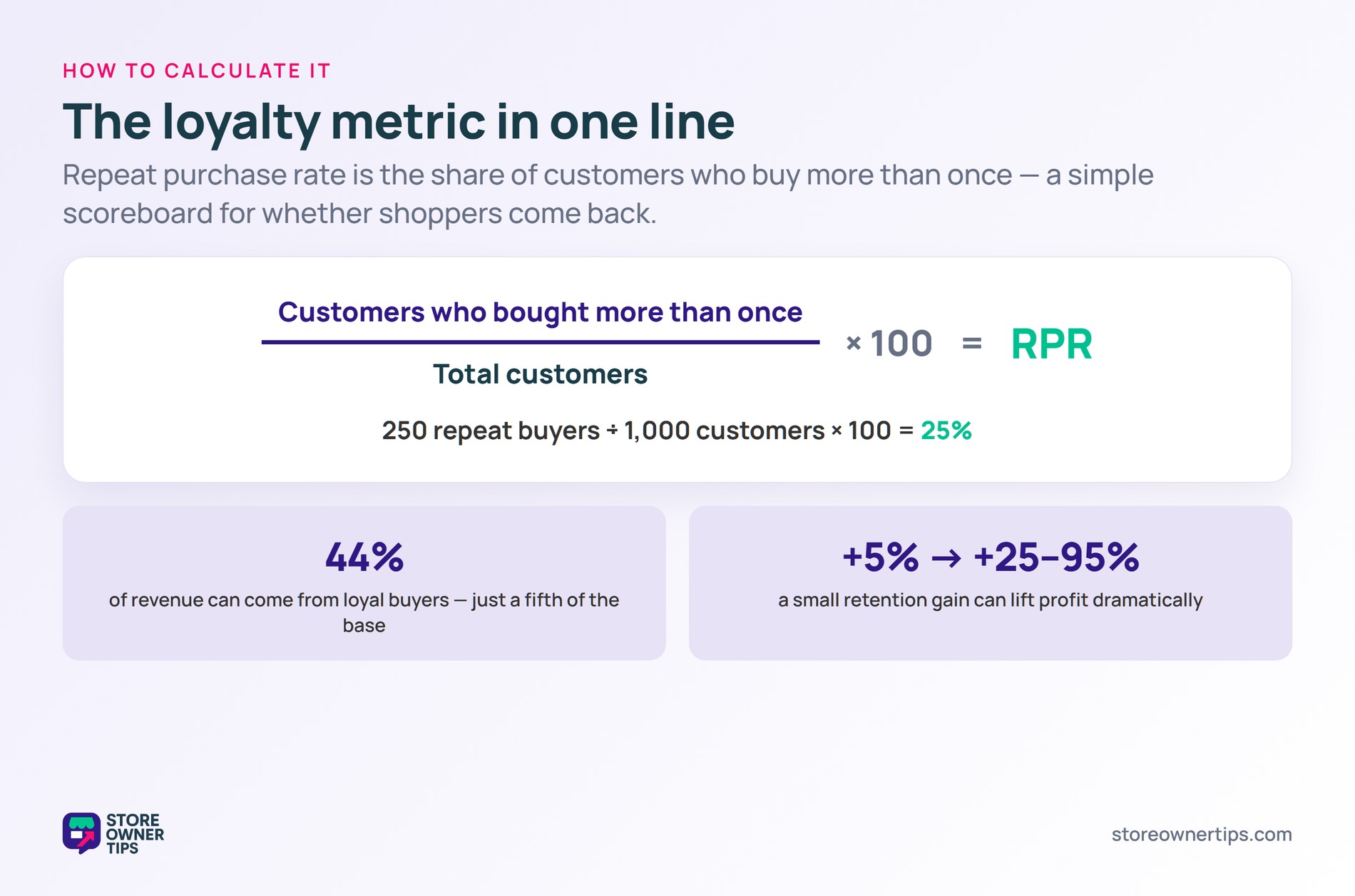
The formula is refreshingly simple. You divide the number of customers who bought more than once by your total number of customers. Then you multiply by 100 to get a percentage. So 250 repeat buyers out of 1,000 customers gives you a 25% repeat purchase rate.
Always measure it over a set window, like a quarter or a year. A longer window naturally captures more repeat orders. The key is to compare the same window over time. That way you can see if loyalty is rising or slipping.
A repeat purchase is any order beyond a customer’s first one. It does not matter if they buy the same item or something new. What matters is that the same person came back to buy again. That return visit is the loyalty signal you are tracking.
This is why clean customer data matters so much. If one shopper checks out as two guests, your numbers get muddy. Linking orders to a single account keeps the rate accurate. So encourage accounts or match orders by email where you can.
Repeat customers quietly carry most stores. Loyal buyers can drive 44% of total revenue while making up just a fifth of the base. They already trust you, so they buy faster and second-guess less. As a result, every repeat order tends to be more profitable than the first.
The compounding effect is the real magic here. Raising customer retention by just 5% can lift profits by 25% to 95%. That is because loyal buyers keep paying off long after you win them. So a healthy RPR is one of the surest signs of a durable business.
Your RPR is really a scoreboard for the whole customer experience. Great products earn the first repeat order almost by themselves. After that, timely follow-up and a smooth reorder process do the heavy lifting. On WooCommerce or Shopify, simple email reminders and a loyalty program can nudge people back.
Trust is the quiet engine behind every repeat order. Reviews matter here more than most owners realize. Purchase likelihood for a product with five reviews is 270% greater than for one with none. So showing happy customers helps both first and repeat sales.
A few proven tactics tend to lift RPR the fastest:
New customers are expensive, since you pay for ads, time, and trust-building. A repeat buyer already knows and trusts you, so the sale costs far less. That is why a small RPR gain often beats a big traffic push. The profit lands faster and sticks around longer.
This also makes your marketing budget go further. Money you would spend chasing strangers can instead delight the buyers you have. Happy customers then tell their friends, bringing new buyers for free. In short, loyalty feeds growth in a way ads alone cannot.
The result is a flywheel that gets cheaper to spin the longer you run it.
The most common mistake is never measuring RPR at all. Many owners chase new sales while loyal buyers quietly drift away. Another trap is treating every customer the same after checkout. Your best repeat buyers deserve more attention, not a generic blast.
A third mistake is going silent right after the sale. The weeks after a purchase are prime time to earn the next one. Stay helpful in that window, and the second order often follows. Disappear, and even happy customers may forget you exist.
Imagine a mid-sized brand called Fern and Fig that sells houseplants on WooCommerce. They get steady sales but feel like they are always chasing new buyers. So they decide to track repeat purchase rate for the first time.
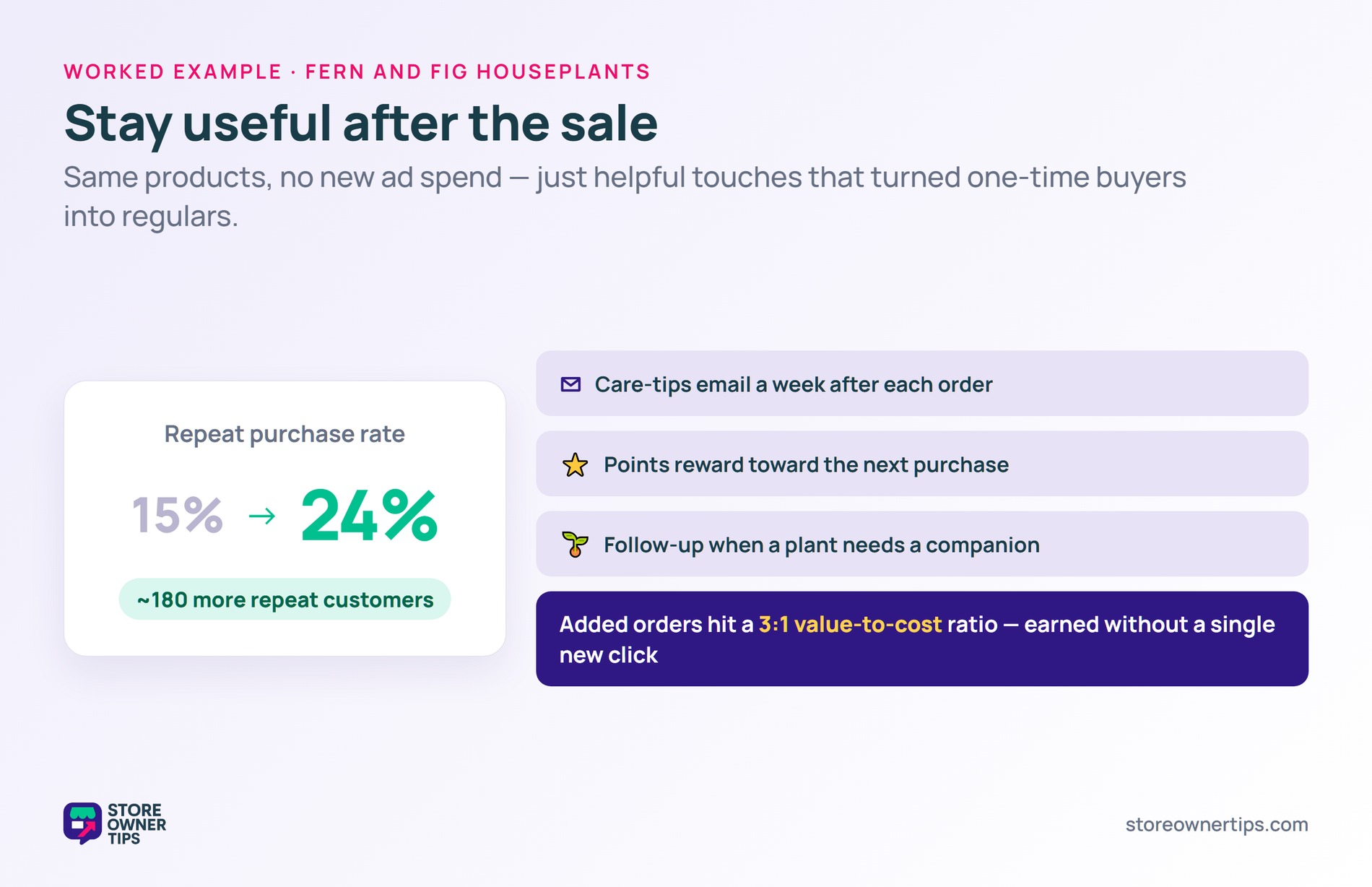
Over the past year, Fern and Fig served 2,000 customers. Of those, only 300 placed a second order. That works out to a 15% repeat purchase rate. The team realizes most buyers are slipping away after a single plant.
Worse, they had been pouring the whole budget into finding new ones.
They start sending a care-tips email a week after each order. They also add a points reward for the next purchase. Then they follow up when a plant likely needs a companion or fresh soil. Each touch gives customers a reason to return.
Within a year, the repeat rate climbs from 15% to 24%. That means roughly 180 more repeat customers, each with a healthy lifetime value. Because they aim for a 3:1 value-to-cost ratio, the added orders drop straight to profit. Best of all, they earned it without buying a single new click.
Fern and Fig did not change their products at all. They simply stayed useful after the sale instead of going quiet. The care emails made shoppers feel looked after, not just sold to. That goodwill turned one-time buyers into regulars.
The rewards points then gave a gentle reason to return sooner. Each small touch built on the last, so loyalty grew steadily. Over time, the higher repeat rate made the whole store more stable. Sales no longer depended on a constant hunt for strangers.
With a loyal base in place, the team could finally plan ahead with confidence.
These two metrics sound alike, but they answer different questions. Repeat purchase rate counts how many customers bought again. Customer retention rate measures how many you kept over a period, including those still subscribed or engaged. One focuses on orders, the other on the relationship.
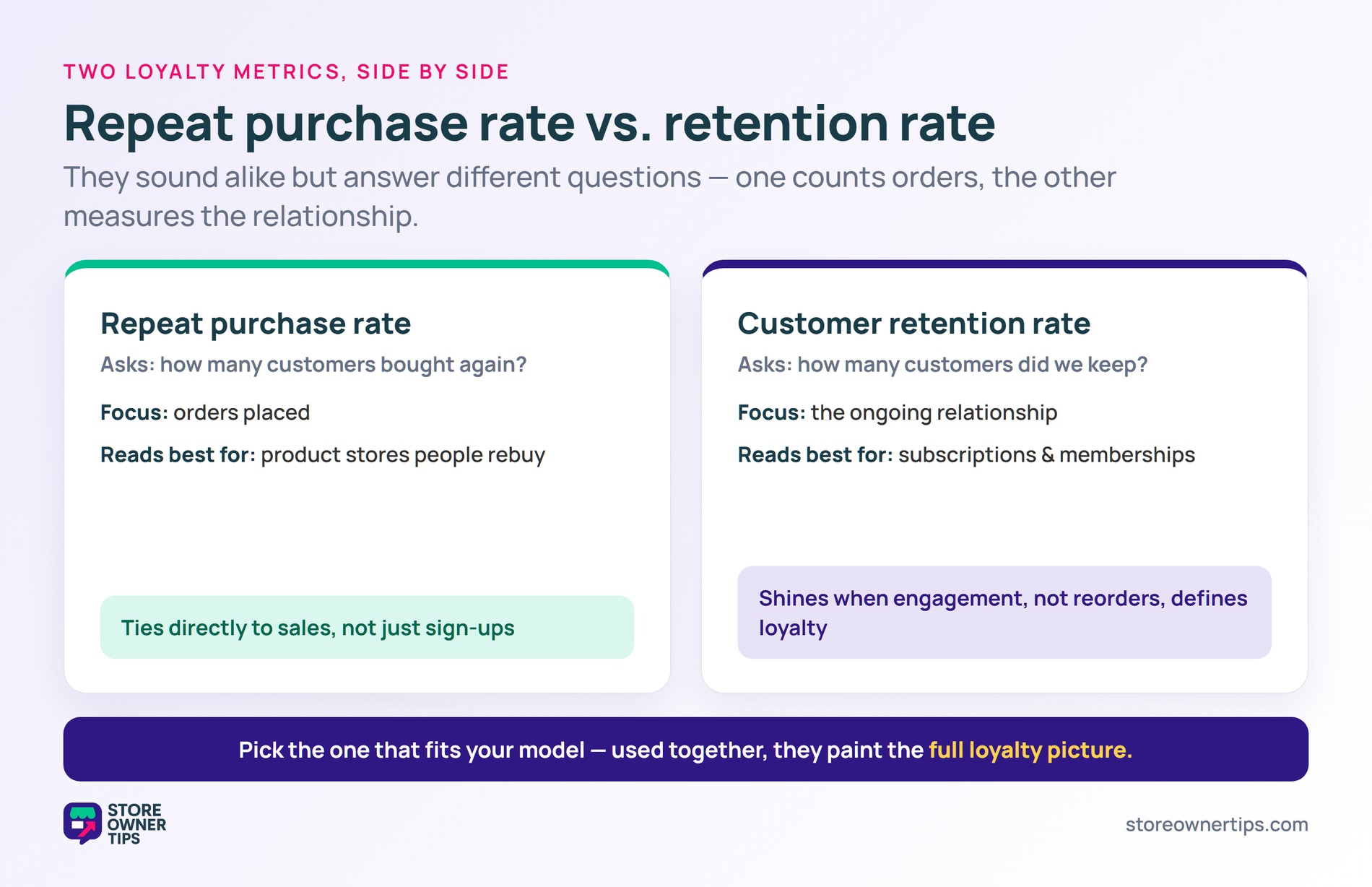
For most product stores, RPR is the more practical number to watch. It ties directly to sales, not just sign-ups. Retention rate shines for subscription or membership businesses instead. Used together, they paint a full picture of customer loyalty.
The practical takeaway is to pick the metric that fits your model. If you sell products people rebuy, lean on repeat purchase rate. If you run a membership, retention rate tells a clearer story. Either way, the goal is the same: keep customers coming back.
It varies a lot by what you sell, so there is no single magic number. Stores with consumable goods often see higher rates than one-time big-ticket sellers. A rate near 20% to 30% is healthy for many shops. The best target is simply beating your own past number.
Compare yourself to your history, not to a store in a different category.
Start with the basics, since great products and service earn most repeat orders. Then add timely follow-up through targeted email marketing and helpful reminders. A rewards program gives shoppers a reason to come back too. Small, consistent nudges beat one big push.
Above all, make the second order as easy and obvious as the first one was.
No, but they are close cousins. Repeat purchase rate counts how often customers come back. Customer lifetime value measures how much total profit those customers bring. A higher repeat rate almost always lifts lifetime value as a result.
Think of repeat rate as a key ingredient in the bigger lifetime-value recipe.
Repeat purchase rate is one of the clearest signs of a healthy, durable store. It rewards the products and service you already offer, with little extra spend. Track it, nudge it upward, and you build a base of loyal buyers that carries your growth for years. While rivals burn cash chasing strangers, you grow on the customers you already earned.
Copyright © StoreOwnerTips.com. All Rights Reserved.
