Weekly ecommerce tips, deals & news.
Return fraud is the deliberate abuse of your returns process to get money back you are not owed. The return itself looks ordinary. What comes back in the box does not match what left it.
So return fraud is not a returns problem. It is a policing problem sitting inside a process you built to be generous. That tension is exactly why it is so hard to shut down.
Return fraud works by borrowing the trust your returns policy hands out in advance. Think of a returns policy as an unlocked door you leave open on purpose. Most people walk through it honestly, and a few treat it as an invitation.
Still, the abuse only becomes visible across many orders. So a store that inspects each return in isolation will almost never spot it.
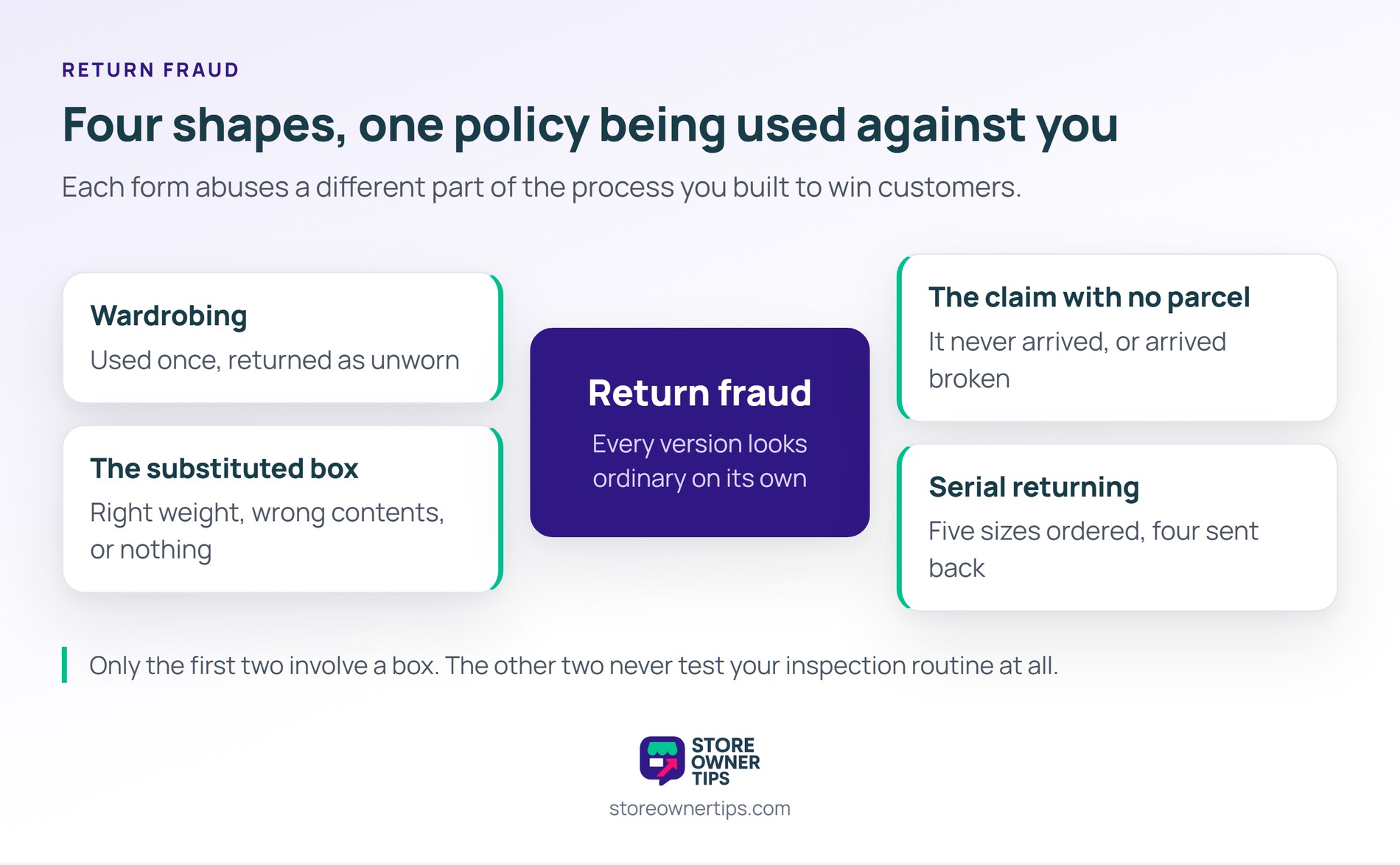
Return fraud shows up in a handful of recognisable shapes. First there is wardrobing, where an item is used once and returned as unworn. For example, party dresses, cameras and power tools are the classic candidates.
Next comes the empty or substituted box. The parcel arrives with the right weight and the wrong contents, or nothing at all. Meanwhile the tracking shows a delivered return, so an automated refund may already have fired.
Then there are the claim-based versions, which never involve a parcel. A buyer says the order never arrived, or arrived broken, and asks for a replacement. Some of those claims are entirely genuine, which is what makes the rest so awkward.
Serial returning is the quietest form of all. For example, one customer orders five sizes, keeps one, and returns four. Even so, nothing there breaks your rules, and the shipping cost lands on you.
Return fraud resists detection because each case is individually defensible. A dress really might not fit. A parcel really can go missing in transit.
Meanwhile your own incentives work against you too. Support staff are measured on resolving tickets quickly. Arguing about a $60 refund costs more time than it saves. So the path of least resistance is always to approve it.
Then automation widens the gap further. Instant refunds on scan are a genuine customer-experience win, but they pay out before anybody opens the box. In practice, that single setting is where most substituted-parcel losses happen.
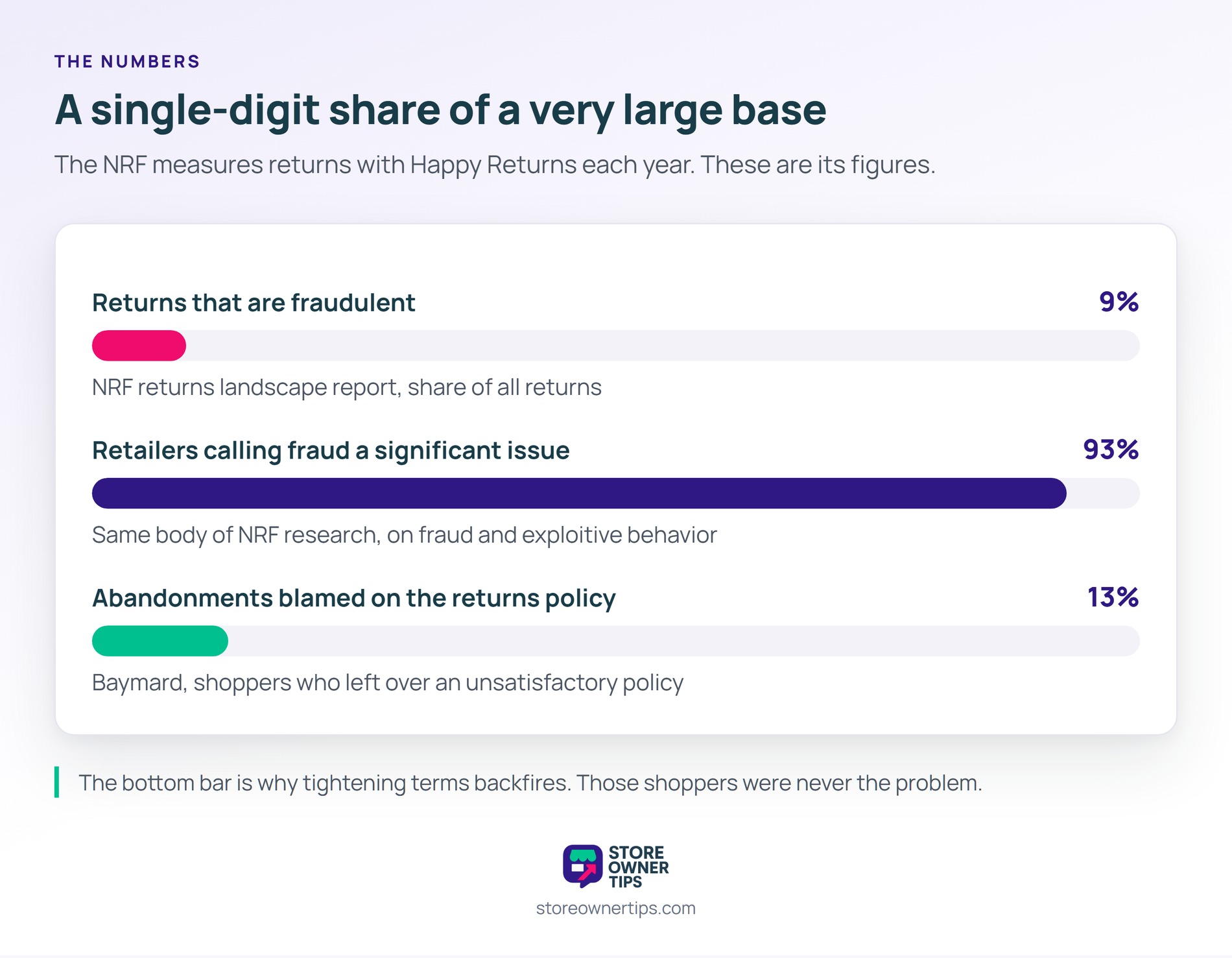
Even so, shoppers are watching your policy closely for the opposite reason. Baymard finds that 13% of abandonments come from a returns policy the shopper found unsatisfactory. Every restriction you add lands on those people too.
Reducing return fraud is about acting on patterns rather than tightening terms for all. First, keep a return history against each customer account rather than each order. As a result, that one change turns invisible behaviour into a sortable list.
Next, require a return authorisation before anything ships back. So a short form asking which item and why gives you a record to compare. Sound returns management is the foundation everything else sits on.
Then inspect before you refund on anything above a value you choose. In practice, the delay costs a little goodwill and removes the empty-box problem. Also photograph what arrives, because a record settles a dispute far faster than an argument does.
Finally, treat the worst repeat cases individually. For example, store credit refunds, asking for the item first, or declining future orders all work. Guidance on preventing policy abuse applies the same thinking to discounts.
Return fraud is measured annually, and the figures are less ambiguous than most retail statistics. The National Retail Federation studies returns with Happy Returns each year. Its landscape report puts fraud at 9% of all returns.
Still, that share sits on top of an enormous base. Total returns across US retail run to hundreds of billions of dollars a year. So a single-digit percentage is still a very large number. Meanwhile the cost is not only the refunded money.
Meanwhile retailers themselves rank the problem highly. In the same body of NRF research, 93% of retailers called retail fraud and exploitive behaviour a significant issue. So this is a standing operating cost rather than an occasional surprise.
Return fraud in practice reads as a generous policy working exactly as designed. Here is a hypothetical example. Imagine a store selling outdoor cameras at $260 each.
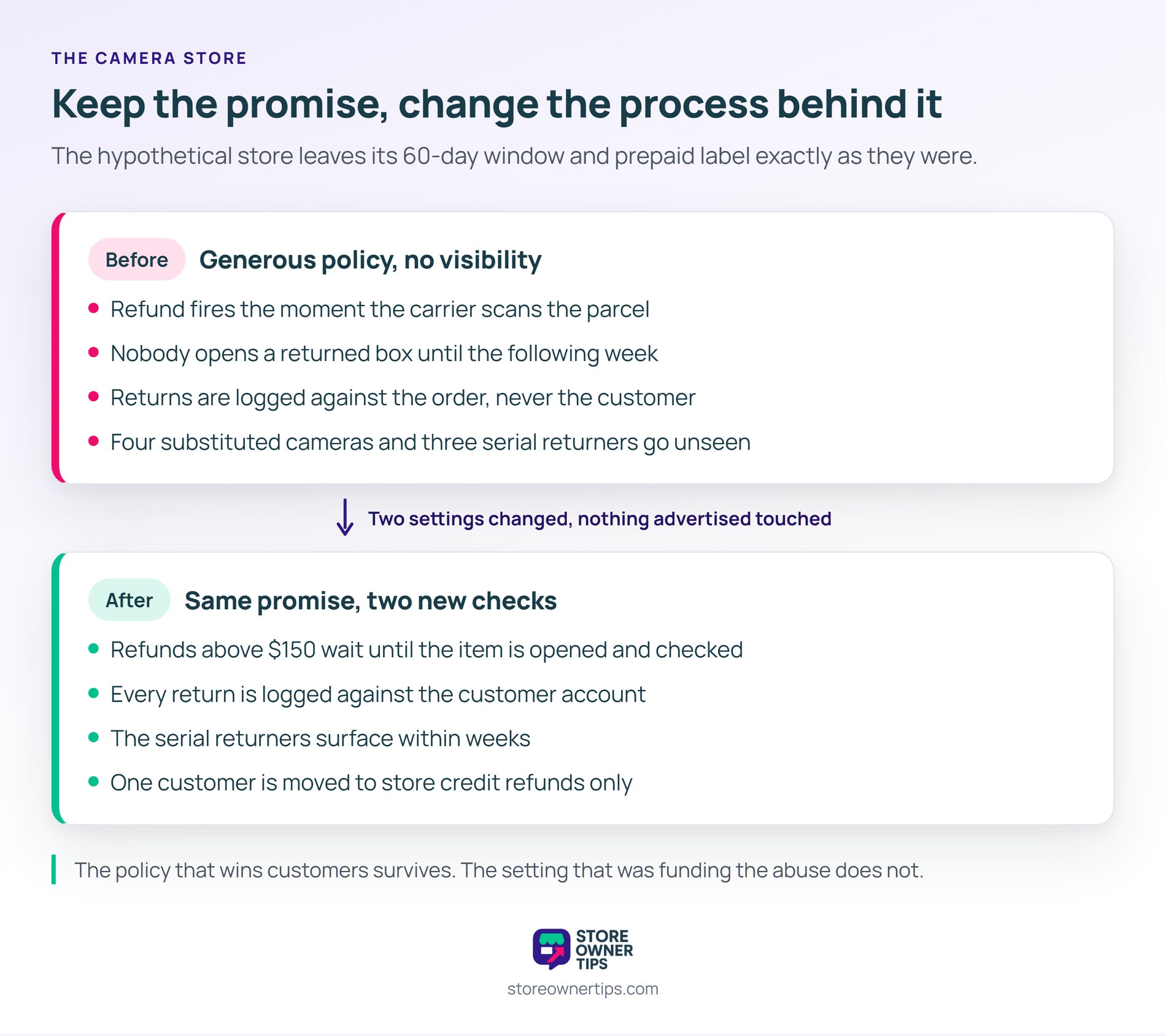
First, the store offers 60-day returns with a prepaid label and an instant refund. That policy is genuinely good marketing and it converts well. Nobody opens a returned box until the following week.
Meanwhile returns run at a normal rate for the category. In this scenario, roughly 40 cameras come back each month across all reasons. The warehouse restocks whatever looks unused.
Over a quarter, four returns turn out to contain the wrong camera entirely. Each one is an older model of similar weight. All four were refunded the moment the carrier scanned the parcel.
Then a separate pattern shows up in the account records. Three customers have each returned six or more cameras in twelve months. Their orders were profitable individually and deeply unprofitable in aggregate.
Nothing in the store’s reporting flags any of this. As a result the losses are filed under an elevated refund rate and blamed on the product. Worse, the team spends a month reviewing camera quality that was never the issue.
So the store changes two things and leaves the headline policy alone. First, refunds above $150 wait until the item is opened and checked. Next, every return is logged against the customer account rather than the order.
Then that second change surfaces the serial returners within weeks. Two of the three moderate their behaviour once contacted politely. One is quietly moved to store credit refunds only.
Even so, the 60-day window and the prepaid label stay exactly as they were. In short, the store keeps the policy that wins customers and removes the setting that was funding the abuse.
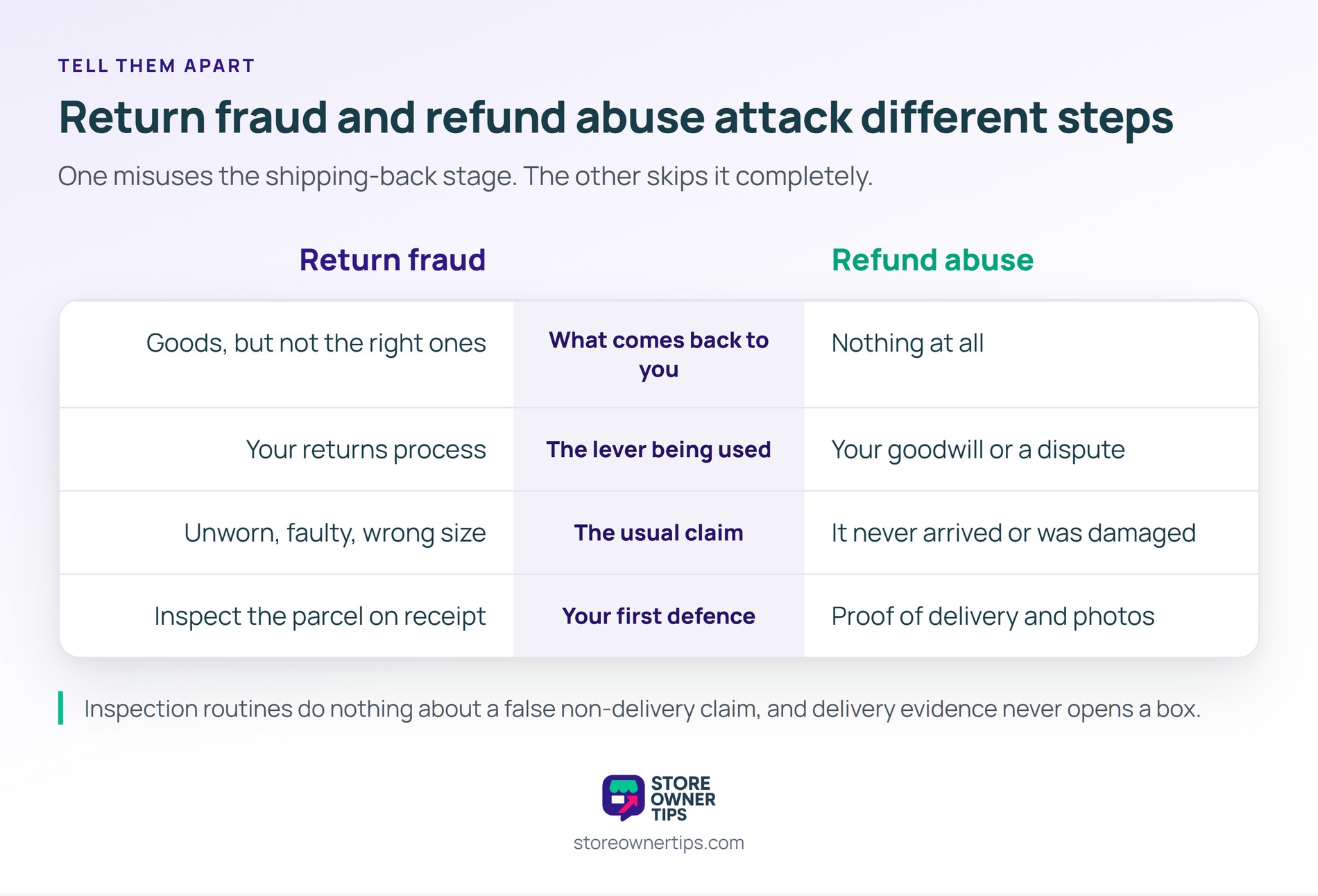
| What you are comparing | Return fraud | Refund abuse |
|---|---|---|
| What comes back to you | Goods, but not the right ones | Nothing at all |
| The lever being used | Your returns process | Your goodwill or a dispute |
| The usual claim | Unworn, faulty, wrong size | It never arrived or was damaged |
| Your first defence | Inspect the parcel on receipt | Proof of delivery and photos |
Return fraud and refund abuse both end with your money leaving, but they attack different steps. One misuses the shipping-back stage, while the other skips it completely.
So the distinction decides where you spend your effort. Inspection routines stop substituted parcels and do nothing about a false non-delivery claim. By contrast, delivery evidence stops the claim-based version and never opens a box.
Judge patterns, never single returns. One suspicious parcel proves nothing, and acting on it will offend someone innocent. A customer whose return rate sits far above everyone else is a different matter.
Then open the conversation neutrally rather than as an accusation. Asking whether something about the sizing or the listing is causing the returns often solves it outright.
Almost never as a first move, because the cost lands on the wrong people. A shorter window or a restocking fee is felt by every honest buyer and by a handful of abusers. The abusers simply adapt.
Change the process instead of the promise. Inspecting before refunding above a threshold removes most of the exposure without altering what you advertise.
Usually yes, though consumer law sets a floor you cannot go below. Faulty goods and, in many regions, a statutory cooling-off period are rights rather than favours. Anything you offer beyond that is your policy to manage.
Check what applies where you trade before you decline anything. Then apply the decision consistently, and put the reason in writing.
Return fraud matters because the policy you use to win customers is what funds it. That makes the obvious response the wrong one. Tighten the terms and you pay for a few abusers with a lot of lost orders. Plus the losses arrive disguised as product quality or an unlucky month.
In short, keep the promise you advertise and change the process behind it.
Copyright © StoreOwnerTips.com. All Rights Reserved.
