Weekly ecommerce tips, deals & news.
A shipping discount is a promotion that reduces or removes the delivery charge on an order. It leaves the product price alone, and it can take the whole fee off or only part of it. Delivery cost is the objection most shoppers actually voice. So discounting that line often works harder than the same money off the goods.
In practice, a shipping discount changes one line on the order total. Your products keep their prices. Then the delivery charge is reduced, replaced or zeroed according to whatever rule you set.
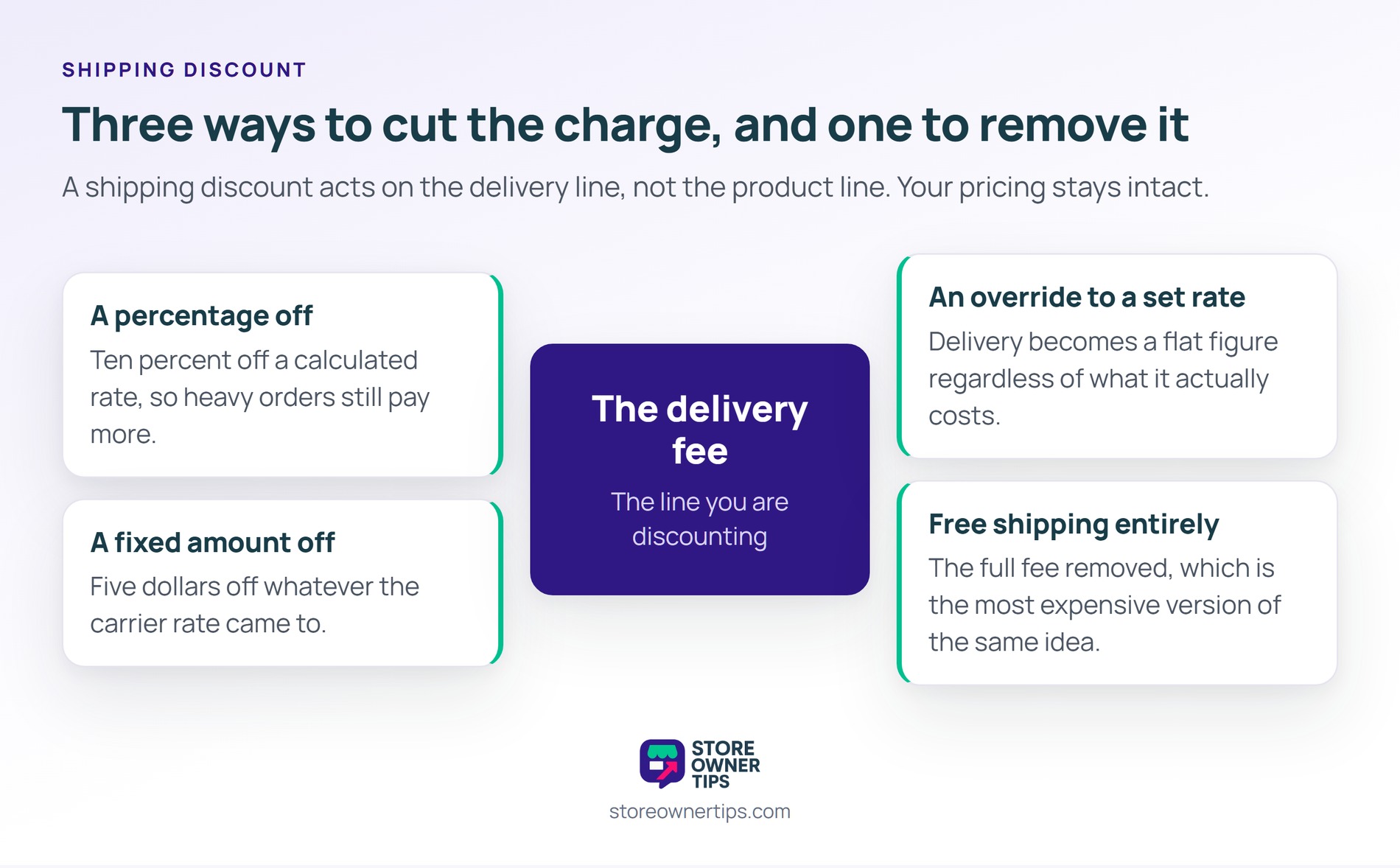
First, picture any order receipt. There is a line for what the shopper bought and a separate line for getting it to them. Most promotions attack the first line.
A shipping discount attacks the second one instead. So the product still looks worth its price, while the charge the shopper resents gets smaller. Meanwhile your catalog pricing never moves.
A shipping discount comes in three shapes, and the choice matters more than store owners expect. Advanced Coupons documents all three, including an example cutting a $10 rate by 20% to $8.
Still, the override is both the most useful and the most dangerous. It ignores whatever the carrier calculation produced, so an unusually heavy order still ships at your flat number. Therefore cap it or condition it rather than leaving it open.
Notably, a shipping discount needs a trigger, and spend is only one option. In practice, most stores use one of four.
The zone option is the one most often skipped. Because your cost to deliver varies by region, a flat national offer subsidizes your most expensive routes. So restricting by shipping zone protects the margin where it is thinnest.
A shipping discount costs real cash, which makes it different from most promotions. A percentage off a product eats margin you had built in. By contrast, the carrier still invoices you the full amount for delivery.
Consequently the offer has to be paid for from somewhere. Either the basket grows enough to cover it, or you accept the cost as acquisition spend. Still, plenty of stores run one without deciding which.
Watch your handling fee too, if you charge one. Discounting delivery while quietly keeping a handling charge reads as a trick. Therefore be clear about which line you actually reduced.
A shipping discount loses its effect the longer it runs. Shoppers stop reading a permanent offer as an offer at all.
Most stores get more from short, repeated bursts than a standing rate. A weekend window creates a reason to order now. Consequently the same spend produces urgency rather than a quietly lower baseline.
The exception is a permanent threshold-based offer, which works differently. There the goal is a bigger basket, not urgency. So a standing rule is fine when it is doing that job instead.
Delivery cost is the single biggest reason shoppers walk away, which is what makes this lever so effective. Baymard Institute found that 40% of abandonments come down to extra costs being too high. Shipping is the largest of those extras for most orders.
The discounts themselves are usually modest rather than dramatic. Advanced Coupons demonstrates the mechanic with a coupon taking 10% off a flat rate, not zeroing it. Meanwhile Advanced Coupons, our own discount plugin, reports 20,000+ active installations.

Here’s a hypothetical example. Picture a store selling cast iron cookware, where items are heavy and delivery is expensive.
First, a $90 skillet carries a $22 delivery charge because of its weight. First the owner tries 15% off the product, which is $13.50 of margin given away.
Even so, conversion barely moves. Shoppers were not objecting to $90 for a skillet they had already chosen. Instead they were objecting to $22 to have it delivered.
So she switches to a shipping discount instead. An override sets delivery to $8 on any order over $75, restricted to her two cheapest zones.
The skillet now costs $90 plus $8. So she gives up $14 of delivery cost rather than $13.50 of product margin. Roughly the same money, aimed at the actual objection. Meanwhile the product still signals $90 of quality.
Notably, the zone restriction is what makes it survivable. Orders to her expensive far regions still pay the calculated rate. Consequently she is not funding a national subsidy to win local sales.

| What you’re comparing | Shipping discount | Free shipping threshold |
|---|---|---|
| What it is | The action taken on the fee | A spend target that triggers it |
| Size of the reduction | Partial or total | Always the full fee |
| How it is triggered | Code, condition, zone or date | Reaching the spend figure |
| Main goal | Remove the delivery objection | Increase average order value |
| Can they combine | Yes | Yes |
A shipping discount and a free shipping threshold get treated as the same thing. They are not. The threshold is a condition, aimed at growing the basket.
The discount is what happens to the fee. Meanwhile a threshold is only one of several ways to set it off.

No, and partial reductions are often the smarter choice. You can take a percentage or a fixed amount off, or override the rate to a lower figure. Cutting a $22 charge to $8 removes most of the objection while keeping some of your cost covered.
Mainly it depends what the shopper is objecting to. Where delivery is the sticking point, discounting it addresses the real problem. That said, a discount code on the products works better when the item itself feels expensive.
Yes, and you usually should. Shipping discounts can be restricted by zone, so you only offer them where delivery is affordable for you. Otherwise a single national offer ends up subsidizing your most expensive flat rate shipping routes.
A shipping discount matters because it spends your promotional budget on the objection shoppers actually raise. Ultimately, a smaller delivery charge often converts better than a bigger product discount. The catch is that it costs real cash, so it works best when targeted rather than left running everywhere.
Copyright © StoreOwnerTips.com. All Rights Reserved.
