Weekly ecommerce tips, deals & news.
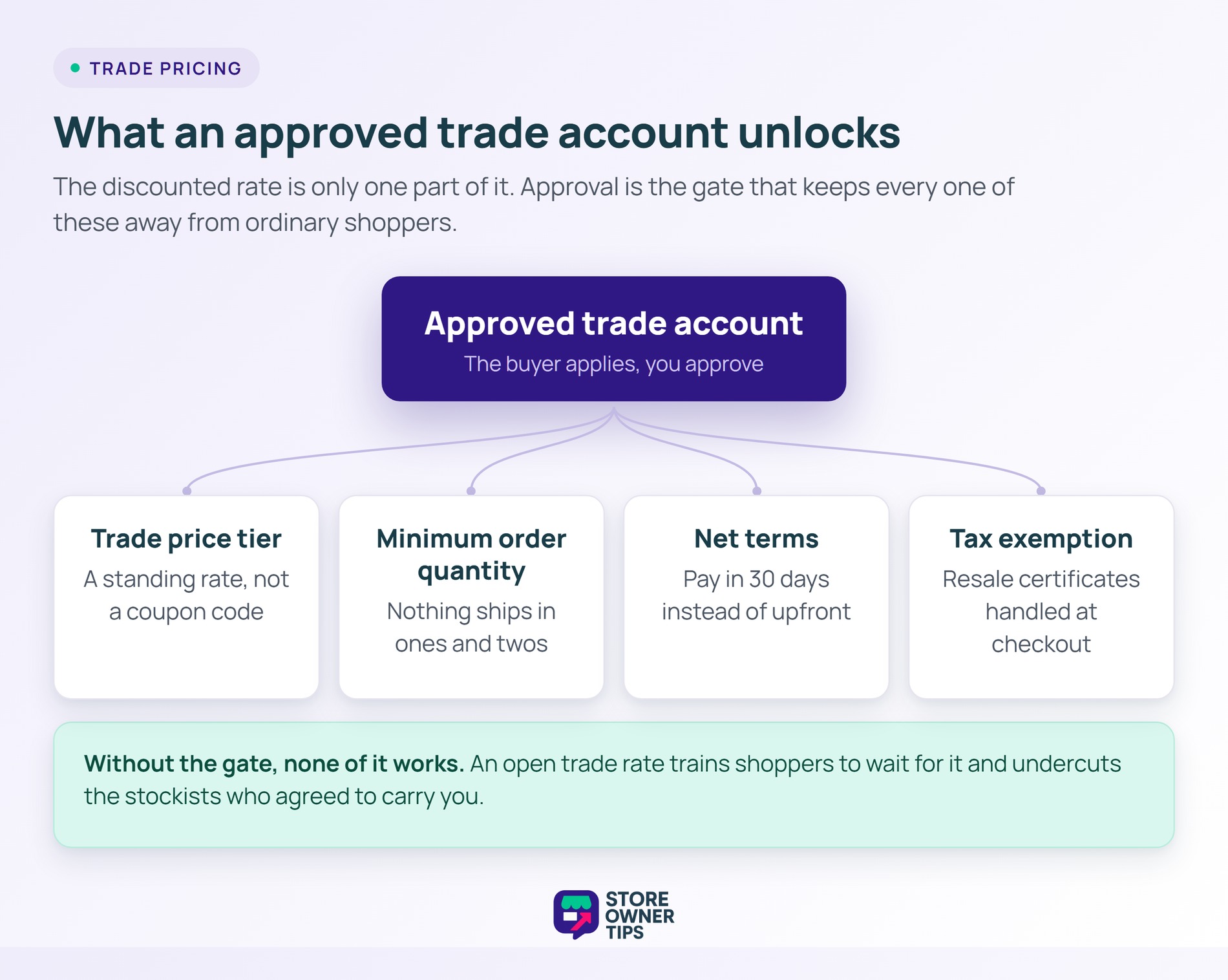
Trade pricing is the discounted price you charge business buyers instead of the general public. Retailers, resellers, and contractors pay this rate so they can mark the product up and still profit. It sits below your retail price but above your cost price. Most stores gate it behind an approved account, so ordinary shoppers never see it.
In short, that gated rate is the whole reason a shop agrees to stock you.
Every product you sell has more than one honest price. First, there is what it costs you to make or buy. Next, there is what a business pays to resell it. Then there is what a shopper pays at checkout.
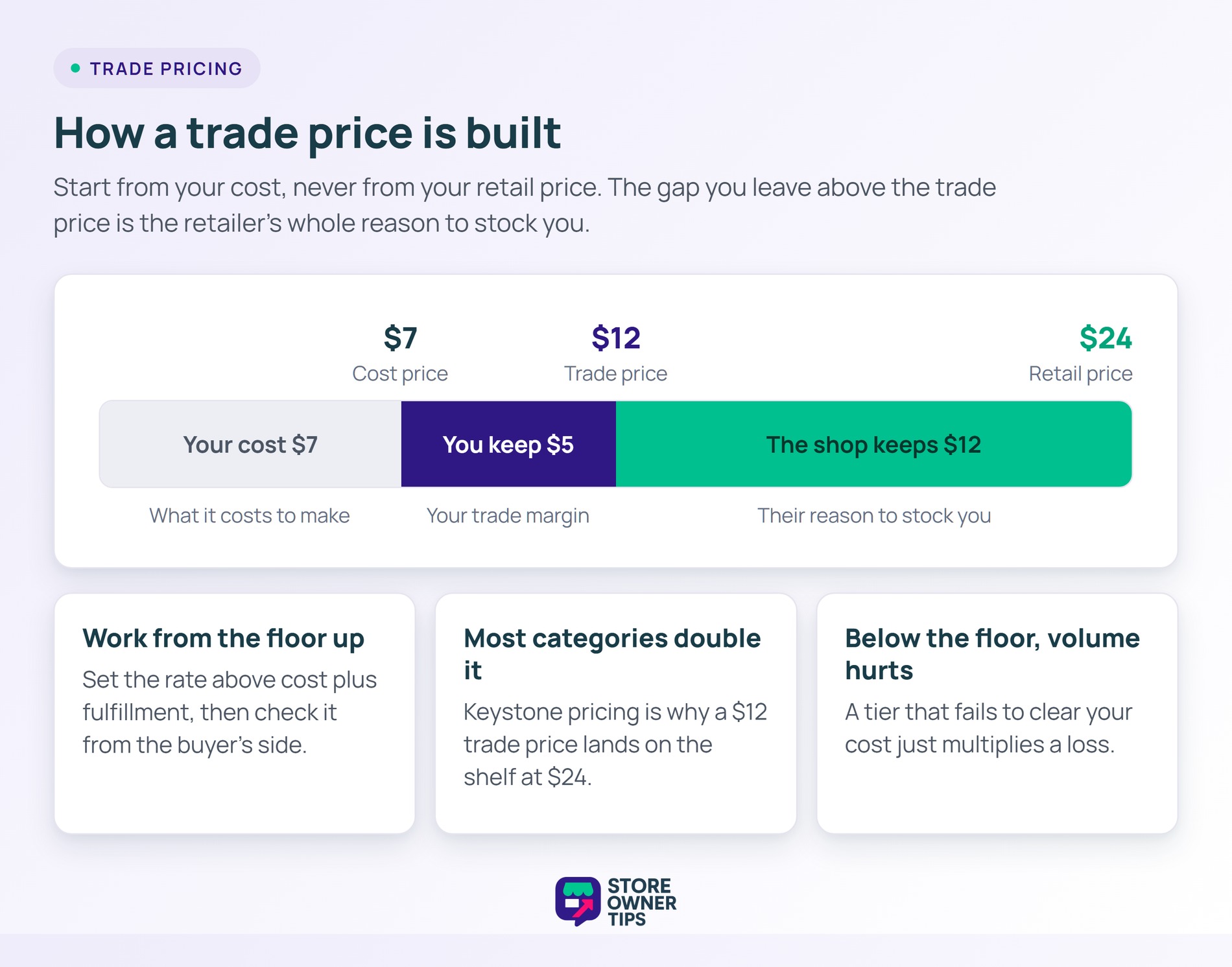
Trade pricing is that middle number. It is also the one most store owners get wrong.
Start from your cost price, not from your retail price. First, work out the gross margin you need, then set the rate above it. After that, check the number from the buyer’s side. A shop must be able to mark it up and still sell at a fair price.
Most categories settle near a doubling. That convention is called keystone pricing. In practice, it is why a $12 trade price often sits on the shelf at $24.
That said, the multiplier moves with the category. Fashion and giftware often expect more headroom, while food and hardware run tighter. Even so, the floor matters more than the multiplier. If your trade price does not clear your cost plus fulfillment, volume just multiplies a loss.
Many stores run more than one trade rate. A single tier is simplest, but tier pricing lets a buyer earn a deeper rate as volume grows. Then a small boutique and a national chain can share the same catalog on different terms.
Think of a trade account like a members-only aisle in a warehouse store. Same building, same stock, different shelf tags. In WooCommerce, this runs on customer roles. A logged-in buyer carrying a wholesale role sees one set of prices, and everyone else sees another.
That role usually carries more than a price. For example, it can enforce a minimum order quantity, unlock net terms, and apply a tax exemption. Store owners often add a registration form so new buyers apply rather than sign up instantly. In practice, approval is what keeps the rate away from bargain hunters.
Some stores go further and hide retail prices from logged-out visitors entirely. That approach, known as hidden pricing, suits trade-only suppliers who never sell to the public. Still, most stores are better off showing retail openly and gating only the trade tier.
Setting the rate itself is straightforward once roles exist. You can enter a fixed trade price per product or a percentage off retail. For a walkthrough, see this guide to wholesale pricing in WooCommerce.
Business buyers behave like shoppers now. They research before they call, and price is doing the heavy lifting. Forrester found that at least a third of B2B buyers in North America and Europe are primarily influenced by price. As a result, hidden rates slow everything down.
The friction is real. Forrester also reported that nearly 90% of global business buyers had a purchase process stall. For example, a quote request that sits in an inbox for three days is one of those stalls.
Meanwhile, the channel has already moved online. E-commerce made up 33.3% of total U.S. merchant wholesaler sales, according to Census Bureau figures. That is the context your wholesale customer is buying in. By contrast, a store still quoting by phone looks slow before the conversation starts.
There is real scale behind that shift. U.S. merchant wholesalers moved $11.38 trillion in sales in a recent survey year. Even a thin slice of that trade is worth more than most retail funnels return.
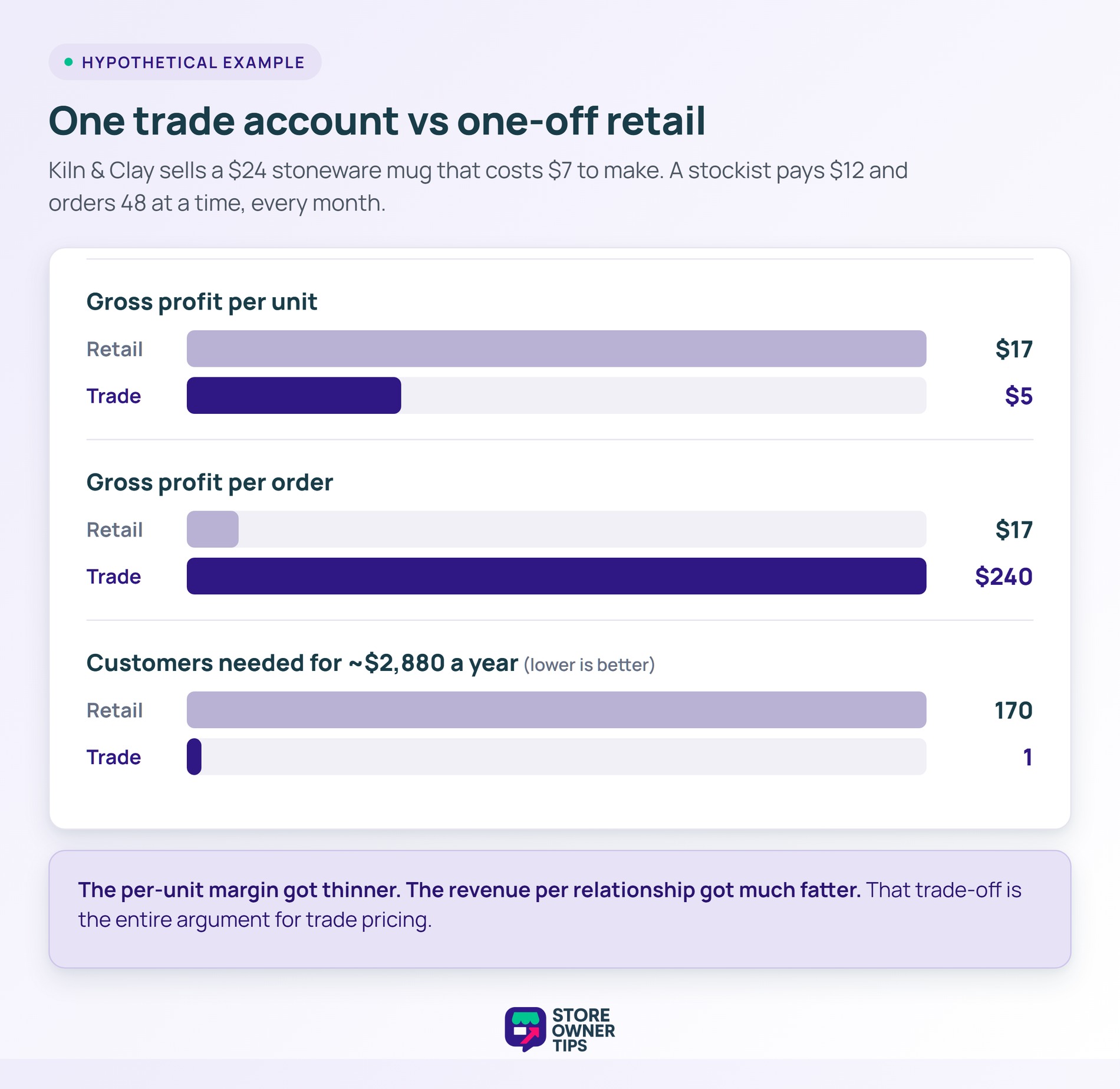
Imagine a mid-sized ceramics studio called Kiln & Clay. It sells a signature stoneware mug directly to the public. Now the owner wants to add stockists without gutting the margin.
The mug retails at $24. Materials, glaze, firing, and packaging cost $7 per unit. So the owner sets a trade price of $12. A stockist can double that back to the usual $24 shelf price.
Each trade unit earns $5 in gross profit instead of $17. On paper, that looks like a downgrade. However, the account also carries a 48-unit minimum order quantity, so nothing ships in ones and twos.
The owner also decides what the trade tier does not include. Free shipping stays a retail perk, and trade orders ship at cost. Instead, buyers get net terms of 30 days, which matters more to a shop than free freight.
One trade order is 48 mugs. That is $576 in revenue and $240 in gross profit from a single transaction. More importantly, the stockist reorders roughly every month.
Across a year, that one account moves 576 mugs. In total, it returns $6,912 in revenue and $2,880 in gross profit. All of it comes from one relationship the studio only had to win once.
Matching that at retail is harder than it looks. The studio would need to sell about 170 mugs at $17 profit each. Every one of those sales carries its own customer acquisition cost. By contrast, the trade account costs almost nothing to keep after the first order.
There is a second effect that never shows up in the order total. Every stockist puts the mug in front of shoppers the studio never reached. Then some of those shoppers come back and buy direct at full retail.
In short, the per-unit margin got thinner. Meanwhile, the revenue per relationship got much fatter. That trade-off is the entire argument for trade pricing.
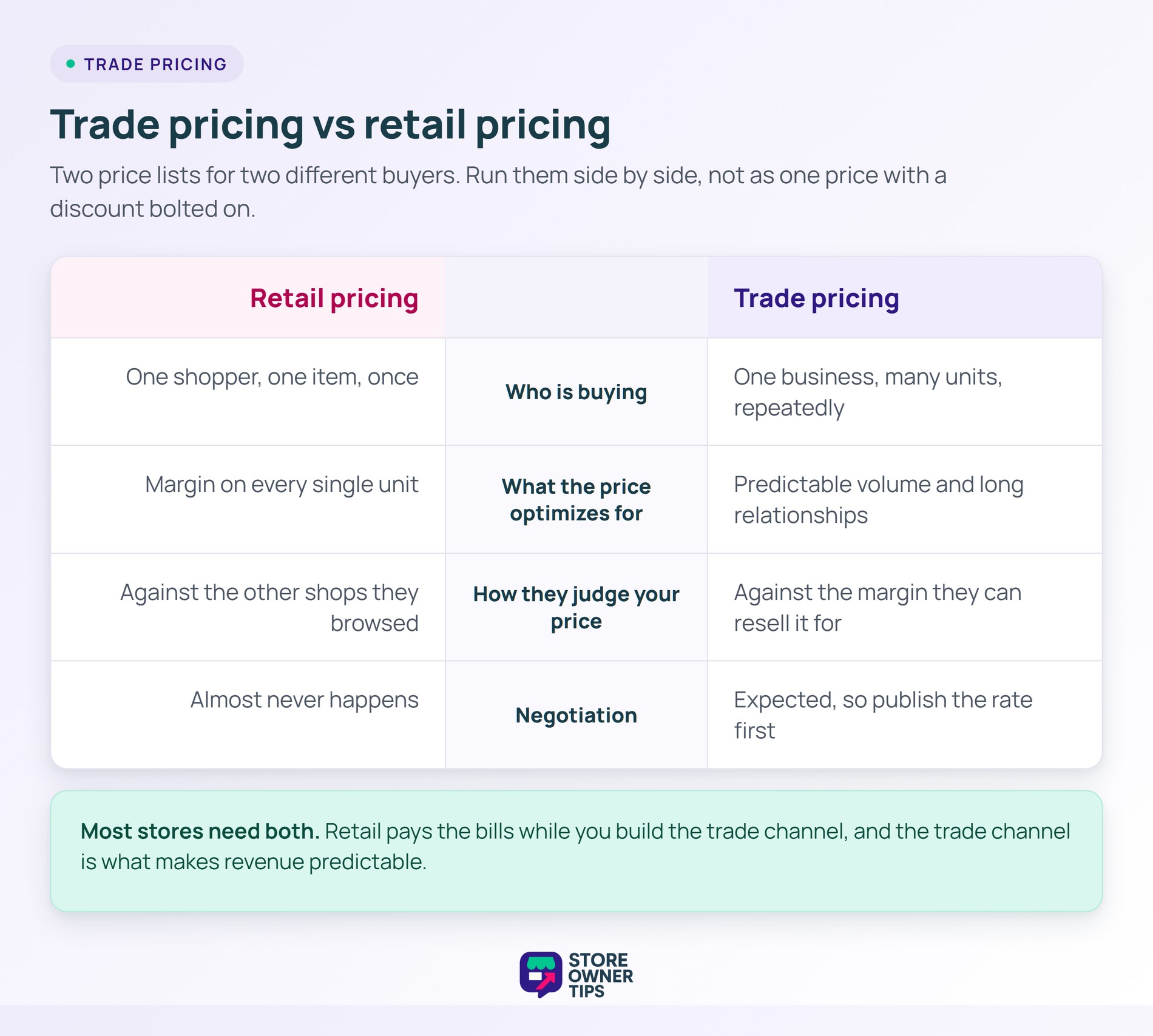
Retail pricing is built for one shopper buying one item. By contrast, trade pricing is built for one business buying many, repeatedly. The gap is not just the number on the tag.
Retail pricing optimizes for margin per unit. It leans on psychology, promotions, and urgency to move a single cart. Trade pricing optimizes for predictable volume and long relationships instead.
The buyers also judge you differently. A shopper compares your price to other shops. Meanwhile, a trade buyer compares your price to the margin they can earn reselling it. That second calculation is unforgiving.
One more difference is worth flagging. Retail buyers rarely negotiate, while trade buyers expect to. A published trade rate is your answer to that, since it sets the anchor before the conversation starts.
In practice, most stores need both. Retail pays the bills while you build the trade channel, and the trade channel is what makes revenue predictable. Run them as separate price lists, not as one price with a discount bolted on.
In everyday use they mean the same thing. Both describe the discounted rate a business pays to resell your product. The difference is regional and habitual rather than technical.
Trade price is more common in the UK, Australia, and among makers selling to independent shops. Meanwhile, wholesale price is the standard term in North America and in bulk distribution. So if a buyer asks for your trade price, they want your wholesale pricing sheet.
Start with the margin the buyer needs, not with a round number. Most resale categories expect enough headroom to roughly double the trade price. In practice, that points at a trade rate near half your retail price.
Then check it against your own floor. Your trade price still has to cover cost, packing, and a real margin. If half of retail lands below that floor, your retail price is too low. Raising retail is usually the fix, not shaving the trade rate.
You do not have to, but almost every store should. An open trade rate trains shoppers to wait, argue, or hunt for a way in. It also undercuts the stockists who agreed to carry you.
Gating it is simple in practice. Approved accounts log in and see trade rates, while everyone else sees retail. Many stores also require an application, so B2B procurement teams get verified before pricing appears. Meanwhile, the public catalog stays clean.
Trade pricing is not a discount you hand out. It is a second business model running beside your retail store, with its own margins, terms, and buyers. Get the floor right and gate the access, and it turns unpredictable retail revenue into orders you can forecast. That predictability is what lets a small store plan more than one season ahead.
Copyright © StoreOwnerTips.com. All Rights Reserved.
