Weekly ecommerce tips, deals & news.
Usage-based billing is a pricing model where customers pay for what they actually use, not a flat monthly fee. In practice, every API call, gigabyte stored, or message sent gets metered and added to the bill.
The model first dominated cloud and SaaS. However, thanks to the clear benefits of usage-based billing, it’s spreading to AI tools, IoT, and even physical products.
The goal is simple: align price with value, so light users pay less and heavy users pay more. Used right, it lowers the barrier to start and grows revenue alongside the customer. The challenge is forecasting, since revenue swings with activity.
Getting usage-based billing explained starts with one core idea: the system measures consumption and prices it by the unit. The unit might be an API call, a stored gigabyte, a sent message, a minute of compute time, or an AI token. Customers only pay when they actually use the product.
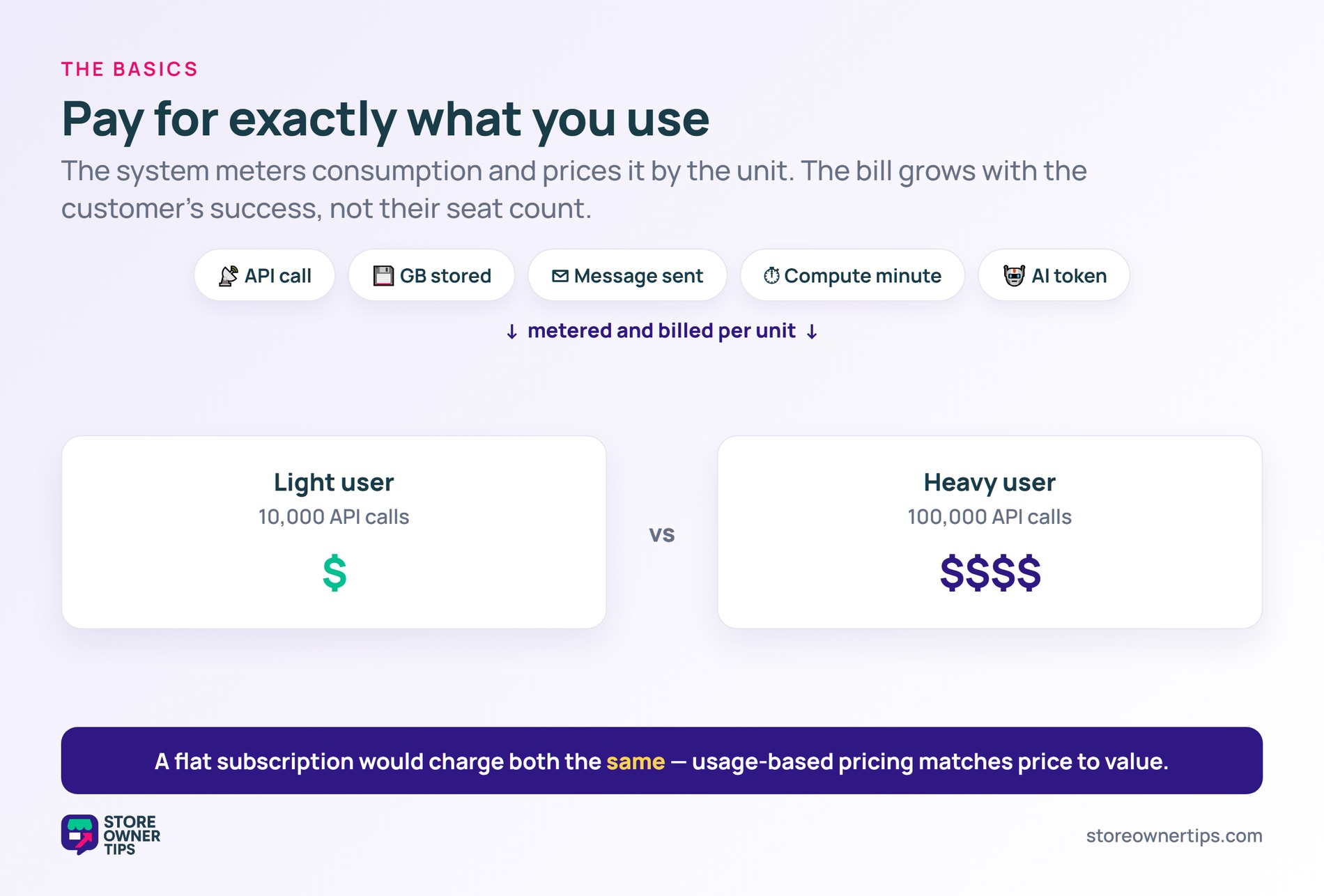
For example, a developer who runs 100,000 API calls pays more than one who runs 10,000. By contrast, a flat-fee subscription would charge both the same. In short, the bill grows with the customer’s success, not their seat count.
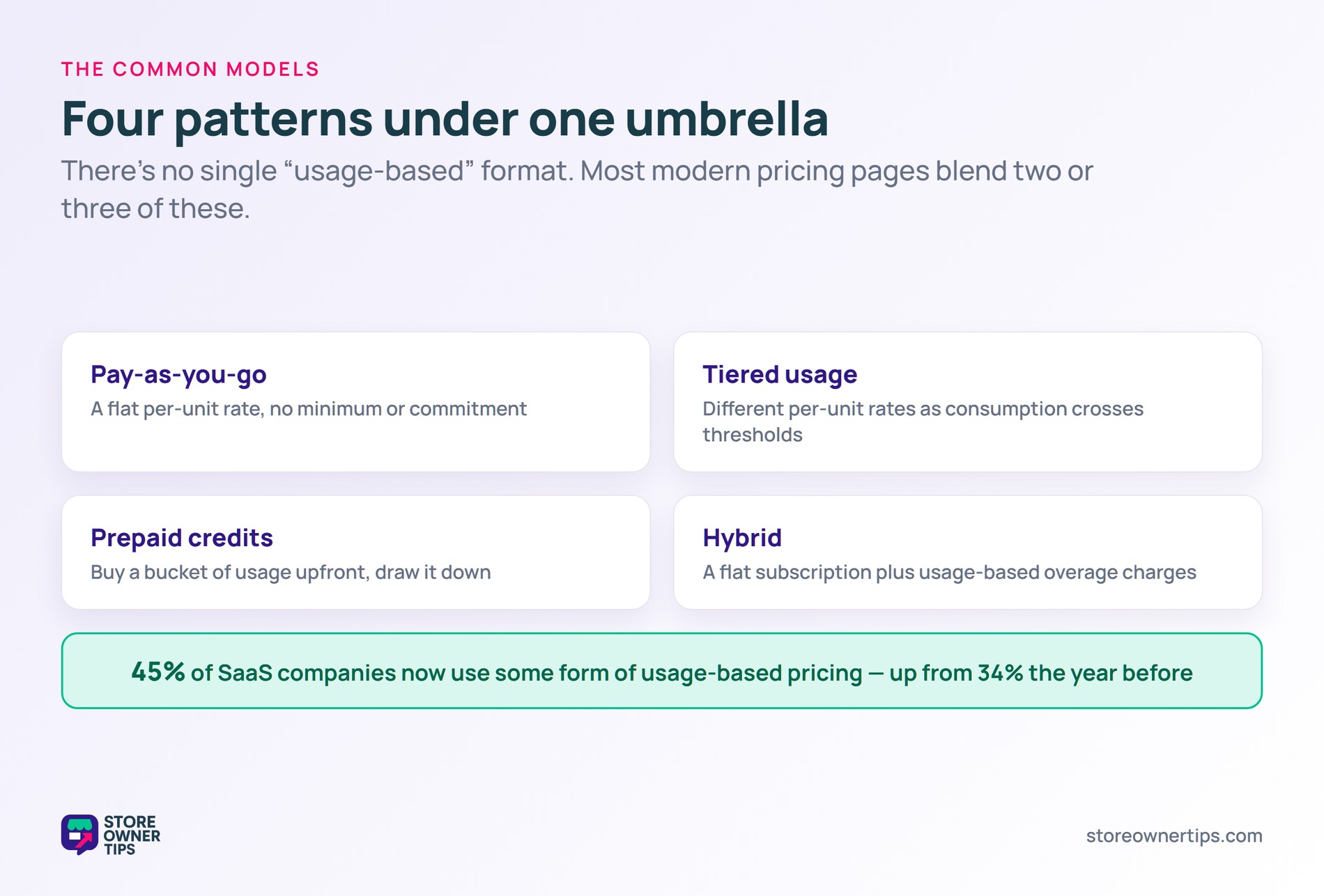
Several billing patterns sit under the usage-based umbrella. First, pure pay-as-you-go charges a per-unit rate with no minimum or commitment. Next, tiered usage applies different per-unit rates as consumption crosses thresholds. Then, prepaid credits let customers buy a bucket of usage upfront.
On top of that, hybrid plans combine a flat subscription with usage-based overage charges. Most modern SaaS pricing pages blend two or three of these patterns. In short, there is no single “usage-based” format. By contrast, the underlying principle stays the same.
The rise of cloud computing and APIs pushed usage-based billing into the mainstream. Modern customers expect to pay only for what t
For instance, OpenAI, Twilio, Snowflake, and AWS all bill by usage. Meanwhile, traditional flat-rate SaaS has had to evolve toward hybrid models. In short, value-based metering is the new normal.
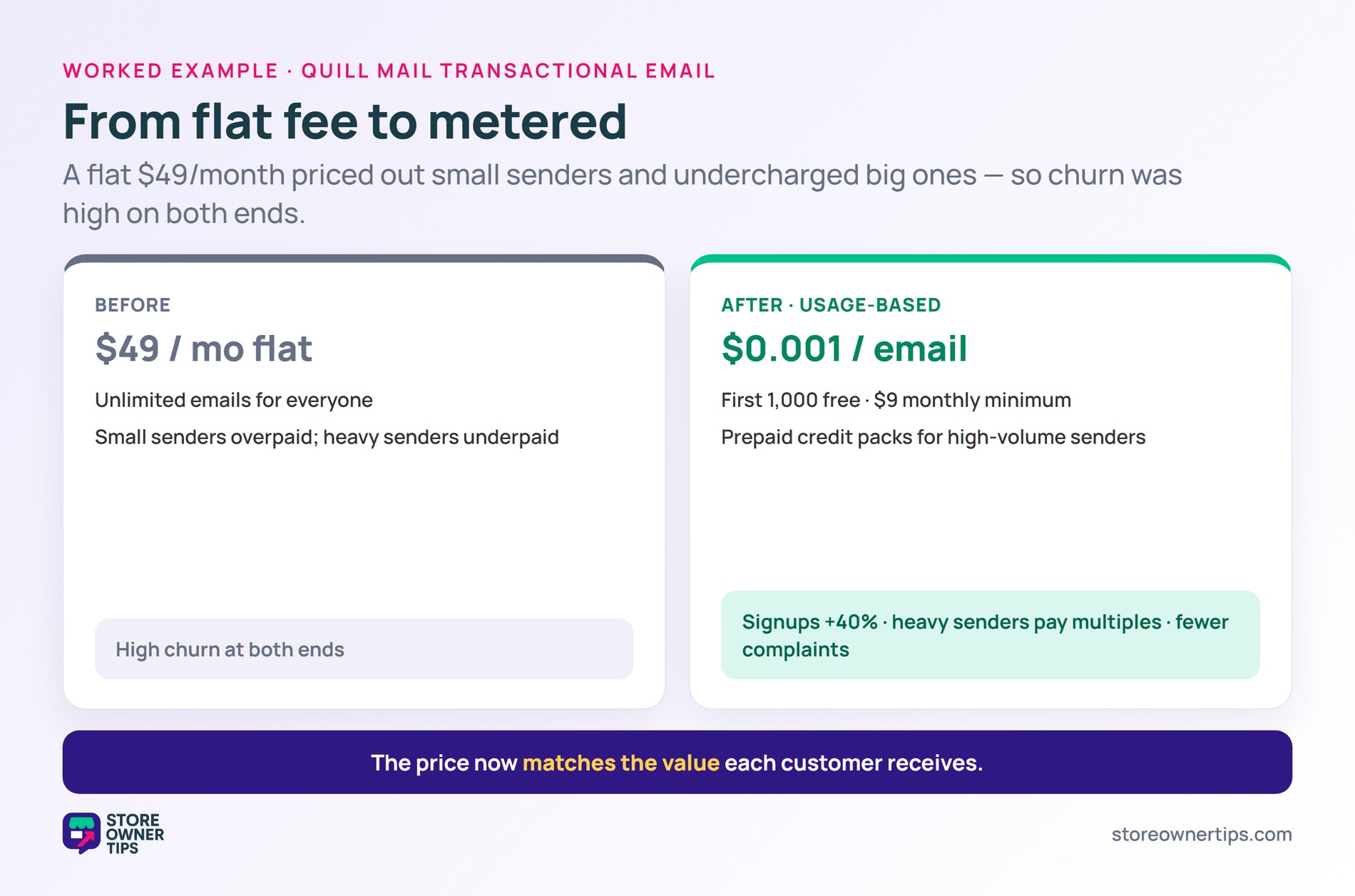
Imagine a transactional email service called Quill Mail. Their old pricing was flat: $49 per month for unlimited emails. This priced out small senders and undercharged large ones. As a result, churn was high on both ends.
The team decides to switch to usage-based billing. First, they price at $0.001 per email after the first 1,000. Next, they keep a $9 monthly minimum to cover platform costs. Then, they add prepaid credit packs for high-volume customers.
Over the next quarter, Quill Mail tracks the shift. Notably, small senders no longer churn over price. As a result, new signups jump by 40%. Meanwhile, heavy senders who used to threaten cancellation now pay multiples of the old flat fee.
Total revenue per customer rises while costs stay aligned with usage. On top of that, the support team sees fewer “why am I paying for unused service” complaints. The price now matches the value the customer receives.
After two quarters, Quill Mail reviews what’s working and what isn’t. Revenue forecasting got harder because activity varies by season. The finance team builds usage-curve models instead of simple subscription multiples. However, the support team also notices new confusion. Some customers struggle to predict their monthly bill.
In response, Quill Mail adds a daily usage dashboard and a billing-cap option. By contrast, customers on the prepaid credits feel more in control. In short, transparency is the price of pricing flexibility.
Subscription billing charges a flat recurring fee, regardless of how much the customer uses the product. In practice, every subscriber pays the same per period whether they log in once or daily.
By contrast, usage-based billing scales with consumption. For example, a heavy API user might pay 10 times what a light user pays in the same month. Meanwhile, a subscriber on a fixed plan pays the same either way. As a result, the two models suit different customer segments and product types.
The key differences:
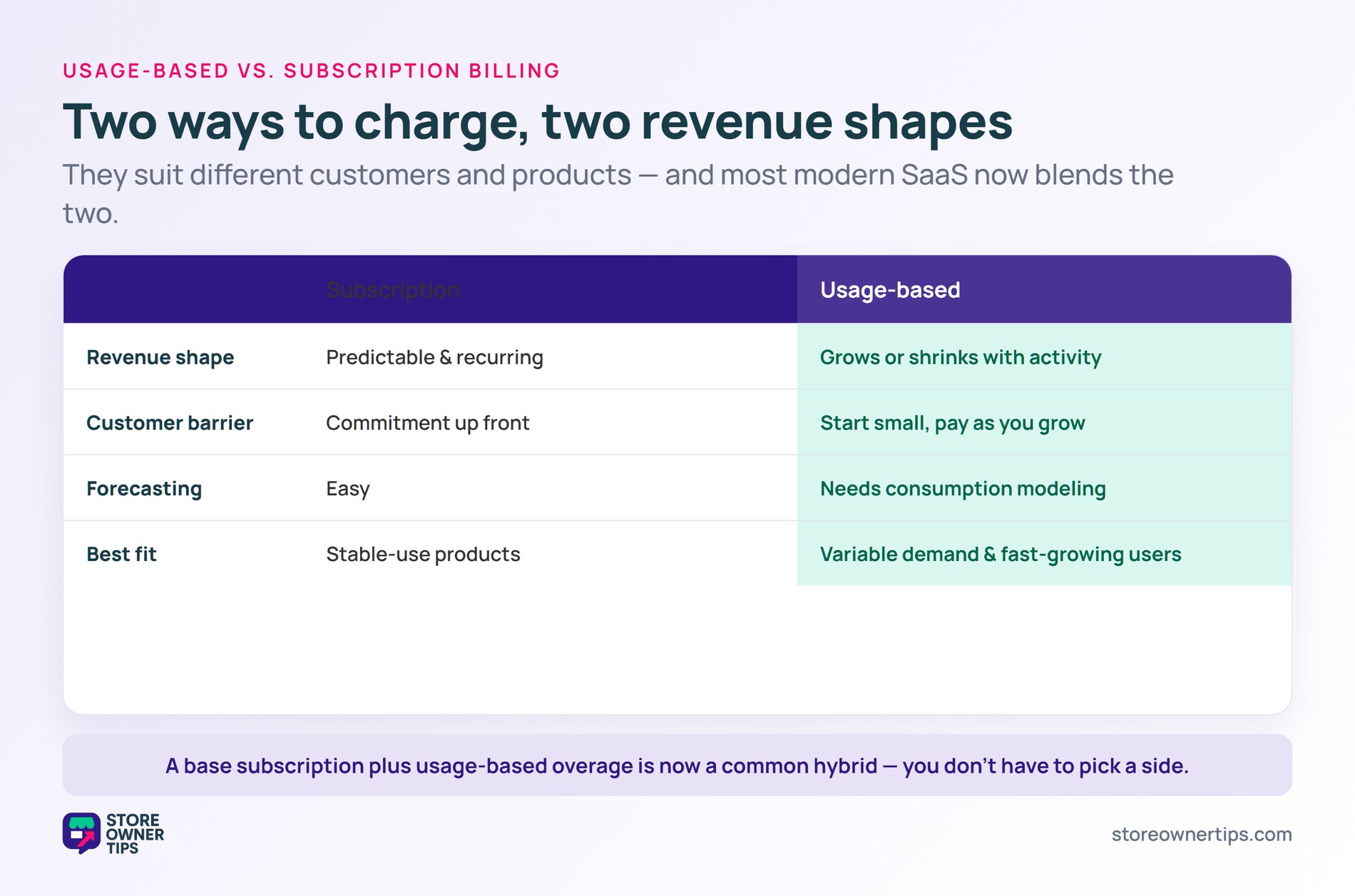
Most modern SaaS blends both. A base subscription plus usage-based overage is now a common hybrid. As a result, you don’t have to pick a side. The right model depends on how your customers consume the product. As a starting point, look at your power users and your trial users separately.
Tiered pricing groups customers into preset plans with fixed limits, like Starter, Pro, and Enterprise. You pay for the plan, not the actual usage.
By contrast, usage-based billing meters real consumption and bills per unit. For example, a Pro plan might allow 50,000 API calls for $99 flat. A usage-based plan might charge $0.002 per call with no plan boundary.
As a result, tiered is simpler to budget but penalizes underuse. In short, usage-based is more flexible but harder to predict. Many SaaS products combine both to balance the trade-offs.
Bill shock is the biggest risk of usage-based billing. After all, an unexpected $5,000 bill destroys trust faster than any pricing model wins.
Smart usage-based products offer multiple safeguards. First, real-time usage dashboards let customers see consumption as it happens. Next, configurable spending caps automatically pause usage above a set limit. Then, threshold alerts notify the customer when they cross 50%, 75%, and 90% of their target. On top of that, soft caps and prepaid credits help customers stay in control.
In short, transparency and limits prevent the worst outcomes.
Yes, in growing categories. For example, IoT devices, telecom plans, electricity, and physical infrastructure have all used metered billing for decades. Any product where consumption varies widely between customers can benefit. By contrast, products with very predictable usage often stick with flat subscriptions.
Meanwhile, AI tools and APIs have made usage-based pricing the new default in tech. Even consumer-facing products like ride-sharing apps and cloud storage now use metered models.
In short, the question isn’t whether usage-based works; it’s whether your usage data is accurate enough to bill on. As a final check, audit your metering pipeline before you ever publish a per-unit rate.
Usage-based billing is one of the fastest-growing pricing models in modern software and beyond. It aligns what customers pay with what they actually use, removing friction at signup and growing revenue with adoption. Expanding customers pay more without any sales conversation needed. If your product’s value scales with consumption, usage-based deserves a serious look.
As a starting point, identify the one unit that best maps to customer value in your product. Then, instrument it cleanly before designing the price points. The hardest part is rarely the pricing math; it’s the data infrastructure that makes the math possible. Treat metering as a first-class engineering priority, not an afterthought.
Copyright © StoreOwnerTips.com. All Rights Reserved.
