Weekly ecommerce tips, deals & news.
A vendor dispute is a disagreement between a buyer and a seller on your marketplace that you have to resolve. Something about the order went wrong. Neither side can settle it alone, so the operator decides. Your written policy, rather than your opinion, is what should decide it.
A vendor dispute works through a sequence you define in advance. First a buyer raises a problem. Then the vendor responds, and you only decide if the two cannot agree.

Usually five complaints cover almost everything that reaches an operator. Each one needs different evidence.
That last one is really a dispute about a dispute. Consequently it damages your marketplace’s reputation faster than any of the others.
Also, each type carries a natural evidence deadline. A damage photo taken on day one convinces, while one taken on day twenty does not. So state in your policy how long a buyer has.
WC Vendors puts the job plainly in its guide to conflict resolution in marketplaces. A marketplace dispute is any disagreement between a buyer and a vendor. As the operator, you have to help resolve it.
So the sequence matters more than your judgment. Four steps cover almost every case.
Also, keep the entire thread on the platform. A conversation that moved to a private chat app is a conversation you cannot audit.
Your payout timing is what decides how much room you have. Funds you still hold can be adjusted, while funds already sent have to be clawed back.
So a marketplace paying out weekly has a window that an instant-payout marketplace does not. Escrow exists for exactly this reason.
Therefore set your vendor payout schedule with disputes in mind, not only vendor happiness. In practice a short holding period is the cheapest dispute insurance available.
Still, somebody absorbs the cost, and vagueness here creates the worst arguments. Three positions are common across marketplaces.
Write down which applies to each dispute type before you need it. Otherwise every case turns into a negotiation about principle instead of facts.
Courier losses deserve their own line in that policy. Neither party is at fault, yet somebody still funds the replacement. In practice splitting it stops vendors treating shipping as purely your problem.
Nobody publishes marketplace dispute rates, so the useful figures come from returns. The NRF projected total US returns of $849.9 billion for 2025. It also put 19.3% of online sales as returned, and 9% of all returns as fraudulent.
Buyers also price your policy into the purchase itself. Baymard’s abandonment research finds 13% abandon a cart because the returns policy was not satisfactory.
Also, marketplace tooling on WooCommerce is a smaller field than retail. WC Vendors, our own multi-vendor marketplace plugin, reports 3,000+ active installations.
Still, none of that tells you your own dispute rate. So the figure worth tracking is disputes per hundred orders, broken down by vendor.

Here’s a hypothetical example. So picture a marketplace of 40 homewares vendors, paying out every Friday.
A buyer says a lamp arrived cracked. First she emails the operator, who forwards it to the vendor.
The vendor replies four days later, disputing the damage. Consequently the buyer opens a bank dispute instead. Meanwhile Friday’s payout has already gone out.
So they add a dispute form on the order page and a 48-hour vendor response window. Then damage claims require a photograph before anything else happens.
As a result, the same case resolves in two days. Instead of a bank dispute, the buyer gets a replacement. In short, the process did the deciding rather than the operator.
Their chargeback count fell over the following quarter. Consequently the payment fees fell with it. Even so, the biggest gain was the operator getting their week back.
Also, one vendor kept losing disputes and blaming the courier each time. So the operator faced a harder call about the relationship itself.
Therefore they started tracking disputes per vendor rather than in total. Even so, removing a vendor is a business decision no policy makes for you.

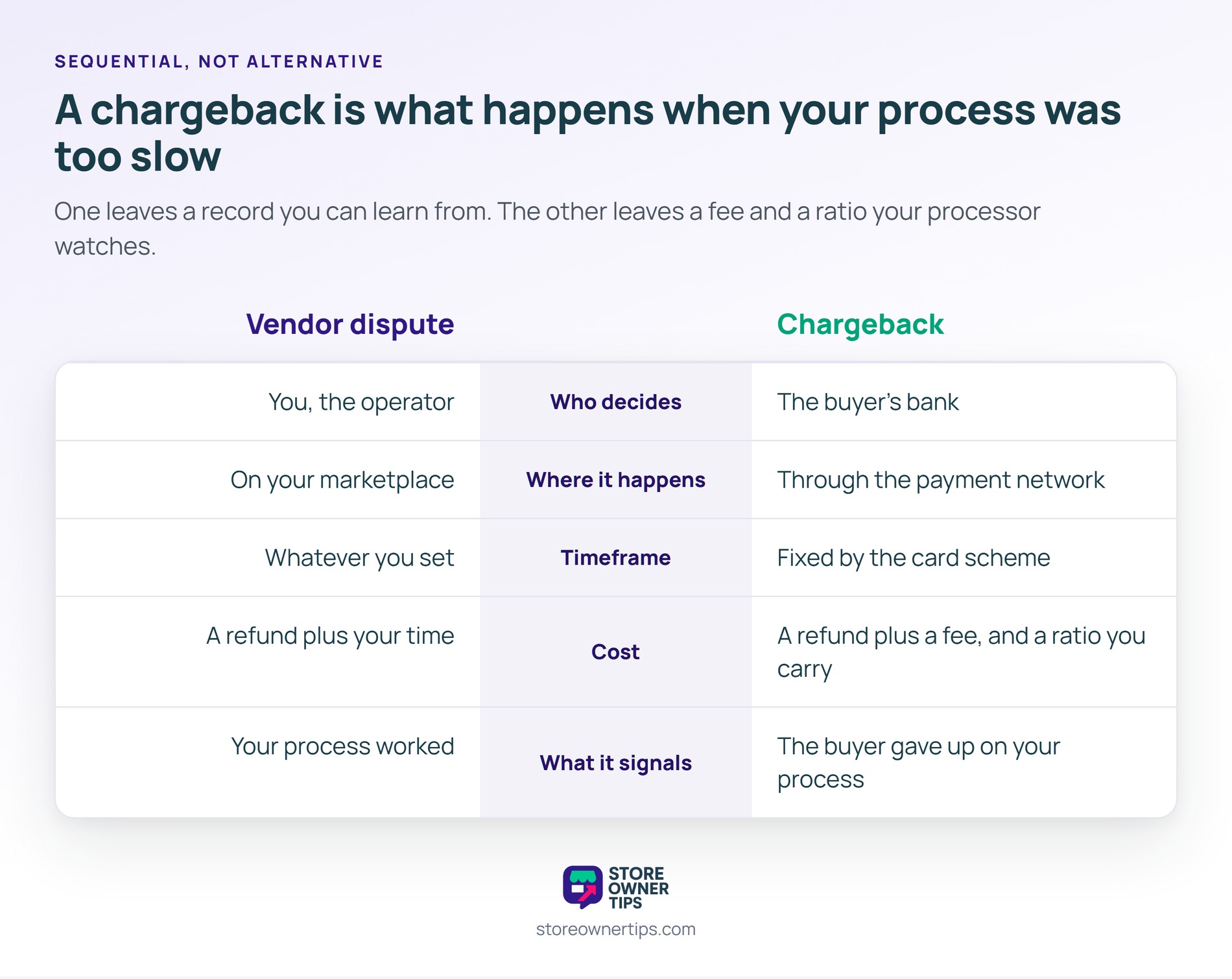
| What you’re comparing | Vendor dispute | Chargeback |
|---|---|---|
| Who decides | You, the operator | The buyer’s bank |
| Where it happens | On your marketplace | Through the payment network |
| Timeframe | Whatever you set | Fixed by the card scheme |
| Cost | A refund plus your time | A refund plus a fee, and a ratio you carry |
| What it signals | Your process worked | The buyer gave up on your process |
In short, a chargeback is what happens when your dispute process failed or ran too slowly. So the two are not alternatives. They are sequential.
Also, chargebacks land on whoever holds the merchant account. With split payments that may be the vendor, while a single account makes it you.
Therefore check which model you actually run before promising anybody anything. The answer changes who carries the fee and the ratio.
One more difference is what each leaves behind. A resolved dispute leaves a record you can learn from. A chargeback leaves a fee and a ratio your processor watches.
The vendor caused it, and your marketplace still owns the buyer’s experience. Most operators refund or replace quickly, then recover the cost from the vendor. Your vendor terms should say so in advance, rather than at the moment it happens.
Between 24 and 72 hours suits most marketplaces. Shorter feels unfair to a one-person vendor, and longer pushes buyers toward their bank. Whatever you choose, state it publicly and apply it consistently.
A short holding period gives you room to resolve problems before the money leaves. It also annoys vendors, so keep it as brief as your dispute rate allows. Instant payouts are workable, though you absorb more of the risk yourself.
Vendor disputes matter because a buyer does not distinguish between your marketplace and your vendors. One bad outcome from one seller simply reads as a bad marketplace.
So the process is what protects the brand you actually own. Meanwhile the same records quietly tell you which vendors are worth keeping. That record is worth more than any single refund decision. Getting the process right once saves you the same argument every month.
Copyright © StoreOwnerTips.com. All Rights Reserved.
