Weekly ecommerce tips, deals & news.
YMYL stands for “Your Money or Your Life.” It is a Google concept for pages that can affect a person’s health, finances, safety, or big life choices. Because mistakes on these pages can cause real harm, Google holds them to a higher trust standard. For store owners, more pages count as YMYL than you might expect.
YMYL is short for “Your Money or Your Life.” It comes from Google’s Search Quality Rater Guidelines, the handbook Google gives its human raters. These raters check whether search results are helpful and safe. They do not control rankings directly. Instead, they grade pages so Google can train and tune its systems.
Think of a YMYL topic like advice from a pharmacist versus a stranger. You expect higher proof of training before you trust it. Google treats high-stakes pages the same way. A page about cancer treatment or retirement savings must clear a taller bar than a page about choosing sneakers.
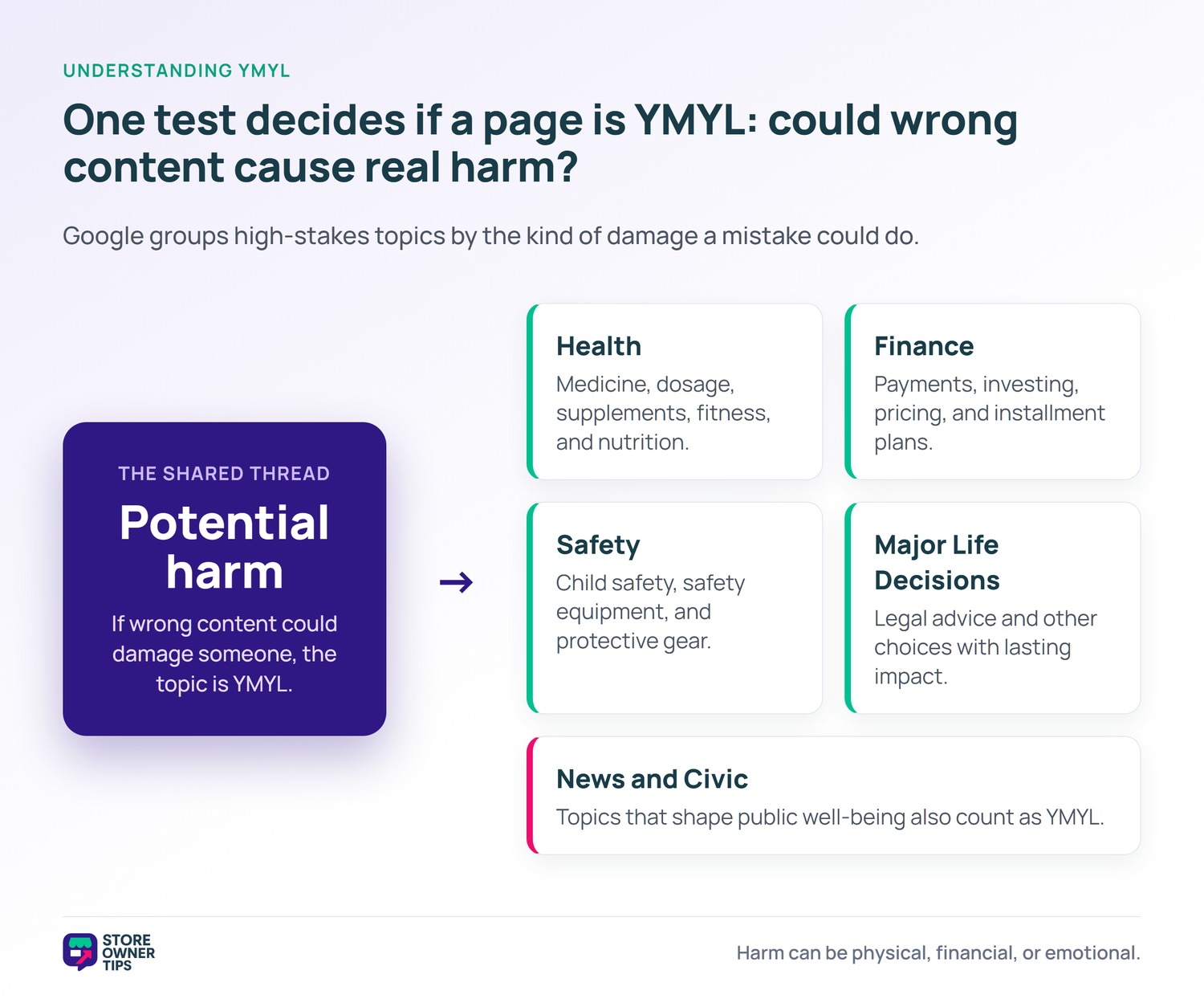
Google groups YMYL topics around real-world harm. The main buckets are health, finance, safety, and major life decisions. News and civic topics also count when they shape public well-being. The shared thread is simple. If wrong content could damage someone, the topic is YMYL.
Importantly, harm can be physical, financial, or emotional. A bad dosage tip can hurt a body. A shady payment page can drain a wallet. Google sorts pages by the size of that potential damage.
Some topics sit clearly inside YMYL. Examples include medicine, investing, legal advice, and child safety. Others land in a gray zone, like fitness or nutrition tips. When in doubt, assume the stricter standard and add proof.
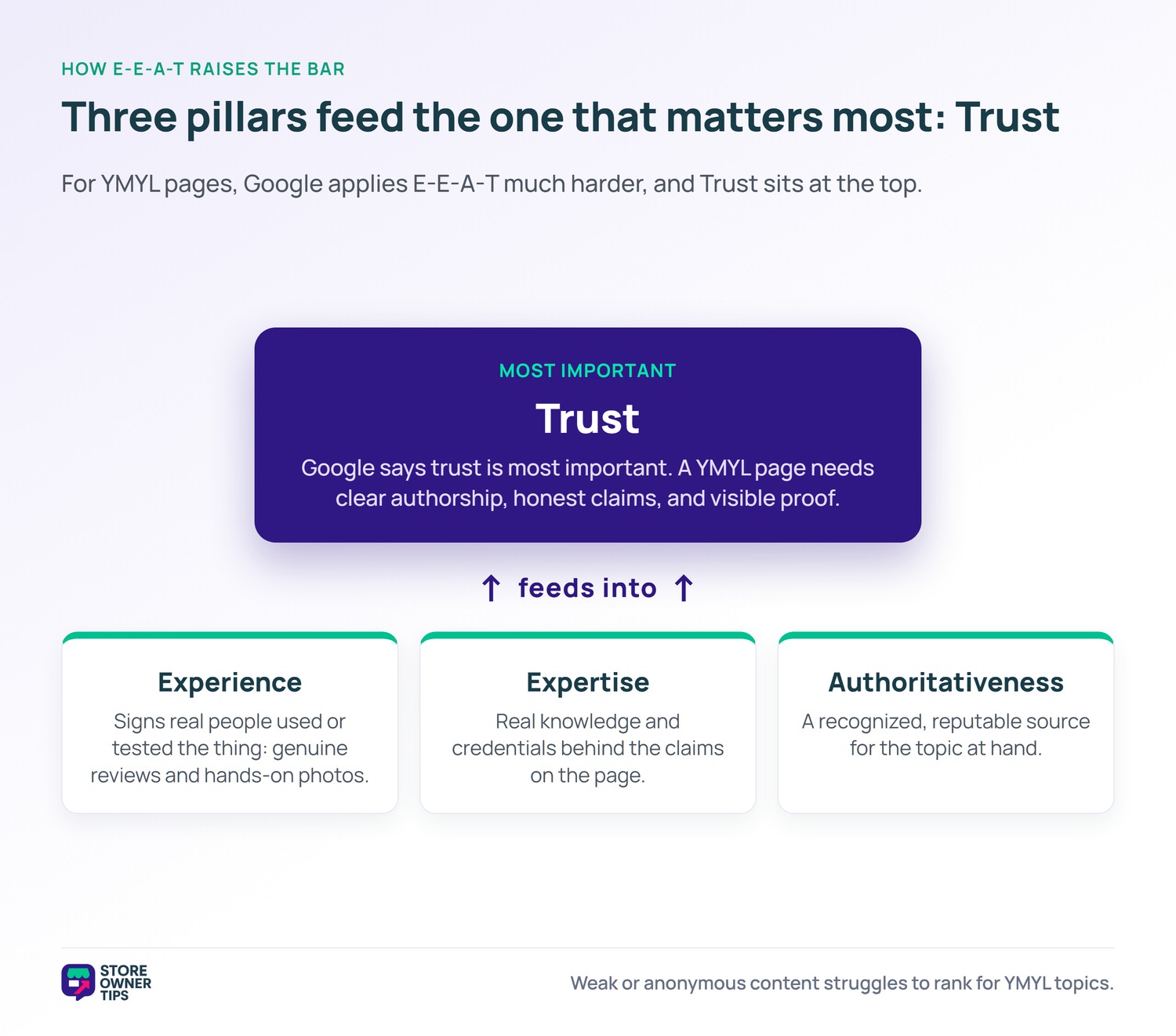
Google grades pages on E-E-A-T, which means Experience, Expertise, Authoritativeness, and Trust. For YMYL pages, Google applies this lens much harder. As a result, weak or anonymous content struggles to rank for these topics.
Of those four parts, trust is the one that matters most. Google states plainly that “trust is most important,” and the other three feed into it. So a YMYL page needs clear authorship, honest claims, and visible proof. Without trust, the page rarely earns Google’s confidence.
Experience adds a human layer on top. Google wants signs that real people actually used or tested the thing. For a store, that means genuine reviews, hands-on photos, and honest detail. These cues show first-hand knowledge, not recycled marketing copy.
Many owners think YMYL only hits medical or banking blogs. In reality, your store touches money on every order. Checkout pages, payment screens, and pricing pages all handle financial decisions. Therefore Google can treat them as YMYL.
Product pages can qualify too. If you sell supplements, baby gear, or safety equipment, the content affects health and safety. Likewise, pages explaining financing or installment plans touch a shopper’s money. In each case, trust signals become non-negotiable.
On WooCommerce or Shopify, the fix lives in the same places. Add author or reviewer details on risky product pages. Show secure-payment badges, clear policies, and real reviews at checkout. These signals tell both Google and shoppers the page is safe.
Trust is not one thing. It is a stack of small, visible proofs that add up. On a YMYL store page, a few signals do most of the heavy lifting. Build these first.
These cues are not just SEO chores. Each one removes a specific worry a buyer feels before paying. So you reduce harm risk for Google and friction for shoppers in one move. That overlap is why YMYL work tends to pay for itself.
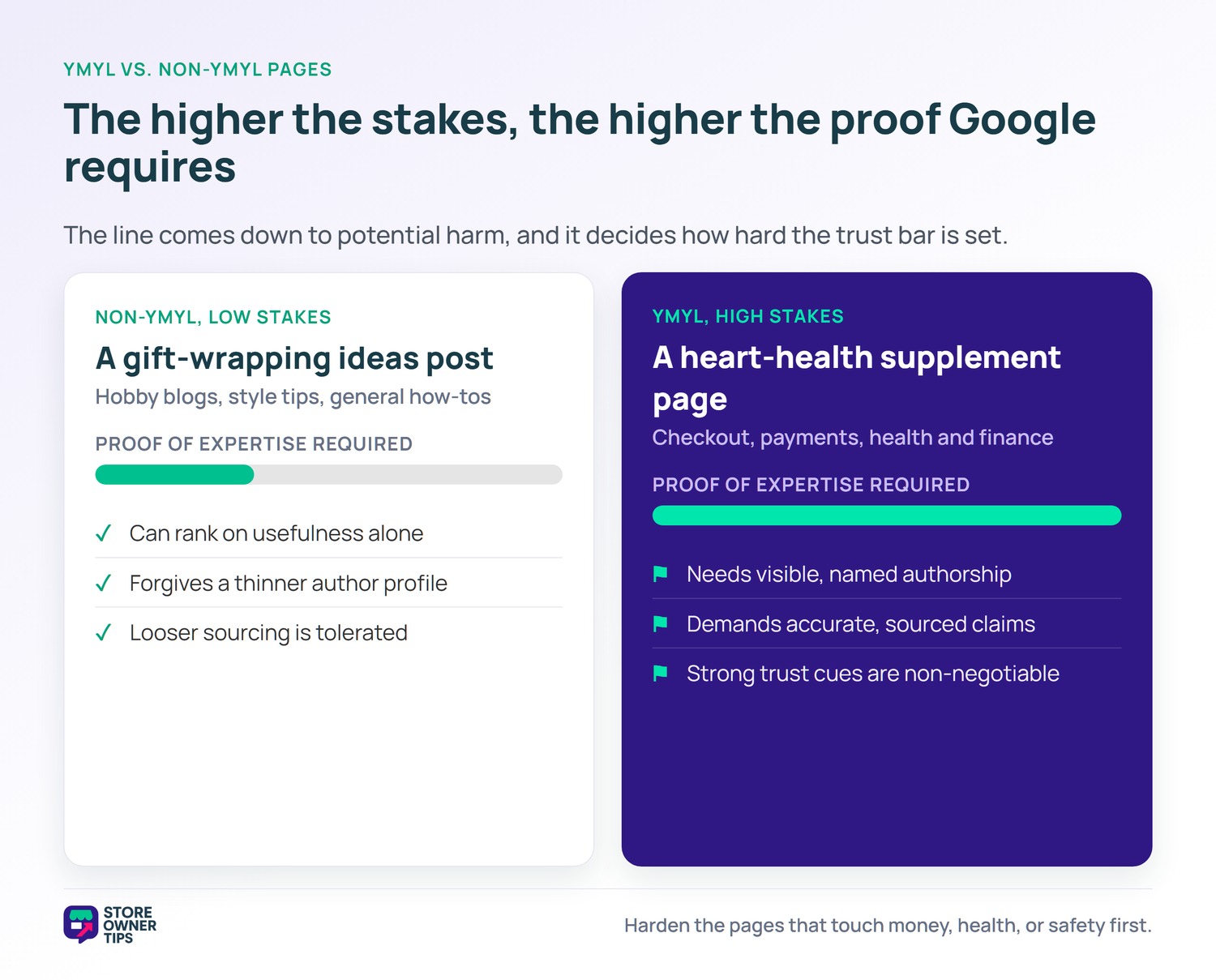
Not every page on your store is YMYL, and that is fine. The line comes down to potential harm. A blog post about gift-wrapping ideas is low stakes. A page selling a heart-health supplement is not.
For a non-YMYL page, Google still likes good content. But it will forgive a thinner profile and looser sourcing. The page can rank on usefulness alone, without heavy proof of expertise.
For a YMYL page, the rules tighten sharply. Now Google wants visible authorship, accurate claims, and strong trust cues. The same checkout shortcuts that pass on a hobby blog can sink a store. In short, the higher the stakes, the higher the proof required.
This also shapes how you spend your time. You do not need to harden every page on the site. Instead, find the pages that touch money, health, or safety first. Then pour your trust-building effort into those.
Imagine a mid-sized WooCommerce store called Harborleaf, which sells vitamins and sleep aids. These products affect health, so the pages count as YMYL. The owner notices strong traffic but weak sales. Shoppers reach checkout, then quietly leave.
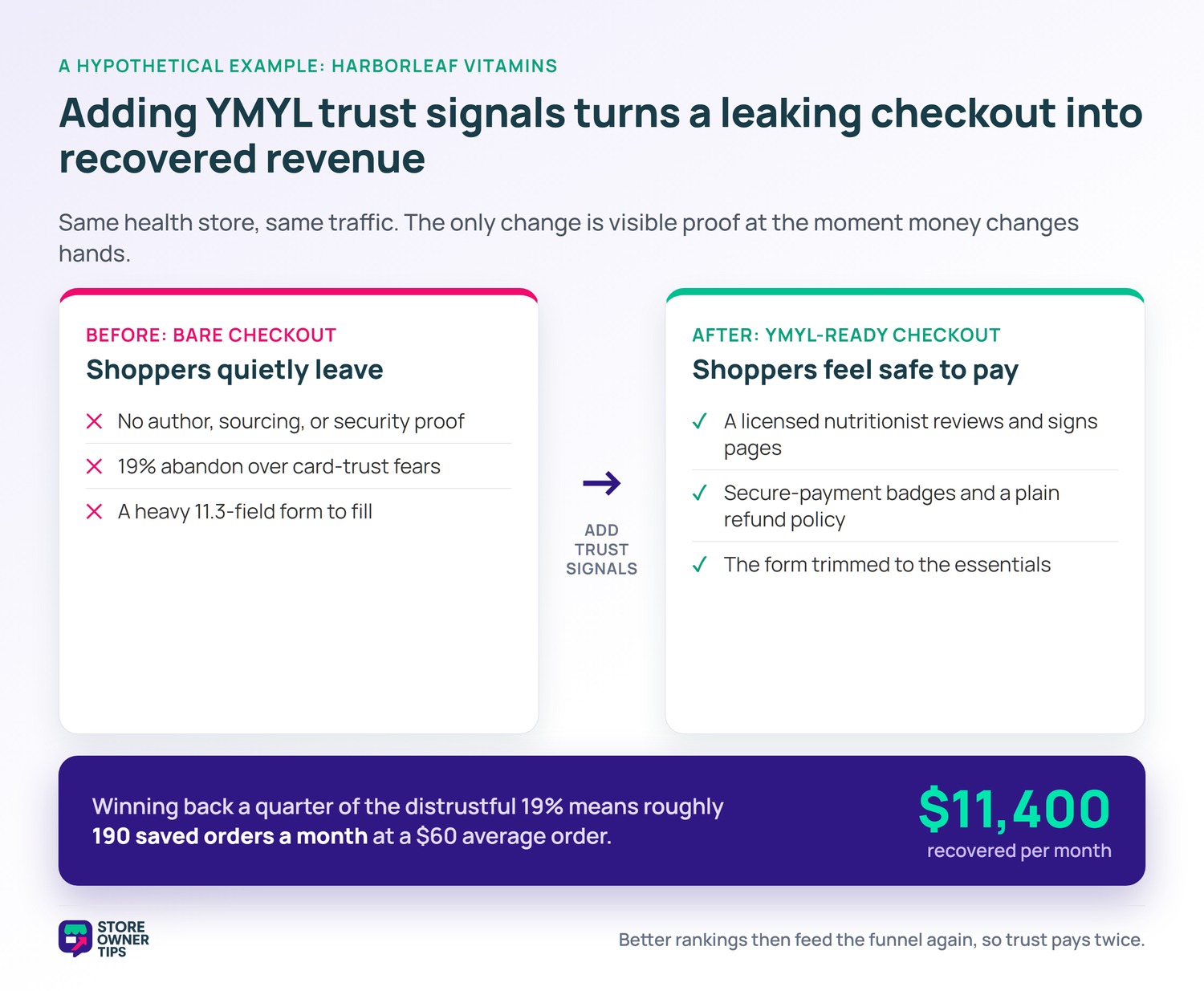
Harborleaf’s checkout looks generic and bare. There is no author, no sourcing, and no security proof. Across e-commerce, 70.22% of carts get abandoned before purchase. Among shoppers who do not finish, 19% bail because they do not trust the site with their card.
The numbers compound for a health store. Buyers want to know the advice is sound and the payment is safe. Without trust cues, Harborleaf loses both groups. So the store leaks revenue at the exact moment money changes hands.
A clunky form makes it worse. The average checkout still carries 11.3 form fields, and Harborleaf’s is no leaner. Every extra field is one more chance for a nervous buyer to quit.
The owner adds clear trust signals built for YMYL. A licensed nutritionist reviews each product page and signs it. Secure-payment badges and a plain refund policy appear at checkout. The owner also trims the form down to the essentials.
Say Harborleaf gets 4,000 checkout starts a month at a $60 average order. Recovering even a slice of that distrustful 19% adds real money. Winning back a quarter of them means roughly 190 saved orders monthly. At $60 each, that is about $11,400 in recovered revenue per month.
The gains do not stop at checkout. The same reviewer credentials help the product pages rank for health queries. Better rankings bring more qualified traffic, which feeds the funnel again. Trust, in other words, pays twice.
Treating your store pages as YMYL takes effort. Still, the trade-offs usually favor the work. Here is the honest balance.
Yes, in most cases it is. A checkout page handles a shopper’s money and payment details directly. That financial impact is exactly what Google means by “Your Money.” So treat your checkout flow with extra care and visible trust signals.
Not always, but expertise must match the risk. If you sell health or safety products, a qualified reviewer adds real trust. For lower-risk items, clear sourcing and honest claims are usually enough. Match the proof to the stakes of the topic.
They work on Google and shoppers at the same time. Security badges, reviews, and clear policies all signal trust. That helps your YMYL pages satisfy E-E-A-T standards. Meanwhile the same cues lift conversion rates by easing buyer doubt.
YMYL is Google’s way of holding high-stakes pages to a higher trust standard. Your checkout, payment, and health or finance pages all qualify. Invest in real expertise and clear trust signals on those pages first. That work protects rankings, revenue, and your buyers at once, which is rare in SEO. Treat trust as the asset it is, and the high-stakes pages will reward you for years.
Copyright © StoreOwnerTips.com. All Rights Reserved.
