Weekly ecommerce tips, deals & news.
Subscription boxes are a booming market, worth about $42.5 billion in 2025. But plenty of subscribers cancel within their first few months. The gap between boxes that thrive and ones that fade comes down to a few decisions. Those decisions get made before the store is even built.
I’ve watched plenty of founders launch a subscription box business on WooCommerce. Some build profitable, growing brands. Others quietly shut down inside two years. This guide covers what the winners get right, from niche selection through setup and launch.
The difference is rarely fancy design or technology. Instead, it’s niche validation, pricing math, and churn control. Get those right, and the operational work becomes manageable.
Table of Contents

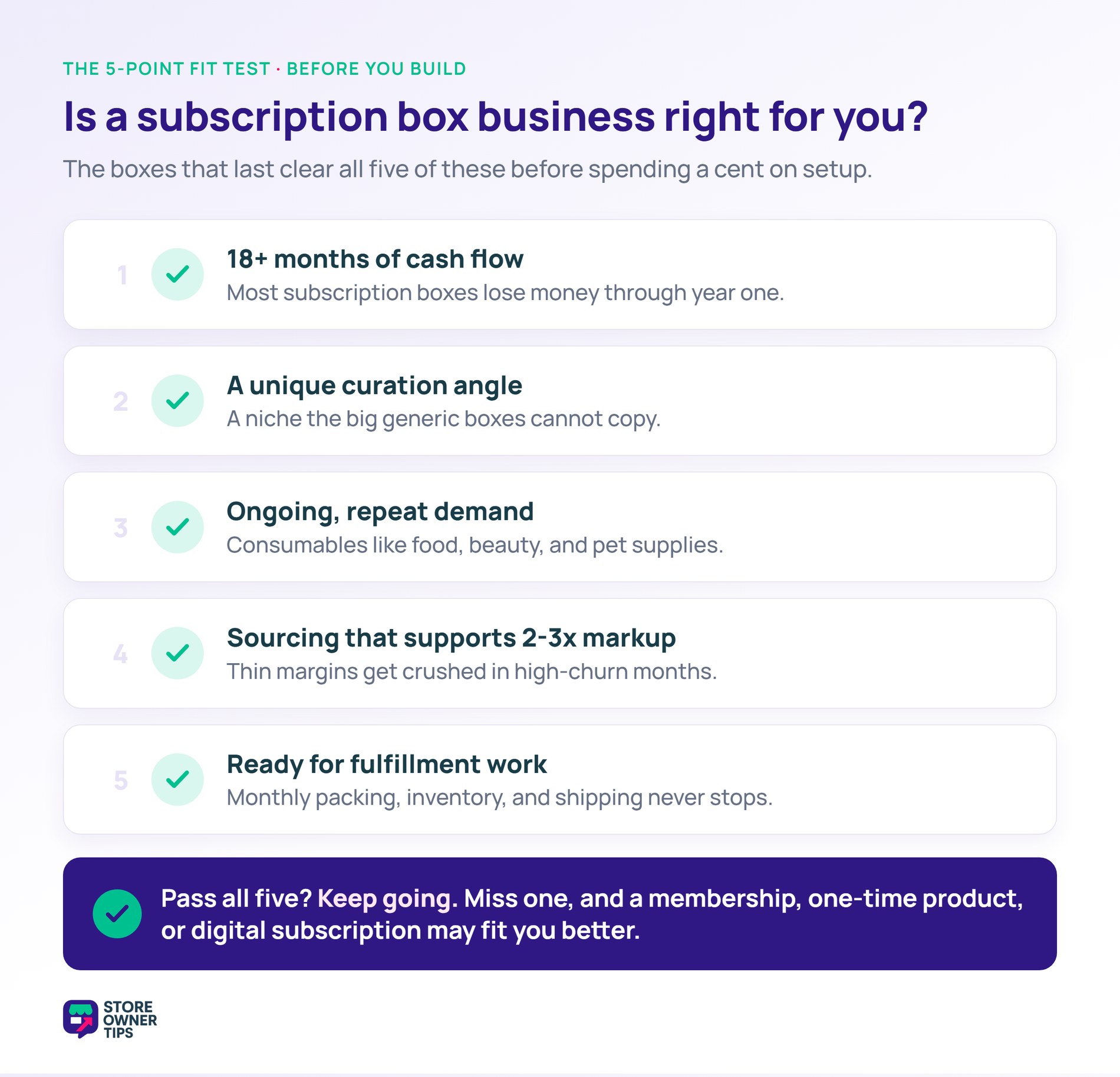
Before building anything, check that the subscription box model fits your situation:
If your idea passes all five tests, keep going. If not, consider whether a different model fits better. One-time products, memberships, or digital subscriptions might suit you more. Either way, it’s worth writing the numbers down first — this free wholesale business plan template walks you through pricing, operations, and financial projections section by section, including the sourcing and supplier side of a product business.
Launching a successful subscription box business takes a lot more than just throwing a few fun items into a cardboard package. If you want a business that actually makes money and grows, you need to nail your pricing, pick a specific audience, and keep your customers excited to open their boxes month after month.
Instead of guessing your way through the process, you can follow a proven playbook. From picking your niche to shipping out your very first batch of orders, here are eight essential steps to build a profitable subscription box store.
“Everyone loves coffee” is not a niche. “Single-origin coffee for people who already grind their own beans” is a niche.
I’d evaluate niches on three criteria:
Demand: Is there an existing audience searching for this type of product? Check Google Trends, Reddit communities, and Facebook groups. A niche needs a sizable pool of active enthusiasts to support a viable box.
Willingness to pay: Are people in this niche comfortable with $20 to $60 per month? Premium niches tend to work better than budget ones. Think artisan food, specialty hobbies, or luxury personal care.
Differentiation: Can you offer something competitors don’t? That might be better curation, exclusive products, deeper personalization, or a stronger community.
Validate with a landing page before sourcing any products. Drive around 1,000 visitors to a waitlist signup page. If 5% or more sign up, demand is real. If under 2%, rethink the niche.
There are three common sourcing models to weigh up.
Wholesale sourcing: Buy products at wholesale from existing brands, then resell them in your box. It’s the fastest way to launch. Margins are lower (typically 2x markup), and you depend on supplier relationships.
Private label: Work with manufacturers to produce products under your brand. Margins are higher (3-5x markup). Lead times run longer, often 3 to 6 months for a first batch. Minimum order quantities are higher too.
Curated partnerships: Brands pay you (or give deep discounts) to include their products as a marketing channel. This needs an established subscriber base first. The margins here are the highest of the three.
Most boxes start with wholesale sourcing. As they grow, they move to private label for core items. Curated partnerships tend to arrive once they pass 5,000 subscribers.
Pricing depends on your cost structure and the competition. Here’s the basic math:
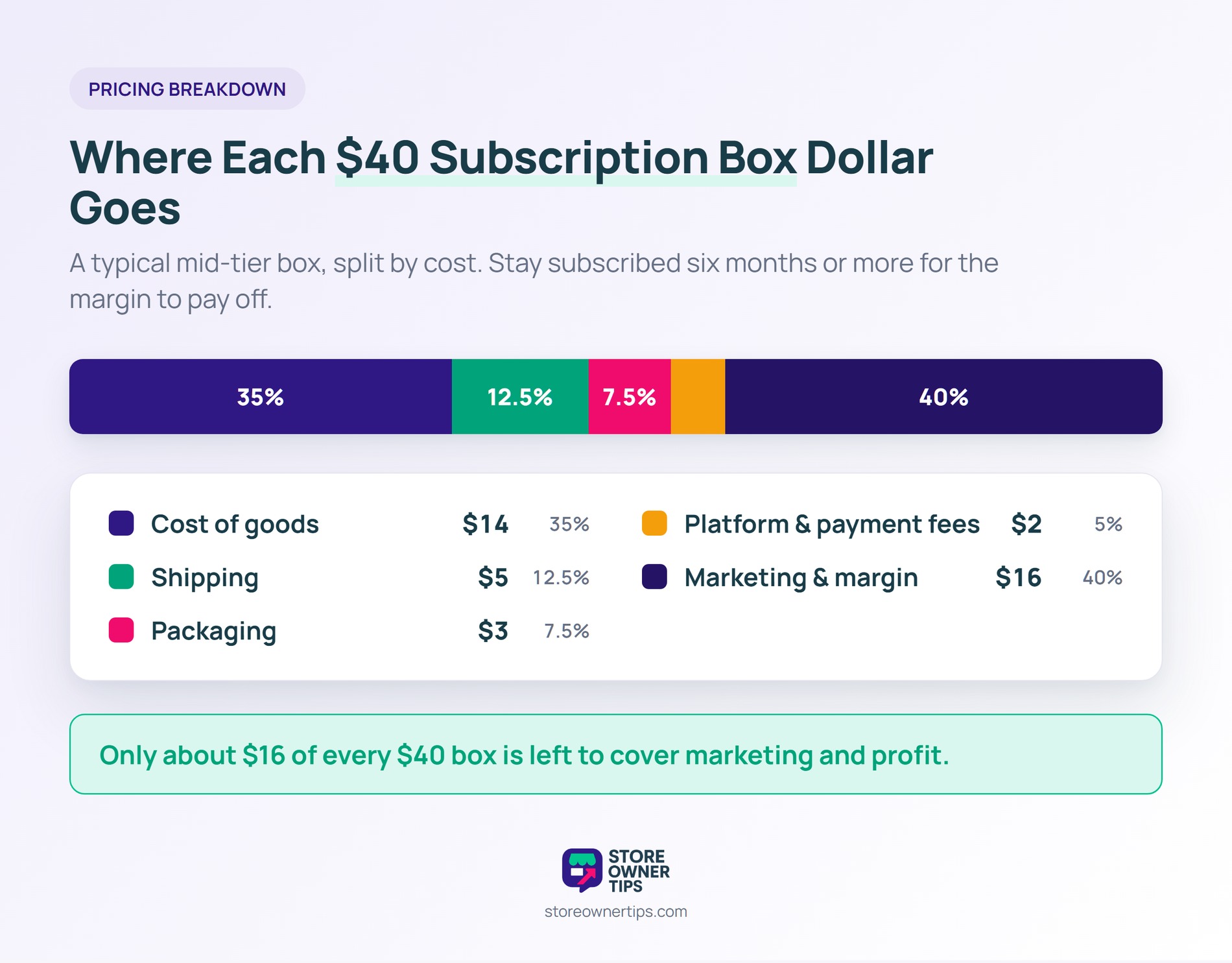
Take a $40 per month box as an example. That’s roughly $14 COGS, $5 shipping, $3 packaging, and $2 fees. You’re left with about $16 for marketing and margin. For that to work, customers need to stay subscribed 6 months or more.
Here are some market pricing anchors to benchmark against:
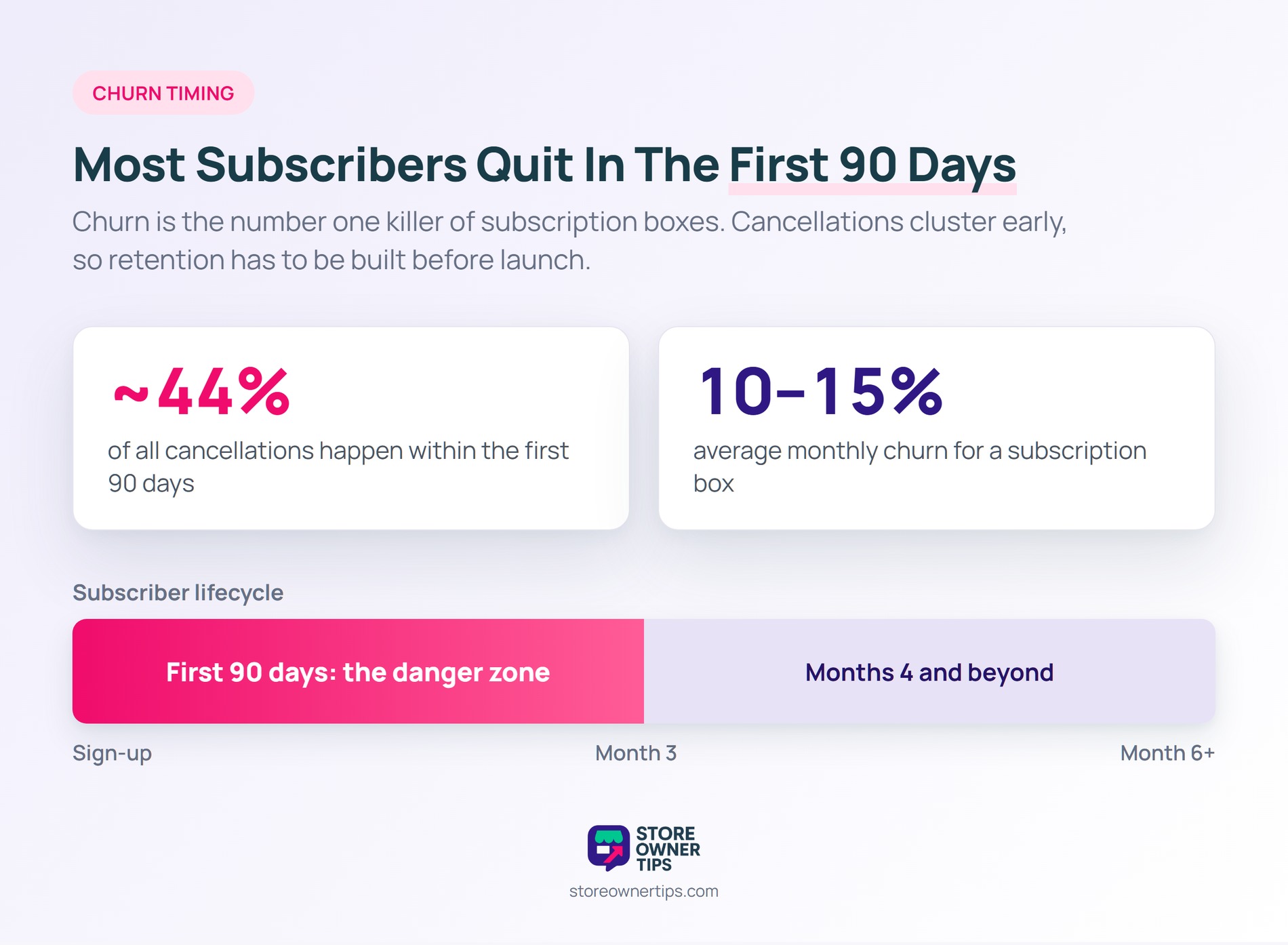
Churn is the number one killer of subscription businesses. Average monthly churn runs 10% to 15%, and cancellations cluster early. Roughly 44% of them happen within the first 90 days. So your retention mechanics need to be ready before launch.
These are the retention levers that matter most:
Most businesses pour energy into acquisition and ignore month-2 churn. They only notice once subscriber counts flatten. Build retention mechanics first, then spend on ads.
WooCommerce is an excellent platform for subscription boxes. Here’s the stack I’d build on.
Core plugins:
Recommended theme: Astra Pro or Shoptimizer. Both handle the single-product subscription layout well.
Recommended hosting: Kinsta, Nexcess, or SiteGround Cloud. Subscription boxes have predictable traffic, but they need reliable recurring billing.
Payment gateway: Stripe is a solid choice for reliable subscription billing.
Recurring billing logic:
See our WooCommerce subscription plugins comparison for deeper detail on the plugin choice.
The unboxing is a make-or-break moment. In the first 30 seconds after a subscriber opens the box, you either win a loyal customer or lose one.
Here’s an unboxing design checklist to work from:
Total unboxing investment runs about $3 to $8 per box. It feels expensive, but it moves retention more than almost anything else.
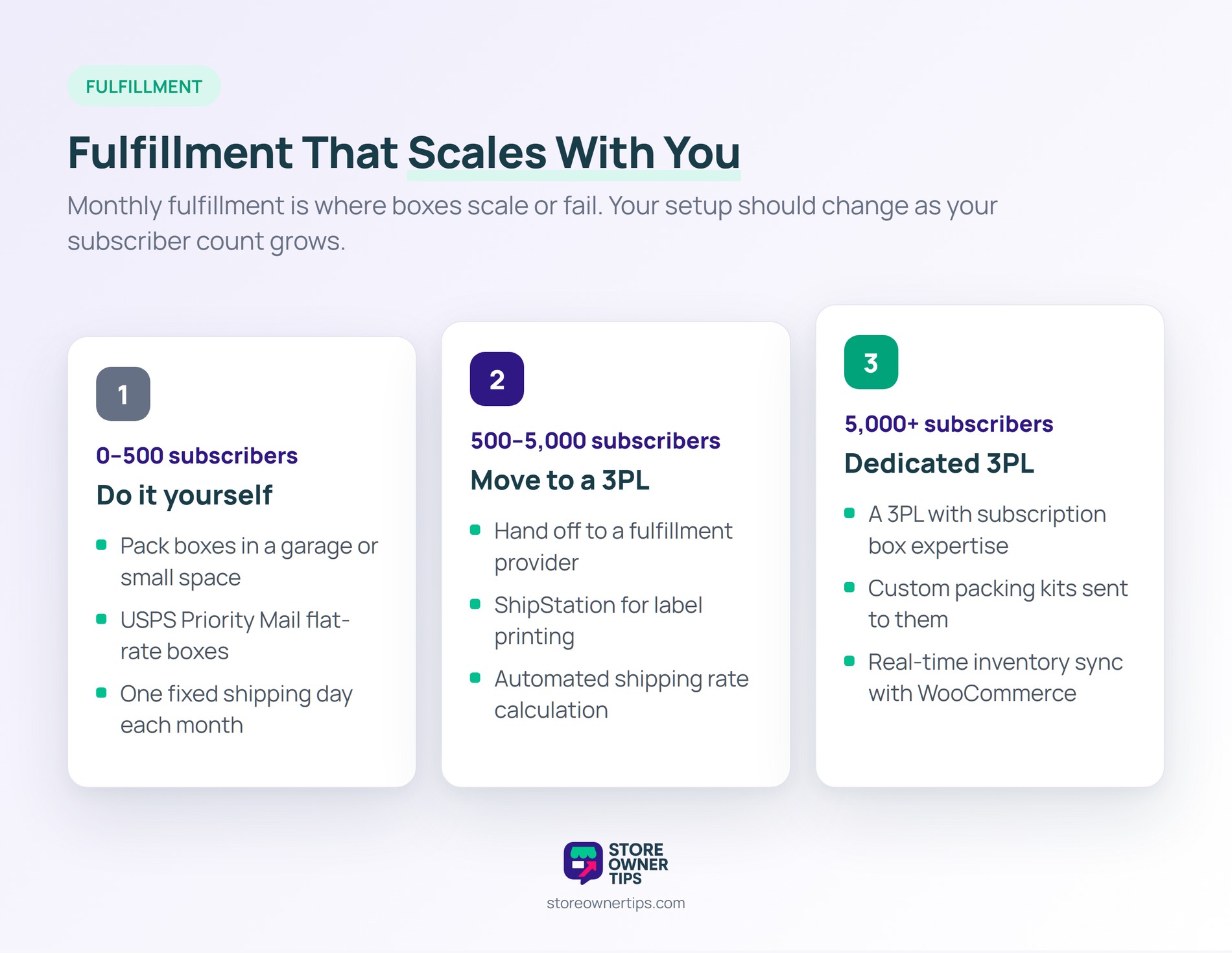
Monthly fulfillment is where subscription businesses scale or fail. Your approach should shift as you grow.
Early-stage fulfillment (0-500 subscribers):
Mid-stage fulfillment (500-5,000 subscribers):
Large-scale fulfillment (5,000+ subscribers):
Transitioning between stages is painful. So plan the move to a 3PL before you’re drowning in manual fulfillment.
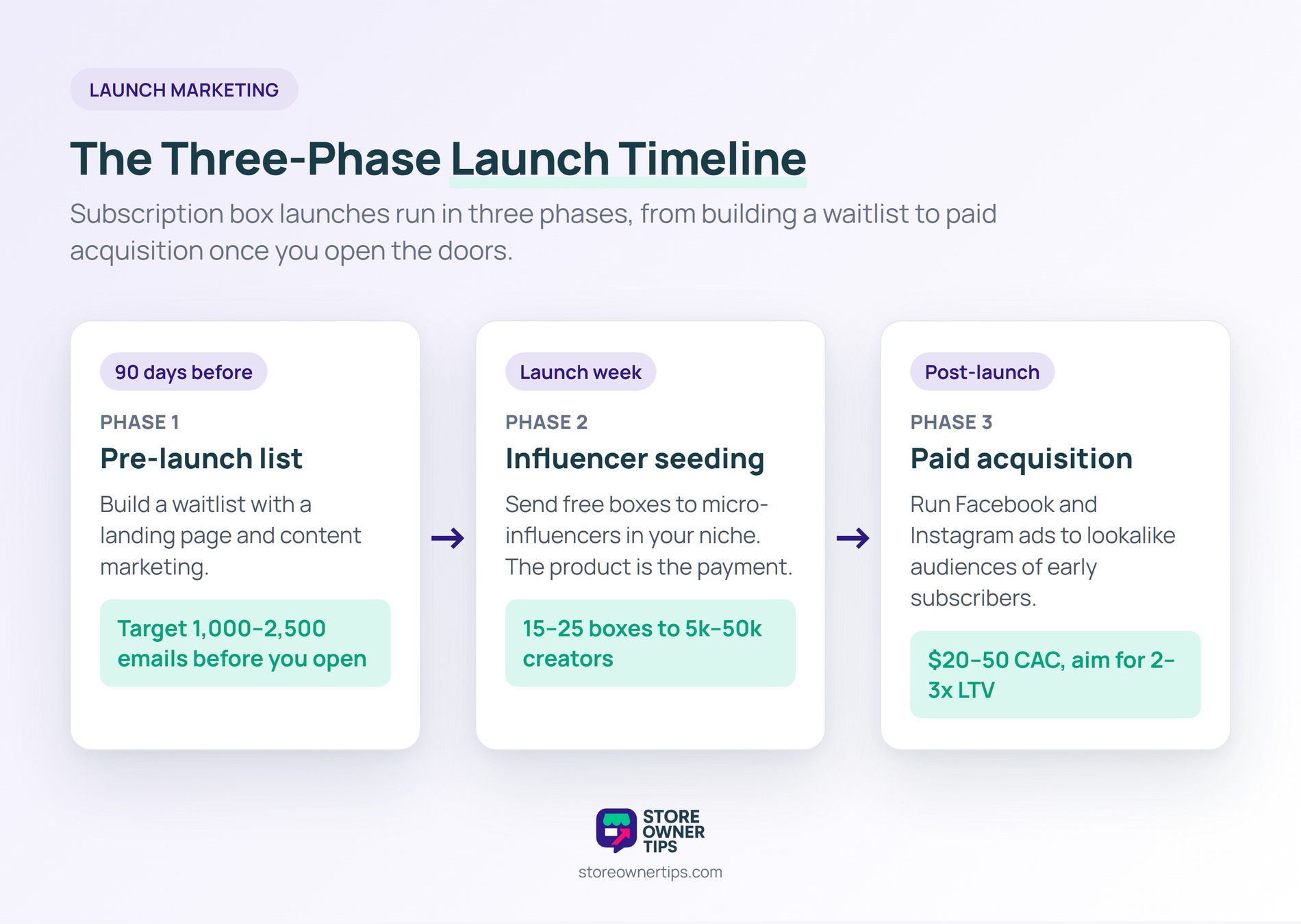
Launch marketing for subscription boxes happens in three phases.
Phase 1: Pre-launch list (90 days before launch). Build a waitlist via a landing page and content marketing. Aim for 1,000 to 2,500 email addresses before you open subscriptions. Early subscribers become your first marketing engine.
Phase 2: Influencer seeding (launch week). Send 15 to 25 free boxes to micro-influencers in your niche (5k to 50k followers). Don’t pay for posts, since the product is the payment. Authentic micro-influencer unboxings tend to outperform sponsored posts.
Phase 3: Paid acquisition (post-launch). Facebook and Instagram ads are the standard channel here. Target lookalike audiences based on your early subscribers. Expect $20 to $50 customer acquisition cost. Aim for 6-month lifetime value at 2-3x that cost.
A realistic minimum is $10,000 to $25,000. That covers initial inventory, packaging design, platform setup, and a few months of ad spend. Many profitable boxes needed $50,000 or more in first-year investment.
SUMO Subscriptions suits budget-conscious launches, at around $39 as a one-time CodeCanyon purchase. WooCommerce Subscriptions ($279 per year) offers broader payment gateway support and more complex logic. Both handle subscription box needs.
It depends on your pricing and unit economics. A rough rule: break even at 300 to 500 subscribers for a $30-40 box. You’ll usually see profit past 1,000 subscribers. High-margin premium boxes can profit earlier.
For the first 6 months, yes. Once you pass 500 subscribers, monthly fulfillment becomes a full-time job. At that point, plan to make it your primary business or hire help.
Cratejoy is tempting for beginners, but its marketplace charges a recurring 10% referral fee on subscribers it sends you. WooCommerce plus a subscription plugin is cheaper long-term. It does take more setup work.
Offer a “skip this month” option prominently in customer accounts. A pause beats a cancel, since paused subscribers often resume. One-click skip lifts retention more than any retention offer.

Starting a subscription box business is a serious commitment. Still, it’s one of the most rewarding ecommerce models when it works. Niche selection, pricing math, churn prevention, and operations matter more than fancy design.
Once you’ve determined if a subscription box business is right for you, observe these following steps:
If you’re ready, start with the niche validation waitlist test. Get 5% or more conversion on 1,000 targeted visitors, and you’ve got real potential. From there, build the platform, source your first two months of products, and ship.

Copyright © StoreOwnerTips.com. All Rights Reserved.
