A gift guide is a curated page or email that groups products by recipient, budget, or interest. Think “gifts for dads,” “under $25,” or “stocking stuffers.” It helps shoppers who don’t know what to buy for someone else decide fast.
A gift guide works by narrowing a store’s full catalog into a few short lists that match a shopper’s situation. The shopper skips hundreds of products, picks a lane like “for the coffee lover,” and sees six good options. It’s a core piece of most stores’ holiday marketing plan.
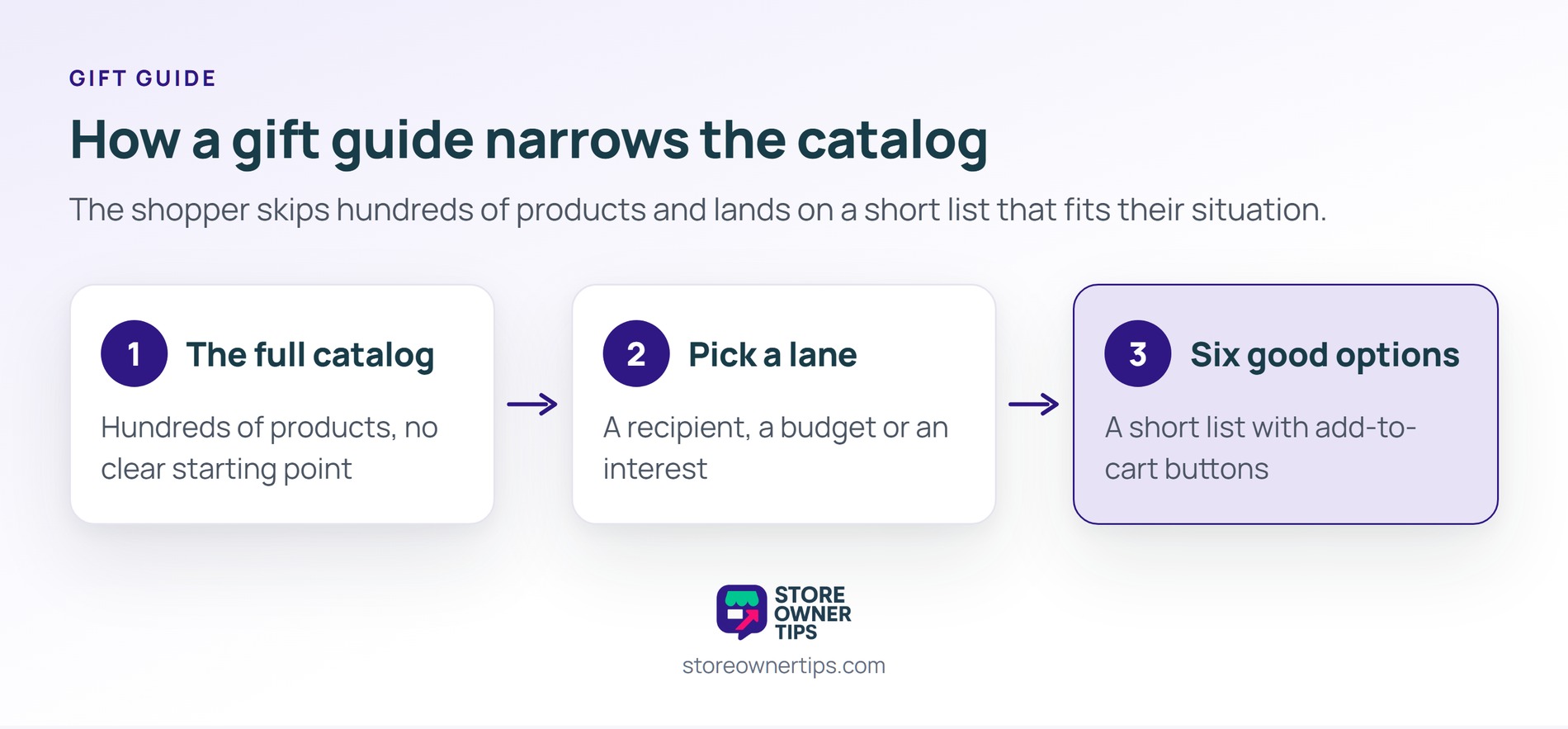
A WooCommerce gift guide usually starts as a dedicated landing page or a blog post. Think of it like a store clerk who pulls six items off the shelves for you. The products stay in your catalog. The guide just puts the right ones in front of the right shopper.
Most stores build one with these pieces:
Because the lists pull from tags, swapping an out-of-stock item is quick. You remove the tag from one product and add it to a replacement.
A gift guide only earns sales when shoppers see it, so stores push it through three main channels. Email comes first, often split by list segment so dog owners get the pet-lover section. Social posts come next, with one recipient list per post. Deloitte’s holiday survey found 59% of shoppers planned to use social media in their holiday shopping.
The third channel is product feeds and ads. Stores can tag gift items with a custom label in their shopping feed. That label lets a separate ad campaign target just those items. These holiday marketing tips for WooCommerce cover how feeds and ads fit the season.
Inside the store, the guide needs a home of its own. A homepage banner and a menu link keep it one click away for returning visitors. Many stores pair the guide with Christmas promotion ideas like a free gift over a set spend.
Gift guides work because buying for someone else is a hard decision. You’re guessing someone’s taste, and you worry about getting it wrong. Every extra option adds to that load, which psychologists call decision fatigue.
Too many options can stop a sale entirely. In Iyengar and Lepper’s jam study, nearly 30% bought from a 6-jam display versus 3% from 24 jams. However, later studies found the effect varies a lot by situation. So treat it as a risk to manage, not a law.
A gift guide manages that risk by acting as a trusted recommendation. It says “these are good picks for this person,” which gives the shopper permission to stop searching. This is the paradox of choice turned in your favor.
Curation signals expertise. When a store labels a list “our best host gifts,” shoppers borrow that confidence.
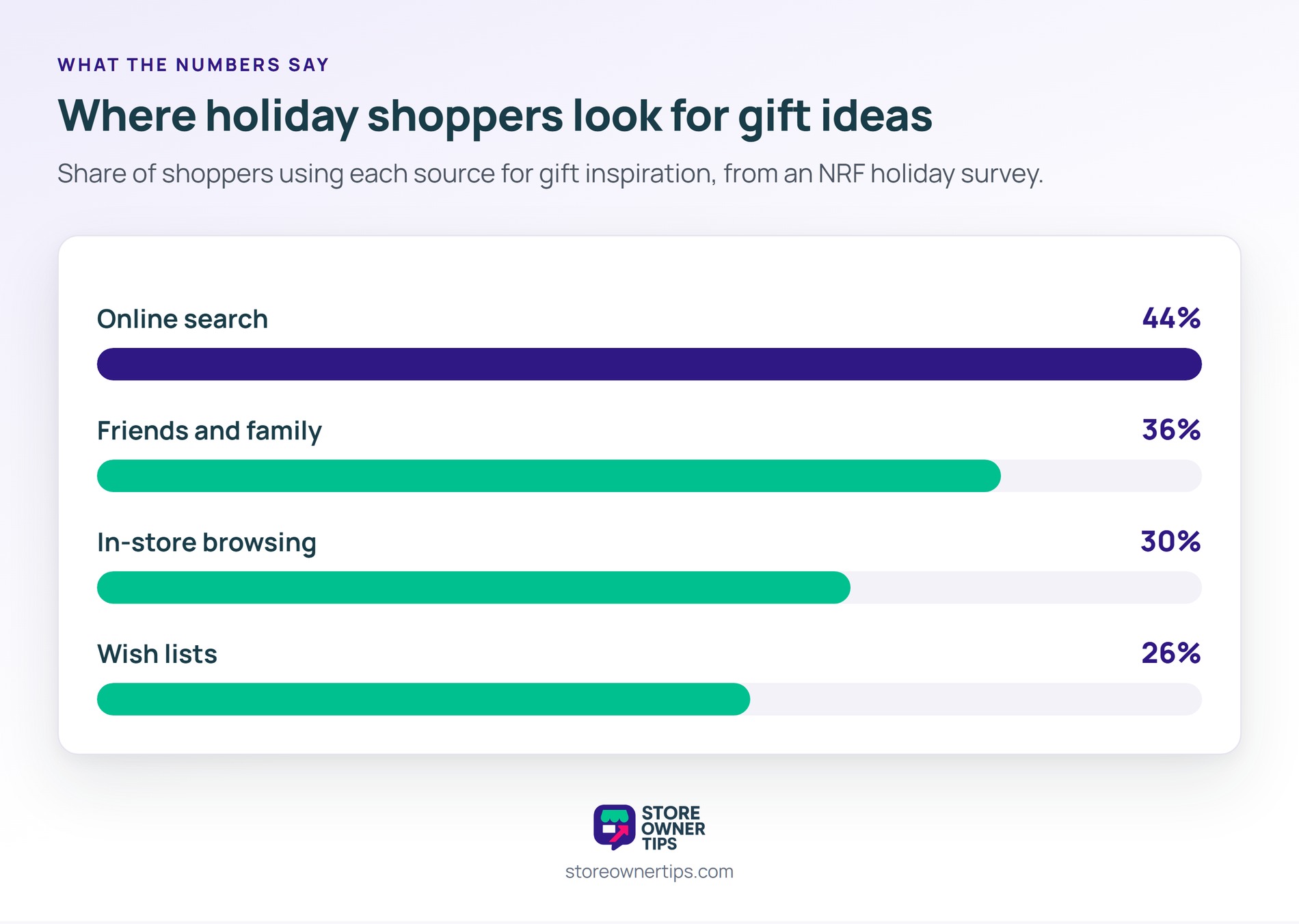
National Retail Federation (NRF) holiday surveys show that gift shoppers actively hunt for ideas. In one NRF survey, 44% of shoppers used online search for gift inspiration. Friends and family (36%), in-store browsing (30%), and wish lists (26%) followed in the same survey.
Indecision slows shoppers down late in the season. In NRF’s Super Saturday survey, shoppers with over half their list left were asked why. The top answer was that they were still trying to figure out what to buy (33%). Another 23% were waiting for family and friends to say what they wanted.
Put together, the NRF figures describe the exact shopper a gift guide is built for. They’re searching online, they have a list, and they haven’t decided.
A gift guide in practice is one landing page, a few product tags, and an email series pointing to it. Here’s a hypothetical example. Imagine a small WooCommerce store called Larkspur Home that sells candles and home goods. It has 140 products and a holiday email list of 8,000 subscribers.
Larkspur Home builds a page called “The Cozy Gift Guide.” It has four recipient sections: for the host, for mom, for the coworker, and for the new homeowner. Each section shows six products, keeping the lists short on purpose. Then three budget tiers sit at the top: under $25, $25 to $50, and $50 and up.
Each section is a product block filtered by a tag such as “gift-host.” Every product card has an add-to-cart button, so shoppers can build an order without leaving the guide. The owner adds a small “stocking stuffers” row of items under $15.
The guide goes live in early November, ahead of the store’s Christmas sale. Larkspur Home sends it to the full list, then follows up with segmented emails by past purchase. Customers who once bought a wine-scented candle get the “for the host” section first.
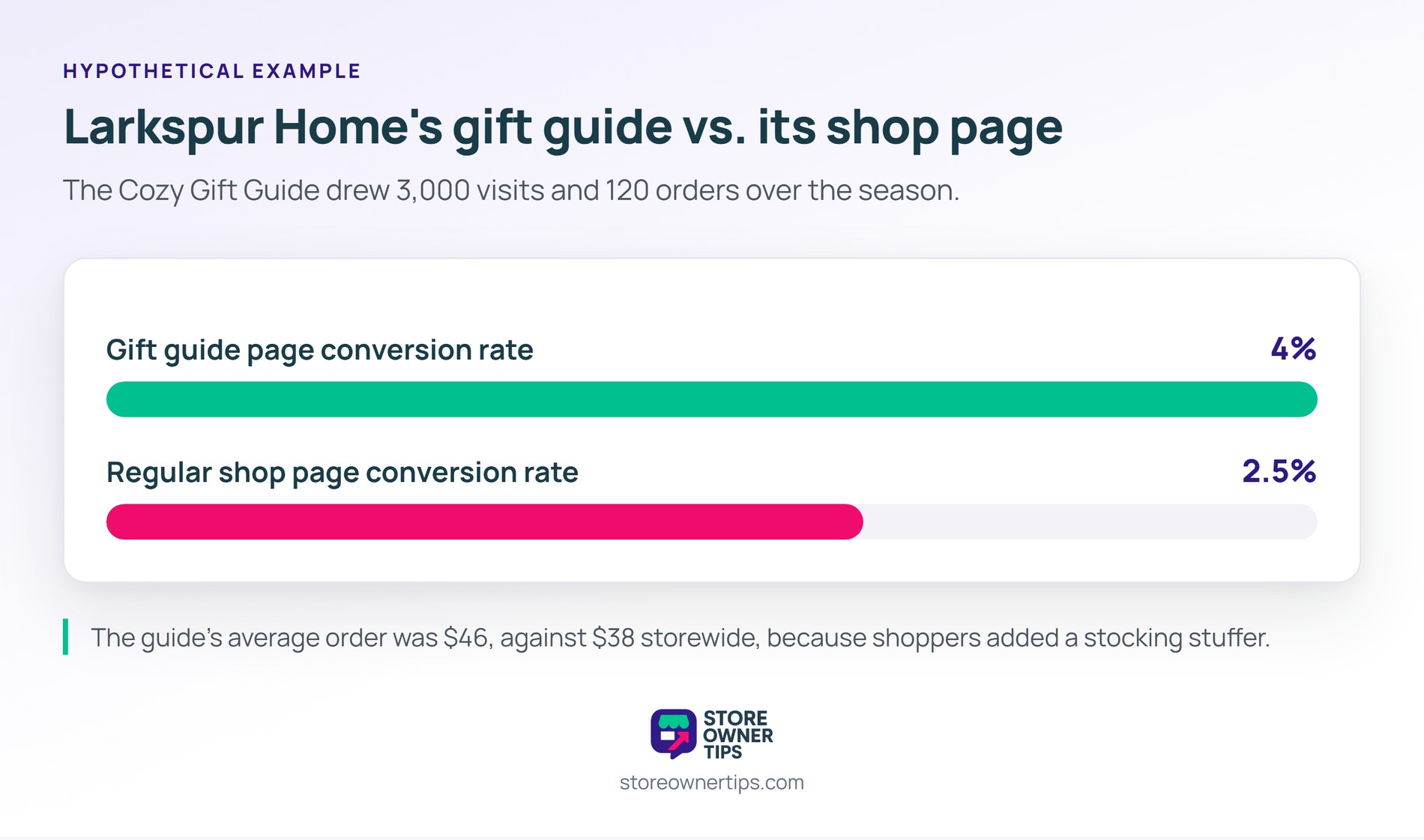
Over the season, the guide page draws 3,000 visits and 120 orders, a 4% conversion rate. The store’s regular shop page converts at 2.5% in the same weeks. Meanwhile, the guide’s average order is $46, compared with $38 storewide, because shoppers add a stocking stuffer.
In mid-December, the owner re-sends the guide with a “still deciding?” subject line. That timing matches NRF’s finding that many late shoppers haven’t decided what to buy. The re-send brings in 30 more orders before the shipping cutoff.
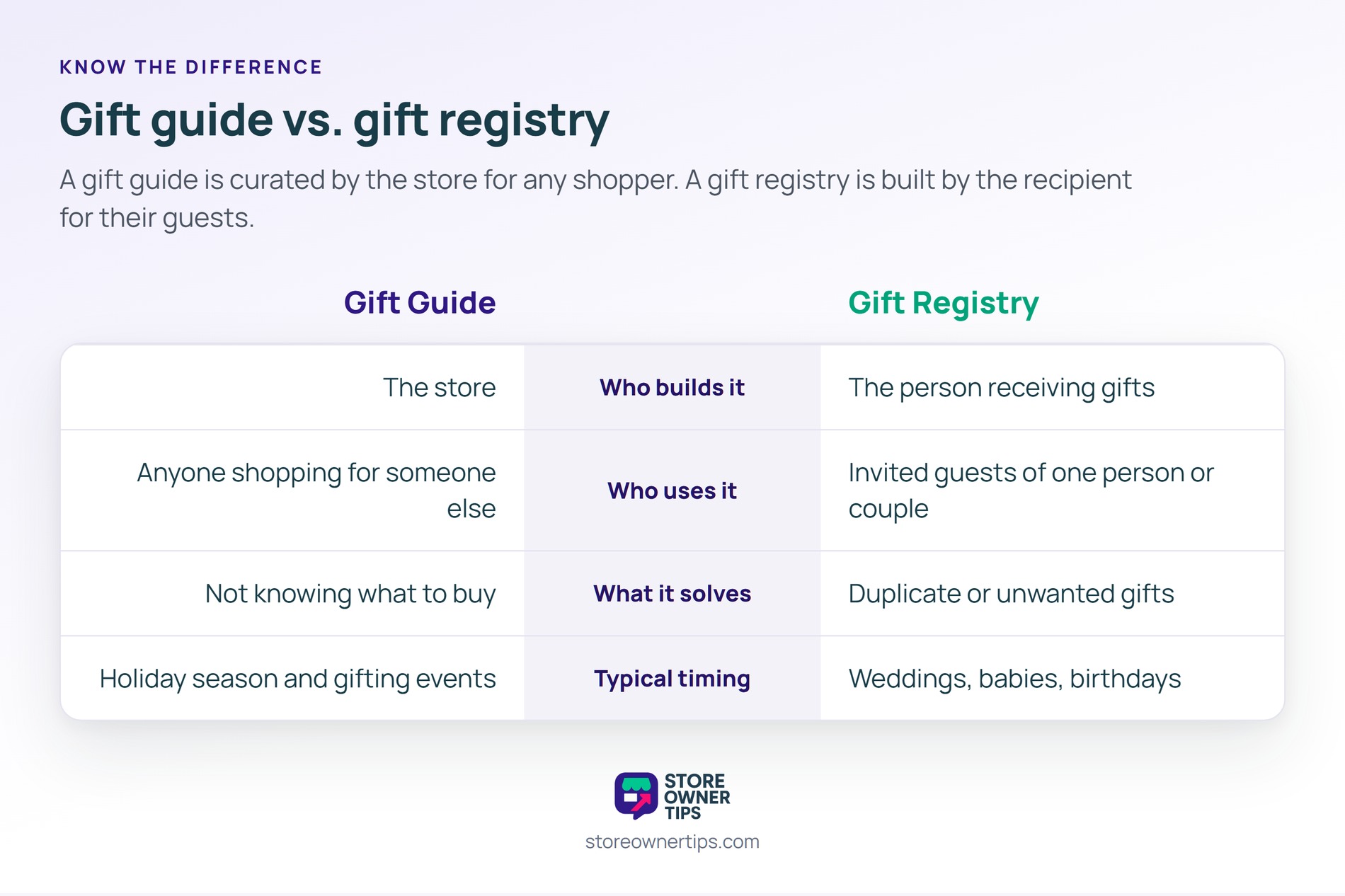
A gift guide is curated by the store for any shopper. A gift registry is built by the recipient for their guests.
| What you’re comparing | Gift Guide | Gift Registry |
|---|---|---|
| Who builds it | The store | The person receiving gifts |
| Who uses it | Anyone shopping for someone else | Invited guests of one person or couple |
| What it solves | Not knowing what to buy | Duplicate or unwanted gifts |
| Typical timing | Holiday season and gifting events | Weddings, babies, birthdays |
A gift registry gives guests certainty, but only when the recipient takes time to make one. A gift guide covers everyone else, including shoppers with a vague idea and a budget. Most stores benefit from both, with the guide carrying the holiday season.
Publish a holiday gift guide before the main shopping rush, so it’s ready for early shoppers and holiday sale emails. Keep it live and updated through December. NRF’s survey data shows many shoppers haven’t decided what to buy late in the season. A mid-December re-send to your email segments can catch them.
A gift guide works best with short sections, often around six to ten products each. The jam study suggests smaller sets can make choosing easier. Still, the right number depends on your catalog and audience. Add more sections rather than packing more products into one list.
Label each section clearly by recipient or price, so shoppers know at a glance which list fits.
Yes, a gift guide should include a gift card as a fallback for shoppers who can’t decide. Deloitte’s holiday survey found gift cards on par with clothing and accessories as a top gift category. Place the gift card at the end of each section. That way, it catches shoppers who scrolled the whole list without picking.
A gift guide matters because holiday shoppers arrive with a person in mind but no product. It turns that uncertainty into a quick, confident purchase. Built once and promoted well, it can drive sales every gifting season for years.
Copyright © StoreOwnerTips.com. All Rights Reserved.
