Weekly ecommerce tips, deals & news.
Shopping cart abandonment, or simply cart abandonment, is when a shopper adds products to their online cart, then leaves without buying. It’s one of the biggest revenue leaks in e-commerce. The global average sits at around 70%, meaning about 7 out of 10 carts never become orders. The main causes are surprise costs at checkout, forced account signup, and slow delivery. Fixing those is one of the fastest ways to grow revenue without buying more traffic.
Cart abandonment isn’t one problem. It’s a cluster of friction points spread across the funnel, from product page hesitation to a stuck checkout button. Understanding where it happens and why is the only path to fixing it. Once you map it, every fix gets cheaper and faster to land.
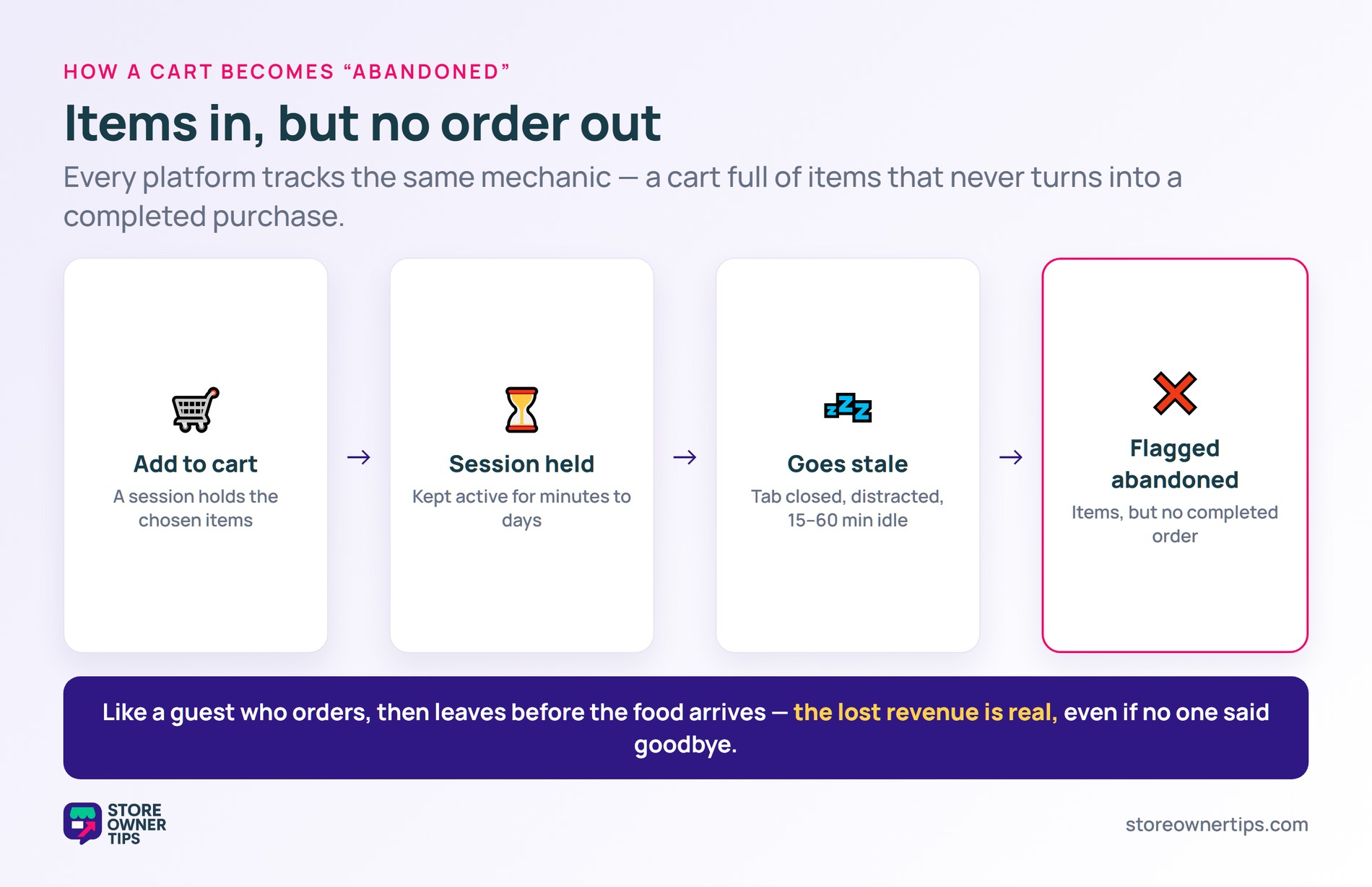
A cart starts when a visitor clicks “Add to Cart” on a product page. Behind the scenes, the store creates a temporary session that holds the chosen items. Most platforms keep that session active for a window of minutes to days, depending on settings.
Once the visitor closes the tab, walks away, or simply gets distracted, the cart enters a “stale” state. If they never return to complete checkout, the platform flags it as abandoned. Most stores treat a cart as abandoned after 15 to 60 minutes of inactivity. That threshold varies by platform and plugin.
Most e-commerce platforms have a built-in concept of an abandoned cart. WooCommerce stores cart data in the session table and exposes developer hooks that recovery plugins can listen on. Shopify keeps abandoned checkouts in a dedicated admin tab. Either way, the core mechanic is the same: a cart with items but no completed order.
Think of it like a restaurant table. A guest sits down, orders, then disappears before the food arrives. The seat is taken, the kitchen has prepped, but no payment lands. The lost revenue is real, even if no one shouted “I quit” on the way out.
Baymard’s most-recent survey of US online shoppers pins down the leading causes. In short, extra costs lead by a wide margin. 48% of US adults say shipping, tax, or other fees pushed them out at checkout. Plus, that’s been the #1 reason for six straight years.
Other top reasons stack on top:
Each of these stacks together. A shopper hit with a $15 shipping surprise AND a signup wall is gone within seconds. The math compounds against you with every extra step.
There’s also a softer category: pure browsing. Still, many people add items to compare options or save for later, with no firm intent to buy yet. That doesn’t mean the visit is wasted. It just means the cart was acting more like a wishlist than a checkout step.
If your store does $100,000 a month in sales at the industry-average 70.22% shopping cart abandonment rate, the math is stark. The value still sitting in those abandoned carts is several times your monthly revenue.
Baymard estimates
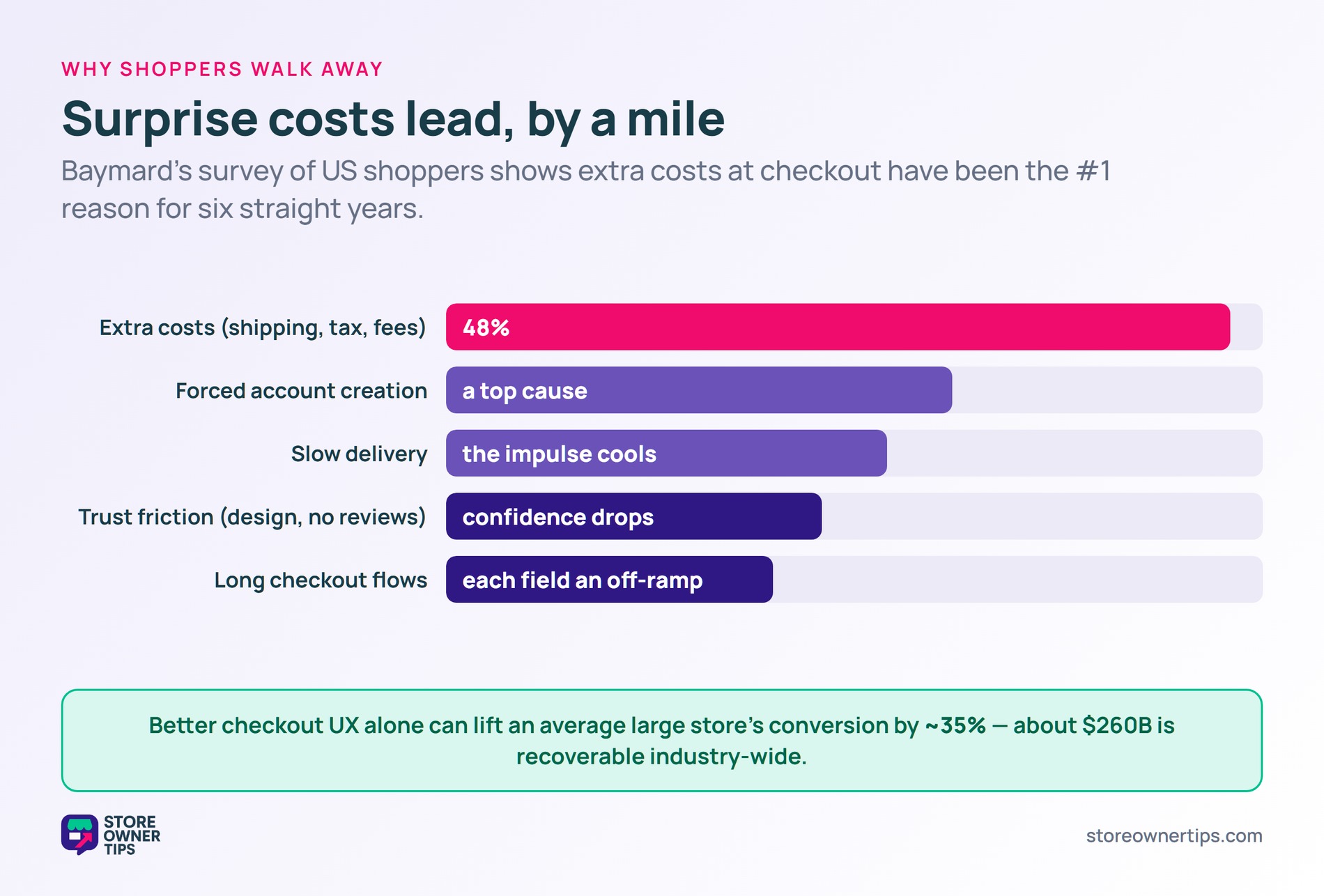
That’s not marginal. On a $1M store, that uplift means another $350,000 in revenue without buying a single new visitor.
Walk through a fully hypothetical scenario to see how cart abandonment plays out. The numbers below show how a typical store can recover real revenue from it.
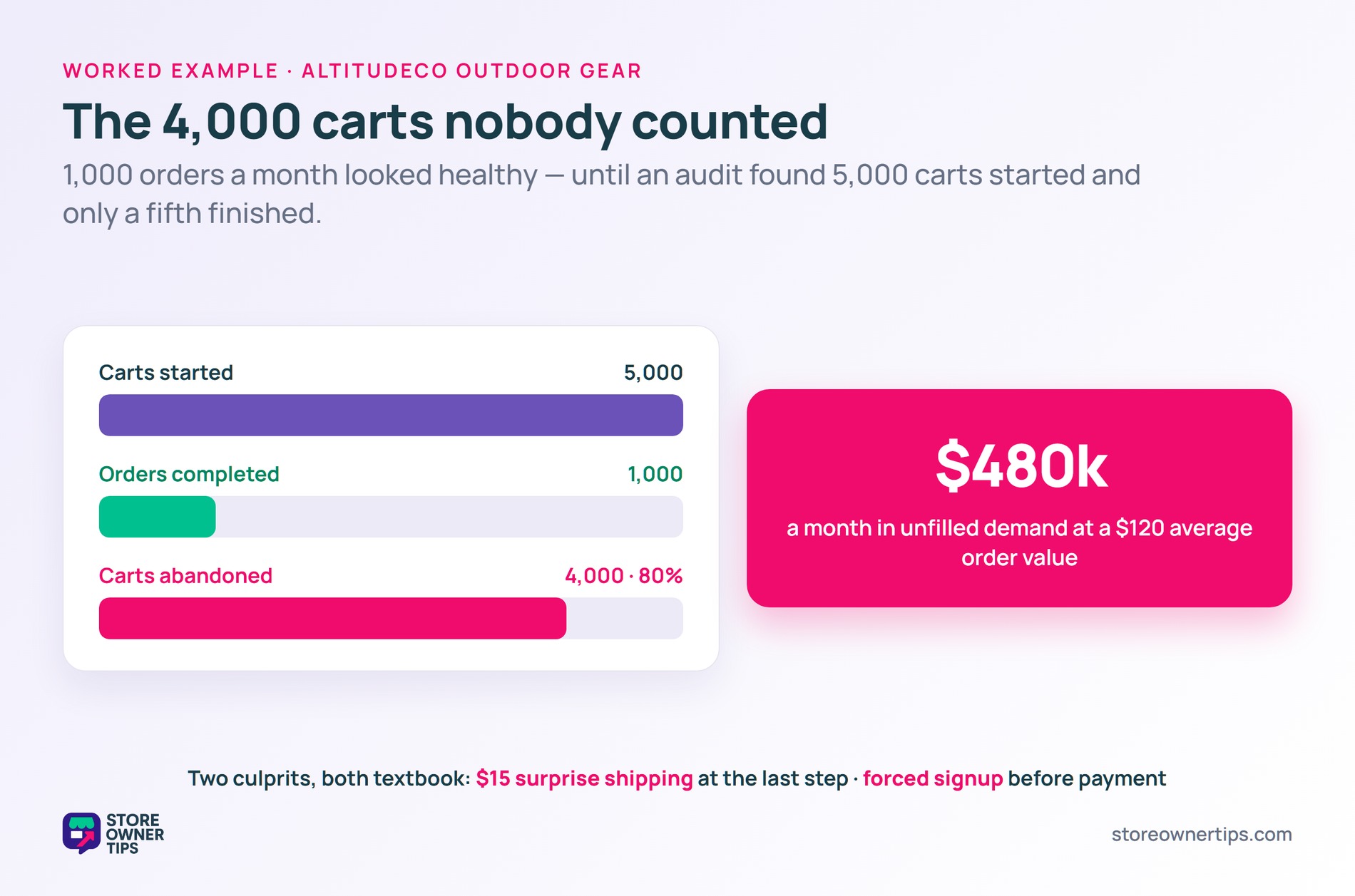
Imagine a mid-sized outdoor gear shop running on WooCommerce. Call it AltitudeCo. The store pushes 50,000 sessions a month and reports a 2% conversion rate on completed orders. Average order value is $120.
At face value that looks healthy: 1,000 orders, $120,000 revenue. But the team isn’t measuring what isn’t there. They run an audit and find that 5,000 unique sessions a month add at least one item to the cart. Only 1,000 of those finish the purchase.
The other 4,000 are pure invisible loss. None of them show up in Google Analytics as “failed” conversions because no one ever flagged them.
The other 4,000 carts walk away. That’s an 80% cart-to-order abandonment rate, just above the industry average for mobile traffic.
Two things become clear after some session replay analysis. Shipping shows up at the final step, adding $15 to most orders. On top of that, guest checkout is off, forcing a signup before payment. Both line up exactly with the leading reasons documented across the industry.
At $120 average order value, those 4,000 lost carts represent up to $480,000 a month in unfilled demand. Not every shopper would have bought. But even capturing a slice of that pool would dwarf any paid traffic experiment AltitudeCo is running.
AltitudeCo tackles the two fixable causes first. The team enables guest checkout and surfaces shipping cost on the cart page, not the final step. Both changes are free.
Next, they add a wishlist option for hesitators. Now a shopper can park an item without losing it on the next visit. They wire up a 3-email abandoned cart recove
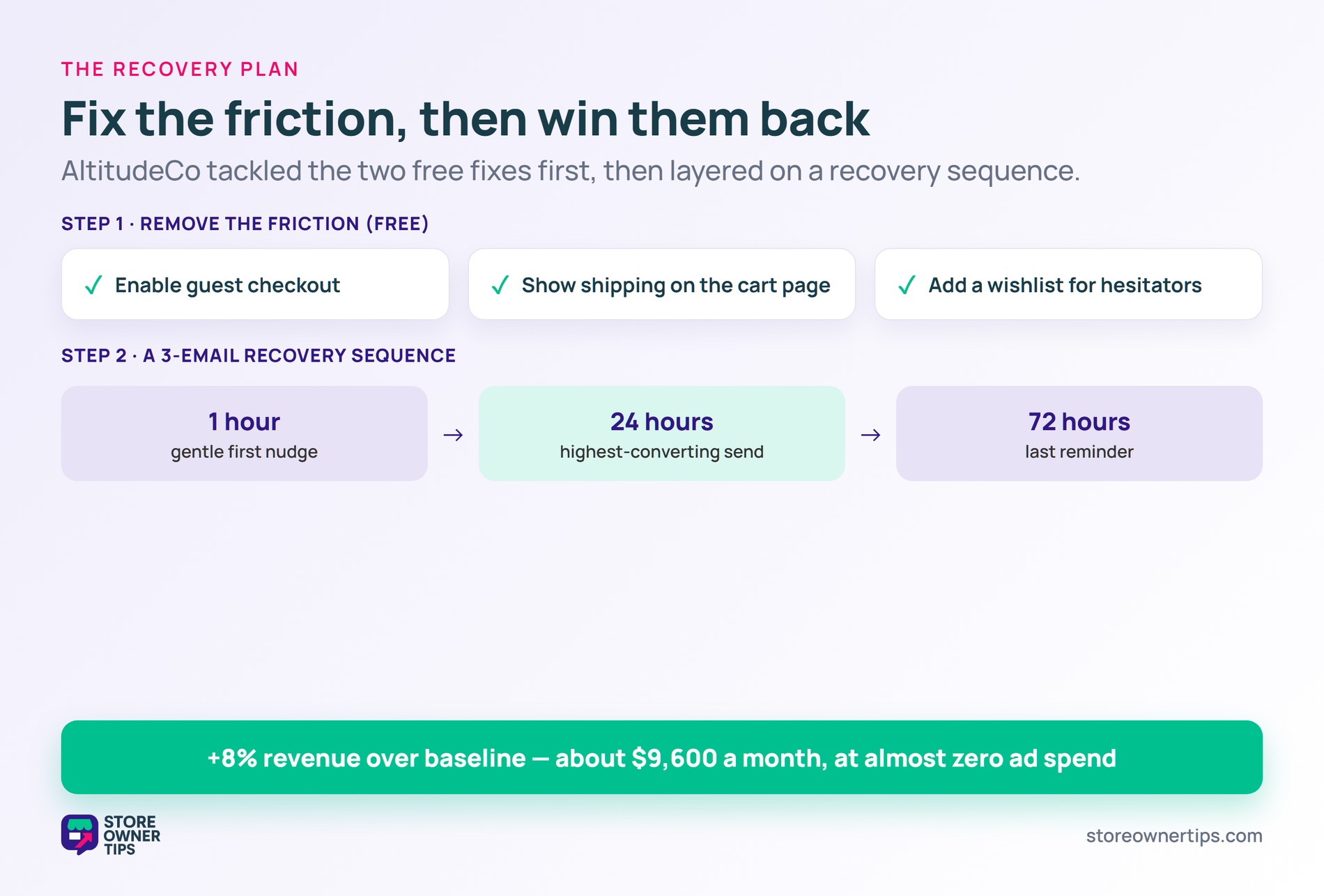
Over the next 90 days, recovered orders contribute an extra 8% on top of baseline revenue. That works out to roughly $9,600 extra monthly. Not the full $480,000 ceiling, but a strong start for almost zero ad spend.
The recovery emails do most of the heavy lifting, with the first send opening at strong rates. The 24-hour reminder typically pulls the highest conversion in the sequence.
The widely-cited industry average is 70.22% across e-commerce, based on Baymard’s analysis of 50 separate studies. Mobile typically runs higher than desktop. Your own shopping cart abandonment rate depends on category, traffic source, and price point.
First, a handful of categories run noticeably higher. Travel, luxury, and high-ticket B2B often run noticeably higher because shoppers research and compare more before buying. Apparel and consumables tend to cluster around the average.
Still, the right benchmark isn’t really “average.” It’s your own trend month over month. A stable 65% is great; a 65% that just jumped from 55% is a red flag.
Track it as a monthly metric in your analytics dashboard. Then segment by device, traffic source, and product category.
Start with the data, not the tactics. Pull your top exit points in checkout and find the friction. The top fixable causes across the industry are extra costs revealed late, forced account creation, and slow delivery.
Three high-leverage moves:
After fixing the friction, add a recovery layer. Cart-recovery emails, retargeting ads, and a save-for-later wishlist all bring some percentage of abandoners back. The right stack depends on your audience and your traffic volume.
WooCommerce stores can layer on official cart-recovery plugins or build flows in Klaviyo or Mailchimp. Whatever the tool, the rule is the same. Act fast and offer real value, not just a generic “you left this behind” nudge.
Cart abandonment is the broader metric: any shopper who adds an item then leaves without buying. By contrast, checkout abandonment is narrower. It counts only those who started the checkout flow then dropped out before paying.
In practice, most stores track both. Checkout abandonment is more diagnostic because it isolates platform-level friction, like a payment failure or a confusing shipping selector. Cart abandonment includes everyone who just changed their mind.
When people quote the industry-average abandonment figure, they usually mean cart abandonment. The checkout-specific rate is typically much lower and varies widely by store.
Cart abandonment is the single biggest gap between traffic and revenue in modern e-commerce. The fixes are well-tested: clean up checkout friction first, then layer on recovery emails, retargeting, and wishlists. Stores that follow that order consistently lift conversion without lifting ad spend.
Copyright © StoreOwnerTips.com. All Rights Reserved.
