Weekly ecommerce tips, deals & news.
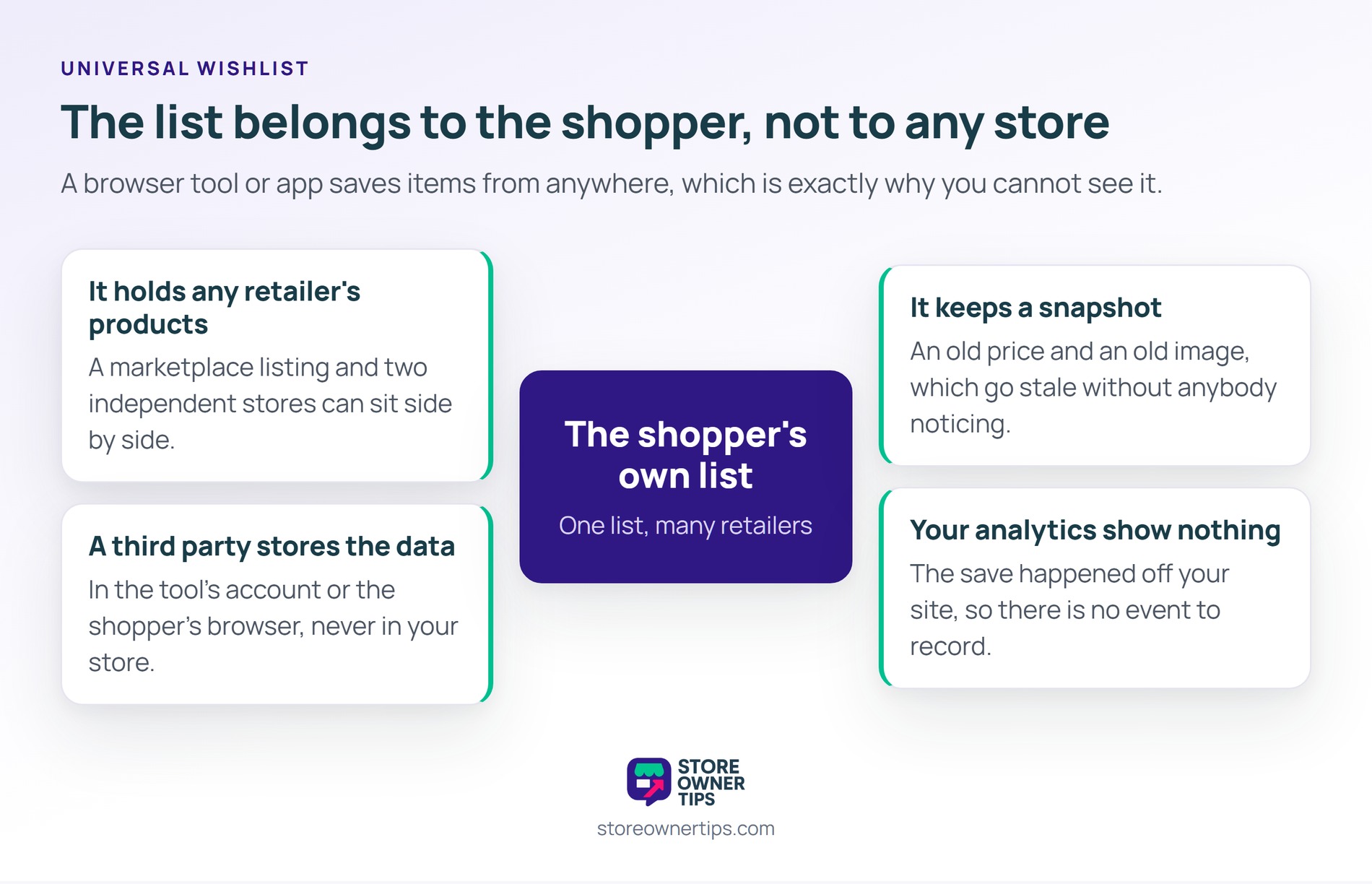
A universal wishlist is a saved list that can hold products from any online store, not just one. The shopper builds it outside your store, usually through a browser extension or a third-party service. That makes it different from the wishlist you run yourself, which only holds items from your own catalog.
In practice, a universal wishlist captures a product’s details from whatever page the shopper is on. First, the tool grabs the title, price, image and link. Then it keeps that snapshot in a list the shopper controls, independent of any single retailer.
First, picture a shopper walking a high street with a notebook. She writes down anything she likes, from any shop, and carries the notebook home. No individual shop can read it.
So a universal wishlist is that notebook. Meanwhile a store wishlist is more like a locker inside one shop. The shop can see what is in its own locker, and can send word when something inside goes on sale.
The notebook has one clear advantage for her. She can compare six shops on one page, which no single shop will ever let her do. Therefore universal wishlists exist because shoppers genuinely want them, not because stores asked for them.
That distinction decides everything else about the two. One belongs to the shopper. The other belongs, at least partly, to the store.
In practice, a universal wishlist is stored by the service that built it, not by the retailers. That service holds the account, the saved items and any alerts attached to them.
Consequently your store may sit in thousands of these lists and never know. There is no record of it in your own database. The only trace is a visit from a saved link, weeks later, that looks like ordinary direct traffic.
Also, those saved snapshots go stale. A price change or a discontinued line will not update itself in the shopper’s list. Still, the link usually survives, which is why some of that traffic lands on products you no longer sell.
A universal wishlist gives your store reach without giving it any signal at all. The reach is real, because a shopper can save your product while comparing across five retailers.
However, everything you would normally do with a save becomes impossible. Consider what a store wishlist gives you that a universal one does not:
The gap shows up most clearly in remarketing. Wishlist remarketing depends entirely on knowing what somebody saved. A universal list removes that knowledge, so the whole tactic becomes unavailable.
Meanwhile, sharing behaves differently too. A social wishlist on your own store sends friends and family to your product pages. By contrast, a shared universal list scatters that traffic across every retailer on it.
So the practical answer is not to compete with universal wishlists. Instead, give shoppers a reason to save with you as well. SaveTo Wishlist covers the underlying behavior in its explainer on what a wishlist is.
Saving behavior is mainstream, which is what makes universal versions viable at all. In Baymard Institute’s study of 1,193 shoppers, 21% said they rely on save features. Therefore roughly one shopper in five is actively looking for somewhere to put an item.
Plus, the pressure behind that is the same pressure behind abandonment. Baymard documents an average cart abandonment rate of 70.22% across 50 studies. Meanwhile store-side tooling is easy to add. SaveTo Wishlist Lite, our own free plugin, reports 500+ active installations.
Here’s a hypothetical example. Picture a shopper furnishing a first apartment over about three months.
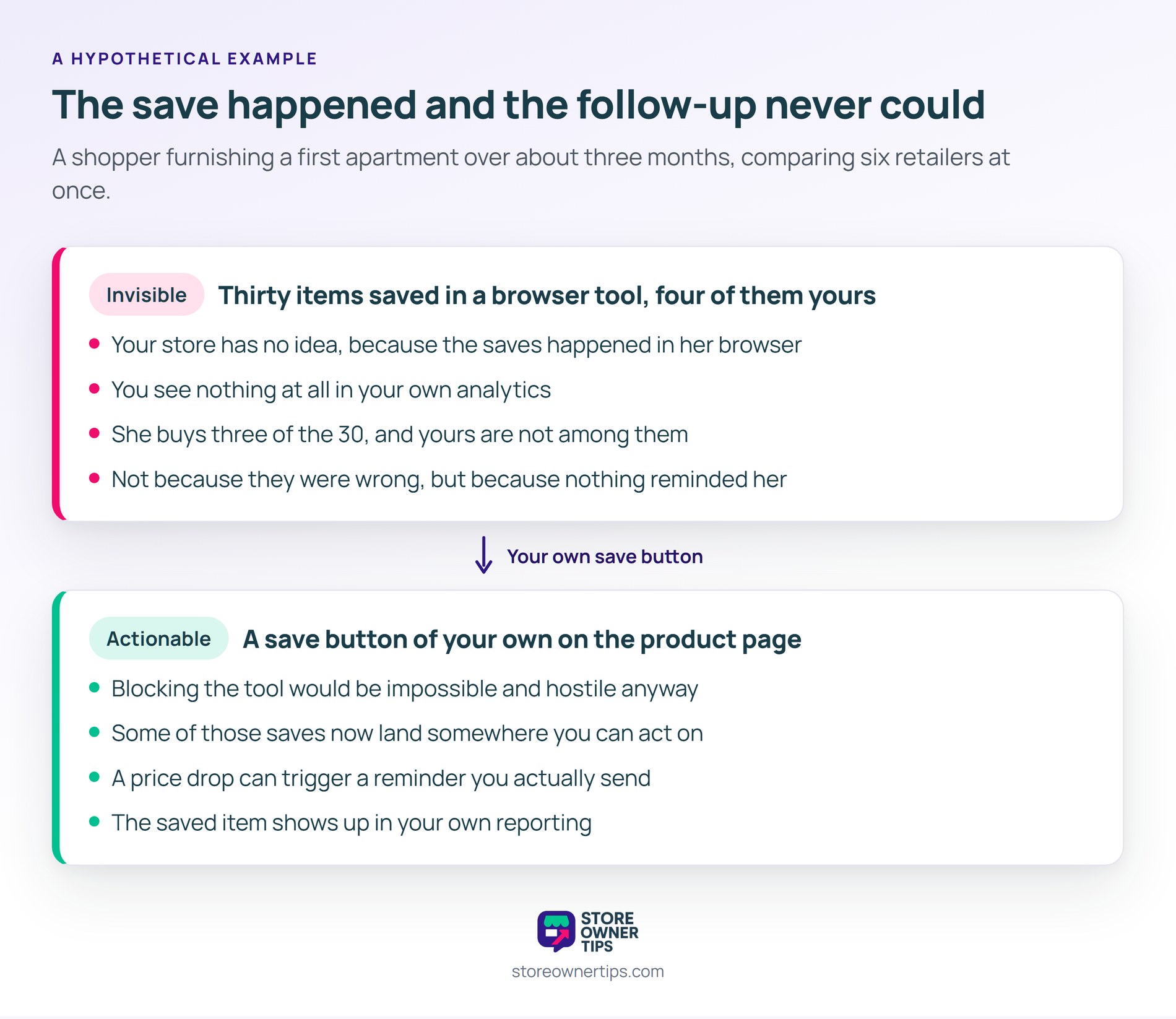
She compares across six retailers at once, from a large marketplace to two independent homeware stores. First she installs a browser tool that saves anything from anywhere. Then she adds 30 items to one list over several weeks.
Notably, four of those items are yours. Your store has no idea, because the saves happened in her browser rather than on your site. Consequently you see nothing at all in your own analytics.
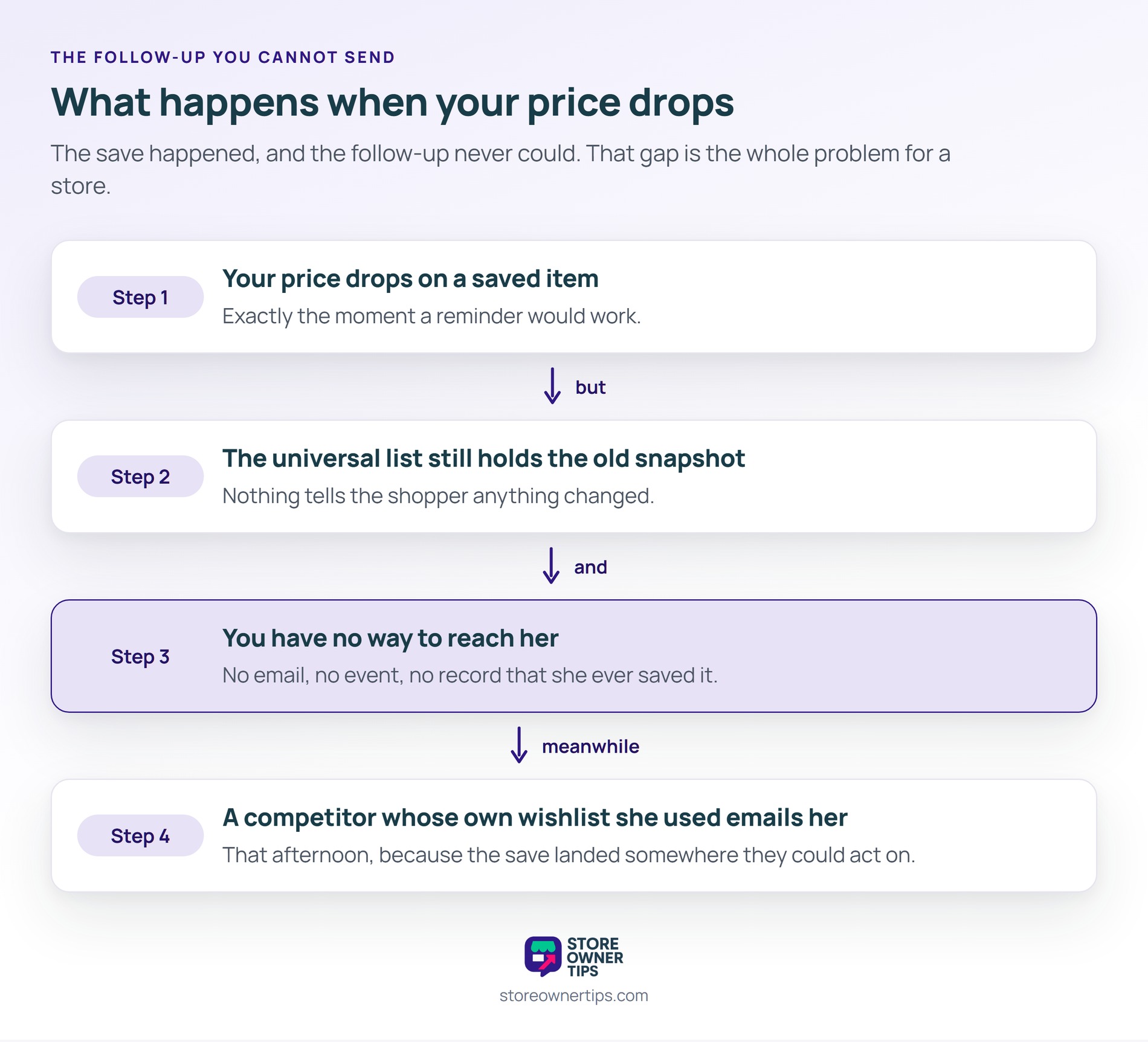
Then, when one of your four items drops in price, nothing happens. The universal list holds an old snapshot, and you have no way to reach her. Meanwhile a competitor whose own wishlist she also used can email her that afternoon.
Eventually she buys three of the 30 items. Yours are not among them, not because they were wrong, but because nothing reminded her. In short, the save happened and the follow-up never could.
Notably, the fix is not blocking the tool, which would be impossible and hostile anyway. Instead, offer a save button of your own on the product page. Then at least some of those 30 saves land somewhere you can act on.
| What you’re comparing | Universal wishlist | Store wishlist |
|---|---|---|
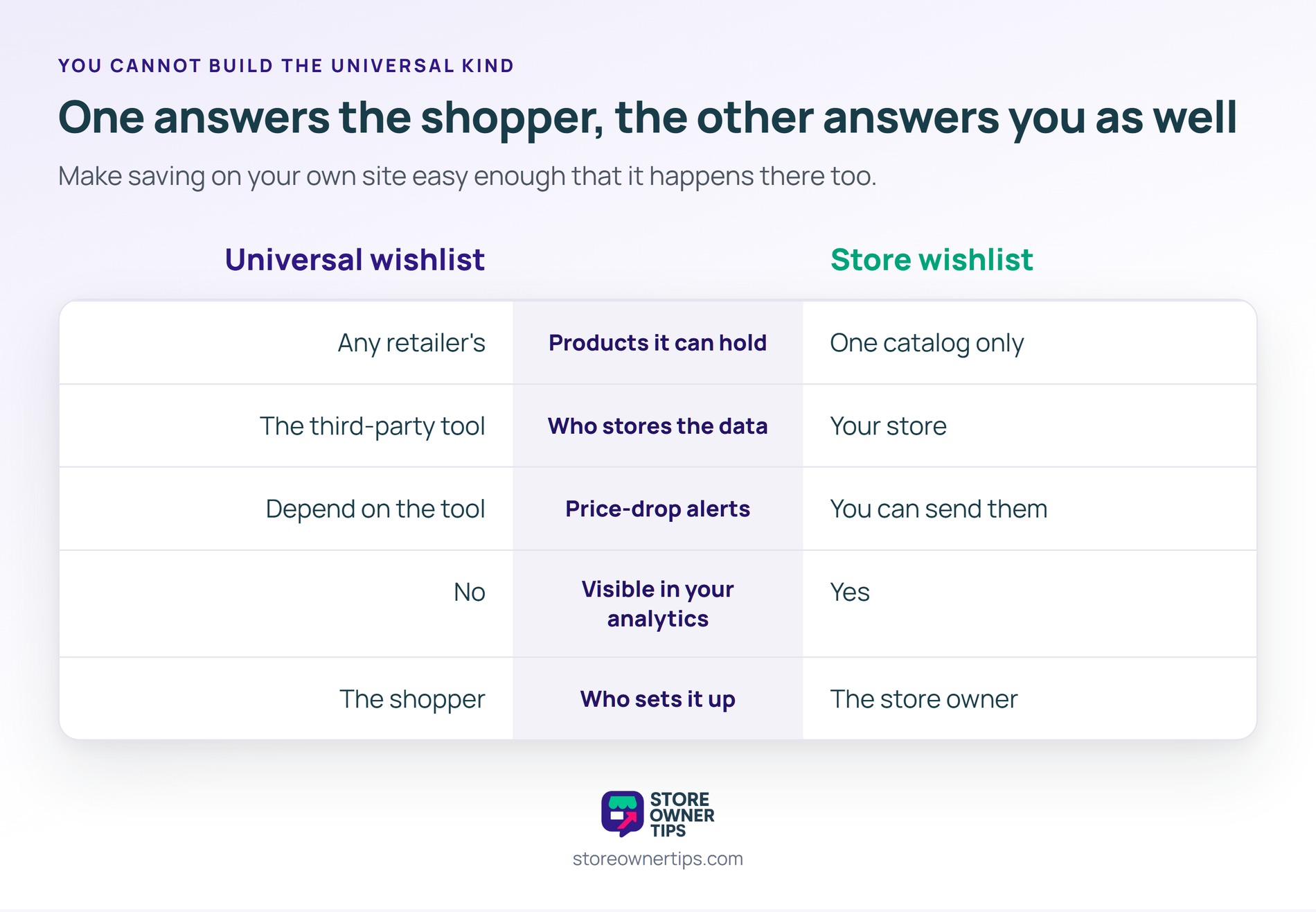
| Products it can hold | Any retailer’s | One catalog only |
| Who stores the data | The third-party tool | Your store |
| Price-drop alerts | Depend on the tool | You can send them |
| Visible in your analytics | No | Yes |
| Who sets it up | The shopper | The store owner |
A universal wishlist and a store wishlist answer one shopper need from opposite sides. Still, you cannot build the universal kind, and you should not try. What you can do is make saving on your own site easy enough that it happens there too.
Not really, and it would not help you even if you could. A universal wishlist has to sit outside any single retailer to work across all of them. What you can build is a strong wishlist for your own catalog, which is the part you actually benefit from.
No. Because the save happens outside your site, nothing is recorded. Later visits from a saved link usually arrive looking like direct or referral traffic. Consequently you cannot separate them from ordinary returning visitors.
No. Instead, save for later means moving an item out of the cart within one store. A universal wishlist spans many stores and never touches your cart at all. The intent is similar, but the mechanics and the ownership are not.
A universal wishlist matters because it shows where saving happens when you do not offer it. Shoppers will bookmark your products regardless, just somewhere you cannot see or act on.
Ultimately, the term is most useful as a contrast. It defines what your own wishlist gets you that a third-party list never will. That gap is the signal to act on.
Copyright © StoreOwnerTips.com. All Rights Reserved.
