Weekly ecommerce tips, deals & news.
Ticket deflection is the share of support questions that get answered without a human agent. A help center article, a search widget or a chatbot resolves the question first. So the customer gets their answer, and nobody opens a ticket. It is tracked as a percentage of total contacts.
Ticket deflection works by putting the answer in front of the customer before they reach your contact form. First the system recognizes what is being asked. Then it returns that specific answer rather than a list of links.
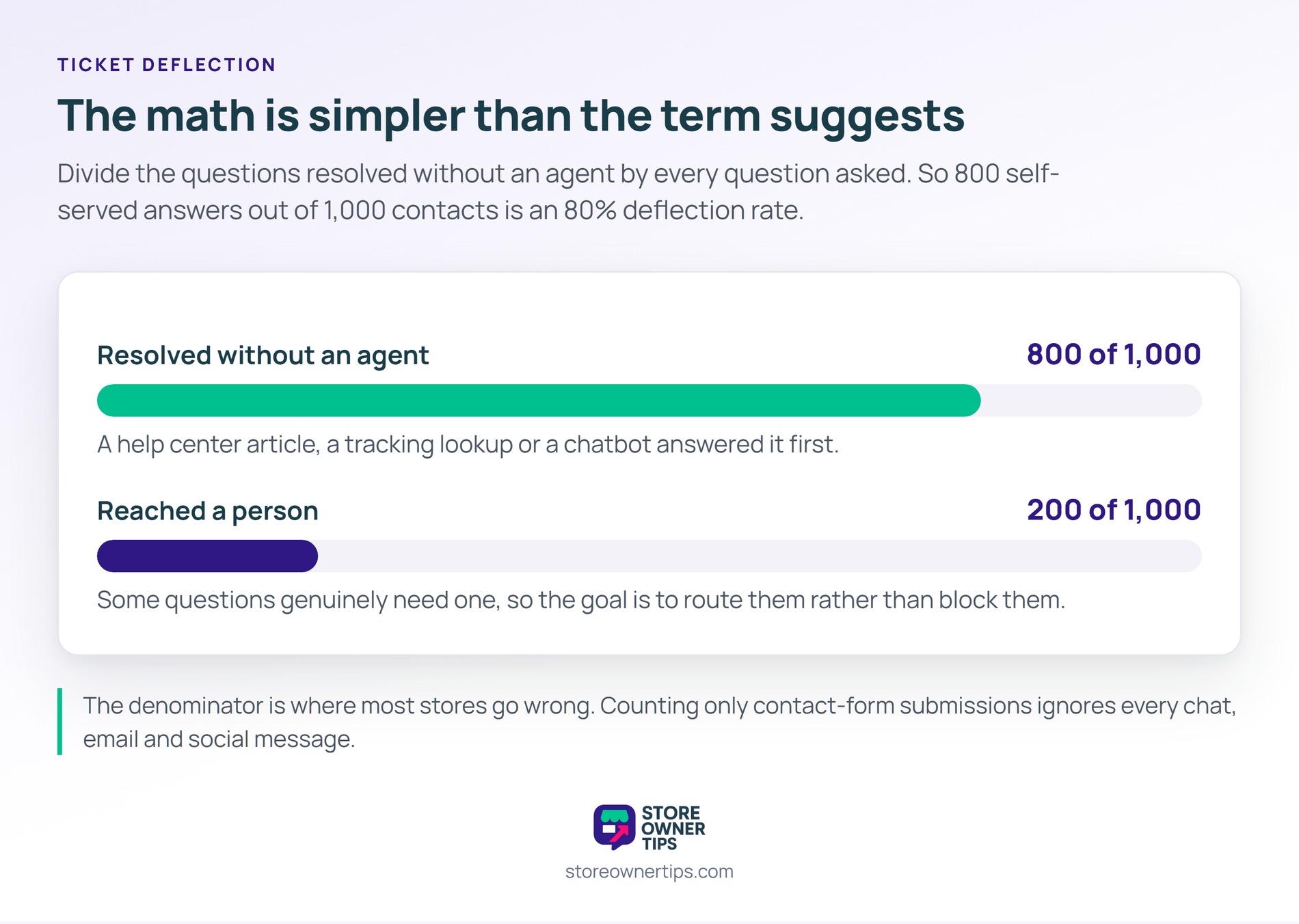
The math is simpler than the term suggests. Divide the questions resolved without an agent by every question asked. So 800 self-served answers out of 1,000 contacts is an 80% deflection rate.
Also, the denominator is where most stores go wrong. Counting only contact-form submissions ignores every chat, email and social message. In practice, the honest denominator is every inbound question, whichever door it came through.
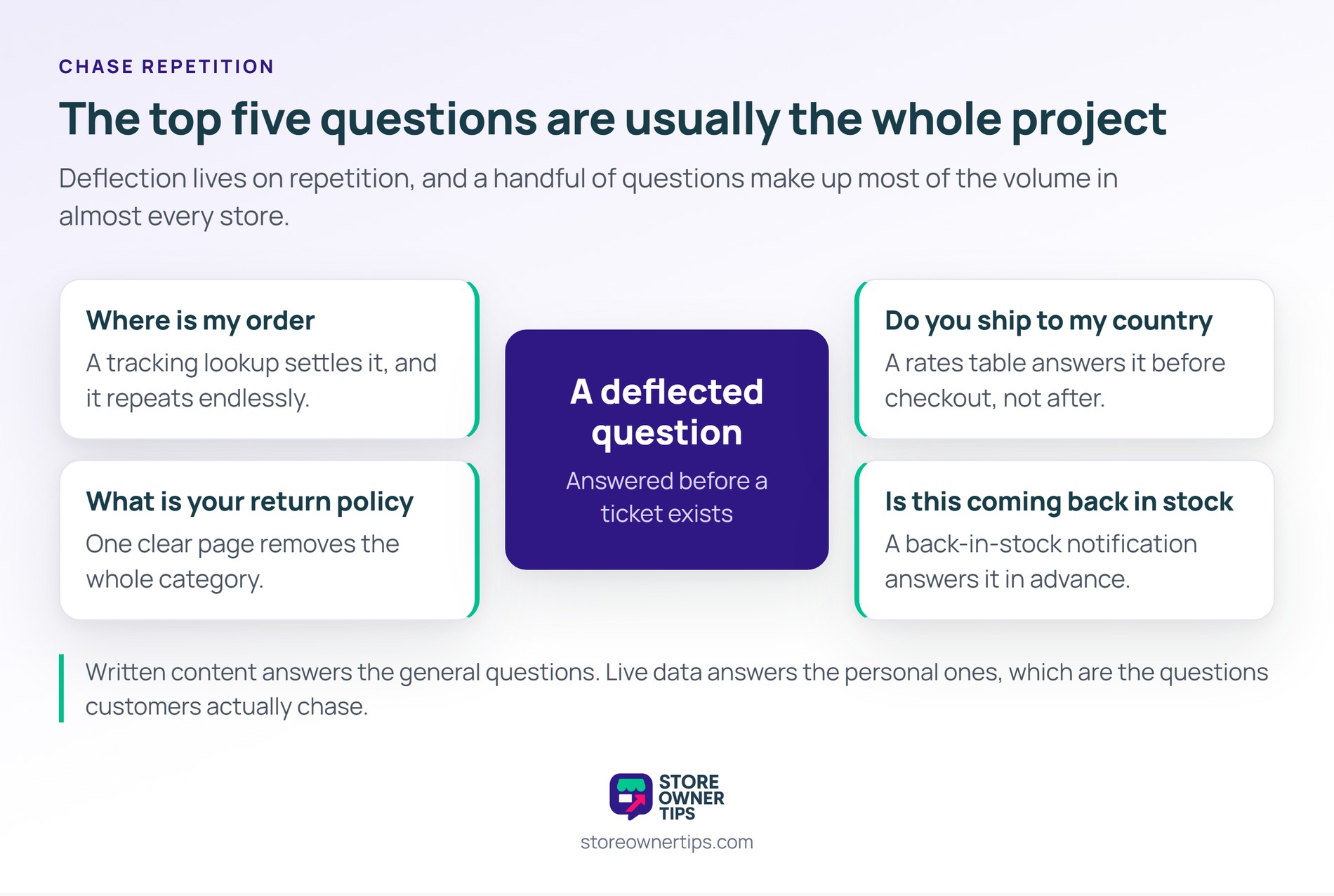
Deflection lives on repetition. A handful of questions make up most of the volume in almost every store.
Consequently the top five questions are usually the whole project. In short, chase repetition rather than coverage.
A deflection layer is only as good as what it can read. Two very different sources feed it, and most stores have one without the other.
In practice, written content answers the general questions. Live data answers the personal ones, which are the questions customers actually chase. A layer with only the first can recite your returns policy but never say where an order is.
A perfect deflection rate would mean nobody ever reached you. That is not a support strategy. Some questions genuinely need a person, so the goal is to route them rather than block them.
Also, a deflected question can still be a failed one. An AI hallucination that sounds confident closes the ticket and loses the sale. Therefore measure satisfaction alongside the rate.
StoreAgent walks through the same trade-off in its guide to running a chatbot for customer support. Its point is that resolving beats deflecting, and escalation is part of the design.
Published figures put the ceiling higher than most store owners expect. StoreAgent’s own analysis of WooCommerce stores reports 70-85% deflection for tools that read real order and product data.
Klarna’s public numbers show what that looks like at scale. Its AI assistant handled 2.3 million conversations in one month, two-thirds of all its support chats. Meanwhile resolution time fell from 11 minutes to under two.
Adoption on smaller stores is still early, though. StoreAgent, our own WooCommerce support chatbot, reports 500+ active installations. So the practice is proven while the tooling is young.
Still, none of these figures is a promise for a given store. Your mix of questions sets the ceiling more than the tool does. A store with 30 unique problems a day has less to deflect.
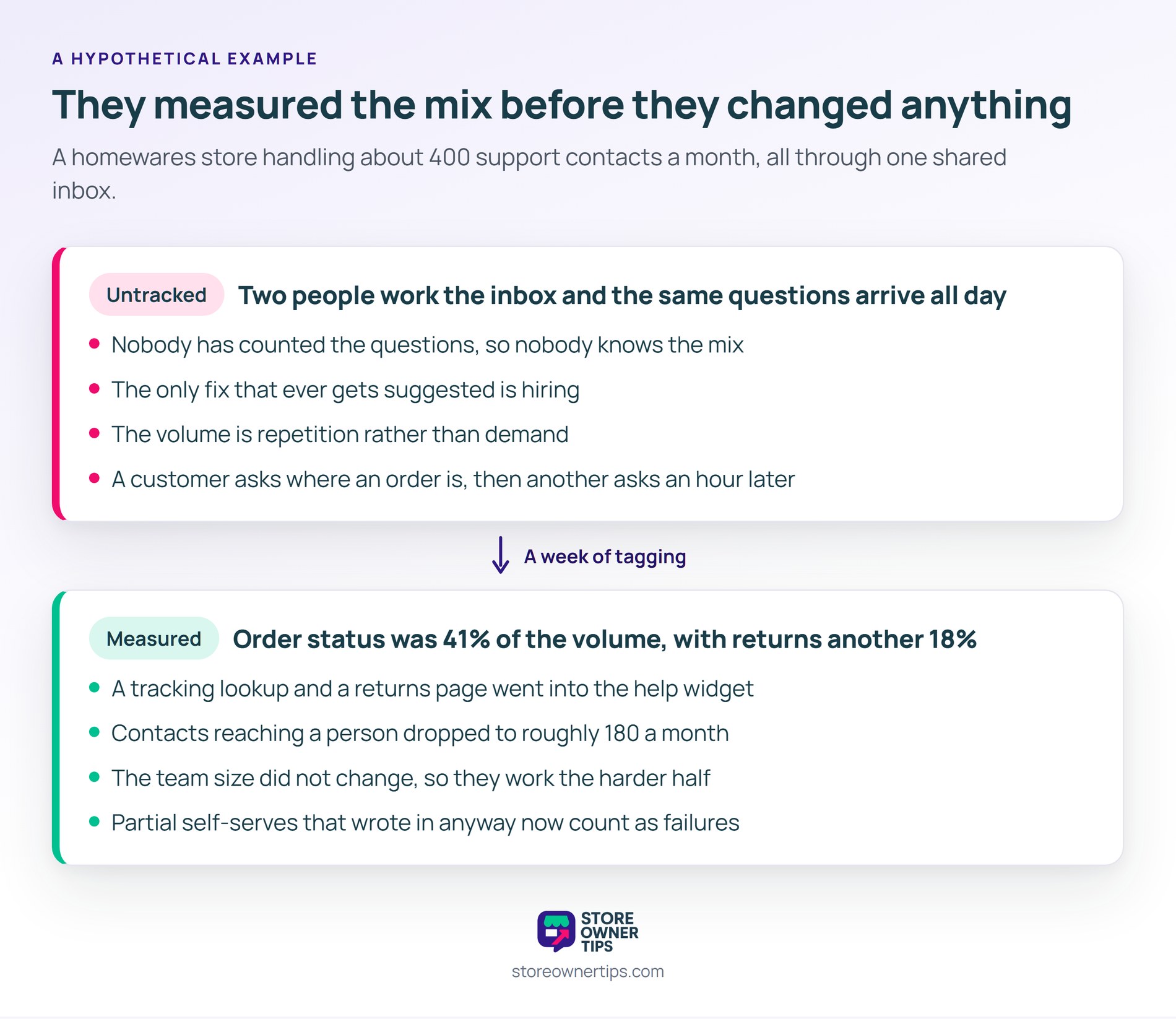
Here’s a hypothetical example. So picture a homewares store handling about 400 support contacts a month, all through one shared inbox.
Two people work the inbox, and the same questions arrive all day. First a customer asks where an order is. Then somebody else asks the same thing an hour later.
Nobody has counted the questions, so nobody knows the mix. Consequently the only fix that ever gets suggested is hiring. In practice the volume is repetition rather than demand.
They spend a week tagging every contact by question type. Order status turns out to be 41% of the volume, with returns another 18%.
So they wire a tracking lookup and a returns page into the help widget. Then those two categories start answering themselves. Meanwhile the inbox still catches everything else.
Contacts reaching a person drop to roughly 180 a month. Still, the team size does not change. Instead those two people spend the day on the harder half.
Also, the rate flattered them at first. Some customers self-served, got a partial answer, then wrote in anyway. Therefore they started counting those as failures rather than deflections.
That correction knocked several points off the reported rate. Even so, the honest number was the one worth having. Because a rate you trust is a rate you can act on.
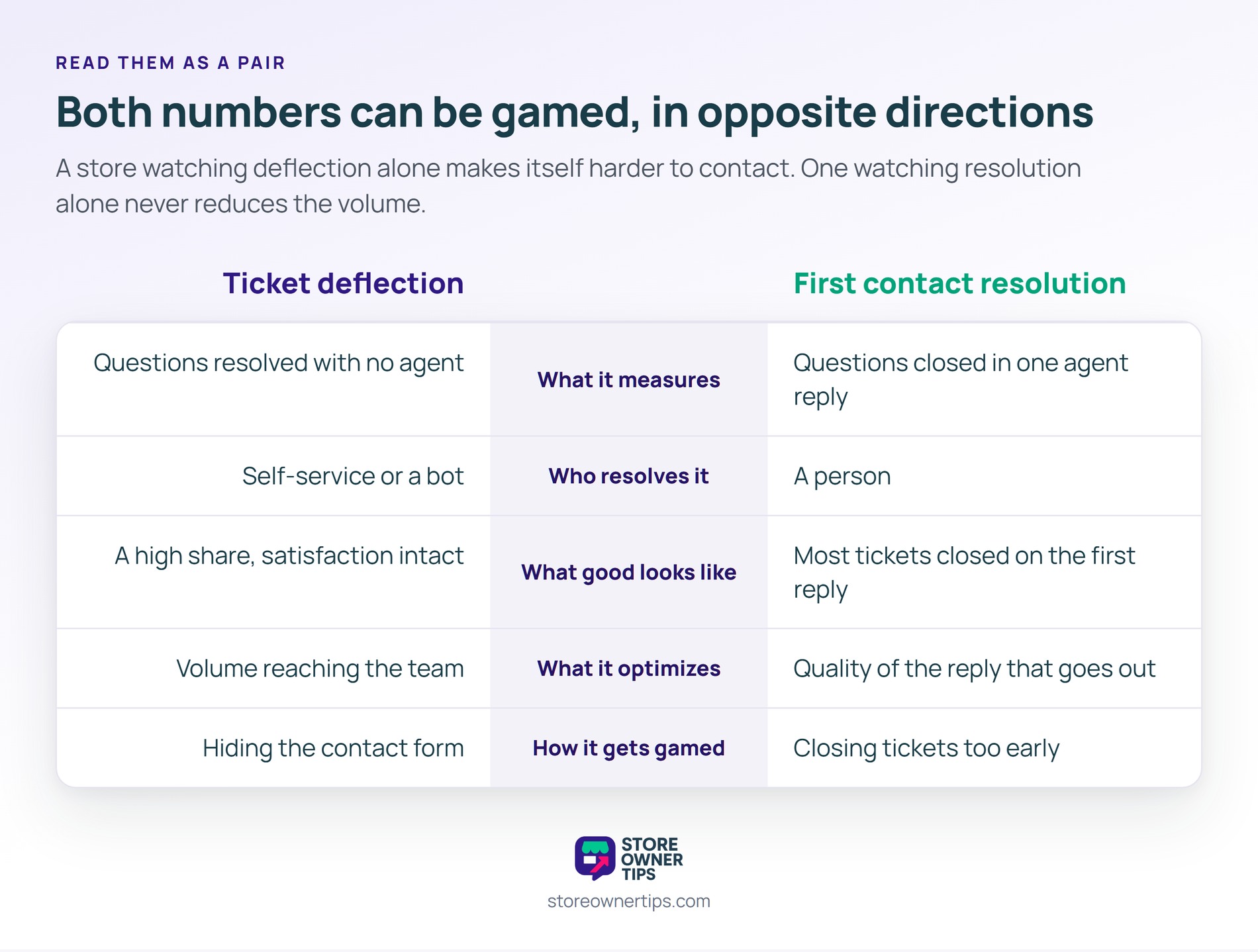
| What you’re comparing | Ticket deflection | First contact resolution |
|---|---|---|
| What it measures | Questions resolved with no agent | Questions closed in one agent reply |
| Who resolves it | Self-service or a bot | A person |
| What good looks like | A high share, satisfaction intact | Most tickets closed on the first reply |
| What it optimizes | Volume reaching the team | Quality of the reply that goes out |
| How it gets gamed | Hiding the contact form | Closing tickets too early |
Both numbers can be gamed in opposite directions, which is why support teams read them as a pair. Deflection rewards keeping questions away from the team, while first contact resolution rewards answering them properly. So one on its own tells you very little.
A store watching deflection alone slowly makes itself harder to contact. A store watching resolution alone never reduces the volume arriving. Reading both keeps each one honest, and the gap between them is usually where the real problem sits.
It depends on how repetitive your questions are, so treat published figures as a range rather than a target. Stores with heavy order-status volume sit at the higher end. Still, a lower rate with satisfied customers beats a higher one with confused ones.
No, and that version is worth avoiding. Burying the form lowers your ticket count while raising frustration, refunds and bad reviews. Real deflection answers the question first, then makes reaching a person easy for whatever it could not solve.
No. A clear returns page and an order-tracking lookup deflect plenty on their own. AI earns its place when the same question arrives phrased a hundred different ways. Matching intent is the part a static page cannot do.
Ticket deflection matters because support volume grows with sales, while support headcount usually does not. Every repeated question you answer once is one your team stops answering weekly. So the metric is really about where your people spend their attention.
Meanwhile customers get their answer sooner than any inbox could manage. In practice that speed is the part they actually notice.
Copyright © StoreOwnerTips.com. All Rights Reserved.
