Weekly ecommerce tips, deals & news.
Add-to-Cart Rate is the share of visits where a shopper adds at least one item to their cart. You divide the number of sessions with an add-to-cart action by your total sessions, then multiply by 100. It shows how well your product pages turn browsers into interested buyers. A higher rate means more people are reaching for the “buy” stage.
Picture a physical shop where people walk in, browse, and pick items off the shelf. The add-to-cart rate is the share of visitors who actually grab something. They have not paid yet, but they are clearly interested. That single action is a strong signal of intent.
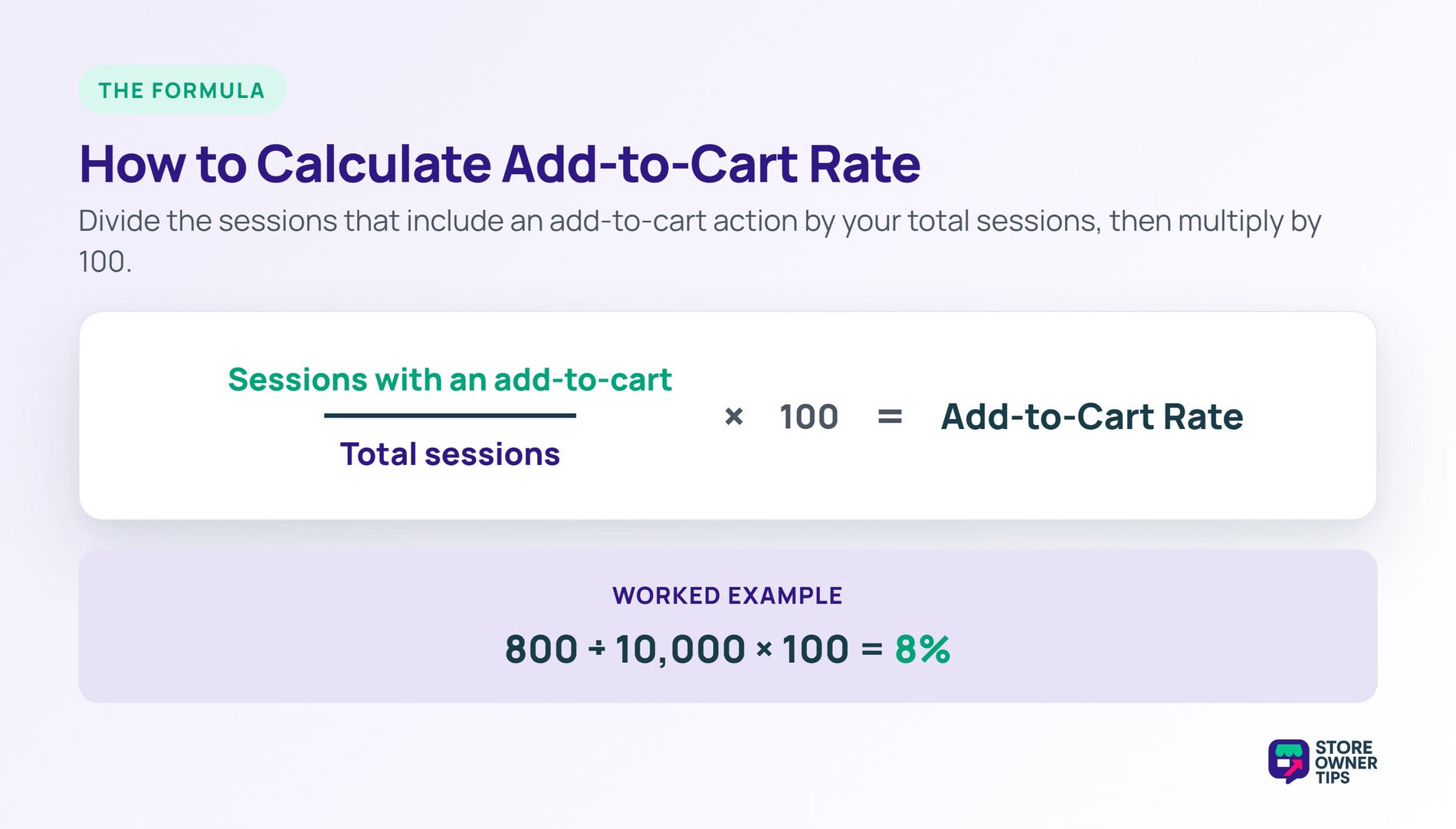
The formula is simple and quick. You divide the number of sessions that include an add-to-cart action by your total sessions. Then you multiply by 100 to get a percentage. So 800 add-to-cart sessions out of 10,000 visits is an 8% add-to-cart rate.
Most analytics tools track this for you out of the box. On WooCommerce or Shopify, it usually appears in your store reports. The exact “good” number varies a lot by industry and price point. As always, the smartest move is to track your own trend over time.
One detail trips people up: sessions versus visitors. A single visitor can return in several sessions before buying. Most tools measure the rate by session, so stay consistent. Pick one method and use it every time you compare results.
Think of the shopping journey as a funnel with three big steps. First people browse, then they add to cart, and finally they check out. Add-to-cart rate measures that crucial middle step. It tells you whether your product pages are doing their job.
This makes it a powerful early warning system. A low rate points to a problem on the product page itself. Maybe the photos are weak, the price feels off, or trust is missing. Fixing those issues lifts the rate before shoppers ever reach checkout.
Not every add-to-cart is a carefully planned decision. Some are an impulse purchase sparked by a great photo or deal. Smart product pages gently encourage these in-the-moment clicks. A “frequently bought together” nudge is a classic example.
These impulse adds can lift your average order value too. A shopper who adds one item may grab a small extra. So a healthy add-to-cart rate often pairs with bigger baskets. Both effects feed the same bottom line.
The trick is to suggest, not pressure, so the extra feels like a favor.
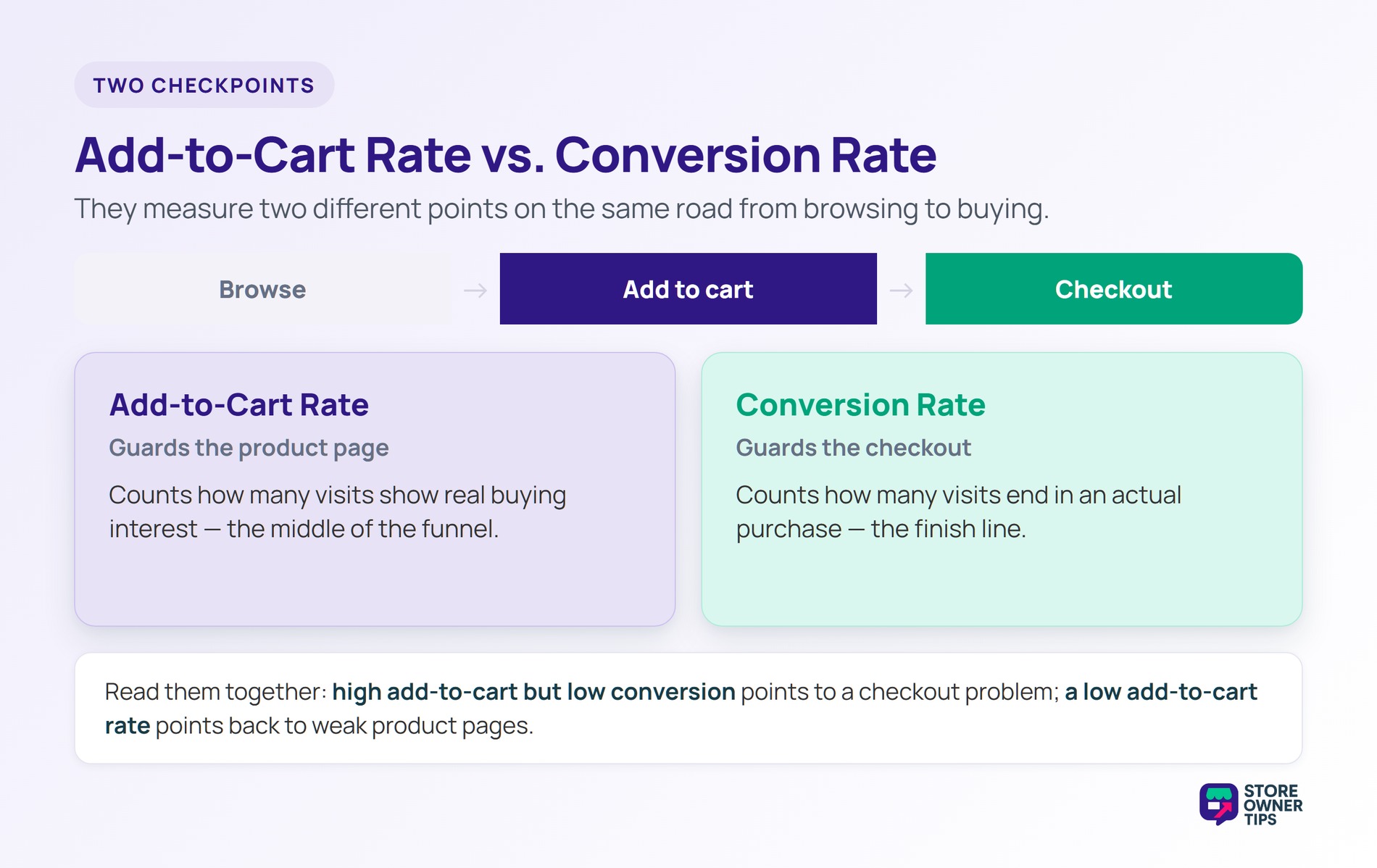
Trust is the biggest lever on any product page. Purchase likelihood for a product with five reviews is 270% greater than for one with none. Clear photos, honest descriptions, and visible pricing also help a lot. Together, these remove the doubts that stop a click.
Some shoppers want to buy later, not right now. Giving them a way to save items keeps that interest alive. A wishlist can lift conversion by capturing intent that a cart would lose. So a save button works alongside add-to-cart, not against it.
A few proven tactics tend to lift the rate fastest:
A full cart is a promise, not a payment. Plenty of shoppers add items and then vanish before checkout. Cart abandonment averages 70.22% across e-commerce. So a great add-to-cart rate can still hide a leaky checkout.
That is why this metric is a starting point, not the whole story. It tells you the product page is working. The next job is making sure those carts survive the trip to payment. Both steps matter for turning interest into revenue.
The most common slip is judging the rate without context. A 5% rate may be great for furniture but weak for snacks. Another mistake is ignoring it entirely while chasing more traffic. You can waste a lot of ad spend feeding a weak product page.
A third trap is treating add-to-cart as the win itself. It is only the halfway mark in the buying journey. Celebrate it, but keep your eye on the final sale. Otherwise a rising rate can give a false sense of success.
Imagine a mid-sized brand called Lumen Candle Co that sells scented candles on WooCommerce. They get healthy traffic but soft sales. So they start tracking add-to-cart rate to find the leak.
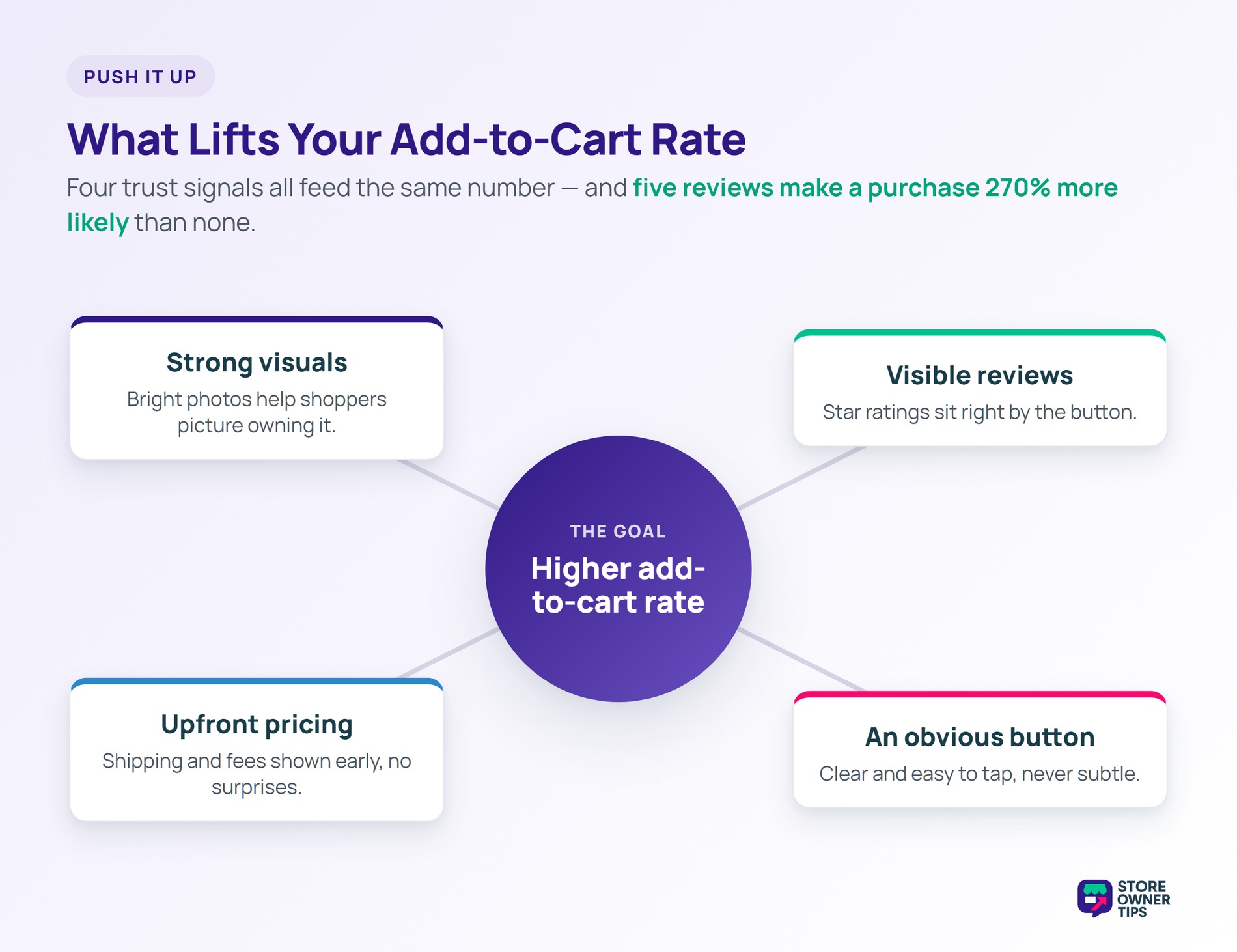
Lumen gets 15,000 visits a month but only 600 add-to-cart sessions. That works out to a 4% add-to-cart rate. The team digs in and finds thin product pages. The photos are dim, and there are almost no reviews.
They reshoot the candles in bright, lifestyle photos. They also add a simple review request to every post-purchase email. Then they display star ratings right next to the add-to-cart button. Each change builds a little more trust at the key moment.
They even add a short scent guide to answer the most common question.
Within a few months, the add-to-cart rate climbs from 4% to 7%. That means roughly 450 more carts started every month. Even after some drop off, the extra carts turn into real sales. Best of all, traffic stayed flat, so the gain was pure efficiency.
The same visitors simply found more reasons to say yes.
Lumen did not buy a single extra visitor to get this lift. They simply gave the visitors they had a reason to trust. Brighter photos helped shoppers imagine the candle in their home. Real reviews then erased the last bit of doubt before the click.
The star ratings beside the button did the heaviest lifting. Seeing that others were happy made the choice feel safe. So more browsers became cart-builders at the exact deciding moment. That is the quiet power of a stronger product page.
None of it cost more than a weekend of focused effort.
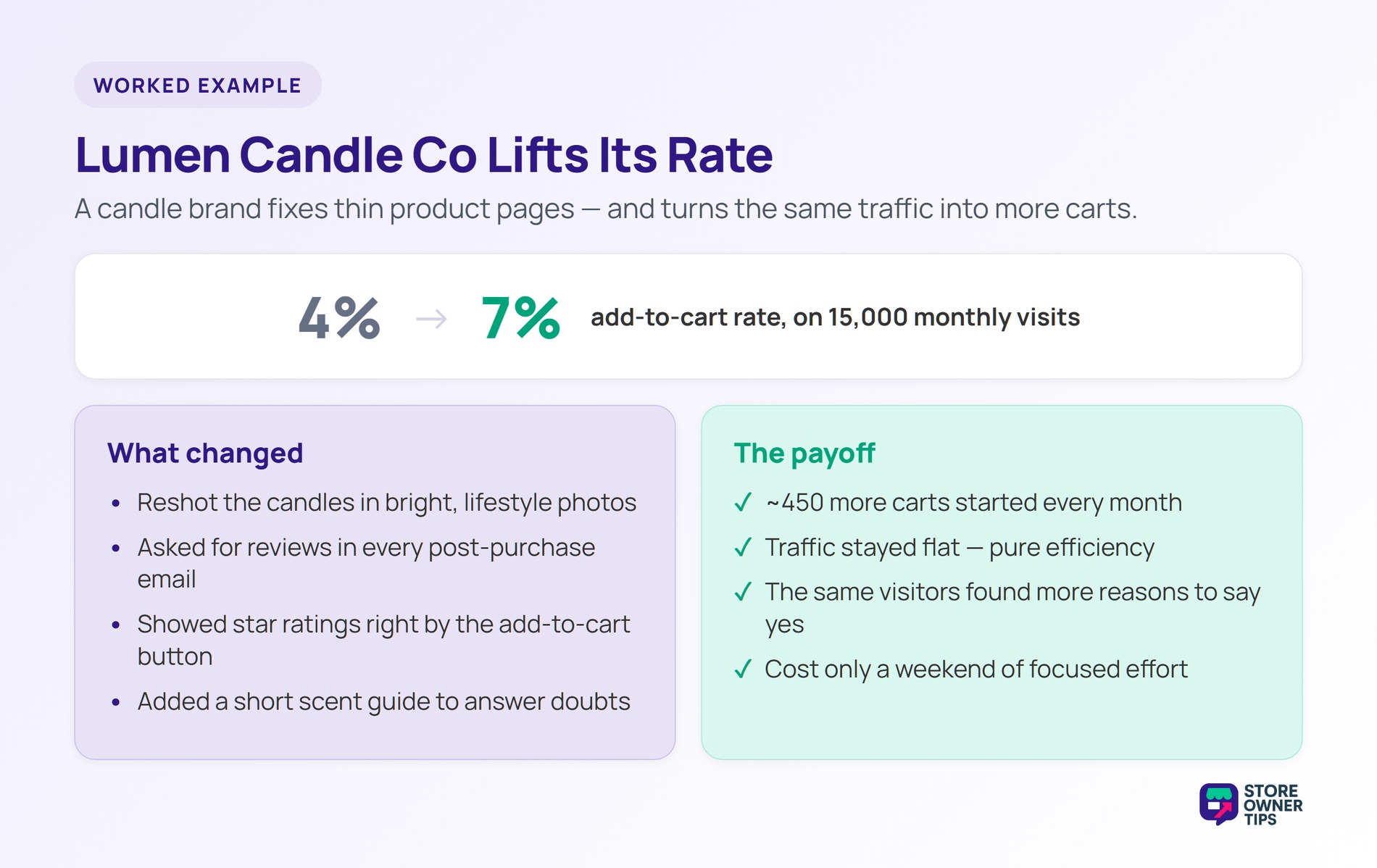
These two metrics measure different points in the journey. Add-to-cart rate counts how many visits show buying interest. Conversion rate counts how many visits end in an actual purchase. One is the middle of the funnel, the other is the finish line.
Comparing them reveals exactly where you are losing people. A high add-to-cart rate with a low conversion rate points to checkout problems. A low add-to-cart rate points back to weak product pages instead. Watching both numbers tells you which fix matters most right now.
Think of them as two checkpoints on the same road. Add-to-cart rate guards the product page, and conversion rate guards the checkout. If both are healthy, your funnel is in good shape. If one dips, you know exactly which stage needs your attention.
It varies widely by industry, traffic source, and price point. Many stores land somewhere in the mid-single digits to low double digits. Rather than chase a benchmark, focus on improving your own number. A steady climb is the real sign of healthier product pages.
Cheaper, everyday items usually see higher rates than big, considered purchases.
This usually means your checkout is leaking sales. Plenty of shoppers add items, then bail when they see the total. In fact, 48% of shoppers abandon carts over high extra costs. Showing shipping early and simplifying checkout will help close that gap.
It also helps to offer guest checkout and a few trusted payment options.
Strengthen your product pages first, since that is where the action happens. Add clear photos, honest details, reviews, and upfront pricing. Make the add-to-cart button easy to spot and tap. Then offer a save option for shoppers who are not ready yet.
Test one change at a time so you can see what actually moves the number.
Add-to-cart rate is one of the clearest windows into how well your product pages perform. It catches problems early, long before they show up as lost sales. Track it next to your conversion rate, fix the weak step, and you turn more browsers into buyers without spending a cent more on traffic. Watch it over time, and your product pages keep getting sharper with every test.
Copyright © StoreOwnerTips.com. All Rights Reserved.
