An advent calendar promotion is a holiday campaign that unlocks a new deal or surprise each day of December. Shoppers come back daily to “open the door” and see what’s waiting. For store owners, it turns one busy month into a string of small reasons to visit.
An advent calendar promotion works by hiding a different offer behind each day, then revealing it on schedule. Think of it like a TV series instead of a movie. A movie gives you everything in one sitting, while a series gives you a reason to tune in tomorrow. The daily reveal is the episode, and your store is the channel.
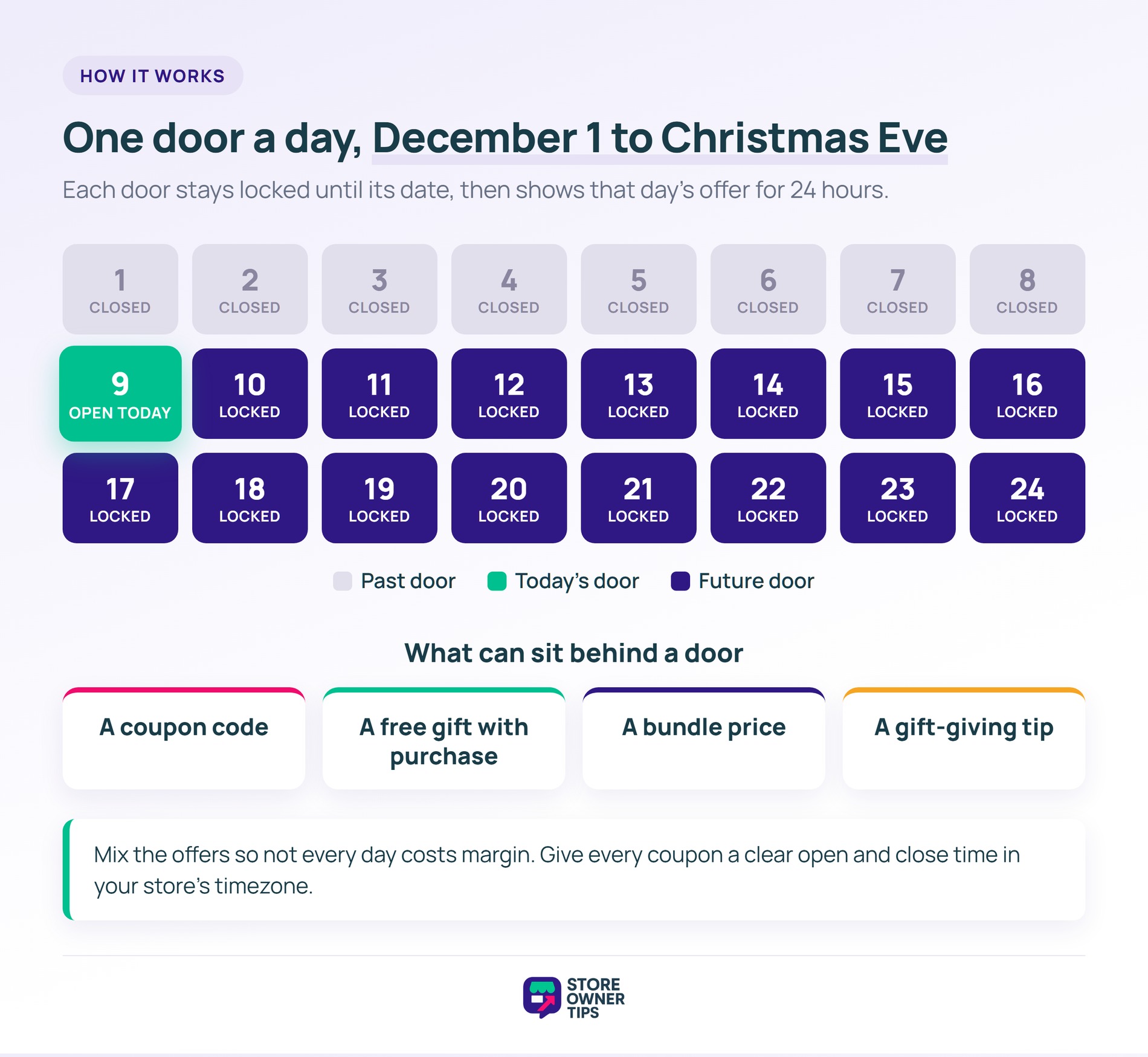
Most advent calendar promotions run on a landing page with a grid of numbered doors, one per day. Each door stays locked until its date, then shows that day’s offer. The offer can be a coupon code, a free gift with purchase, a bundle price or a gift-giving tip. Many stores mix them, so not every day costs margin.
In WooCommerce, the daily offer is usually a coupon. Out of the box, a WooCommerce coupon has an expiry date but no true start date. One workaround is to schedule the coupon itself to publish on its start day. A cleaner route is a coupon tool that lets you schedule each coupon’s start and end date on one screen.
Treat each coupon like a shop’s opening-hours sign. It needs a clear open time and a clear close time, or people arrive to a locked door. Set every coupon to your store’s timezone, then test one door a day early. Also decide whether daily codes can combine, because coupon stacking rules stop one order from using five codes.
An advent calendar promotion pulls shoppers back through curiosity and routine. Nobody knows what tomorrow’s door holds, so checking becomes a small daily habit. That habit keeps your store top of mind while gift buying peaks. A single sale gets one visit and then competes with every other inbox.
On top of that, scarcity does the rest. Each offer lasts only 24 hours, which gives every day its own small deadline. It works like a flash sale broken into bite-size pieces across the month. The difference is the drumbeat, since shoppers expect the next reveal instead of a one-off surprise.
That drumbeat is why many holiday marketing tips suggest a “12 Days of Deals” format. The format is easy to explain, easy to share and easy to remember.
An advent calendar promotion needs a message cadence that matches the reveals without flooding inboxes. A daily email for 24 days is a lot, even for loyal fans. A common pattern is one launch email, a weekly roundup and a daily text only for people who ask. Let subscribers choose “daily” or “weekly” when they join.
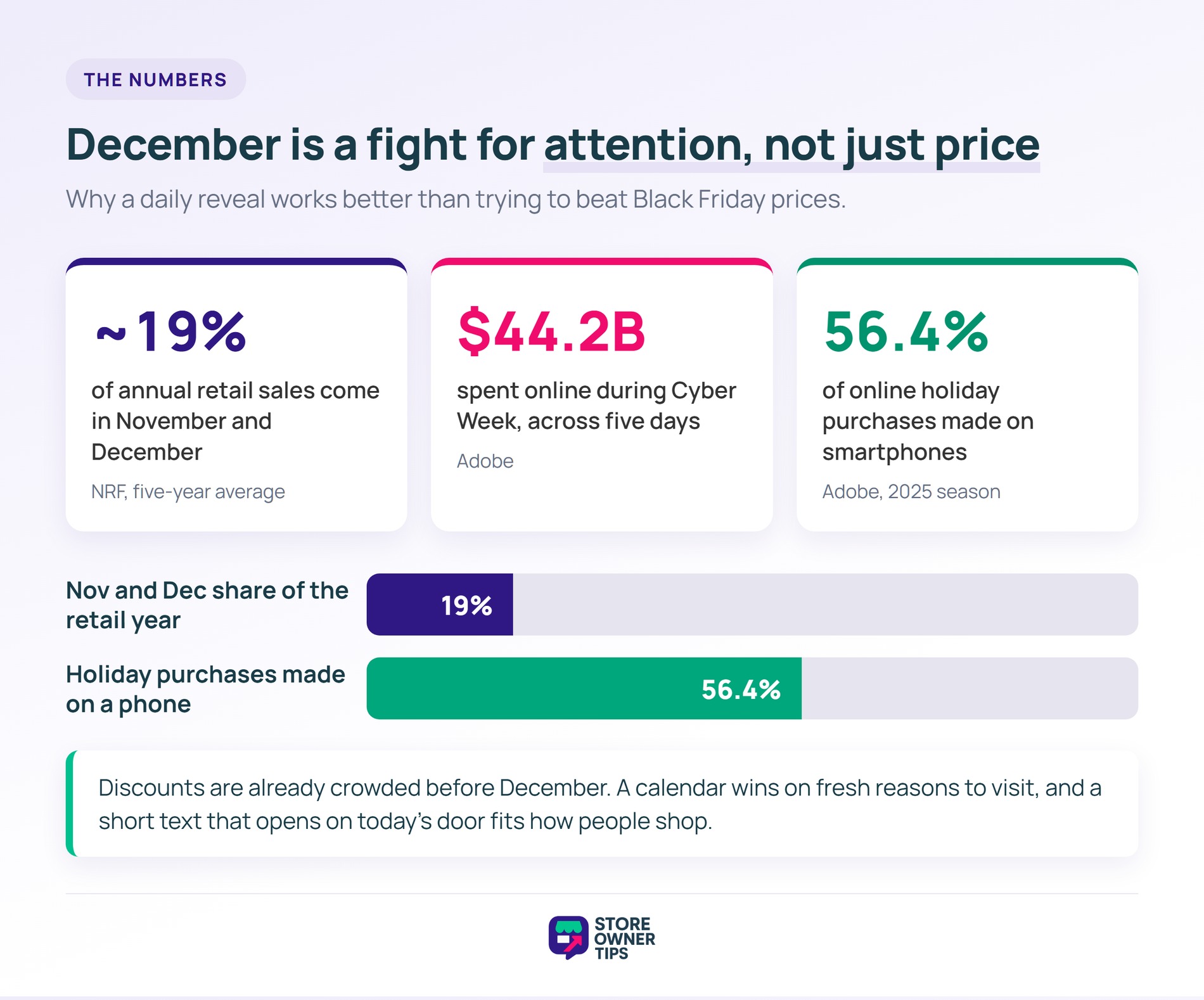
Plus, mobile matters here. Adobe Analytics found 56.4% of online holiday purchases in the 2025 season happened on smartphones. A text that opens straight onto today’s door fits how people already shop. Keep each message short: the door number, the offer and when it ends.
Wishlists can carry part of the load. Christmas wishlist emails can ping shoppers when a saved item goes on sale behind a door. In the US, the CAN-SPAM Act says you must honor opt-outs within 10 business days. Treat an unsubscribe spike as a signal to slow down.
The numbers behind advent calendar promotions show December is a fight for attention, not just price. NRF says November and December sales have averaged about 19% of annual retail sales over five years. NRF also notes that most consumers still finish their holiday shopping in December. That late window is exactly what a daily reveal is built to hold.
Meanwhile, discounting is already crowded before December starts. Adobe reported that Cyber Week alone brought in $44.2 billion online across five days. Adobe also expected discounts to come down from their peaks after Cyber Week. A December campaign rarely wins by beating Black Friday prices, but it can win on fresh reasons to visit.
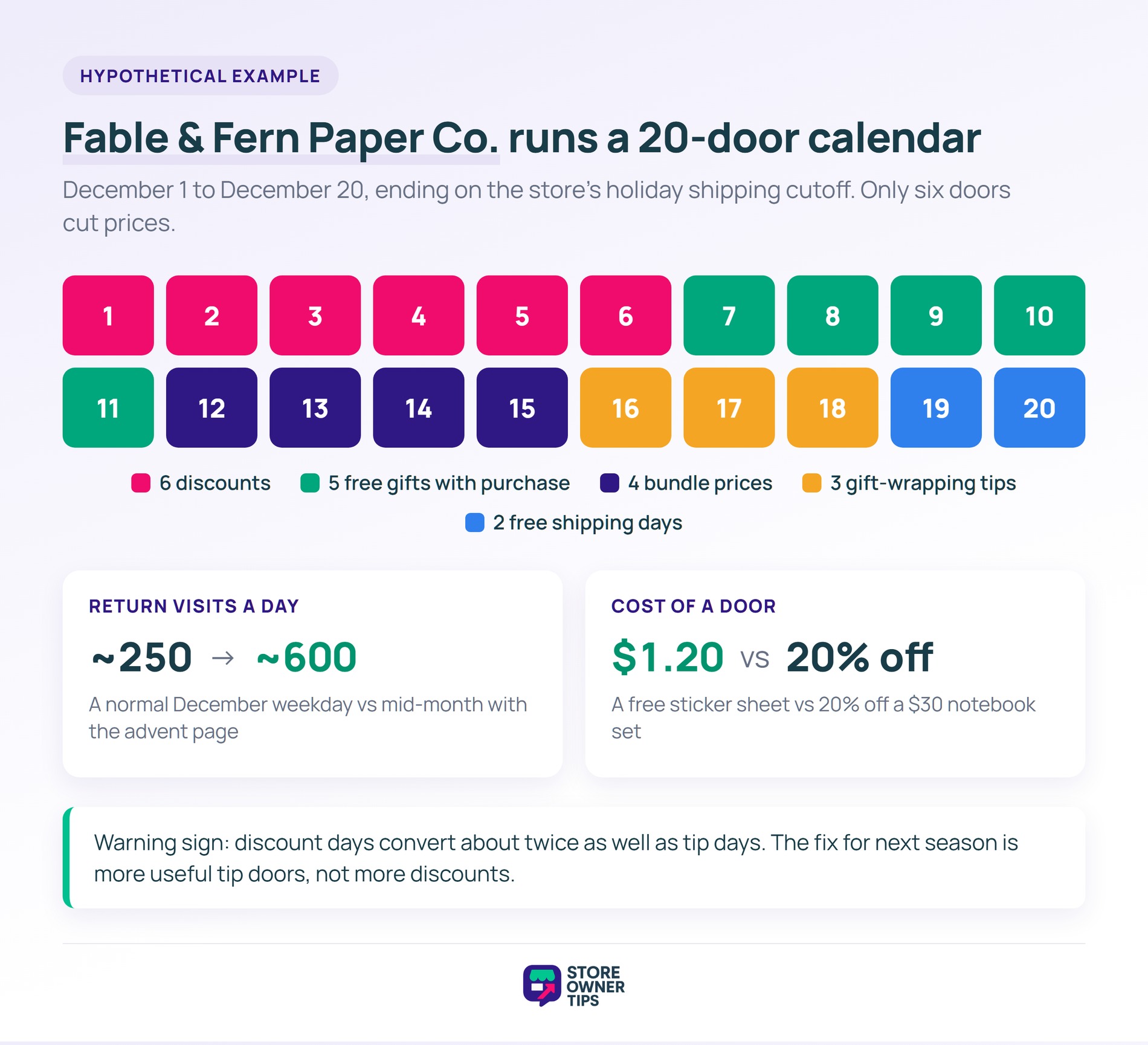
Here’s a hypothetical example. Imagine Fable & Fern Paper Co., a small online shop selling notebooks, wrapping paper and greeting cards. The owner plans a 20-door advent calendar promotion running from December 1 to December 20. It ends early on purpose, because the store’s holiday shipping cutoff falls on December 20.
Only six of the 20 doors are percentage discounts. Five are free gifts with purchase, like a sticker sheet or a set of gift tags. Four are bundle prices, three are gift-wrapping tips and two are free shipping days. Every coupon opens at midnight and closes at 11:59 p.m. store time.
For messaging, Fable & Fern sends one launch email on November 30 and a roundup every Sunday. About 2,000 subscribers also opt in to a daily text. The landing page marks past doors as “missed,” which nudges people to check sooner next time.
By mid-month, the advent page draws around 600 return visits a day. A normal December weekday used to bring about 250. A little over half of those visitors arrive on a phone, mostly from the morning text. The Sunday emails pull in the weekly browsers who don’t want daily alerts.
Margin holds up because only six doors cut prices. A free sticker sheet costs the store about $1.20, far less than 20% off a $30 notebook set. The owner still spots a warning sign. Discount days convert about twice as well as tip days, so shoppers may be learning to skip the free doors.
For next season, the fix is to make the tip doors more useful, not to add more discounts. Fable & Fern plans to swap generic tips for printable gift tags and a free card-writing guide. That keeps the calendar a habit rather than a coupon feed.
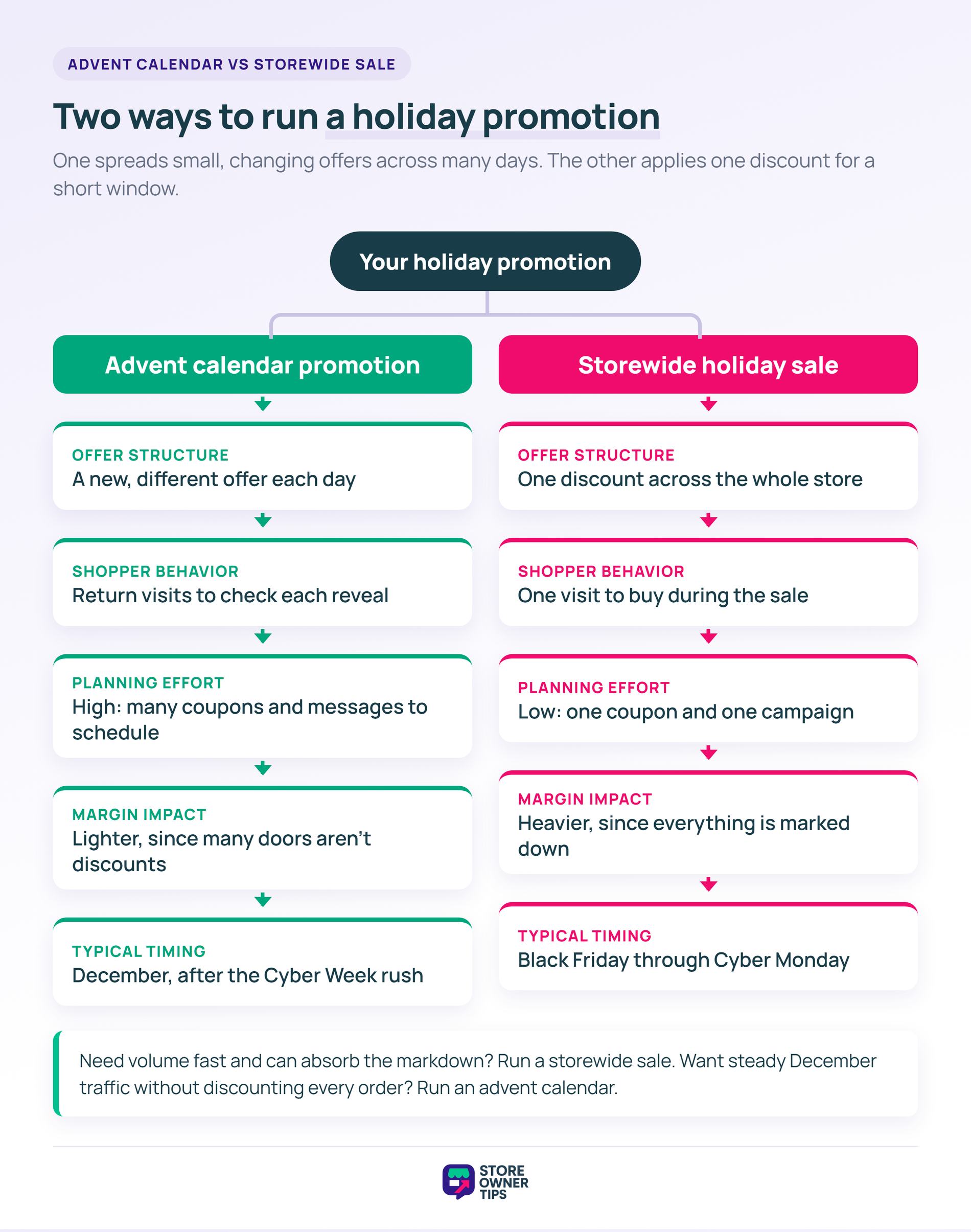
| What you’re comparing | Advent calendar promotion | Storewide holiday sale |
|---|---|---|
| Offer structure | A new, different offer each day | One discount across the whole store |
| Shopper behavior | Return visits to check each reveal | One visit to buy during the sale |
| Planning effort | High: many coupons and messages to schedule | Low: one coupon and one campaign |
| Margin impact | Lighter, since many doors aren’t discounts | Heavier, since everything is marked down |
| Typical timing | December, after the Cyber Week rush | Black Friday through Cyber Monday |
An advent calendar promotion spreads small, changing offers across many days. A storewide holiday sale applies one discount for a short window. Pick a storewide sale when you need volume fast and can absorb the markdown. Pick an advent calendar when you want steady December traffic without discounting every order.
Many stores run both, using these Black Friday marketing strategies for November and a calendar for December.
An advent calendar promotion trades extra setup work for steady daily traffic and tighter margin control.
Most advent calendar promotions run for 12 or 24 days, starting December 1. A 12-day version is easier to staff and fill with strong offers. Whatever length you pick, end the physical-product doors before your last reliable shipping date. After that, switch the remaining doors to gift cards, digital products or local pickup.
No, and most stores shouldn’t discount every day of an advent calendar promotion. Instead, mix in free gifts, bundles, free shipping, early access or useful tips. Fewer discount days protect margin and lower the risk of training shoppers to wait. For more door ideas, see these Christmas promotion ideas, including a 12 days of Christmas sale.
A launch email plus one roundup a week suits most lists during an advent calendar promotion. Offer a daily option, such as a text alert, only to people who choose it. Then watch your unsubscribe rate after each send. If it climbs, cut back to weekly emails for everyone except daily opt-ins.
An advent calendar promotion matters because it turns December’s crowded attention into a daily habit that points at your store. It keeps you visible after Cyber Week without slashing prices every day. Run it with restraint, and it builds an engaged audience you can reach again next season.
Copyright © StoreOwnerTips.com. All Rights Reserved.
