Black Friday Cyber Monday (BFCM) is the five-day shopping window that runs from Thanksgiving Day through the following Monday. It’s often called Cyber Week, and it’s the busiest stretch of the year for online stores. For WooCommerce store owners, BFCM brings the year’s biggest traffic spikes, order surges, and discount pressure.
BFCM works as a fixed, calendar-driven sales event that nearly every retailer joins at the same time. Thanksgiving falls on the fourth Thursday of November in the US. Black Friday is the next day, and Cyber Monday closes the window three days after that.
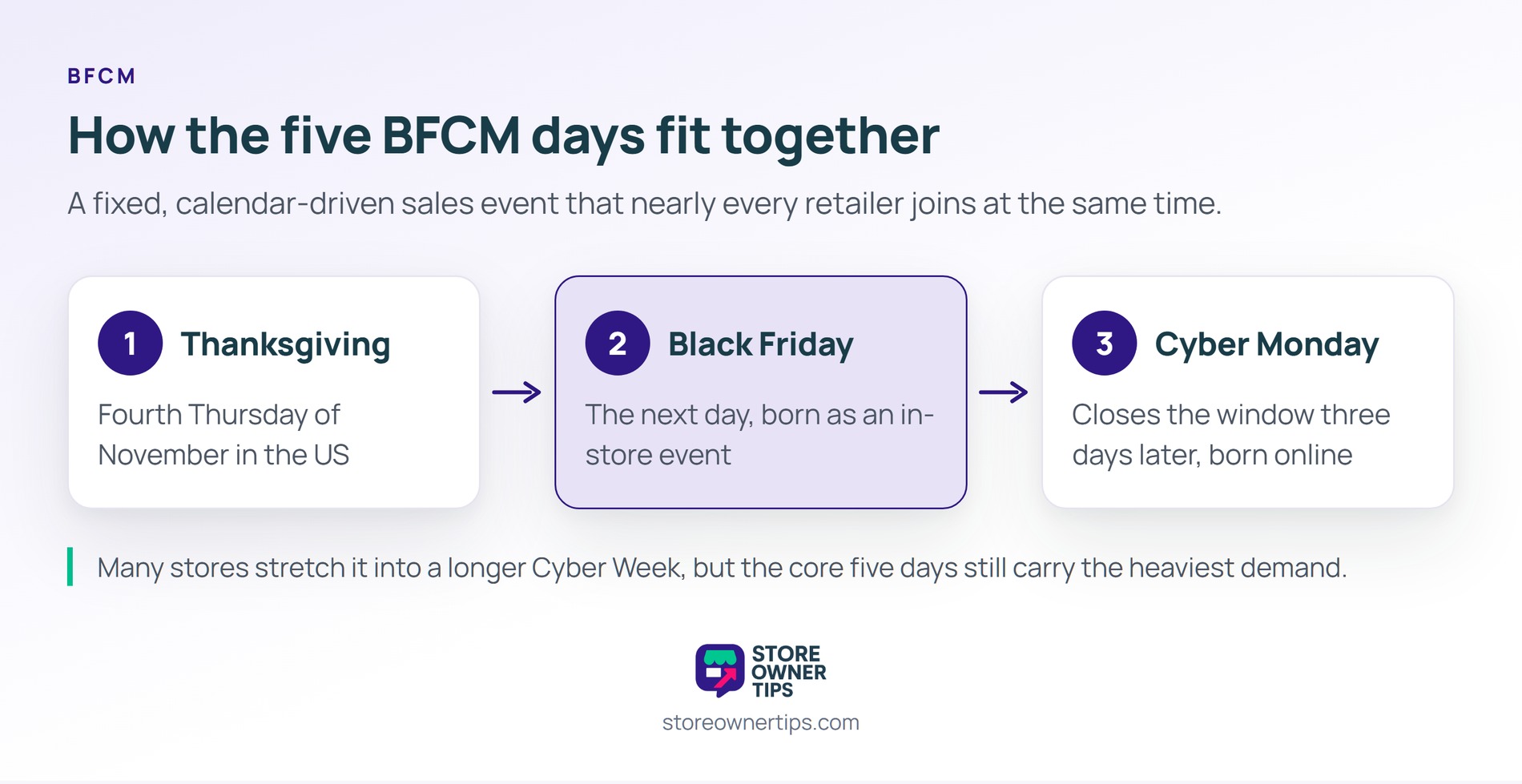
Each BFCM day has its own history. Black Friday started as an in-store event, with early openings and limited stock. Cyber Monday began as the online answer, when shoppers went back to work and browsed from their desks. Today, both days run heavily online, and the line between them has blurred.
Many stores now stretch the event into a longer Cyber Week or even a month of offers. Some layer hourly flash sales on top of a sitewide discount to keep shoppers coming back. Others give email subscribers an early look before Thanksgiving. Either way, the core five days still carry the heaviest demand.
BFCM has also spread well beyond the US. Stores in the UK, Canada, Australia, and much of Europe now run the same window. Shoppers there expect the deals even without a Thanksgiving holiday.
BFCM traffic arrives in sharp spikes, not a gentle rise. Think of your store as a coffee shop on a quiet morning. Now imagine three buses of commuters walking in at once. The espresso machine, the till, and the staff all get tested in the same minute.
In WooCommerce, every order triggers database writes, stock updates, payment calls, and emails. A slow host or a heavy plugin can turn that spike into downtime at the worst possible moment. Caching helps product pages load fast. However, cart and checkout pages are personal to each shopper, so they can’t be cached the same way.
Stock is the second pressure point during BFCM. When many shoppers buy the same item at once, a store with loose stock tracking risks overselling. That means cancelled orders, refunds, and unhappy customers during your most visible week.
Payment is the third BFCM pressure point. Every order waits on your payment gateway to approve the card. Running a test order through each payment method before the sale catches setup problems early. It’s far easier to fix a broken gateway in October than on Black Friday morning.
BFCM taps into urgency and social proof. Shoppers know the deals won’t last, so fear of missing out pushes them to buy now. Limited stock and countdown timers lean on the scarcity principle too.
BFCM shoppers also plan ahead. Many build holiday wishlists in early November and wait for prices to drop. Then they move fast once the sale goes live. That’s why good Cyber Monday marketing focuses on reminding people who already showed interest in a product.
BFCM also changes how shoppers compare prices. Deal roundups and coupon aggregator sites put every offer side by side. As a result, your discount competes with dozens of other stores in a single scroll.
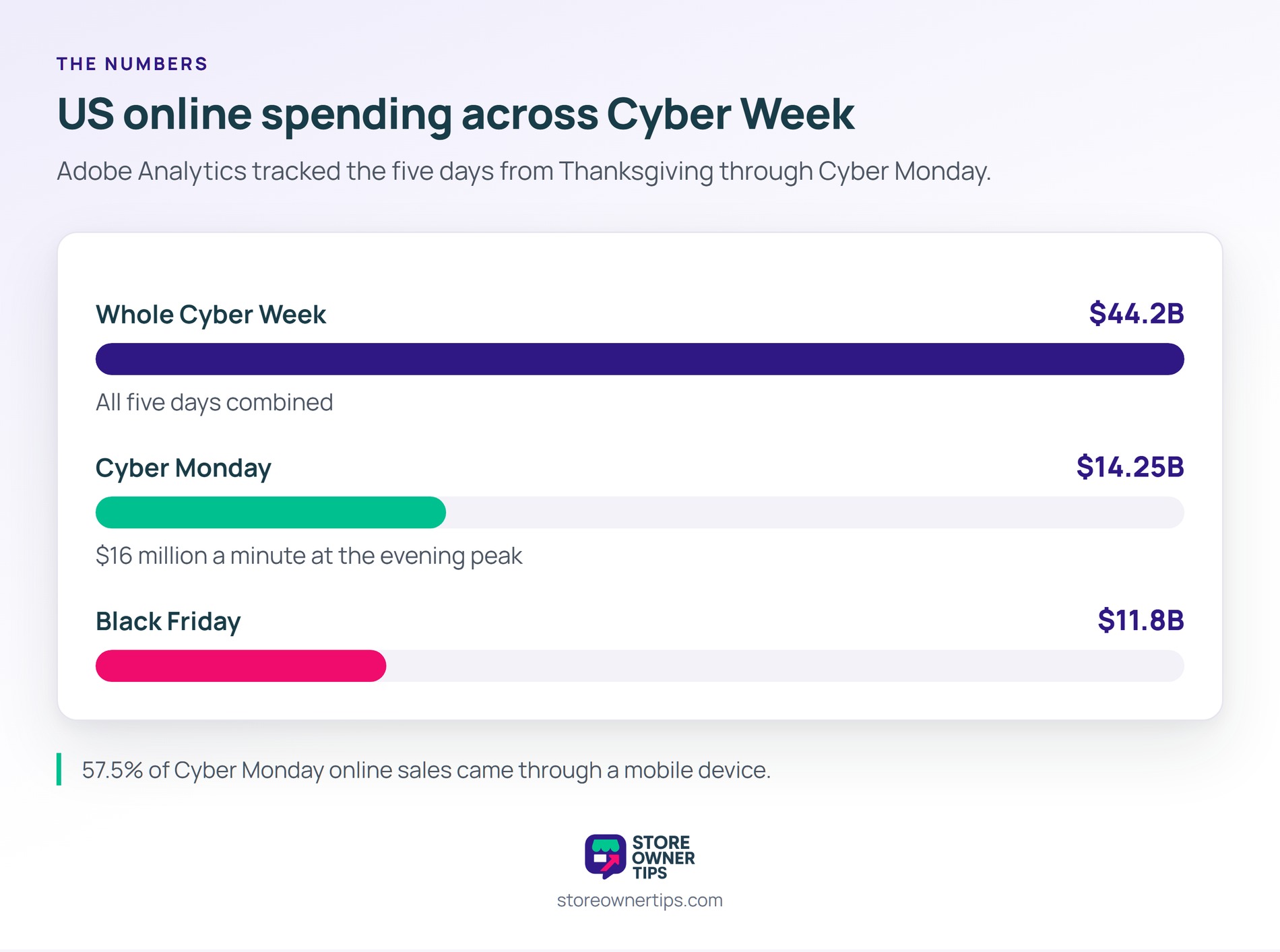
BFCM results are tracked each year by Adobe Analytics and the National Retail Federation (NRF). Adobe found US shoppers spent $44.2 billion online across the 2025 Cyber Week. Cyber Monday alone brought in $14.25 billion, while Black Friday reached $11.8 billion.
The BFCM peak is even sharper than the daily totals suggest. Between 8 pm and 10 pm on Cyber Monday, shoppers spent $16 million every minute. Adobe also reported that 57.5% of Cyber Monday online sales came through a mobile device.
NRF’s survey counted a record 202.9 million shoppers over the same five days. Of those, 134.9 million shopped online. NRF also found 84% of consumers had already started their holiday shopping by that weekend.
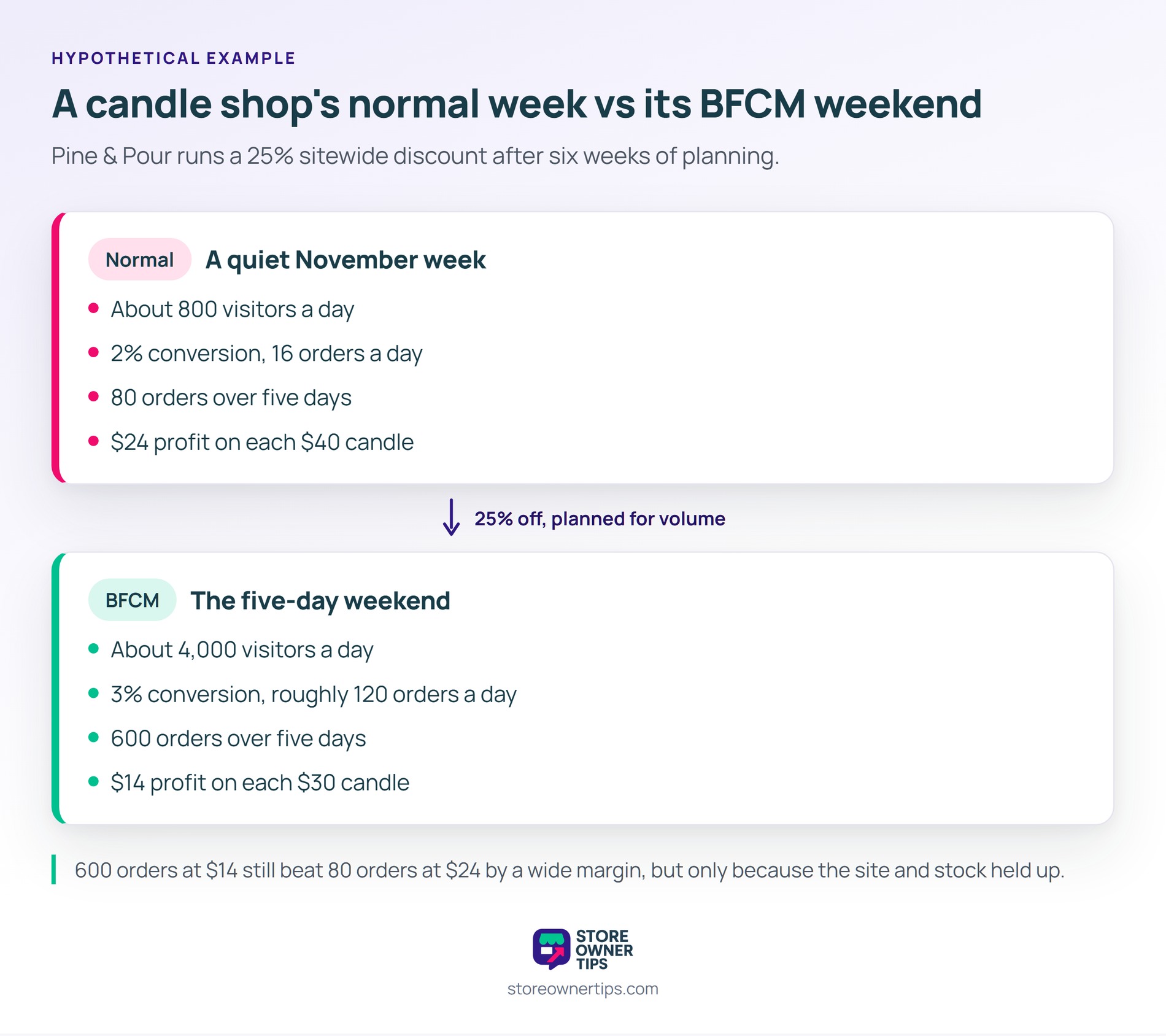
BFCM in practice is a planning job first and a selling job second. Here’s a hypothetical example. Picture a hypothetical store called Pine & Pour, a small WooCommerce shop selling candles. On a normal November day, it gets about 800 visitors and 16 orders.
Six weeks out, the owner plans a 25% sitewide discount. She works through a Black Friday checklist and upgrades her hosting plan. She also builds the sale as a scheduled discount, so prices switch on at midnight without manual edits.
Next, she counts stock on her ten bestselling candles. She sets low-stock alerts so popular scents don’t sell past zero. Finally, she runs a full test checkout on her phone, since much BFCM traffic arrives on mobile. She also writes her sale emails in advance and schedules them for Thanksgiving morning and Cyber Monday.
Over the five days, traffic jumps to about 4,000 visitors a day. Her conversion rate climbs from 2% to 3%, giving roughly 120 orders a day. That’s 600 orders across the weekend instead of the usual 80. Her support inbox gets busier too, so she prepares saved replies for shipping questions ahead of time.
Abandoned carts still bite. Baymard Institute puts the average documented cart abandonment rate at 70.22%. So most carts on her site never reach checkout. She sends reminder emails to shoppers who left items behind and wins back a slice of those sales.
The discount has a real cost, though. Her candles sell for $40 and cost $16 to make, leaving $24 of profit. At 25% off, each candle sells for $30 and earns $14. Across the weekend, 600 orders at $14 still beat 80 orders at $24 by a wide margin.
That outcome only works because she planned for volume. If her site had crashed, the same discount would have cut profit for nothing. Running out of stock on day one would have done the same.
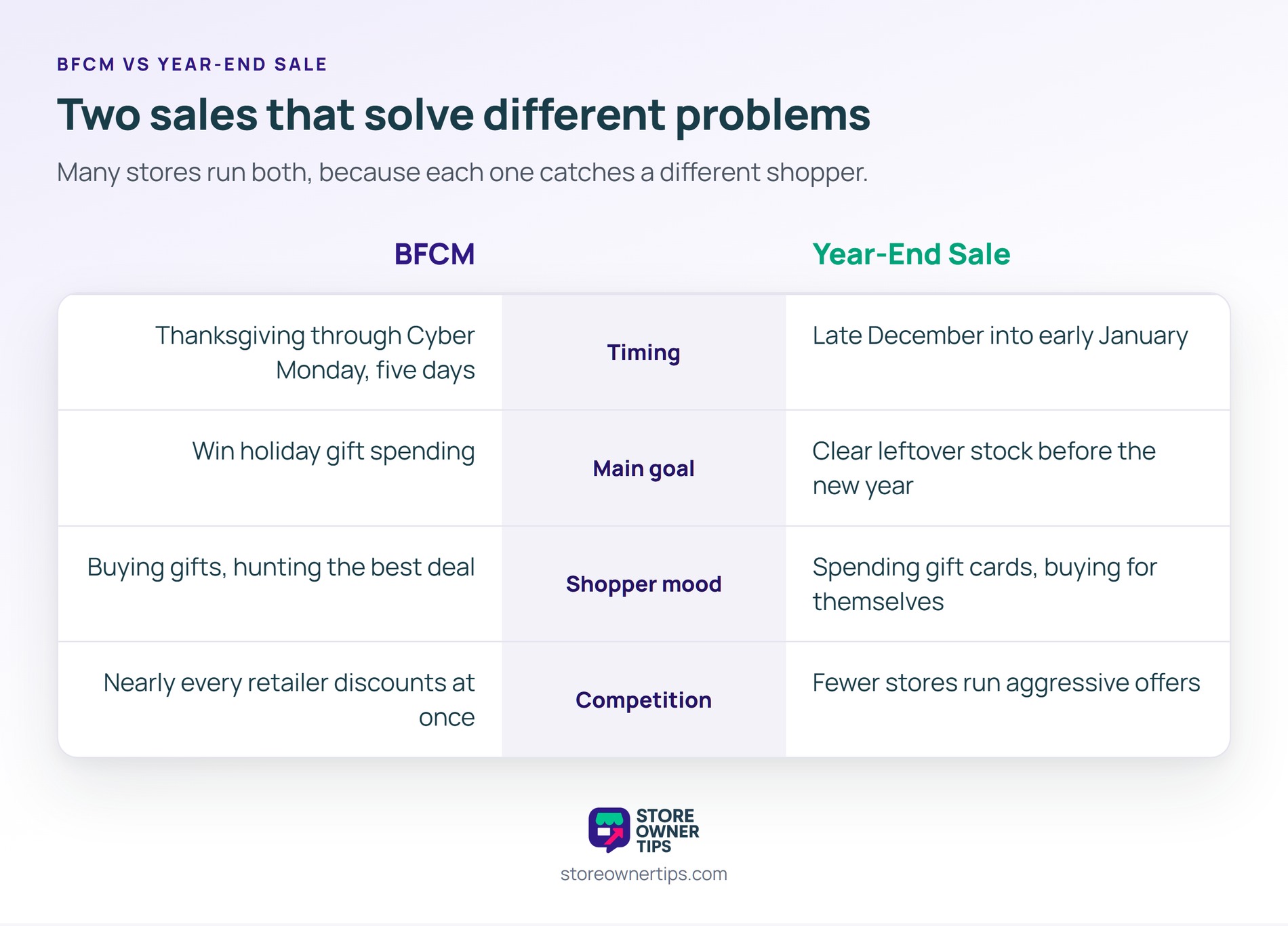
| What you’re comparing | BFCM | Year-End Sale |
|---|---|---|
| Timing | Thanksgiving through Cyber Monday, five days | Late December into early January |
| Main goal | Win holiday gift spending | Clear leftover stock before the new year |
| Shopper mood | Buying gifts, hunting the best deal | Spending gift cards, buying for themselves |
| Competition | Nearly every retailer discounts at once | Fewer stores run aggressive offers |
BFCM and a year-end sale solve different problems. BFCM is about grabbing gift demand while competition is fierce. A year-end sale is about clearing inventory once the gifting rush is over, so many stores run both.
BFCM starts on Thanksgiving Day, the fourth Thursday of November in the US. It ends on Cyber Monday, four days later. Many stores open their deals earlier in November, and some extend them through the following week. Still, the five core days are when shoppers expect the best offers.
Yes, Cyber Monday is usually the bigger BFCM day for online sales in the US. Adobe’s tracking showed Cyber Monday at $14.25 billion online, ahead of Black Friday at $11.8 billion. Black Friday still draws more shoppers across stores and websites combined. That’s why many stores run a different offer each day. They use fresh Cyber Monday promotion ideas instead of repeating Friday’s deal.
Most store owners start preparing for BFCM several weeks ahead, not the week before. Use that time to test site speed, check stock levels, and set up your discounts. Also confirm your coupon settings block unwanted coupon stacking. Plan your emails early too, so a last-minute flood doesn’t cause email fatigue.
BFCM matters because it packs a huge share of holiday demand into just five days. Stores that prepare their site, stock, and offers can win new customers who come back all year. Stores that skip preparation risk slow pages, oversold items, and discounts that wipe out their profit.
Copyright © StoreOwnerTips.com. All Rights Reserved.
