Weekly ecommerce tips, deals & news.
A deal site is a third-party website that collects and publishes discount codes for other people’s stores. Shoppers visit them to hunt for a code before completing a purchase. For a store owner they sit awkwardly between two things. They are part acquisition channel, part leak that discounts customers who were already buying.
In practice, a deal site aggregates discount codes and ranks them by how well they convert. It earns money from traffic and from affiliate commission on the orders it sends. Your codes are the inventory, whether you supplied them or not.
First, picture a public noticeboard on the street outside your shop. Anyone can pin something to it, and passers-by read it before they come in.
You can pin your own offers there deliberately. However, a customer can just as easily pin the private code you gave them last week. Meanwhile you do not own the board and cannot take things down.
So a deal site is that noticeboard at internet scale. The practical question is not whether to use one. It is how much of your discounting you are willing to have posted publicly.
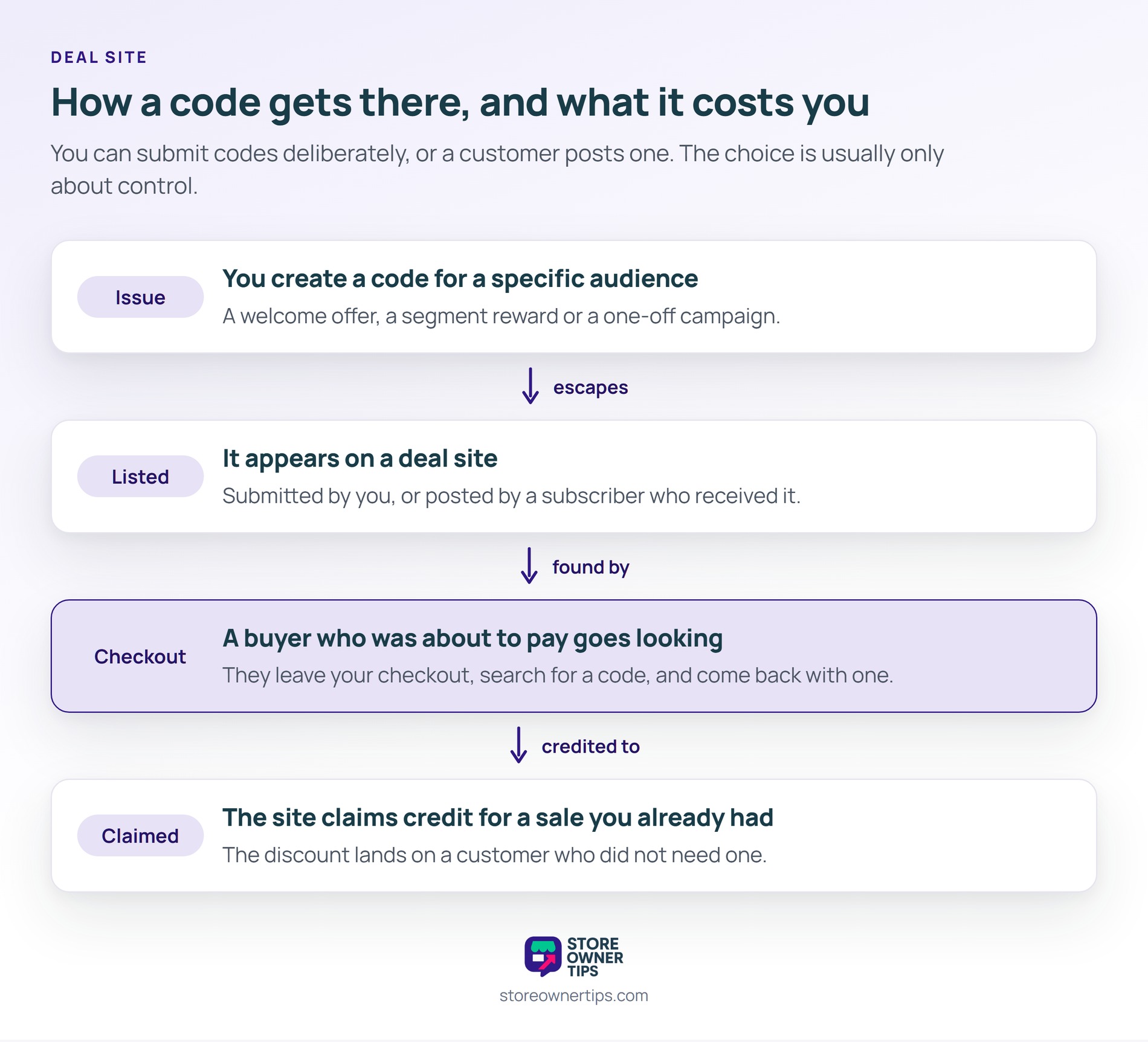
Usually, codes reach a deal site through one of two routes, and each needs a different response.
Advanced Coupons describes the second route plainly. Customers share exclusive codes on forums, social media and unauthorized third-party sites. Therefore an exclusive offer stops being exclusive quickly.
There is a useful early warning for the second case. If redemptions jump outside a live campaign window, the code has probably been posted somewhere public. So watch your redemption rate against the dates you actually promoted.
Notably, a deal site does most of its damage at the last moment before payment. A shopper sees an empty discount code box and opens a new tab. Then they search your store name plus the word coupon.
Then two things can happen, and neither is ideal. Either they find a code and you pay a discount plus commission on a sale you already had. Or they find nothing and come back slightly less willing to pay full price.
Sometimes they simply do not come back at all. Baymard Institute puts the documented average cart abandonment rate at 70.22% across 50 studies. Consequently anything that sends a paying shopper off-site late in checkout deserves scrutiny.
Ultimately, a deal site is only worth paying for when it brings people who were not coming anyway. That distinction is the whole economic question, and it is measurable.
First, look at whether redeemers are first-time buyers or returning ones. If most already had an account, you are funding a discount rather than growth. Therefore compare the cost against your customer acquisition cost from other channels.
Still, the honest answer is that attribution here is genuinely hard. A shopper who searched for a code was already on your site, so the site did not find them. Even so, you cannot always prove that from the data alone.
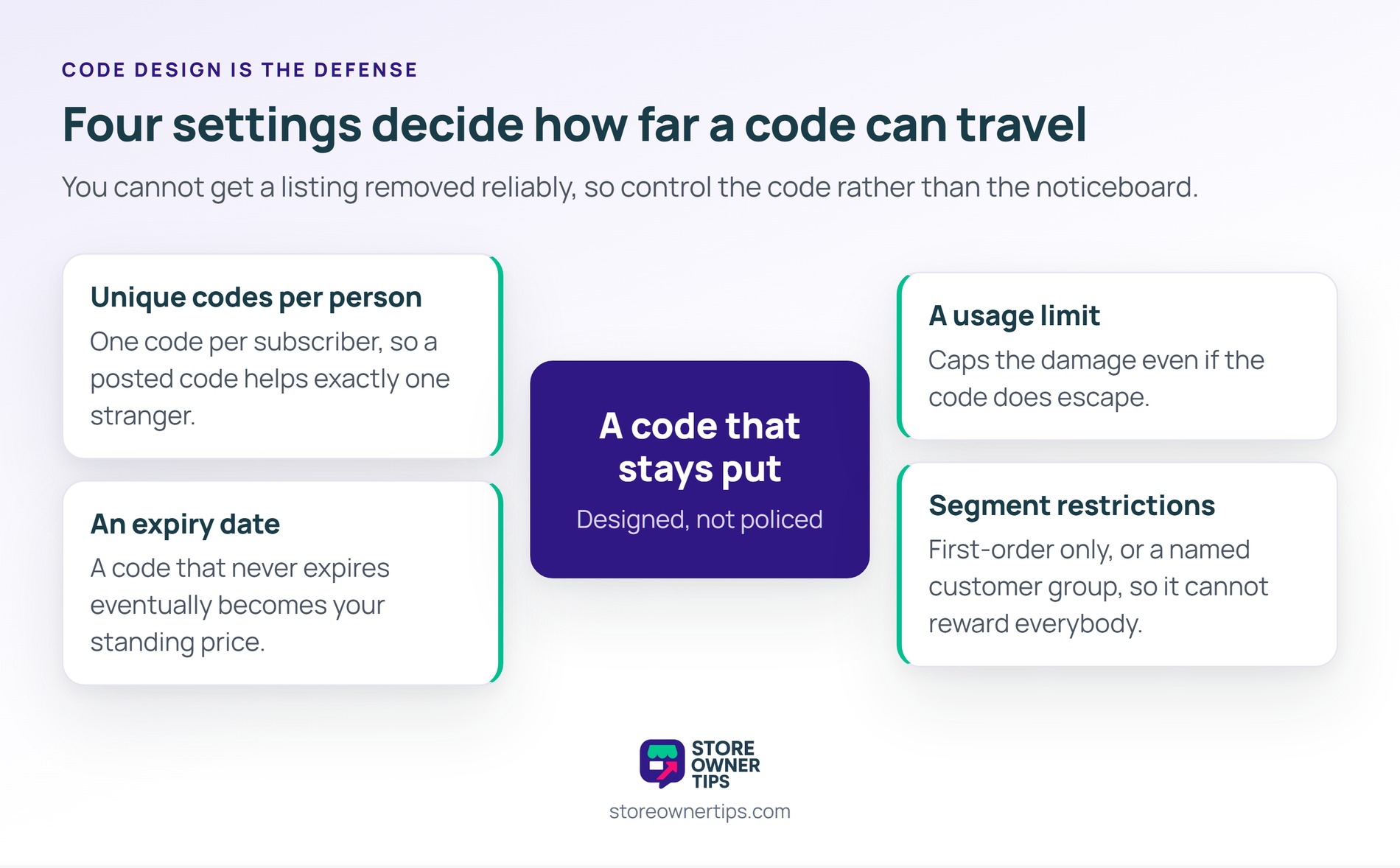
You cannot remove a code from a deal site. Still, you can make it worthless. Four habits do most of the work.
A URL coupon helps too, because there is no code string to copy and repost. Instead the discount applies through a link you control and can retire.
Notably, discount misuse is a mainstream problem rather than an edge case. Advanced Coupons reports that 90% of online retailers treat policy abuse as a significant problem. Global losses are put at around $100 billion. Codes escaping onto public sites are one route into that figure.
Meanwhile the tooling to control codes is widely held. Advanced Coupons, our own discount plugin, reports 20,000+ active installations on its free listing. Expiry dates and usage limits are standard features rather than advanced ones.
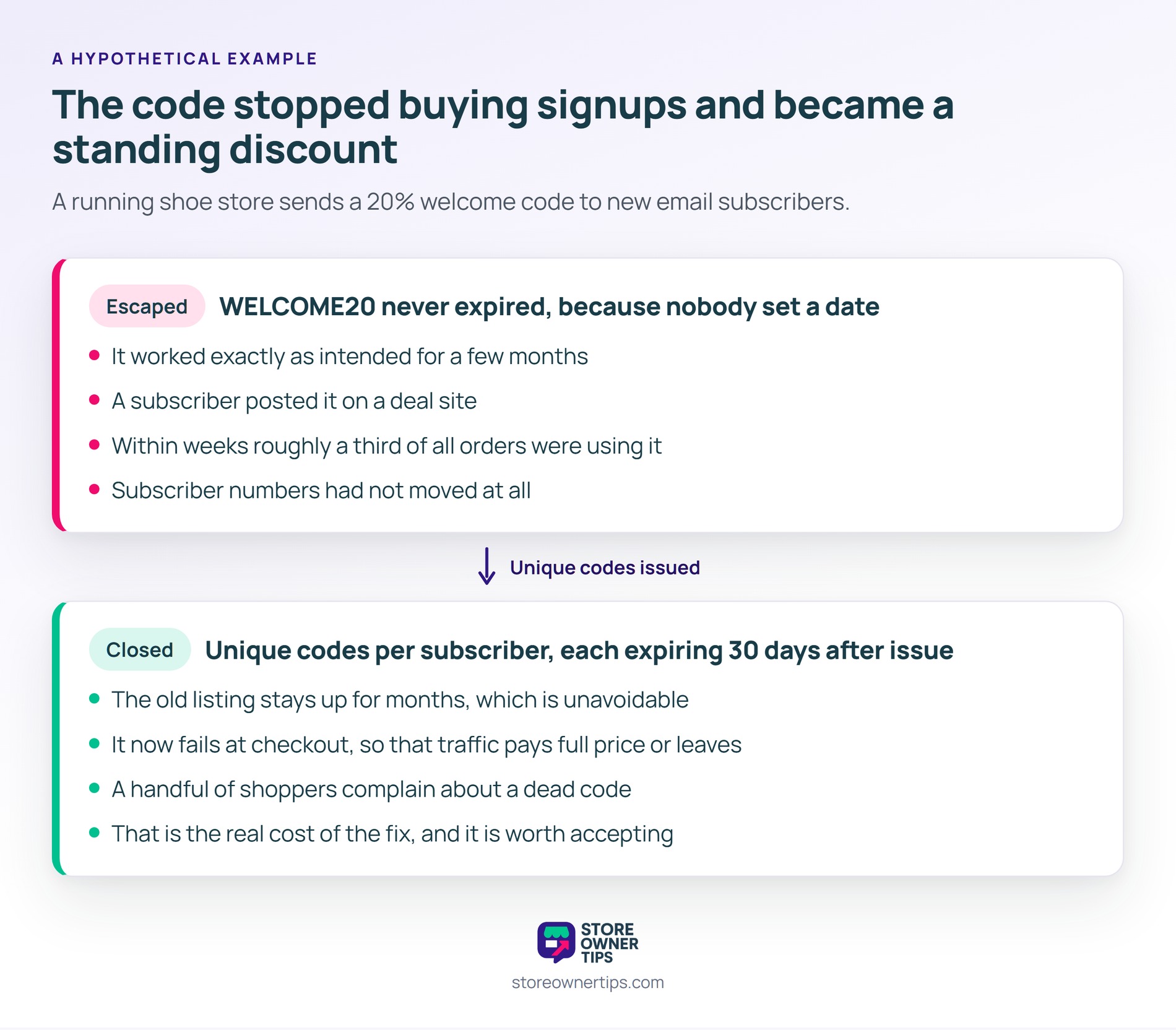
Here’s a hypothetical example. Picture a store selling running shoes, which sends a 20% welcome code to new email subscribers.
First, the code is WELCOME20, and it never expires because nobody set a date. First it works exactly as intended for a few months.
Then a subscriber posts it on a deal site. Within weeks, roughly a third of all orders are using it. Meanwhile subscriber numbers have not moved at all.
So the code is no longer buying email signups. Instead it is a permanent 20% discount available to anyone who searches for one.
So the owner retires WELCOME20 and switches to unique codes per subscriber. Each one expires 30 days after it is issued.
The old listing stays on the deal site for months afterwards, which is unavoidable. Even so, it now fails at checkout. Consequently the traffic it sends either pays full price or leaves.
Notably, a handful of those shoppers complain about a dead code. That is the real cost of the fix, and it is worth accepting. A code that never expires eventually becomes your standing price.
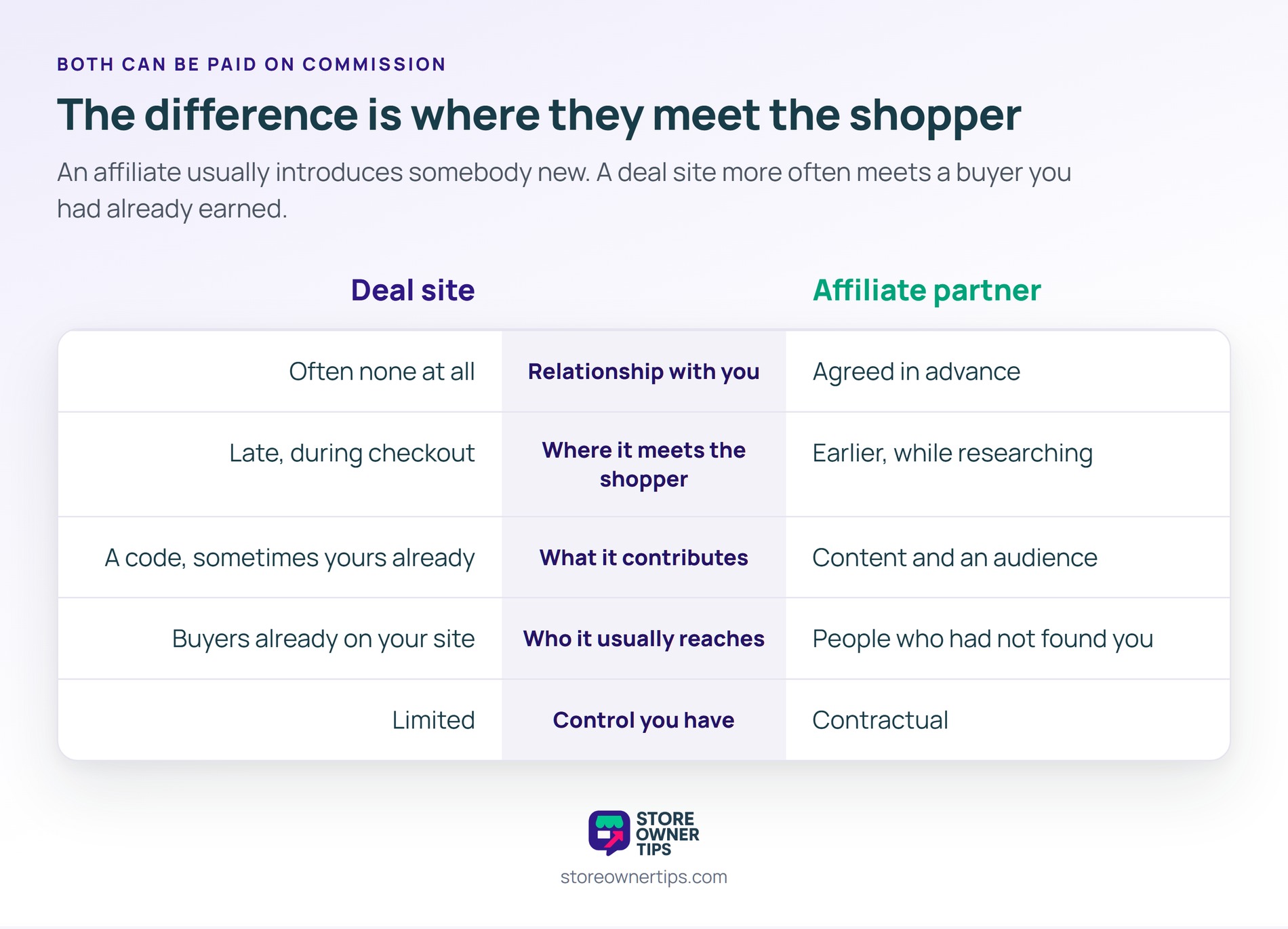
| What you’re comparing | Deal site | Affiliate partner |
|---|---|---|
| Relationship with you | Often none at all | Agreed in advance |
| Where it meets the shopper | Late, during checkout | Earlier, while researching |
| What it contributes | A code, sometimes yours already | Content and an audience |
| Who it usually reaches | Buyers already on your site | People who had not found you |
| Control you have | Limited | Contractual |
A deal site and an affiliate partner can both be paid on commission. That is why they get lumped together. The difference is where they intercept the shopper. An affiliate typically introduces someone new, while a deal site more often meets a buyer you had already earned.
Only with a specific job in mind, like clearing stock or entering a new market. Treat it as a paid channel and measure it against your other channels. Submitting a general discount code with no end date is how stores end up permanently discounted.
Usually, customers post them. A code sent to one subscriber or one segment gets shared on forums, social media and public coupon pages. This overlaps with coupon abuse, and the usual first sign is redemptions rising outside your campaign dates.
Rarely, and it is never the reliable fix. You have no control over a third-party listing, and old entries linger for months. Instead expire the code and replace it, so the listing still exists but no longer works.
A deal site matters because it is where your discounting becomes public whether you planned it or not. Ultimately, you cannot control the listings, only the codes you put into the world. That makes expiry dates and usage limits a pricing decision rather than an admin detail.
Copyright © StoreOwnerTips.com. All Rights Reserved.
