Weekly ecommerce tips, deals & news.
A bulk discount is a price cut a shopper earns by buying more units at once. In practice, the more they add to the cart, the less each unit costs. Stores use it to lift order size, clear stock faster, and cut the cost of packing each unit.
In short, you trade margin per item for a much bigger order.
A bulk discount answers one question for the shopper. What do I get for buying more than I planned? Get the answer right and your average order value climbs without a single extra visitor.
By contrast, get it wrong and you hand a discount to people who were already buying that much.
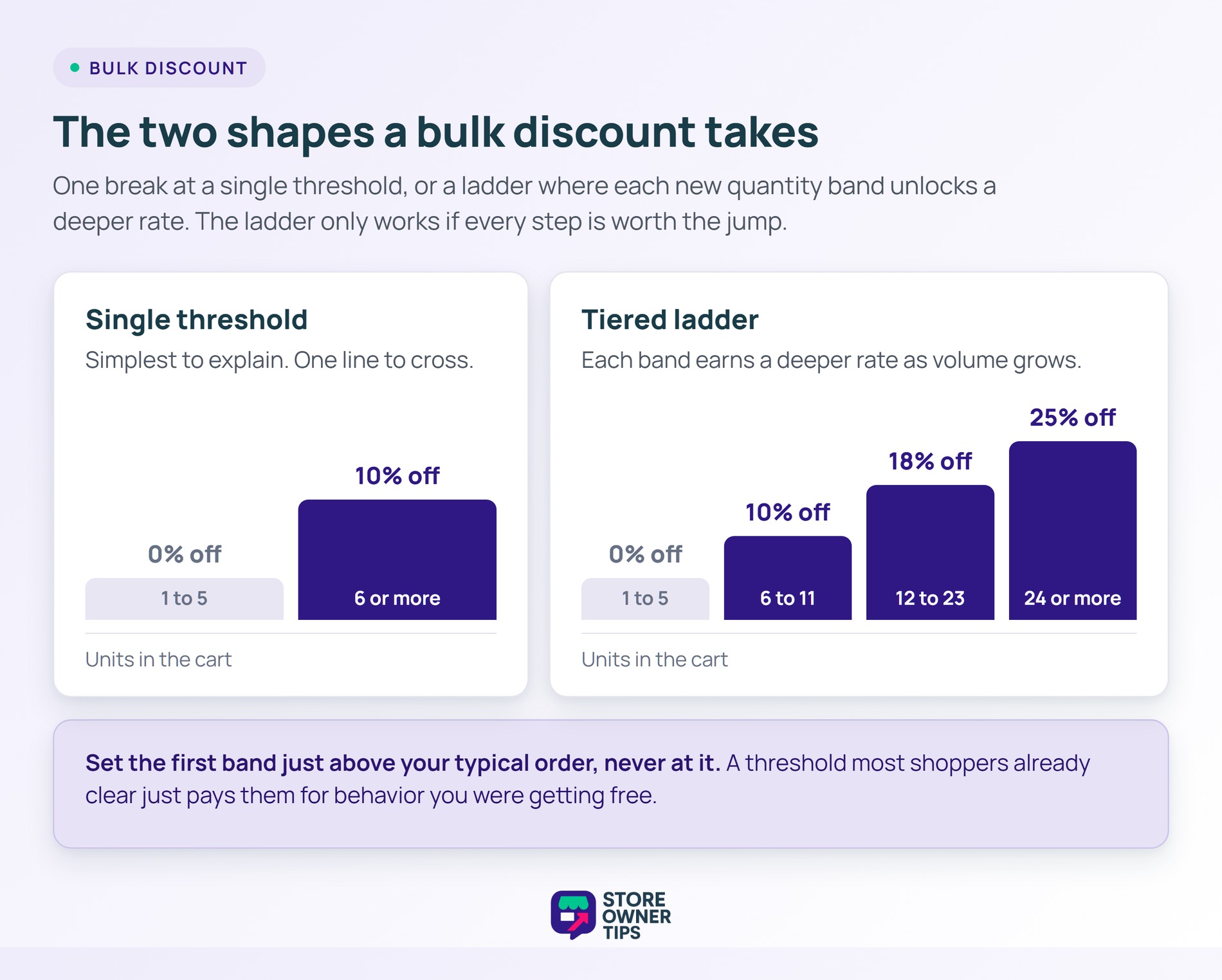
Most bulk discounts fall into two shapes. First, there is a straight break at a single threshold, such as ten percent off six or more. Next comes the ladder, where each new quantity band unlocks a deeper rate.
That ladder is usually called a tiered discount. In practice, it works like a toll road with cheaper rates the further you drive. Even so, each band has to be worth the jump, or shoppers will not climb it.
You also choose what the threshold actually counts. Some stores count units of one product, while others count total cart quantity or value. Counting cart value is more forgiving, since a shopper can mix products to qualify. By contrast, counting units of a single product moves stock you specifically want gone.
Meanwhile, a related model prices every unit at the band rate once you cross it. That approach is closer to volume pricing, and it is far easier for buyers to understand. The alternative, where only units above the threshold get the lower rate, is called stairstep pricing.
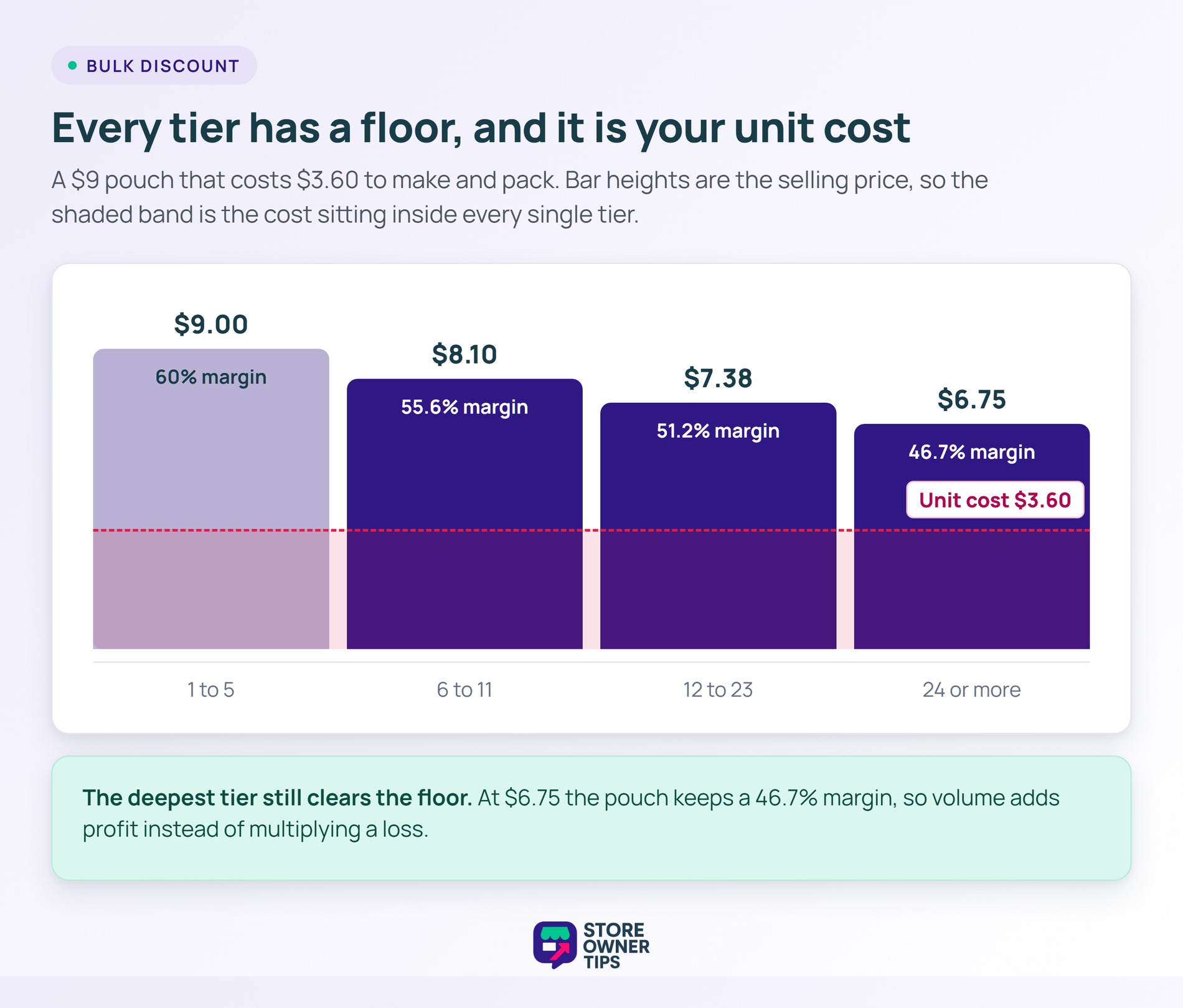
Every bulk tier has a floor, and that floor is your unit cost. Work out the gross margin you still need at the deepest rate. If that tier drops below the line, it is not a discount but a slow leak.
Then account for the savings a bulk order actually creates. For example, one larger order costs less to pick, pack, and ship than several small ones. Those savings fund part of the discount.
There is a second benefit that never shows on the order line. Moving stock faster improves inventory turnover and reduces the odds of dead stock. For seasonal or perishable ranges, that alone can justify a deeper tier.
Finally, be honest about cannibalization. If most orders already clear your first threshold, that tier is discounting behavior you were getting free. So set the first band just above your typical order size, never at it.
WooCommerce does not ship quantity tiers out of the box. Instead, stores add a discount rule that watches the cart and applies a price once a condition is met. That condition might be a unit count, a cart total, or a product combination.
Those triggers are commonly called cart conditions. Think of them like a bouncer checking a list at the door. When the cart matches the rule, the price changes automatically and no code is typed.
Where the discount appears matters more than store owners expect. A saving that only shows up at checkout is easy to miss. Meanwhile, Baymard Institute puts the average documented cart abandonment rate at 70.22%, so late surprises are expensive.
Show the tiers on the product page instead. For a step-by-step build, see this guide to setting up a WooCommerce bulk discount.
Imagine a small store called Rinse Refill Co. that sells eco-friendly cleaning refills. Refills are a repeat purchase, so shoppers are open to stocking up. Now the owner wants bigger orders without cutting the headline price.
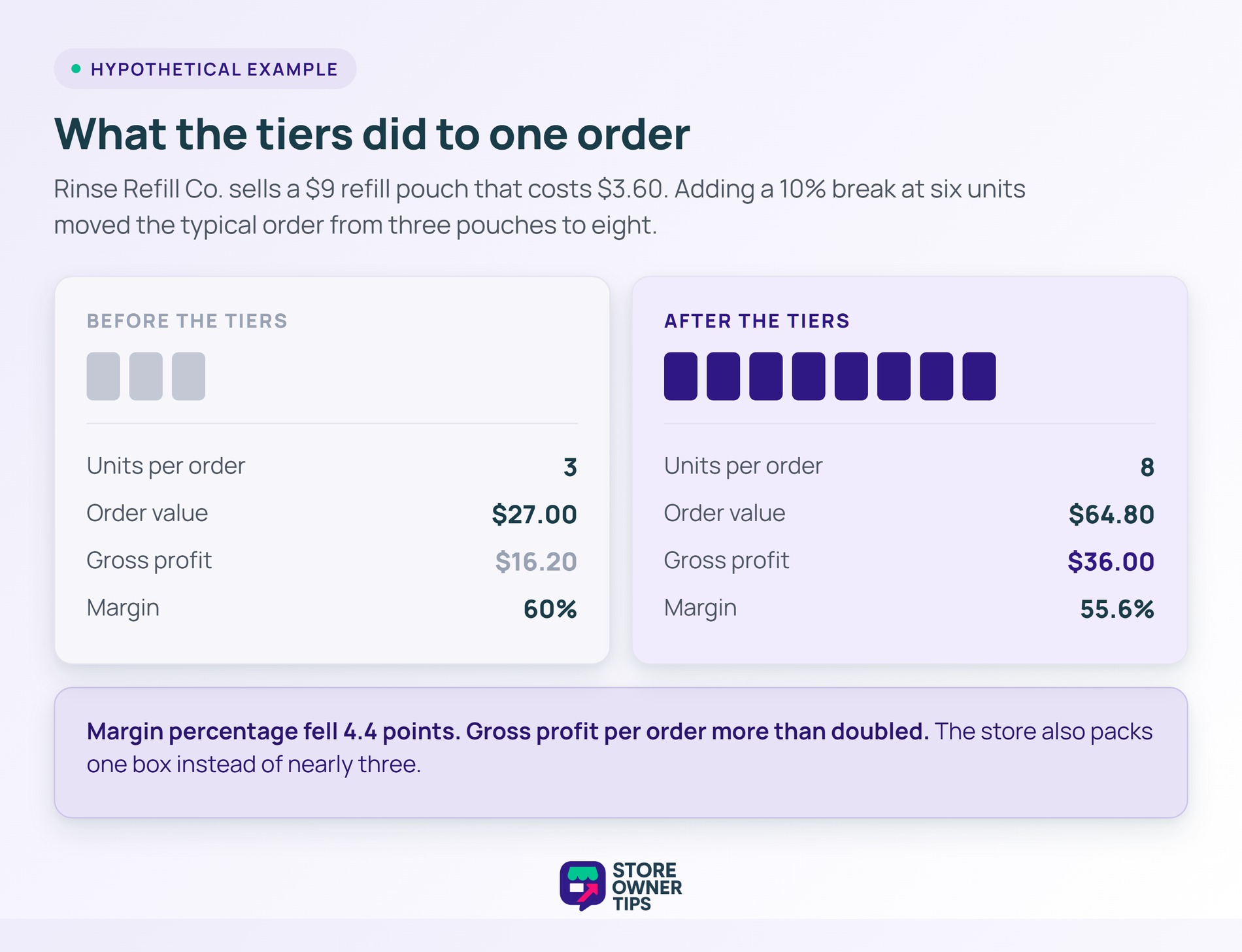
One refill pouch sells for $9 and costs $3.60 to make and pack. That is a 60% gross margin at full price. The typical order today is three pouches, or $27.
So the owner sets the first band just above that. Six or more pouches take 10% off, twelve or more take 18%, and twenty-four take 25%. The first tier starts at six rather than three.
Next comes the floor check. At the deepest tier the pouch sells for $6.75 against a $3.60 cost. That still leaves a 46.7% margin, which clears the owner’s floor comfortably.
Shoppers move up to the first band, and the typical order becomes eight pouches. At $8.10 each, that order is $64.80 instead of $27. Gross profit per order climbs from $16.20 to $36.00.
Margin percentage did fall, from 60% down to 55.6%. However, the store now banks more than double the profit on each order. It also pays to pack one box instead of nearly three.
The tiers are visible on the product page, not buried at checkout. That matters, because late cost surprises are the top fixable reason shoppers quit. Baymard puts them at 40% of abandonments once idle browsing is excluded.
Still, the owner does not assume the lift is permanent. For example, one study of price promotions in British retail stores compared the two approaches. Straight price reductions raised total purchase volume at least 50% more than multi-buy offers. So the tiers get tested against a simple sitewide cut first.
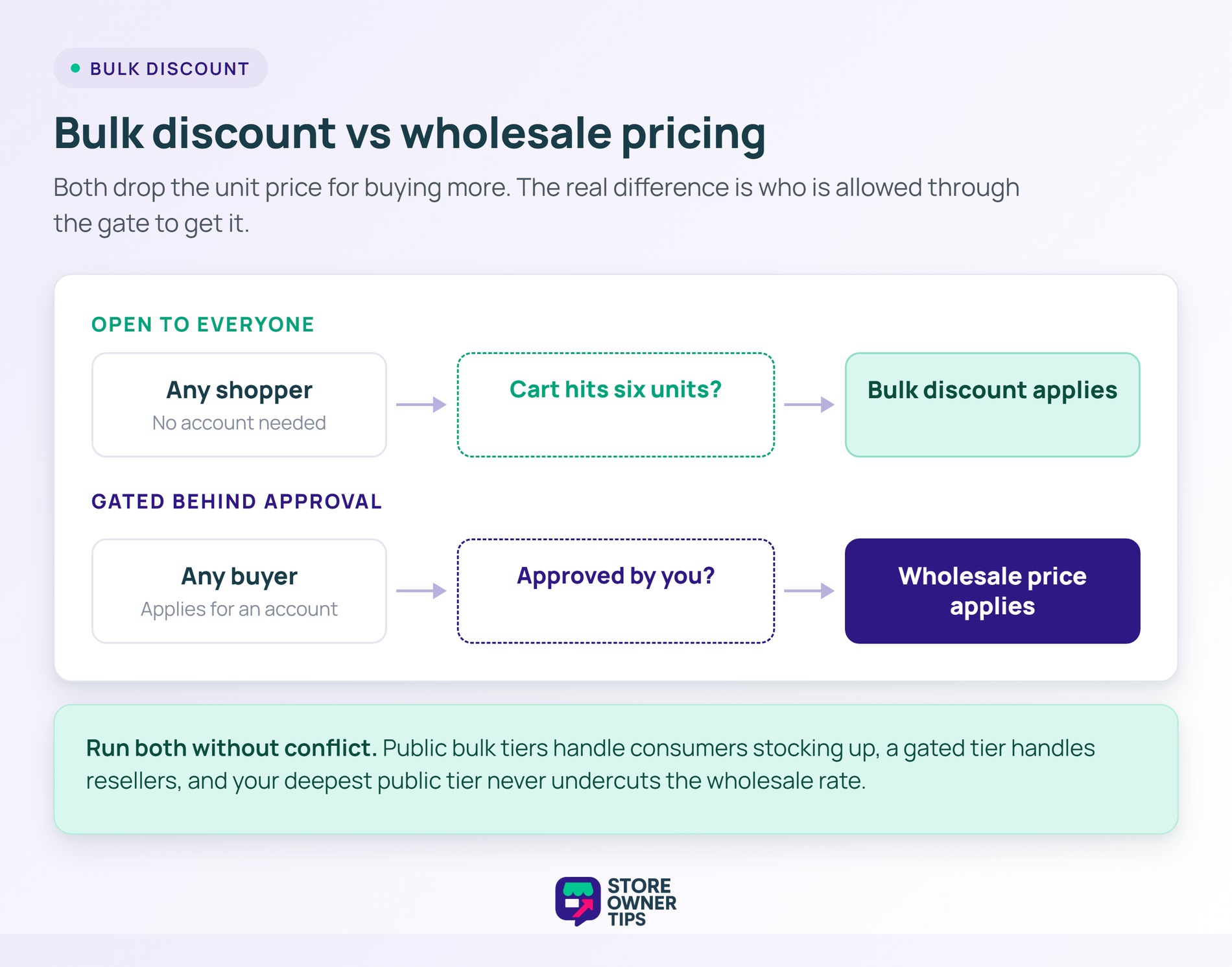
Both lower the unit price for buying more, so they get confused constantly. The real difference is who qualifies. A bulk discount is open to anyone whose cart is big enough.
By contrast, wholesale pricing is gated behind an approved account. A retail shopper never sees the rate, no matter how much they buy. That gate exists to protect the stockists who resell your product.
The intent differs too. Bulk discounts are a conversion tactic aimed at consumers who might stock up. Meanwhile, wholesale rates are a channel decision aimed at businesses who will resell.
The scale is different as well. U.S. merchant wholesalers moved $11.38 trillion in sales in a recent survey year. By contrast, a bulk tier on your storefront is not competing in that arena.
In practice, many stores run both without conflict. Public bulk tiers handle consumers stocking up, while a gated tier handles resellers. Just make sure your deepest public tier never undercuts the wholesale rate.
Big enough to change behavior, small enough to clear your floor. In practice, a first tier under about five percent rarely moves anyone. Below that, shoppers read it as a rounding error rather than a reason.
Work backwards from the deepest band instead of forwards from the first. Decide the lowest unit price you can live with, then space the tiers upward. Three bands is plenty for most catalogs.
Just above your current typical order, never at it. If most shoppers already buy three, a tier starting at three pays them to keep doing that. By contrast, starting at five or six asks for a real stretch.
So check your own order data before guessing. Look at the distribution of units per order, not the average alone. Set the band where a meaningful group sits just short of it.
No, and pretending otherwise wastes margin. They work on consumables, refills, supplies, and anything a customer runs out of. For example, shoppers happily stock up on coffee, filters, or pet food.
By contrast, they work badly on one-off, considered, or fashion purchases. Nobody wants six identical jackets, whatever the saving. For those catalogs, product bundling across different items usually beats quantity tiers.
A bulk discount is a deliberate trade, not a giveaway. You accept a thinner margin per unit in exchange for larger orders, cheaper fulfillment, and stock that moves.
So set the thresholds on your own order data, not on a guess. Then check the deepest tier against your cost floor. Finally, show the tiers where shoppers actually decide.
Copyright © StoreOwnerTips.com. All Rights Reserved.
