Weekly ecommerce tips, deals & news.
Frictionless checkout is a payment flow that removes every unnecessary step between a shopper deciding to buy and actually buying. In practice, that means autofilled forms, guest checkout, saved payment methods, and one-tap wallets like Apple Pay or Google Pay.
The goal is simple: cut the time and effort to checkout to nearly zero to complete a truly frictionless shopping journey. As a result, fewer carts get abandoned and more orders go through. For most online stores, it’s one of the highest-leverage upgrades they can make.
Frictionless checkout is a design philosophy, not a single feature. It acts as the final, essential step in creating truly frictionless shopping for your customers. You strip the checkout flow of everything that doesn’t help the buyer pay.
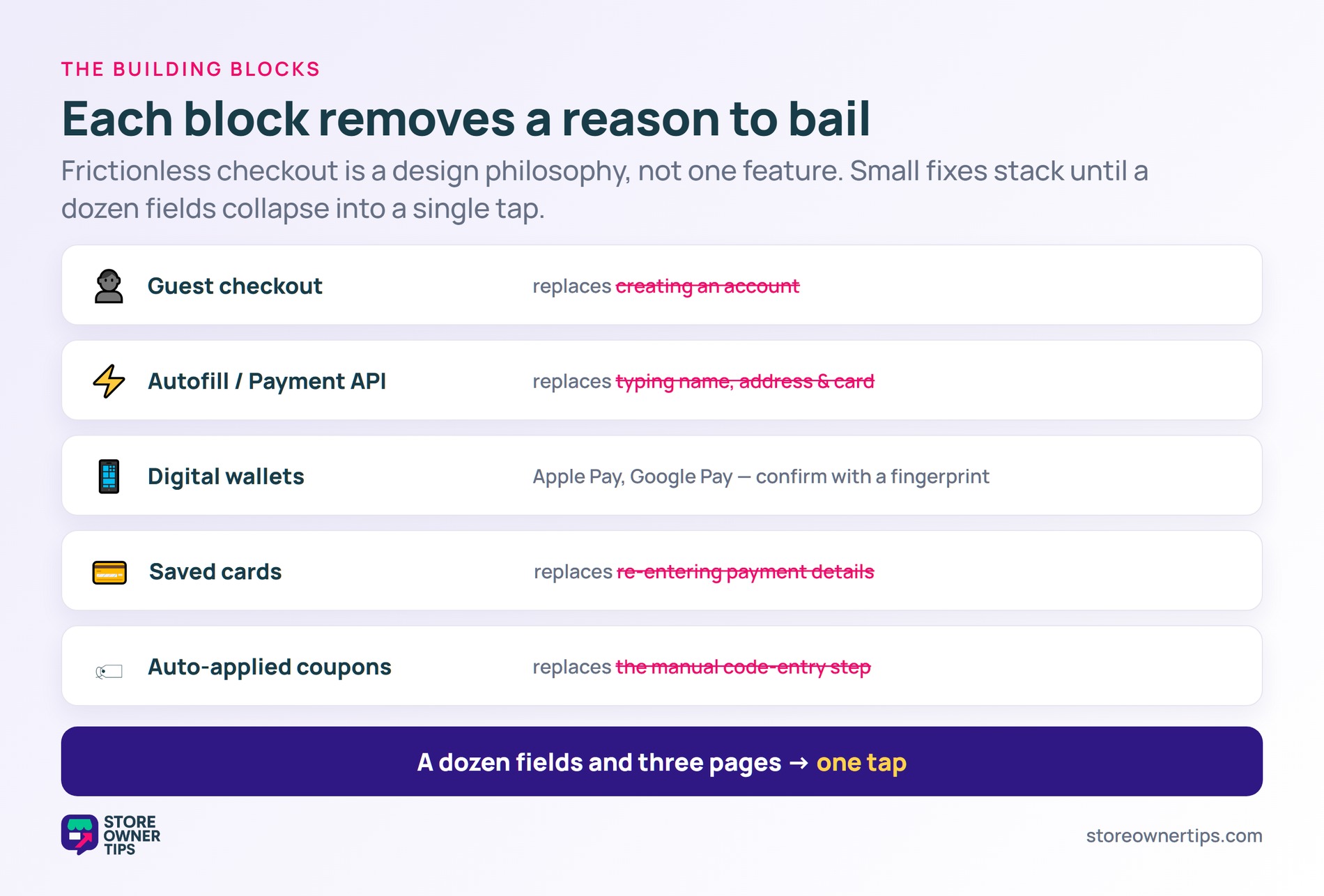
For example, autofill replaces typing. Guest checkout replaces account creation. Saved cards or wallets replace re-entering payment details. As a result, what used to take a dozen fields and three pages collapses into a single tap. Baymard Institute reports that 70.22% of shopping carts are abandoned across e-commerce, with checkout friction as a major driver.
Several techniques stack to create a frictionless flow. First, guest checkout lets shoppers buy without making an account. Next, browser autofill or the Payment Request API pre-populates name, address, and card fields. Then, digital wallets like Apple Pay, Google Pay, and PayPal One Touch let shoppers confirm with a fingerprint or face scan.
On top of that, auto-applied coupons remove the manual code-entry step. In short, every block you add removes a reason to bail.
The math is hard to ignore.
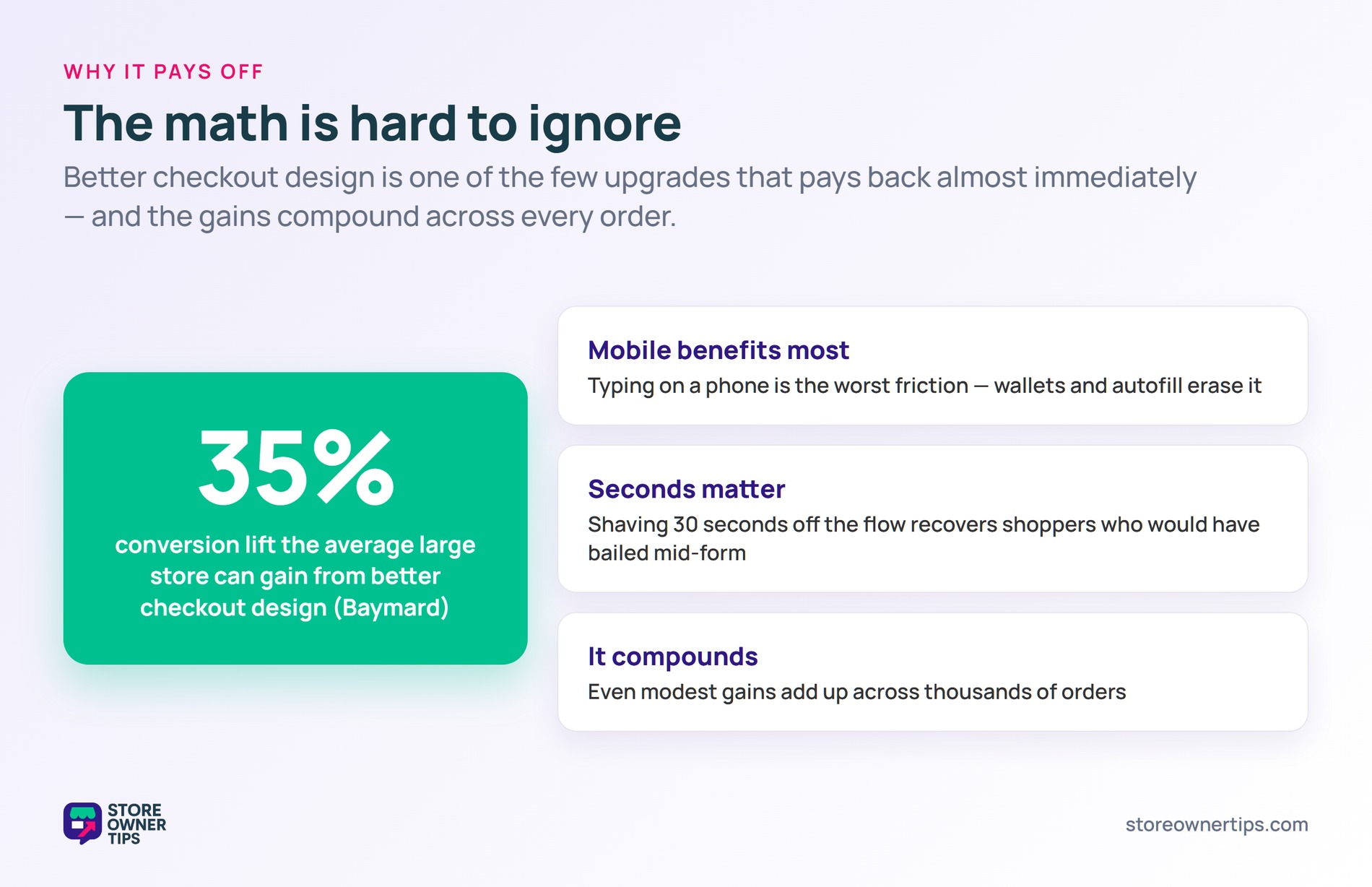
Even modest improvements compound across thousands of orders. For example, shaving 30 seconds off the checkout flow can recover shoppers who would have bailed during a long form. Mobile shoppers benefit most because typing on a phone is the worst form of friction.
In short, frictionless checkout is one of the few upgrades that pays back almost immediately.
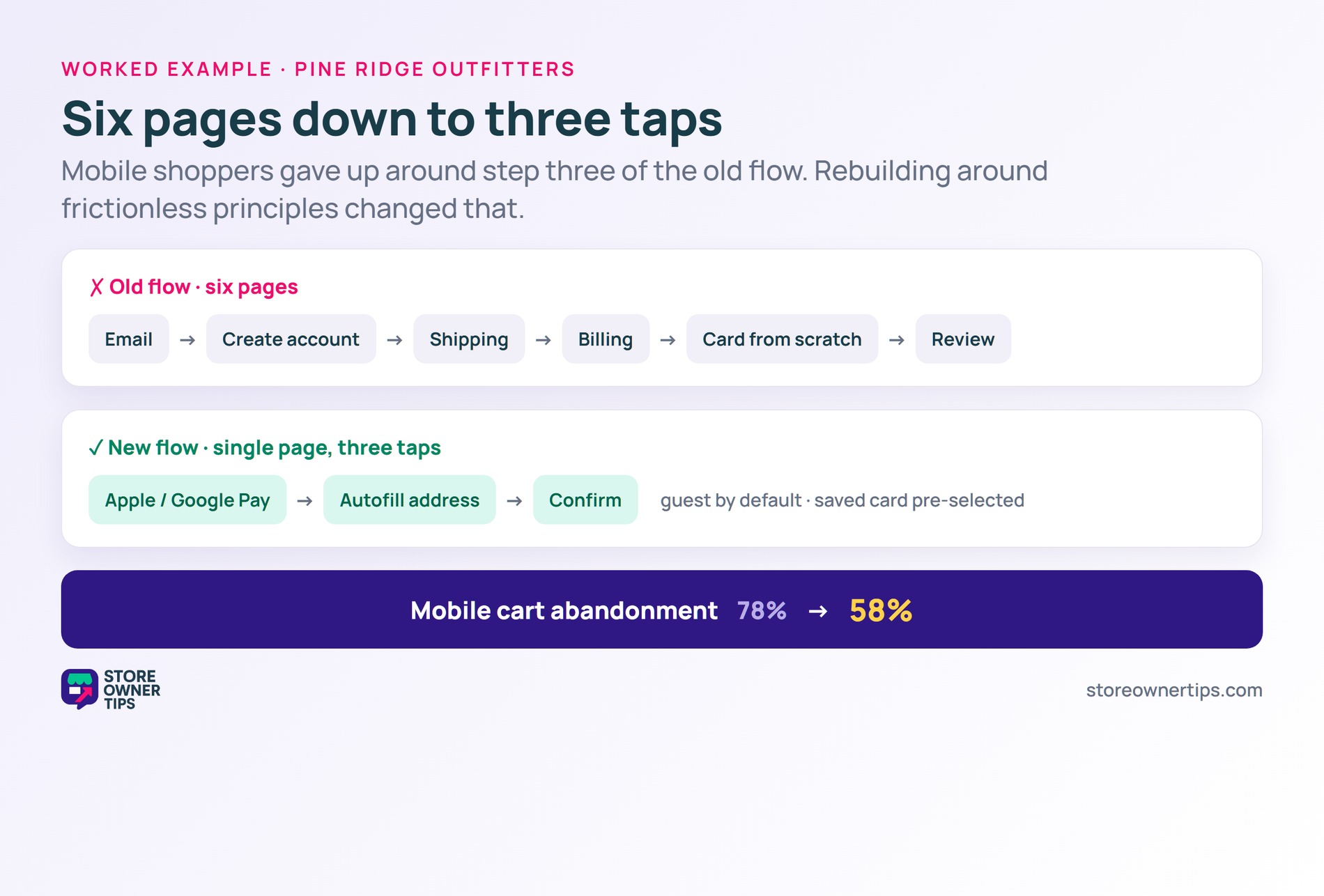
Imagine an outdoor gear shop called Pine Ridge Outfitters. Their old checkout had a six-page flow. First, shoppers entered their email. Next, they created an account with a password. Then, they typed shipping and billing details on separate pages. After that, they entered card details from scratch.
Finally, they reviewed and submitted. In practice, mobile shoppers gave up around step three. As a result, the team’s cart abandonment rate sat at 78%.
Pine Ridge rebuilds the flow around frictionless principles. First, they move to a single-page checkout. Next, they add guest checkout as the default option, with account creation as optional after purchase. Then, they enable Apple Pay and Google Pay buttons above the cart.
On top of that, browser autofill handles address fields automatically. Meanwhile, returning shoppers see their saved card pre-selected. As a result, the new flow can finish in three taps on a phone.
After two months, Pine Ridge reviews the data. Notably, mobile cart abandonment drops from 78% to 58%. Conversion lift covers the engineering investment within the first month.
However, a small share of shoppers still abandon at the address step. In response, the team adds postal code lookup to auto-fill city and state.
Desktop shoppers convert at almost the same rate as before. Frictionless wins are mostly mobile wins, but the desktop flow stays intact.
Traditional checkout flows ask shoppers to complete every step manually. That means typing name, address, card details, and creating an account before paying.
By contrast, frictionless checkout pre-fills or skips most of those steps. For example, a returning shopper might tap one button to pay with a saved wallet.
Meanwhile, a first-time shopper might use browser autofill to populate the form in seconds. The time to complete a purchase shrinks dramatically, which creates a much smoother overall shopping experience.
The key differences:
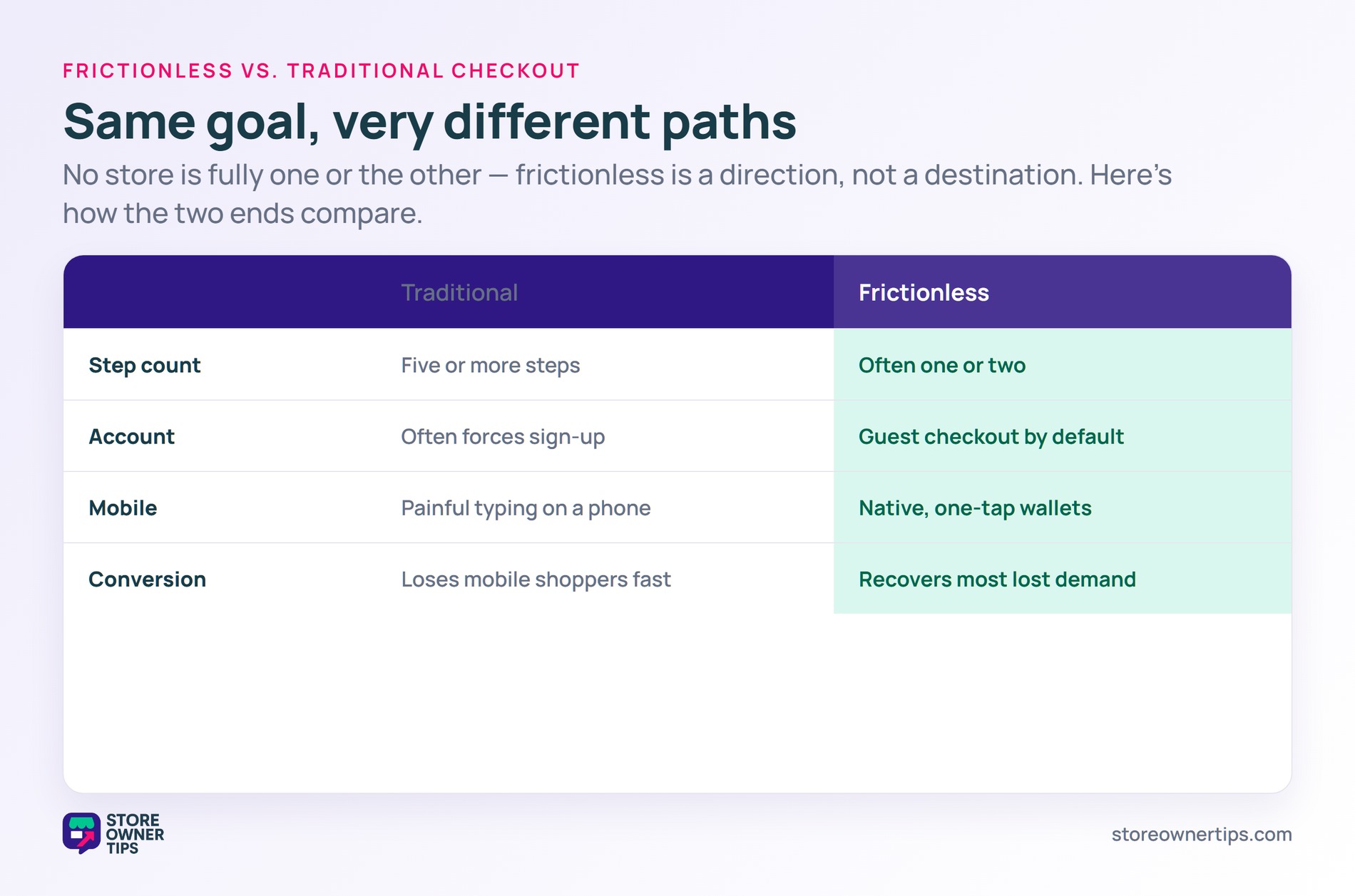
No store is fully one or the other. Most flows sit somewhere in between, with room to keep removing friction. As a starting point, audit your current flow for the worst pain point and fix that first. In short, frictionless is a direction, not a destination.
Forced account creation is usually the worst offender. Most shoppers don’t want yet another login to manage. It’s no surprise requiring an account is a top self-reported reason for cart abandonment. Thankfully, offering guest checkout removes that block entirely. You can still invite shoppers to create an account after their purchase.
On top of that, surprise costs like shipping or taxes that appear late are the second biggest source of friction.
For these reasons, you must show total cost early and let people buy without signing up.
Yes, in most cases. For example, mobile shoppers complete checkout much faster with wallet buttons than with manual forms. As a result, conversion typically rises on mobile after wallets go live.
By contrast, desktop wallet usage is lower but still meaningful.
The integration with platforms like WooCommerce or Shopify is straightforward through Stripe or similar processors. On top of that, wallet payments often come with stronger fraud protection than raw card entry. In short, the upside almost always outweighs the integration cost.
One-click checkout is a specific feature; frictionless checkout is a broader philosophy. In practice, one-click means returning shoppers complete an order with a single confirm action because their details are saved. By contrast, frictionless covers everything from guest checkout to autofill to wallets to zero-click commerce.
For example, you can have a frictionless flow without true one-click if you use Apple Pay and autofill instead. One-click is a feature you might build; frictionless is the goal you’re optimizing toward.
Frictionless checkout is one of the highest-leverage upgrades any online store can make. Removing extra steps recovers shoppers who would have abandoned otherwise. The math usually pays back within weeks, not months. Thus, it’s a good strategy to default to guest checkout, add digital wallets, lean on autofill, and clear the path to the pay button.
As a starting point, audit your current flow for the worst step and remove it first. The brands that deliver the ultimate frictionless shopping standard treat friction reduction as an ongoing program, not a one-time project. Otherwise, the gains erode as new features and form fields creep back in.
Copyright © StoreOwnerTips.com. All Rights Reserved.
