Weekly ecommerce tips, deals & news.
An HS code is a standardized number that classifies a product for customs when it crosses a border. Every country’s customs authority reads the same code and knows roughly what the item is. It decides the duty rate applied, which is why a wrong code costs money rather than just causing paperwork.
In practice, an HS code is a shared vocabulary between customs authorities that share nothing else. You assign a code to your product. Then any border agency can look up that number and find the same category, whatever language it operates in.

First, think of a library catalog number on the spine of a book. It is not the title, and it is not a barcode. Instead it says where this book belongs among all books.
An HS code does that for physical goods at a border. So a leather wallet lands in one drawer of the world’s filing system, and a cotton t-shirt in another. Meanwhile the duty rate is attached to the drawer, not to your brand.
The analogy holds for the awkward part too. Some items genuinely could sit in two drawers. Therefore classification involves judgment, and two reasonable people can disagree.
Usefully, an HS code is read in pairs, narrowing as it goes. Understanding the structure makes it far easier to check somebody else’s work.
That last point causes most of the confusion. A code you were given for one destination may not be complete for another. So the six shared digits travel, while the extra ones do not.
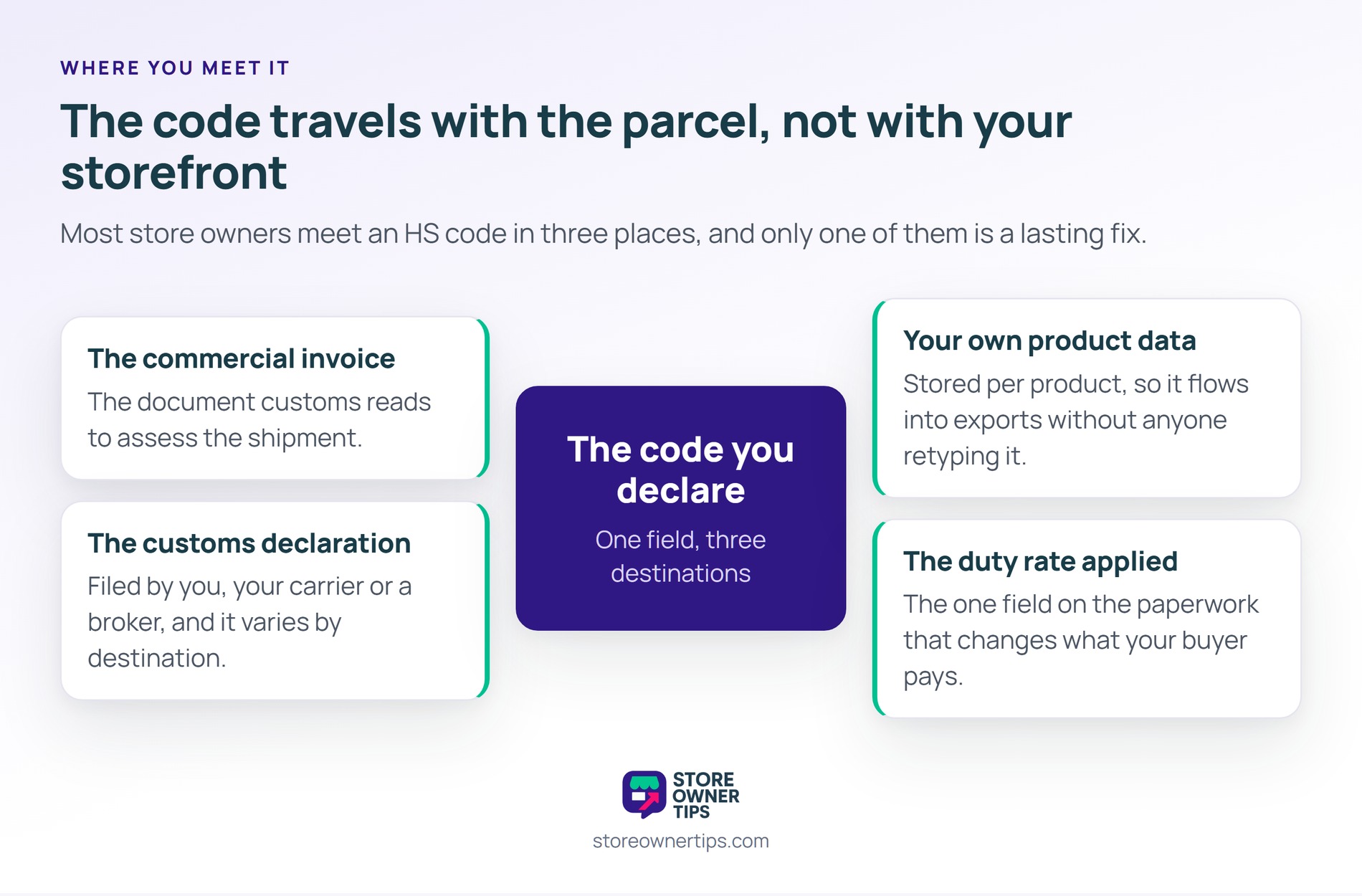
Notably, an HS code appears on the paperwork that travels with a parcel, not in your storefront. Most store owners meet it in three places.
That third one is the practical fix. Keeping the code as a product field means it flows into paperwork without anyone retyping it. Visser Labs covers the mechanics of pulling that data out in its guide to exporting WooCommerce orders.
Still, the declaration is legally yours even when somebody else typed it. That surprises store owners who assume the carrier owns the classification.
Meanwhile a wrong code has two failure modes, and both cost you. Undershoot the duty and you may face a back-assessment later. Overshoot it and your customer pays more than they needed to, which turns into a refund conversation.
Consequently the code feeds directly into landed cost. Still, plenty of stores treat it as a box to fill rather than a number worth checking once per product.
The classification schedule gets revised periodically, so a code is not permanent. Categories get split, merged or renumbered as trade changes.
Consequently a code you assigned years ago may no longer be the current one. Nothing in your store will tell you, because the number still looks valid. Instead you find out when a shipment is queried.
A yearly review of your main product lines is usually enough. Still, it is worth doing before a big seasonal push rather than during one. So treat it like a stocktake for paperwork.
Cross-border wholesale is where HS codes matter most, because the volumes make duty errors expensive. A single miscoded pallet costs far more than a miscoded parcel.
The code should be settled before you confirm the order, not at the packing bench. Therefore capture it alongside the agreed price when you accept a purchase order from an overseas buyer.
That timing also lets you quote duty honestly upfront. Meanwhile buyers in a wholesale channel tend to expect that level of preparation from a supplier.
The system is close to universal, which is what makes one code portable. The World Customs Organization states that over 98% of merchandise in international trade is classified using the Harmonized System. It covers more than 5,000 commodity groups and is used by over 200 countries and economies.
Plus, the trade it governs is vast. Digital Commerce 360 reports US manufacturing and wholesale distribution sales of $15.12 trillion in a recent year. Meanwhile Wholesale Suite, our own B2B plugin, reports 20,000+ active installations.
Here’s a hypothetical example. Picture a store selling handmade leather bags, taking its first overseas wholesale order.
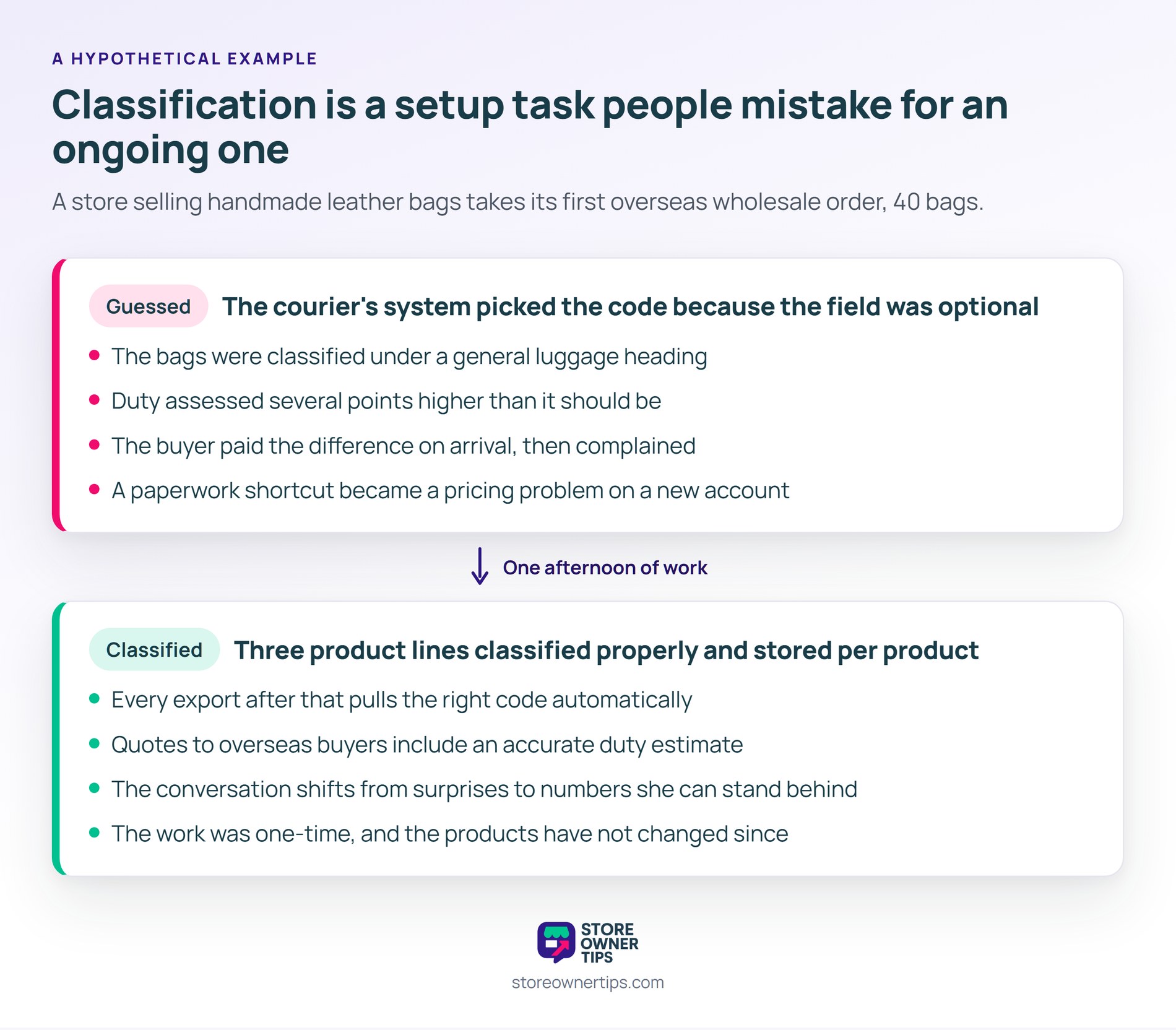
The order is 40 bags heading to a retailer abroad. First the owner lets the courier’s system pick a code. The field was optional and she was in a hurry.
The system classifies them under a general luggage heading rather than the one for leather handbags. Consequently the duty assessed is several points higher than it should be.
Her buyer pays the difference on arrival and complains. That is a common pattern in dropshipping too, where nobody owns the paperwork. So a paperwork shortcut became a pricing problem with a new wholesale account.
So she classifies her three product lines properly, which takes an afternoon. Then she stores each code against the product in her store rather than in a spreadsheet.
Every export after that pulls the right code automatically. Meanwhile her quotes to overseas buyers can include an accurate duty estimate. Therefore the conversation shifts from surprises to numbers she can stand behind.
Notably, the work was one-time and the products have not changed since. In short, classification is a setup task that people mistake for an ongoing one.
| What you’re comparing | HS code | Incoterm |
|---|---|---|
| What it describes | What the product is | Who is responsible for what |
| Form it takes | A number, six or more digits | A three-letter term |
| Who defines it | The World Customs Organization | The International Chamber of Commerce |
| What it determines | The duty rate applied | Cost and risk transfer points |
| Varies by product | Yes, per item | No, per agreement |
An HS code and an Incoterm both appear on international paperwork. That is why they blur together. The code answers what is in the box. The Incoterm answers who pays the freight and who carries the risk if it goes missing.

Start with your own country’s tariff lookup tool, which searches the schedule by description. Your supplier may already know it for goods you resell. For anything genuinely ambiguous, a customs broker is worth the fee once per product line.
Mostly. The first six digits are shared, and that is the point of the system. Beyond six digits, countries add their own for tariff and statistical purposes. So a ten-digit code from one country will not match another country’s ten-digit version.
At best, the shipment is delayed while customs queries it. At worst you face a back-assessment for underpaid duty, plus penalties in some jurisdictions. Because the declaration is legally yours, blaming the carrier that typed it rarely helps.
An HS code matters because it is the one field on your customs paperwork that changes what your customer pays. Ultimately, getting it right once per product removes a recurring source of delays and awkward invoices. Getting it wrong quietly overcharges your buyers or leaves you exposed to a bill later.
Copyright © StoreOwnerTips.com. All Rights Reserved.
