Weekly ecommerce tips, deals & news.
A human handoff is the moment a support conversation passes from an automated assistant to a person. Then the chatbot stops answering, and an agent picks up the same thread. So the customer keeps their place instead of starting over. Done properly, they barely notice the switch.
A human handoff works by detecting that a conversation needs a person. It then moves that conversation without losing what was already said. First something triggers the transfer. Then the conversation, and everything attached to it, changes hands.
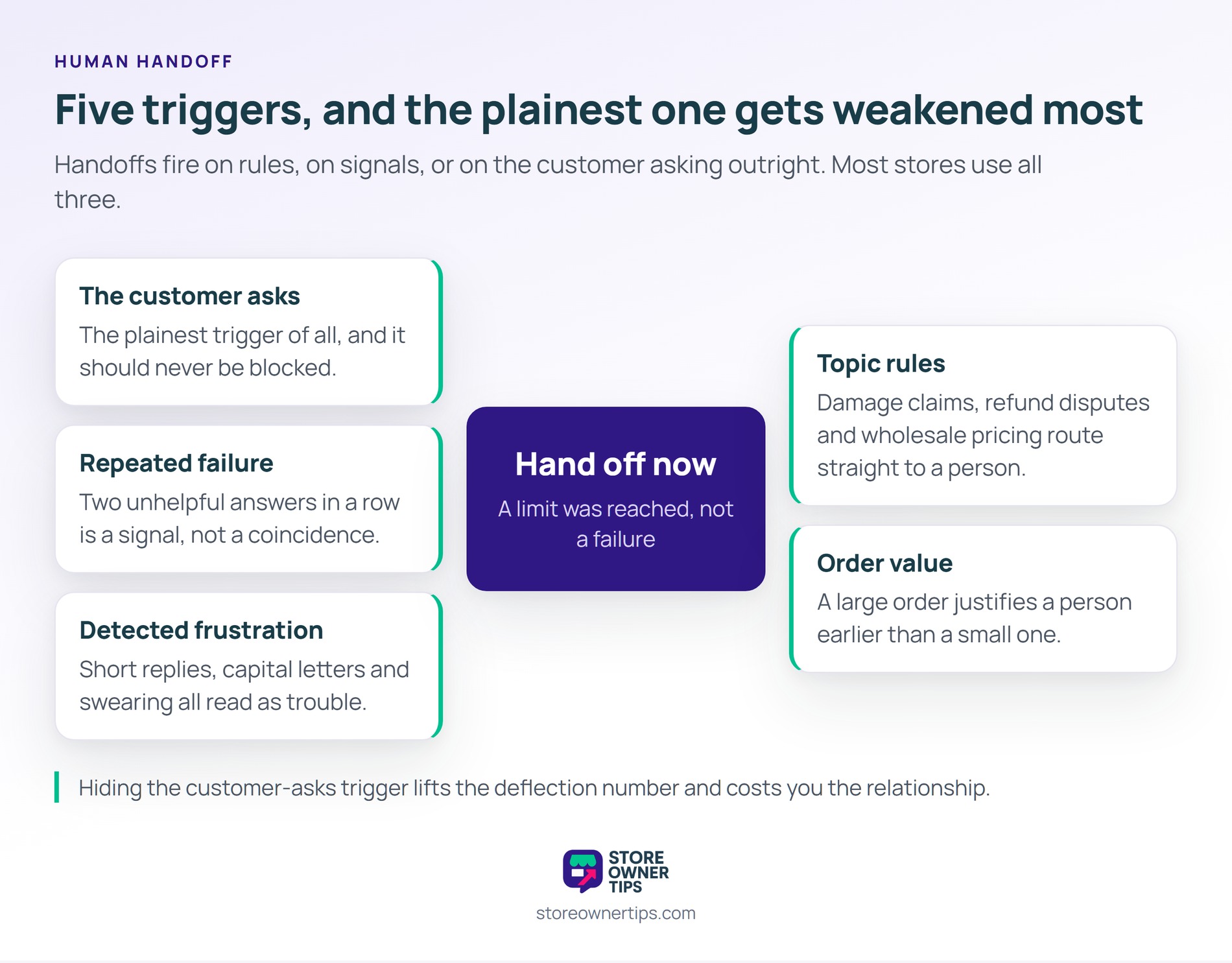
Handoffs fire on rules, on signals, or on the customer asking outright. Usually stores use all three, and the mix is worth setting deliberately.
Assistants built on a large language model can read tone rather than just keywords. That makes the frustration trigger far more reliable than a swear-word list. In practice, though, the customer-asks trigger is the one stores weaken. Hiding it lifts the deflection number and costs you the relationship.
A handoff that arrives empty is barely better than a fresh ticket. So the agent needs everything the assistant already knew.
StoreAgent describes this shape in its guide to running a chatbot for customer support. Its version handles the repetitive, high-volume tickets first. Then it hands complex cases to a human agent with the full conversation history attached.
Handoffs fail in a few predictable ways. Still, each failure is operational rather than technical, which means each one is fixable.
In practice the most common is the silent queue. The assistant promises a person, then nobody arrives for six hours. Meanwhile the customer has no idea whether the message even landed.
Also, an agent who cannot see the transcript will ask the opening question again. That one repetition undoes all the goodwill the transfer earned. Therefore the context matters more than the response time.
A confident wrong answer before the transfer is the third failure. An AI hallucination leaves your agent correcting your own assistant. A thin knowledge base causes constant handoffs, which is a content problem rather than a routing one.
Nobody publishes a clean handoff benchmark, so the useful figures sit around the edges of the question. StoreAgent’s analysis targets 60-80% deflection rather than 100%. So that deliberately leaves a fifth to two-fifths of conversations in human hands.
Klarna’s published results suggest the split can raise quality rather than lower it. It reported a 25% drop in repeat inquiries after its assistant launched, crediting more accurate resolution.
Pew Research adds the customer’s side of it. It found 61% of Americans want more control over how AI is used in their lives. That is not a support survey, though it does explain why a visible route to a person matters.
Also, adoption on smaller stores is still early. StoreAgent, our own WooCommerce support chatbot, reports 500+ active installations. So the handoff patterns are still being written.

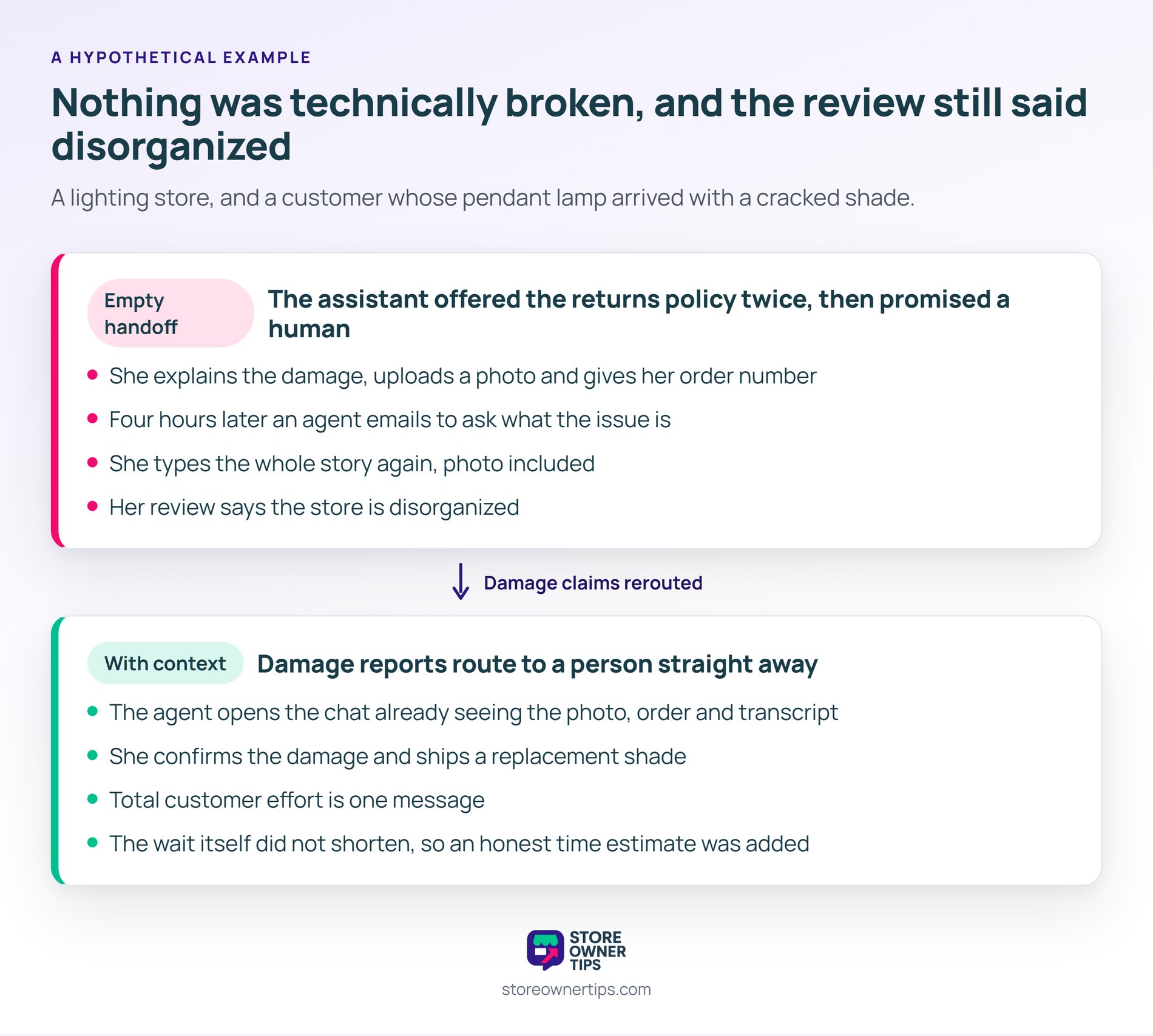
Here’s a hypothetical example. So picture a lighting store, and a customer whose pendant lamp arrived with a cracked shade.
She opens the chat, explains the damage, uploads a photo and gives her order number. The assistant offers the returns policy twice. Then it says a human will be in touch.
Four hours later an agent emails to ask what the issue is. So she types the whole story again, photo included.
Nothing was technically broken here. Still, she now believes the store is disorganized. Consequently that is what her review says.
Next, they rewire the same conversation. Damage reports now route to a person straight away, skipping the policy answer entirely.
Instead the agent opens the chat already seeing the photo, the order and the transcript. First she confirms the damage. Then she ships a replacement shade.
As a result, total customer effort is one message. Meanwhile the store spent nothing on a returns-policy answer nobody wanted. In short, the same conversation cost a fraction of the goodwill.
Also, the rewiring did not shorten the wait. An agent still had to be available, and overnight messages still sat until morning.
Therefore they added a holding message with an honest time estimate. Even so, a wait is a wait. No routing rule changes that part.
| What you’re comparing | Human handoff | Escalation |
|---|---|---|
| What changes | Who is answering | The level of authority |
| Typical direction | Assistant to person | Tier one to tier two, or to a manager |
| What triggers it | A limit was reached | Complexity, risk or a complaint |
| Is it a bad sign | No, it is designed in | Sometimes, it can signal a failure |
| What the customer sees | A new responder | A different, usually senior, responder |
Every escalation involves a handoff, yet most handoffs are not escalations. For example, routing a damage report to the returns team is a handoff. Sending an unresolved refund dispute to a manager is an escalation.
So the two words are worth keeping apart in your process notes. Mixing them makes every transfer look like a problem, and your team stops reporting them honestly.

As soon as it has failed twice, detected frustration, or simply been asked. Topic rules help as well, so route damage claims, refund disputes and wholesale pricing straight to a person. Waiting longer than that only annoys somebody who already knows what they want.
Yes. Saying it up front sets expectations. It also makes the handoff feel like progress rather than an unannounced switch. It also stops people phrasing questions as though a person is reading them.
A clear message saying a person is coming, and roughly when. Silence is what turns a normal wait into a complaint. If nobody is available until morning, say that rather than implying somebody is already typing.
A human handoff matters because it decides what automation costs you at the moment it hits its limit. Consequently a clean transfer makes the assistant look careful. A broken one makes the whole store look careless.
So the handoff, rather than the answer rate, is where customers form their opinion of your support. Meanwhile your agents feel the difference too. Arriving with context is a completely different job from arriving cold.
Copyright © StoreOwnerTips.com. All Rights Reserved.
