Store Owner Tips

Subscribe to our newsletter

Weekly ecommerce tips, deals & news.

Thank You, we'll be in touch soon.

Latest News

IKEA Effect

The IKEA Effect is a mental shortcut where people value things more when they help make them. The name comes from flat-pack furniture you assemble yourself. Put in a little effort, and you suddenly love the result more than a finished version. For online stores, it means shoppers who customize, build, or curate a product feel more attached and will pay more.


Key Takeaways

  • Effort creates value: When customers help build a product, they value it far more than a ready-made version.
  • It only works on success: The boost fades if the task fails or feels too hard.
  • It is everywhere online: Product builders, customization tools, and even wishlists all tap the same instinct.
  • Higher value means higher spend: Attached shoppers pay more, return more often, and abandon less.

Understanding The IKEA Effect

How effort changes value

The IKEA Effect runs on a simple trade. You put in effort, and your brain rewards you by inflating the value of what you made. Three researchers named it in 2011: Michael Norton, Daniel Mochon, and Dan Ariely.
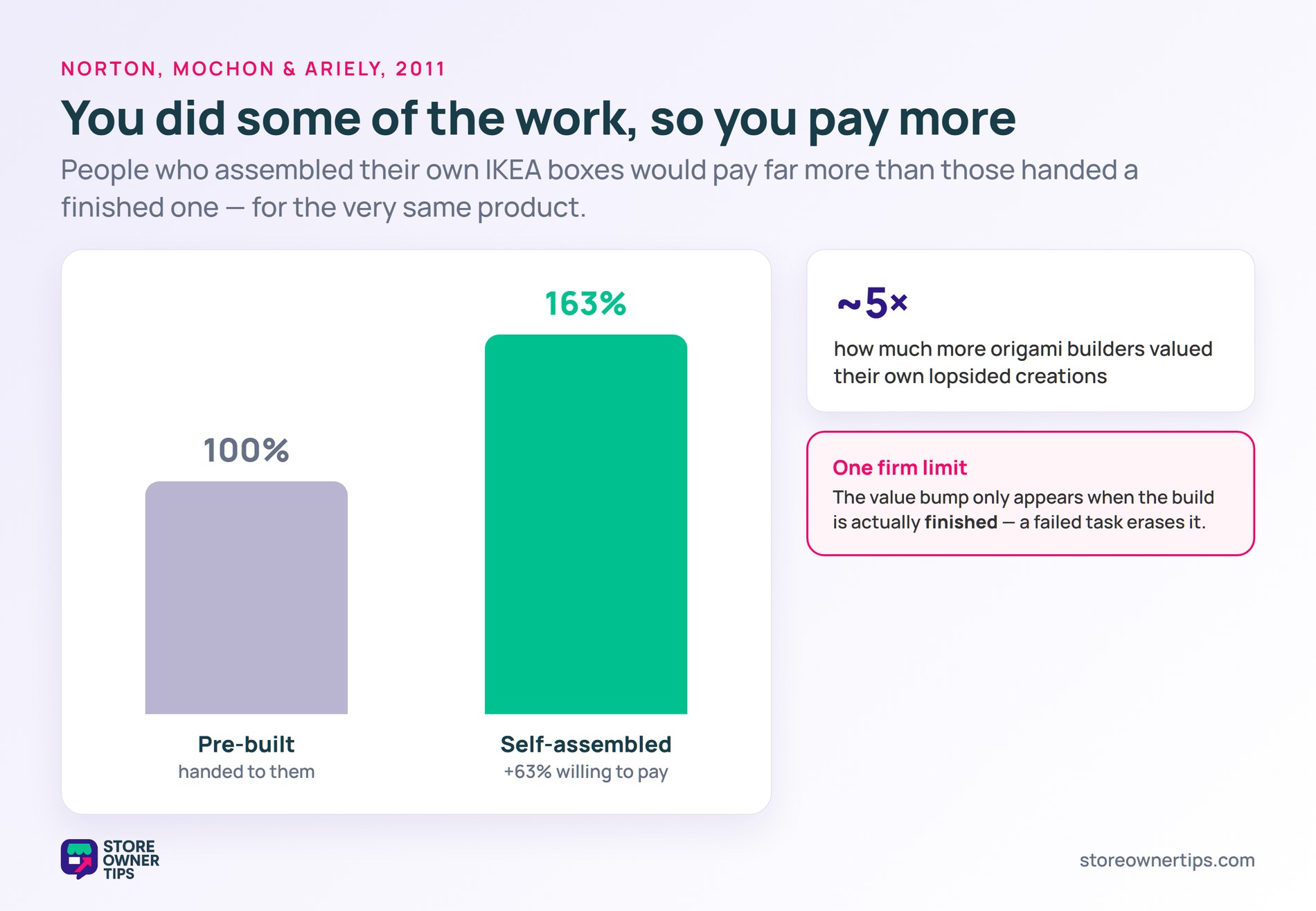
They ran a now-famous set of experiments. People who assembled plain IKEA boxes were willing to pay 63% more than people handed pre-built ones. A third test used Lego sets, with the same result.

The pattern repeated with origami. Builders valued their lopsided paper creations about five times higher than non-builders would pay. They even believed strangers would love the results as much as they did.

What makes this so useful is how little effort it takes. The work does not need to be hard or skilled. A few simple, guided choices are enough to trigger the value bump. Easy tasks are also the ones shoppers actually finish.

There is one firm limit, though. The effect only appears when people finish the job. When the task failed, or the creation was destroyed first, the extra value disappeared.

The psychology behind the love

Two forces drive the IKEA Effect. The first is competence. Finishing a task makes you feel capable, and that warm glow attaches itself to the product.

The second is ownership. Your own labor makes the item feel like a piece of you. That bond is hard to fake with a finished product off the shelf.

Psychologists also point to effort justification. We tell ourselves the work was worth it, so the result must be valuable. Admitting otherwise would mean the effort was wasted.

A home-cooked meal is the perfect example. It rarely beats a restaurant dish, yet it tastes better because you made it. The effort is the seasoning.

This pull is close to loss aversion, where losing something hurts more than gaining it helps. Once effort makes a product feel like yours, walking away feels like a loss. The value lives in the effort, not the finish, so amateur quality barely matters to the maker.

Where the IKEA Effect shows up online

Online, the IKEA Effect lives in any feature that asks shoppers to do a little work. Product configurators are the clearest case. On WooCommerce or Shopify, a customer who picks the color, size, and engraving has helped create that product.

Build-your-own bundles work the same way. So do subscription boxes that let people choose what goes inside. Each small choice adds a little effort and a little ownership.

Curated tools count too. When a shopper builds a wishlist, they invest effort that makes those saved items feel more like theirs. The same goes for gift registries and saved collections.

Physical products lean on it as well. Furniture, model kits, and craft sets all ask the buyer to finish the job at home. Personalized goods like engraved jewelry or monogrammed bags work the same way, since the buyer’s choices are baked into the final item.

Even loyalty programs borrow the idea. Earning points feels like work, so the reward feels earned and worth keeping. The thread connecting all of these is participation, and the more a shopper shapes the outcome, the more they value it.


A Hypothetical E-commerce Example

The setup

Imagine a mid-sized brand called Hearthside Candle Co. They sell quality ready-made candles, but growth has stalled. Shoppers browse, compare, and often leave without buying.

To break the pattern, they add a build-your-own candle tool to their WooCommerce store. Shoppers pick the wax, the scent, the vessel, and a custom label. They keep the choices limited on purpose, because too many options would overwhelm shoppers and stall the build. The whole process takes about two minutes and ends with a clear preview.

The results

The effort changes everything. A plain Hearthside candle sells for $20. Because customers helped design the custom version, they happily pay around $32 for it.

That lift mirrors what researchers found with self-built furniture. The buyer is not paying for better wax. They are paying for the candle they helped make.

The tool also rescues lost sales. Around 70.22% of online carts are abandoned, often by shoppers who simply were not ready. A short, satisfying build pulls hesitant visitors into the process.

Once they finish designing, they feel invested and far more likely to check out. The benefits do not stop at one sale, either. Shoppers who design something they love tend to come back, and they share their creations with friends.

There is a quieter benefit, as well. Customers who design their own candle often leave proud, detailed reviews. That user content becomes free marketing that pulls in the next wave of shoppers.


IKEA Effect Vs. Endowment Effect

The IKEA Effect has a close cousin, the endowment effect. Both make people overvalue things, but the trigger differs.

The endowment effect needs only ownership. Once something is yours, you want more to give it up. In the classic mug study, owners demanded about twice as much to sell as buyers would pay.

The IKEA Effect goes a step further. It needs effort, not just ownership. You do not just own the thing, you helped make it.

Online, you can stack them in one flow. A shopper builds a custom product, adds it to the cart, and now owns something they also made. Ownership creates attachment, and effort multiplies it, so the smart move is to use both.


The Pros And Cons

Like any psychological lever, the IKEA Effect cuts both ways. Used well, it lifts value and loyalty. Pushed too hard, it frustrates shoppers or distorts your own pricing. Here is the honest balance.

The Pros

  • Higher prices: Shoppers who help build a product accept higher prices without feeling cheated.
  • Stronger loyalty: Effort builds attachment, so customers return to the brand they helped create.
  • Built-in differentiation: A custom build is hard for copycat stores to match on price alone.

The Cons

  • Effort can backfire: Too many steps frustrate shoppers, and a failed build kills the value boost.
  • Overvaluation risk: Owners may price products too high because they overvalue their own work.
  • Not for everyone: Some shoppers just want a fast, finished purchase with zero work.

Frequently Asked Questions

Is the IKEA Effect the same as the endowment effect?

No, but they are related. The endowment effect comes from owning something. The IKEA Effect comes from helping make it. Effort is the key extra ingredient that pushes value even higher. Used together, the two biases make a product feel both owned and earned.

How can a small online store use the IKEA Effect?

Start small and simple. Add a product customizer, a build-your-own bundle, or a wishlist shoppers curate themselves. Even a basic choose-your-color option can start the effect. The goal is light, satisfying effort that always ends in success. Test one feature first, then expand once you see the lift.

Does the IKEA Effect work if the product turns out badly?

Usually not. Research shows the value boost only appears when people finish the task. A broken or abandoned build erases the effect. So make sure the process is easy enough to complete, even for a first-time visitor. A smooth, guided flow protects the value you are trying to create.


The Bottom Line

The IKEA Effect turns effort into attachment, and attachment into sales. When you let shoppers help build, customize, or curate, you give them a reason to value your products more. That attachment also keeps them loyal. The takeaway is not to make shoppers work for no reason. It is to invite the right kind of effort, the kind that ends in something they are proud of.

Share article

Subscribe to our newsletter

Weekly ecommerce tips, deals & news.

Nice – You're in!

Copyright © StoreOwnerTips.com. All Rights Reserved.