Weekly ecommerce tips, deals & news.
The IKEA Effect is a mental shortcut where people value things more when they help make them. The name comes from flat-pack furniture you assemble yourself. Put in a little effort, and you suddenly love the result more than a finished version. For online stores, it means shoppers who customize, build, or curate a product feel more attached and will pay more.
The IKEA Effect runs on a simple trade. You put in effort, and your brain rewards you by inflating the value of what you made. Three researchers named it in 2011: Michael Norton, Daniel Mochon, and Dan Ariely.
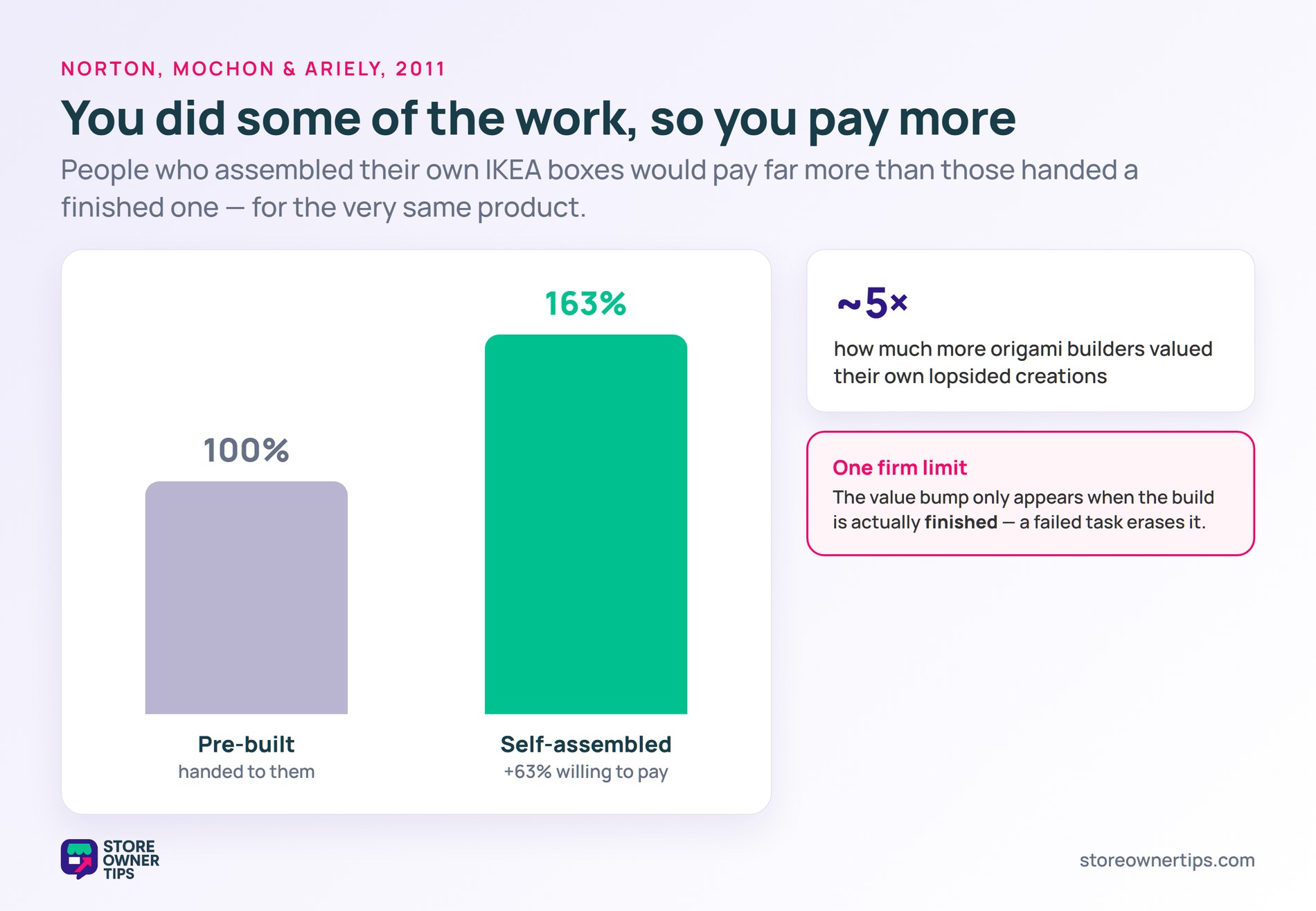
They ran a now-famous set of experiments. People who assembled plain IKEA boxes were willing to pay 63% more than people handed pre-built ones. A third test used Lego sets, with the same result.
The pattern repeated with origami. Builders valued their lopsided paper creations about five times higher than non-builders would pay. They even believed strangers would love the results as much as they did.
What makes this so useful is how little effort it takes. The work does not need to be hard or skilled. A few simple, guided choices are enough to trigger the value bump. Easy tasks are also the ones shoppers actually finish.
There is one firm limit, though. The effect only appears when people finish the job. When the task failed, or the creation was destroyed first, the extra value disappeared.
Two forces drive the IKEA Effect. The first is competence. Finishing a task makes you feel capable, and that warm glow attaches itself to the product.
The second is ownership. Your own labor makes the item feel like a piece of you. That bond is hard to fake with a finished product off the shelf.
Psychologists also point to effort justification. We tell ourselves the work was worth it, so the result must be valuable. Admitting otherwise would mean the effort was wasted.
A home-cooked meal is the perfect example. It rarely beats a restaurant dish, yet it tastes better because you made it. The effort is the seasoning.
This pull is close to loss aversion, where losing something hurts more than gaining it helps. Once effort makes a product feel like yours, walking away feels like a loss. The value lives in the effort, not the finish, so amateur quality barely matters to the maker.
Online, the IKEA Effect lives in any feature that asks shoppers to do a little work. Product configurators are the clearest case. On WooCommerce or Shopify, a customer who picks the color, size, and engraving has helped create that product.
Build-your-own bundles work the same way. So do subscription boxes that let people choose what goes inside. Each small choice adds a little effort and a little ownership.
Curated tools count too. When a shopper builds a wishlist, they invest effort that makes those saved items feel more like theirs. The same goes for gift registries and saved collections.
