Weekly ecommerce tips, deals & news.
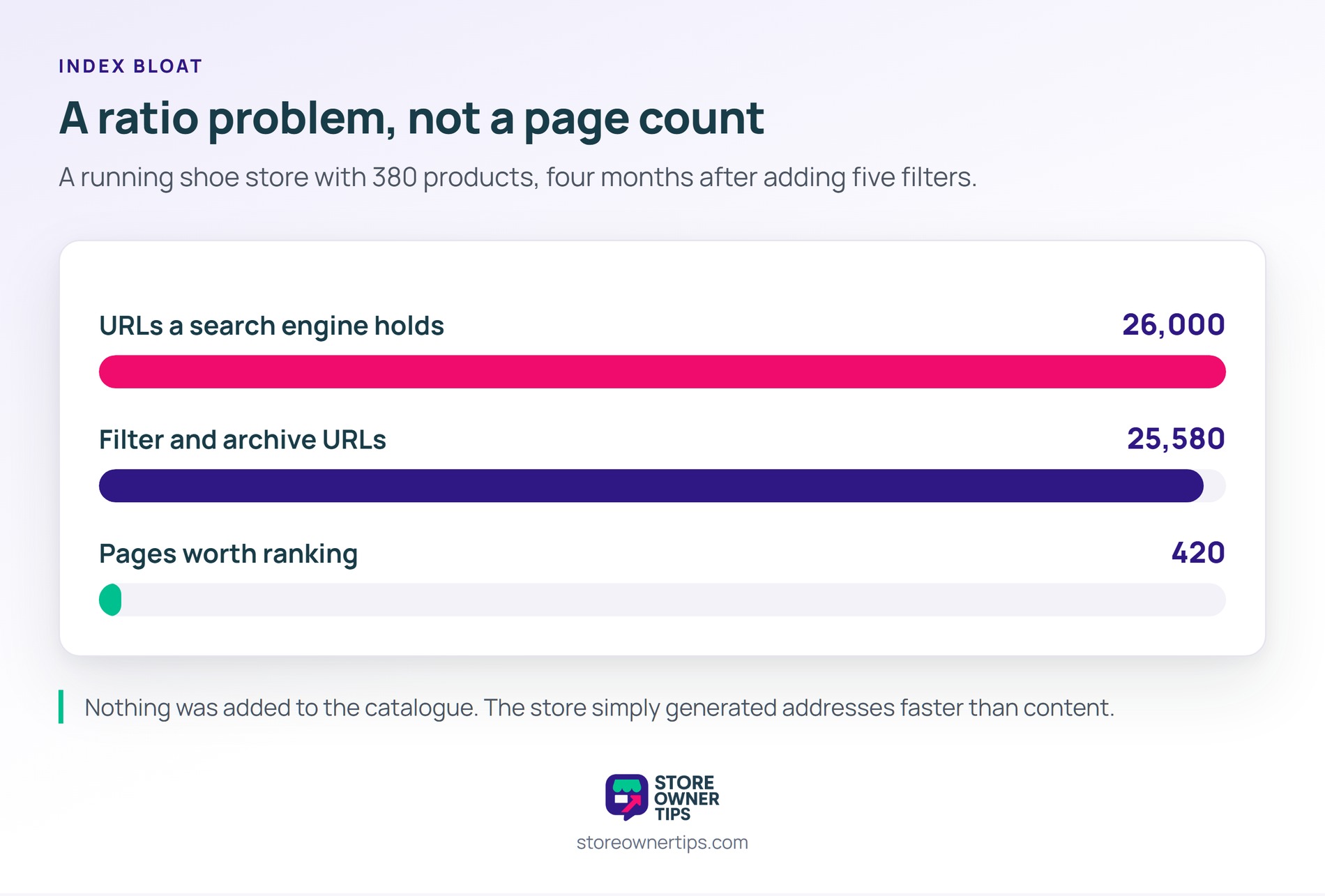
Index bloat is when a search engine indexes far more of your URLs than you have pages worth ranking. Your store might sell 400 products. Google might hold 40,000 URLs for it.
The extra URLs are mostly filter combinations, sort orders and archives. So index bloat is a dilution problem rather than a penalty. The page you carefully optimised is competing with thousands of near-copies of itself.
Index bloat works because a store creates URLs faster than it creates content. Think of a library that files a fresh catalogue card every time somebody reshelves a book. So the shelves have not changed, but the catalogue is now unusable.
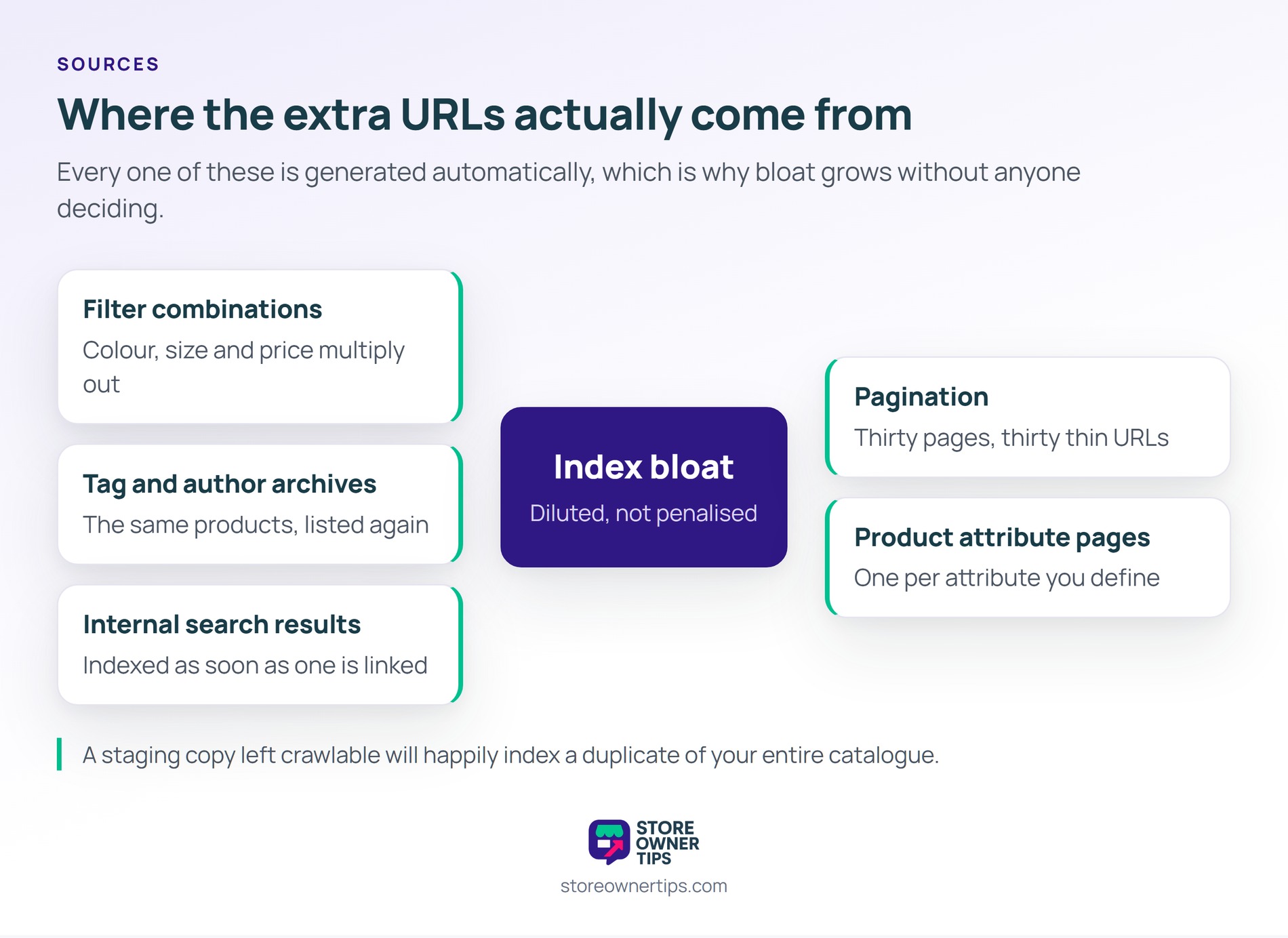
Index bloat in a WooCommerce store has a handful of reliable sources. First, filters combine colour, size and price into a huge set of addresses. Each one is a real URL that a crawler can follow.
Then come the archives nobody asked for. For example, tag pages, author pages and dated archives all list the same products again. Meanwhile internal search result pages get indexed whenever something links to one.
Then pagination adds another layer on top of that. A category with 30 pages of results produces 30 more thin URLs. So faceted navigation is usually the first place to look when the numbers stop making sense.
Two quieter sources catch stores out as well. Product attribute pages get created automatically for every attribute you define. Meanwhile a staging copy left crawlable will happily index a duplicate of your entire catalogue.
Index bloat rarely gets a store penalised, and that is worth saying plainly. Instead, the harm shows up in which URL wins. A filtered variant can outrank the clean category page you promote.
Still, position is almost everything. Backlinko’s study of four million results found the top three positions take 54.4% of all clicks. Landing a thin filter URL there instead of your category page wastes the placement.
Meanwhile internal links get spread thin in the same way. Every link pointing at a filtered copy is a link not pointing at the page you want to rank. On a big catalogue that split becomes the whole problem.
Your own reporting suffers too, which is a quieter cost. Averages calculated across thousands of dead URLs make every page look weak. So the pages that genuinely work get buried in your own numbers.
Index bloat is diagnosed by comparing two numbers you already have. So count the pages you genuinely want ranking, which is products plus categories plus content. Next, check how many URLs are actually indexed.
For example, a gap of a few percent is normal housekeeping. A gap of ten times is a structural problem. So the ratio, rather than either number alone, is what tells you whether to act.
Next, look at which indexed URLs earn impressions but almost no clicks. Those are your bloat candidates, and they usually share a query string. Checking a page’s indexability tells you whether the fix is a directive or a link change.
Index bloat sits inside a much larger pattern of pages that earn nothing. Ahrefs studied its entire Content Explorer database, roughly 14 billion pages. It found 96.55% of pages get zero traffic from Google.
So being indexed is clearly not the same as being useful. Most URLs in existence simply never rank for anything. Adding thousands more of your own to that pile changes nothing about your visibility.
The stakes are high because organic search carries so much traffic. BrightEdge puts the organic channel at 53.3% of traffic across the sites it measures. So confusion about which URL should rank is expensive confusion.
Index bloat in practice announces itself as a rising page count and flat traffic. Here is a hypothetical example. Imagine a store selling running shoes, with 380 products across 12 categories.
In this scenario, the store adds filters for size, width, colour, brand and price band. Every combination produces its own crawlable URL. Nothing tells a search engine that these are variations of one page.
Then, within four months, the indexed count passes 26,000. The real total worth ranking is closer to 420. Meanwhile organic traffic has not moved at all.
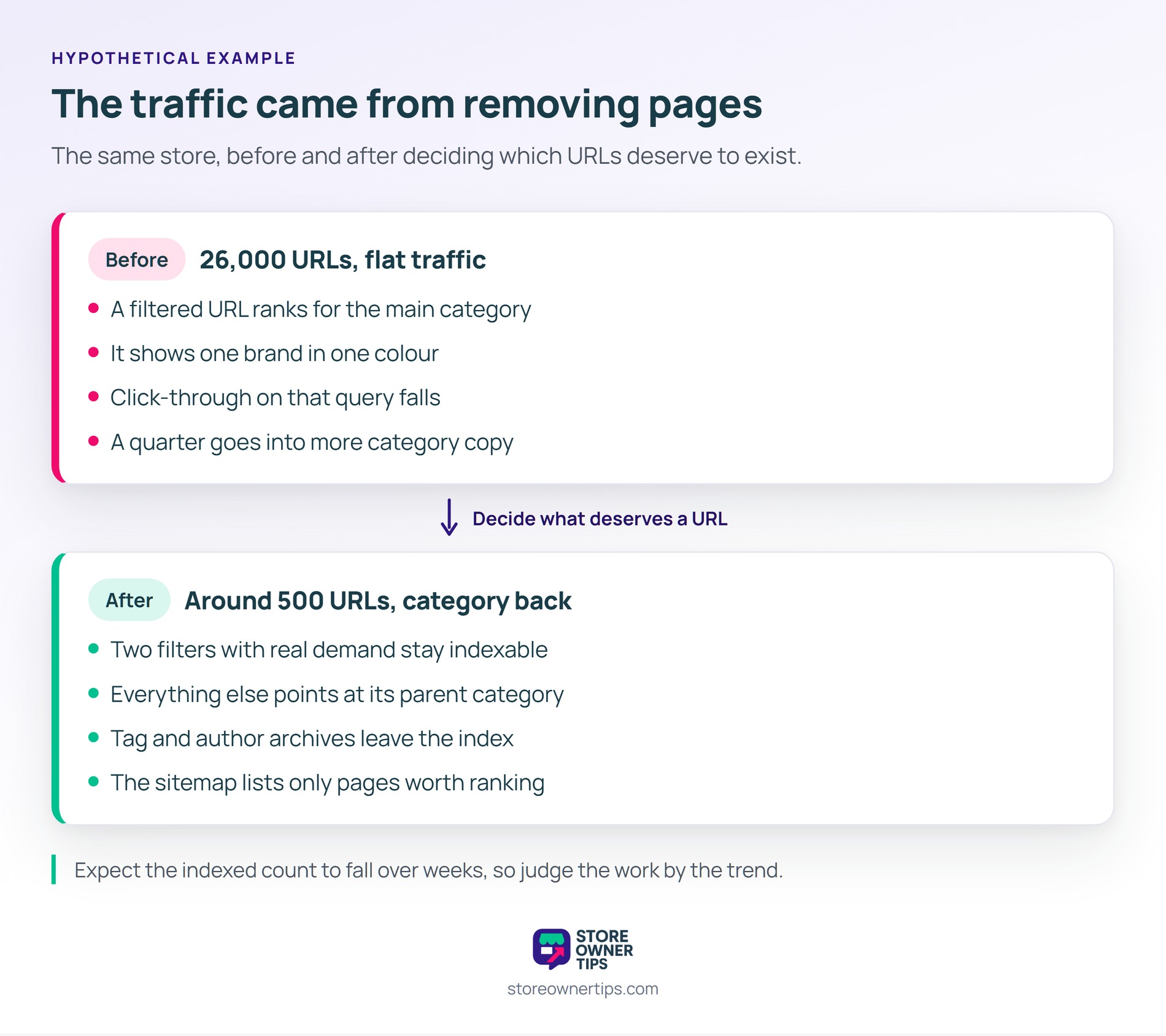
Searches for the store’s main category start returning a filtered URL. It shows one brand in one colour, which is not what the searcher asked for. As a result the click-through on that query falls.
The owner reads the flat traffic as a content problem. So the next quarter goes into writing more category copy. Still, the copy lands on a page that is no longer the one ranking.
First, the store decides which filter combinations deserve to exist as pages. Two of them have real search demand and stay indexable. Everything else gets pointed back at its parent category.
Next, tag and author archives come out of the index entirely. The sitemap is rebuilt to list only URLs the store wants ranking. Even so, the indexed count takes weeks to fall.
Three months later the count sits near 500, and the category page ranks again. In short, nothing was added, and the traffic came from removing noise.
| What you are comparing | Index bloat | Keyword cannibalization |
|---|---|---|
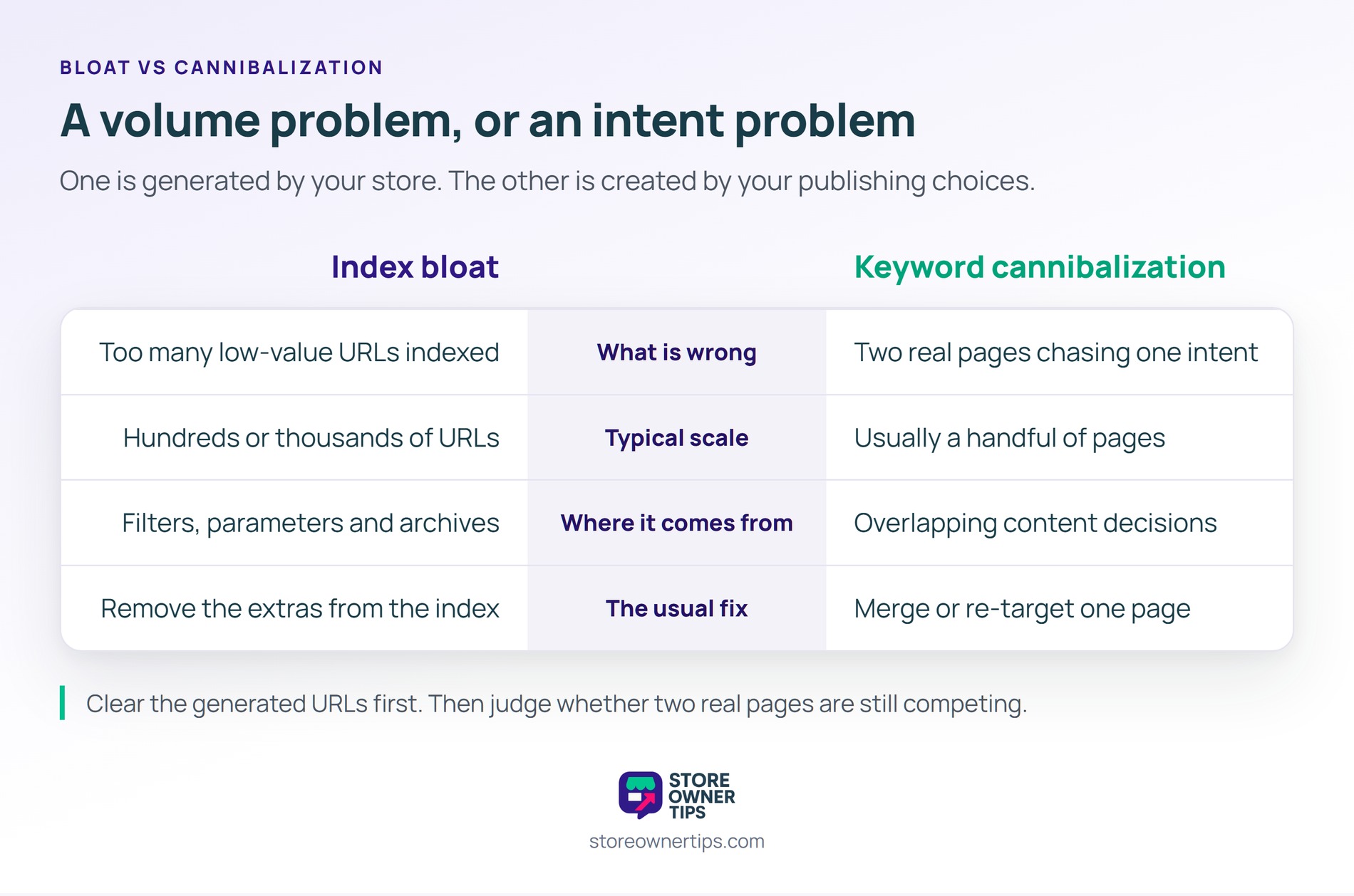
| What is wrong | Too many low-value URLs indexed | Two real pages chasing one intent |
| Typical scale | Hundreds or thousands of URLs | Usually a handful of pages |
| Where it comes from | Filters, parameters and archives | Overlapping content decisions |
| The usual fix | Remove the extras from the index | Merge or re-target one page |
Index bloat is a volume problem, while cannibalization is an intent problem. One is generated automatically by your store, and the other is created by your own publishing choices.
They do feed each other, which is why they get confused. Thousands of near-duplicate URLs make keyword cannibalization much more likely. So clearing the bloat often resolves the overlap without touching your content.
Order of work matters when you have both. Clear the automatically generated URLs first, because that is a settings change. Then judge whether two real pages are still competing, once the noise around them is gone.
First, count the pages you want ranking and compare that to the indexed total. Products, categories and articles are the pages that count. If the indexed number is several times larger, you have bloat.
Then sort your indexed URLs by clicks and look at the bottom. A long tail of URLs with query strings and no clicks is the signature.
Keep the handful that people genuinely search for and remove the rest. A filter like waterproof running shoes may have real demand of its own. A filter combining three attributes almost never does.
Also stop linking to the combinations you do not want indexed. Directives tell a crawler what to do, while your own links tell it what you care about.
Not as a penalty, and it helps to be clear about that. Search engines do not punish a site for having thin URLs indexed. The damage is that the wrong URL ranks and your internal links get split.
On a large catalogue there is a second cost. Crawlers spend their time on duplicates instead of your new products, which slows down how quickly those get picked up.
Index bloat matters because it decides which of your URLs a searcher actually meets. You can write the best category page in your market and still lose the click to a filtered copy. Plus the fix removes pages rather than adding work. Expect the count to fall over weeks, so judge the result by the trend rather than by tomorrow.
In short, a small index you control beats a large one you do not.
Copyright © StoreOwnerTips.com. All Rights Reserved.
