Weekly ecommerce tips, deals & news.
A key performance indicator (KPI) is a number you track because it shows progress toward a specific goal. Think of it as a vital sign for your business, like a pulse for a doctor. A regular metric only reports data, while a KPI ties that data to an outcome you care about. So every KPI is a metric, but only goal-linked metrics earn the KPI label.
KPIs sound corporate, but the idea is simple. They are the dashboard gauges for your store. You cannot watch every dial at once, so you pick the few that keep you on the road.
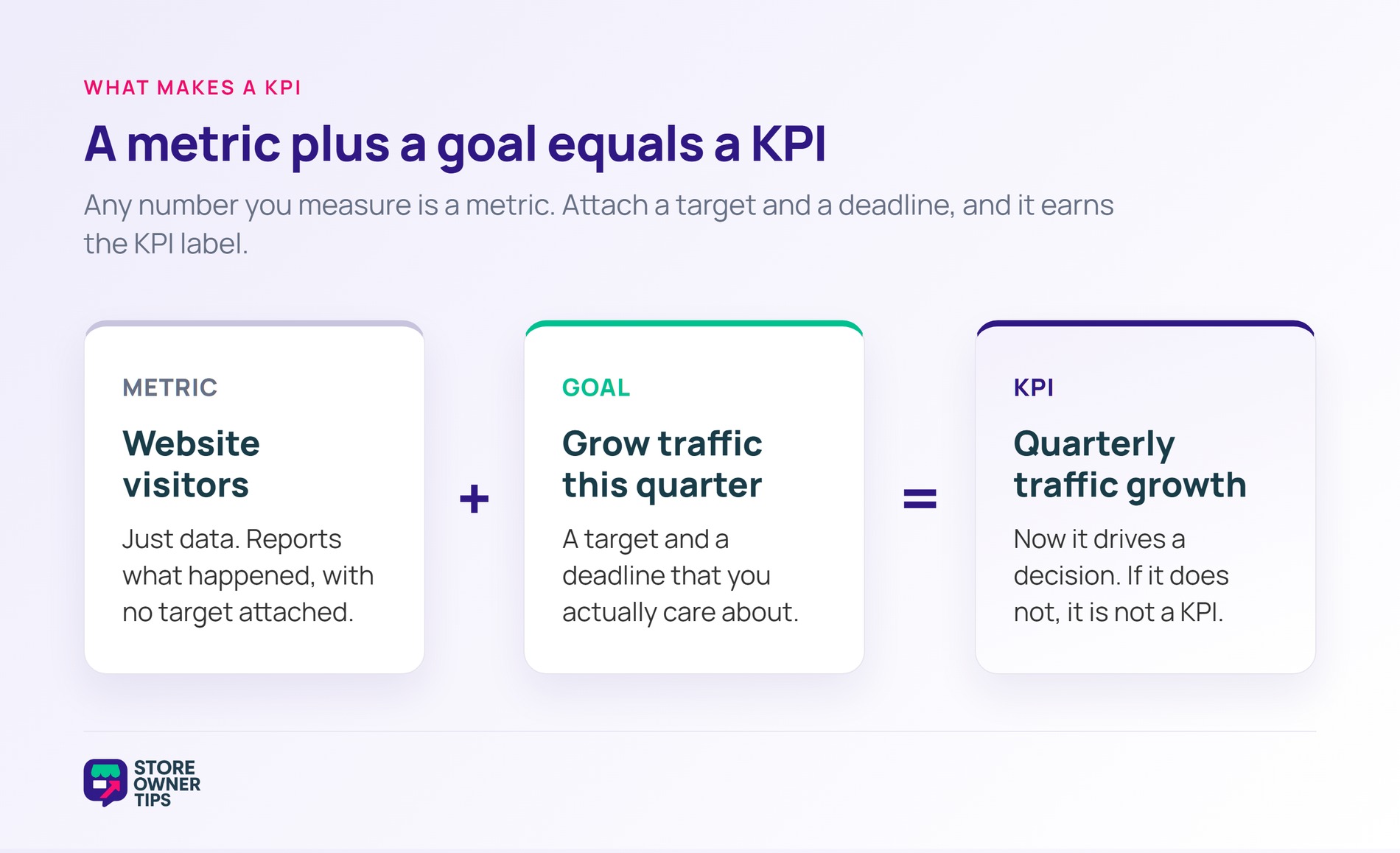
Every KPI starts as a metric. The difference is a goal. When you attach a target and a deadline to a metric, it becomes a KPI.
Say you track website visitors. On its own, that is just a metric. Tie it to a goal, like growing traffic this quarter, and now it drives action.
That link to a decision is the whole point. A KPI should answer a question you actually care about. If a number does not change what you do next, it is not a KPI.
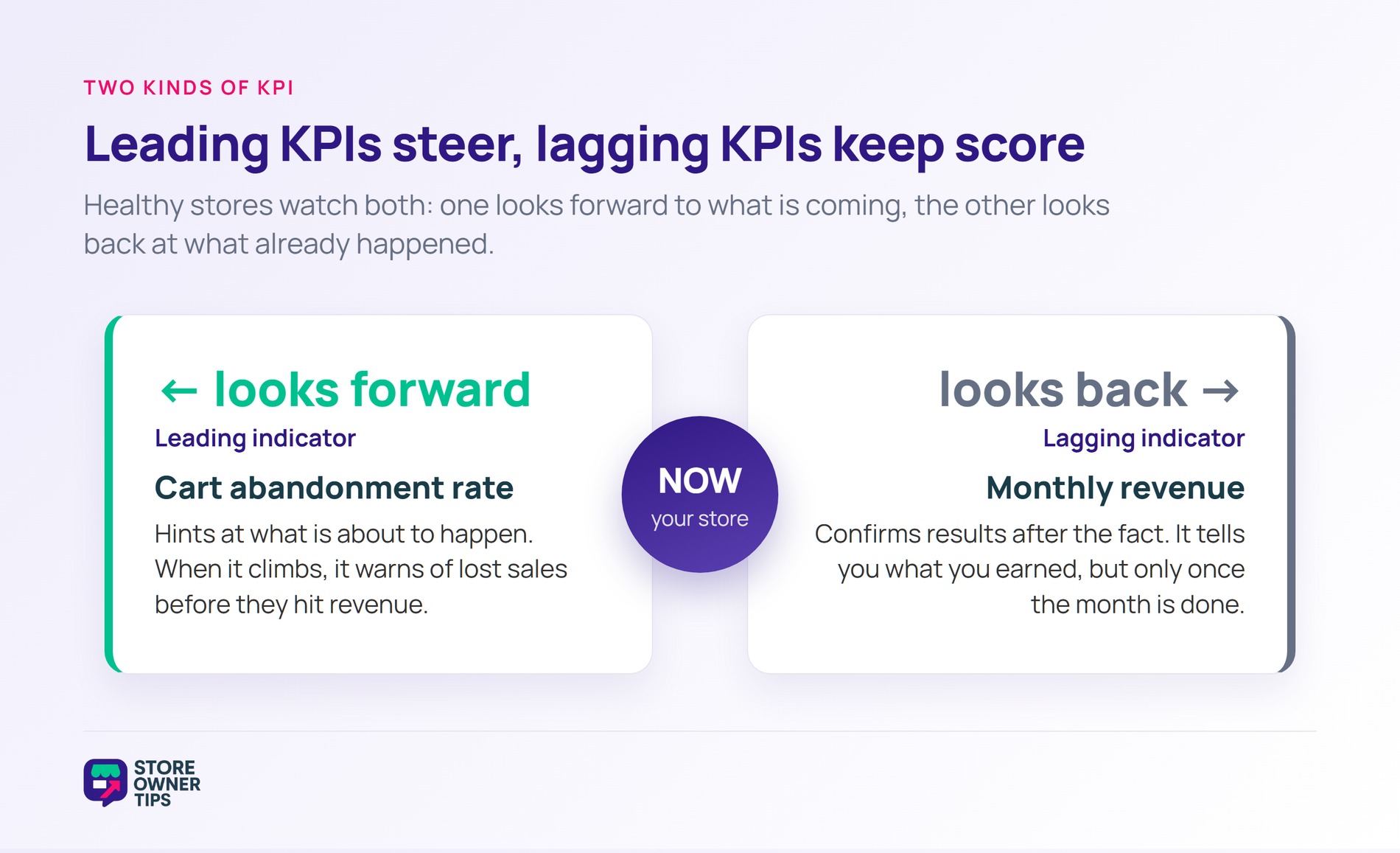
KPIs come in two flavors, and you want both. Leading indicators look forward. Lagging indicators look back.
A leading KPI hints at what is about to happen. Cart abandonment rate is a good example. When it climbs, it warns you of lost sales before they show up in revenue.
A lagging KPI confirms results after the fact. Monthly revenue is the classic one. It tells you what you earned, but only once the month is done.
Healthy stores watch both. Leading KPIs let you steer, while lagging KPIs let you keep score.
Most stores rally around a core set of KPIs. These map to the money: getting visitors, converting them, and keeping them.
On the sales side, conversion rate and average order value show how well traffic turns into revenue. Customer acquisition cost tracks what you pay to win each buyer. Profit-focused owners also watch margin, since retail runs lean. The Retail (General) sector averages a net margin of just 5.61%.
On the loyalty side, repeat purchase rate and churn rate reveal whether customers stick around. That matters because acquiring a new customer costs 5 to 25 times more than keeping one.
Traffic and engagement KPIs round out the set. Organic sessions, email open rate, and bounce rate show how people find and react to your store. The right mix depends on your stage. A new store may obsess over traffic, while a mature one guards margin and retention.
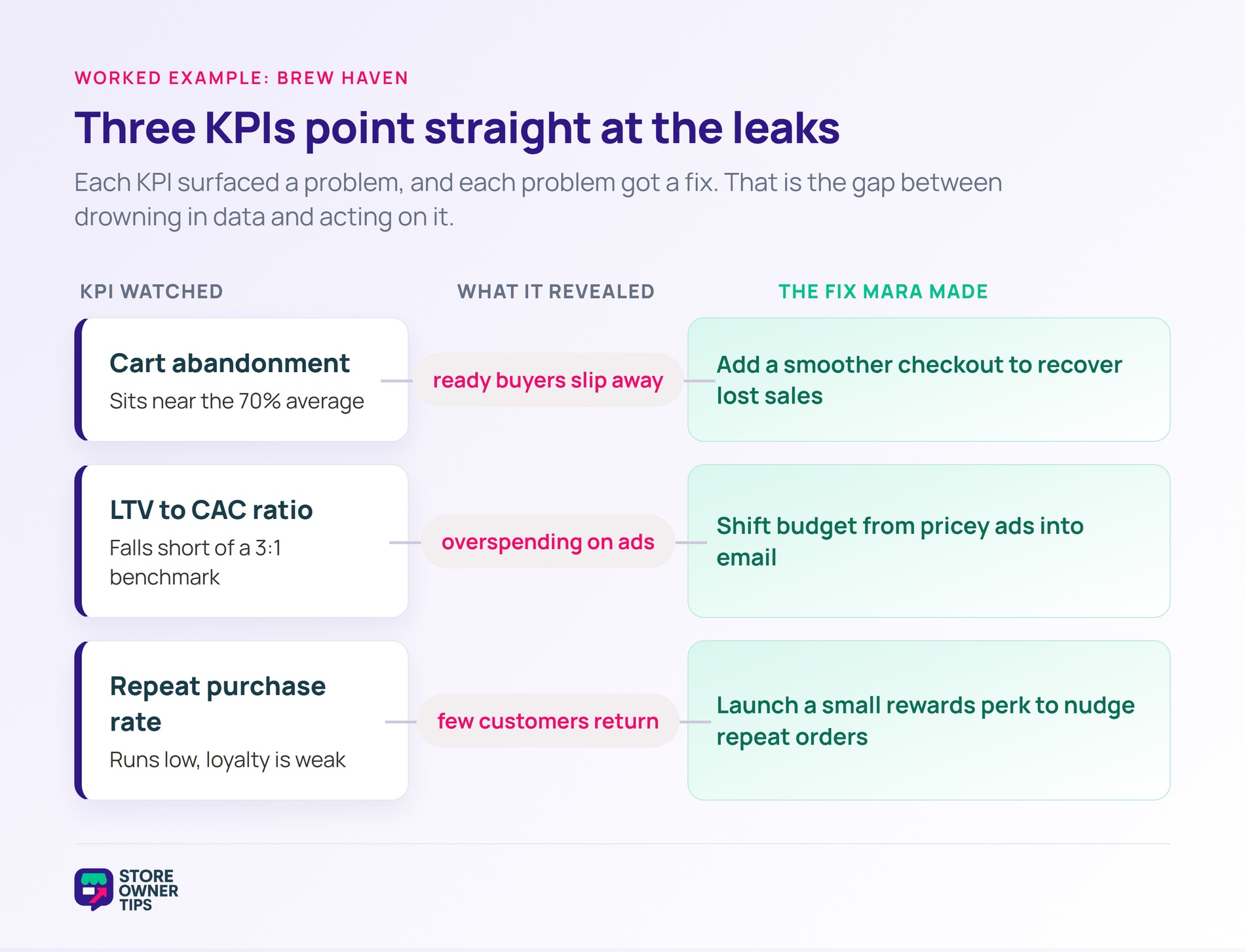
Imagine a mid-sized store called Brew Haven that sells coffee gear. The owner, Mara, feels busy but cannot tell if she is winning. So she picks three KPIs to watch instead of guessing.
First, she tracks cart abandonment rate. The ecommerce average sits at 70.22%, and Brew Haven lands right around it. That tells Mara many ready buyers slip away at checkout.
Next, she watches her LTV to CAC ratio. This weighs what a customer is worth over time against what it costs to win them. A healthy benchmark is 3:1, yet Brew Haven falls well short. Now she knows she is overspending on ads for each sale.
Finally, she follows repeat purchase rate, her leading sign of loyalty. It runs low, which stings, since keeping a customer costs much less than chasing a new one. A small lift here would pad her profit without a bigger ad budget.
With three KPIs, Mara has a plan, not a hunch. She adds a smoother checkout to cut abandonment. She shifts budget from pricey ads into email to lift her ratio. Plus she launches a small rewards perk to nudge repeat orders.
None of this needed a fancy dashboard. The KPIs pointed straight at the leaks, and Mara patched them one by one. That is the gap between drowning in data and acting on it.
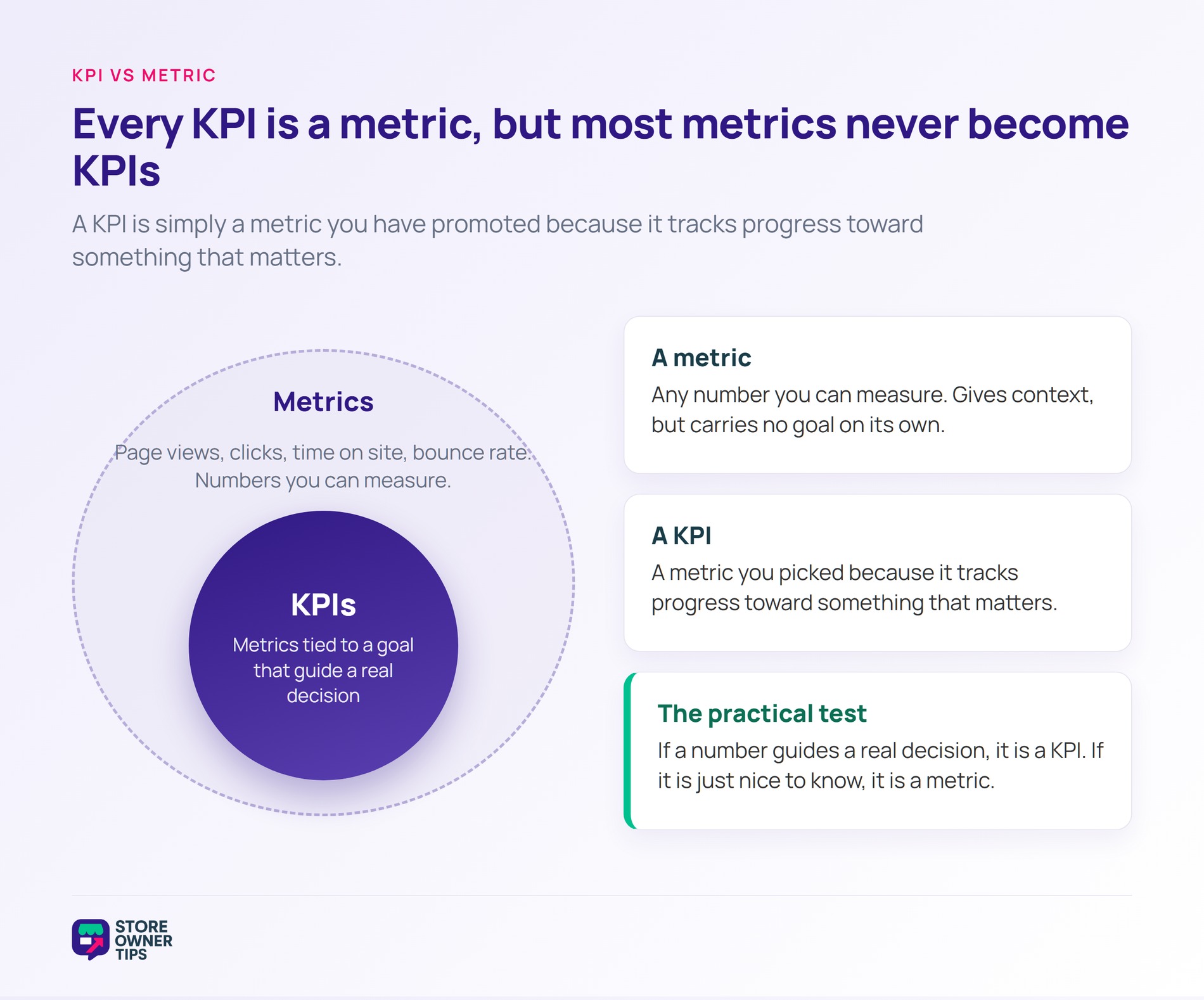
People use ‘KPI’ and ‘metric’ as if they mean the same thing. They do not, and the difference is worth knowing.
A metric is any number you can measure. Page views, clicks, time on site, and bounce rate are all metrics. They give context, but they do not carry a goal on their own.
A KPI is a metric you have promoted. You picked it because it tracks progress toward something that matters. Every KPI is a metric, but most metrics never become KPIs.
Here is the practical test. If a number guides a real decision, treat it as a KPI. If it is just nice to know, it is a metric.
The trap is treating every metric like a KPI. That scatters your focus across numbers that do not move the business.
A metric is any measurable number, like total page views. A KPI is a metric tied to a goal you are trying to hit. Put simply, a KPI is a metric with a job to do. Every KPI is a metric, but not every metric earns KPI status.
Fewer than you think. Most small stores do well with just a handful of KPIs at a time. Too many, and you cannot tell which numbers actually need attention. So pick the ones that match your current goal, then revisit them as priorities shift.
It depends on your goal, but a few show up almost everywhere. Conversion rate, average order value, and cart abandonment rate cover the buying journey. Customer acquisition cost and repeat purchase rate track profit and loyalty. Start with the ones that map to your biggest current problem.
KPIs turn a pile of numbers into a clear story about your store. The skill is not tracking more, but tracking the few that tie to your goals. Your KPI list should also stay flexible as your goals shift. Choose those wisely, watch them often, and let them guide what you build next.
Copyright © StoreOwnerTips.com. All Rights Reserved.
