Weekly ecommerce tips, deals & news.
Net Revenue Retention (NRR) measures how much revenue you keep and grow from your existing customers over time. It looks only at current buyers and ignores brand-new sales. That tells you whether your business is naturally growing or shrinking. If you stopped all marketing today, NRR shows what happens to your recurring revenue next year.
To understand how net revenue retention works, picture your store’s recurring revenue as a reservoir of water. Every month, water naturally flows in and out. NRR measures the volume in your reservoir at the end of the month versus the start. The catch is that you must exclude any “new rain,” meaning revenue from brand-new customers.
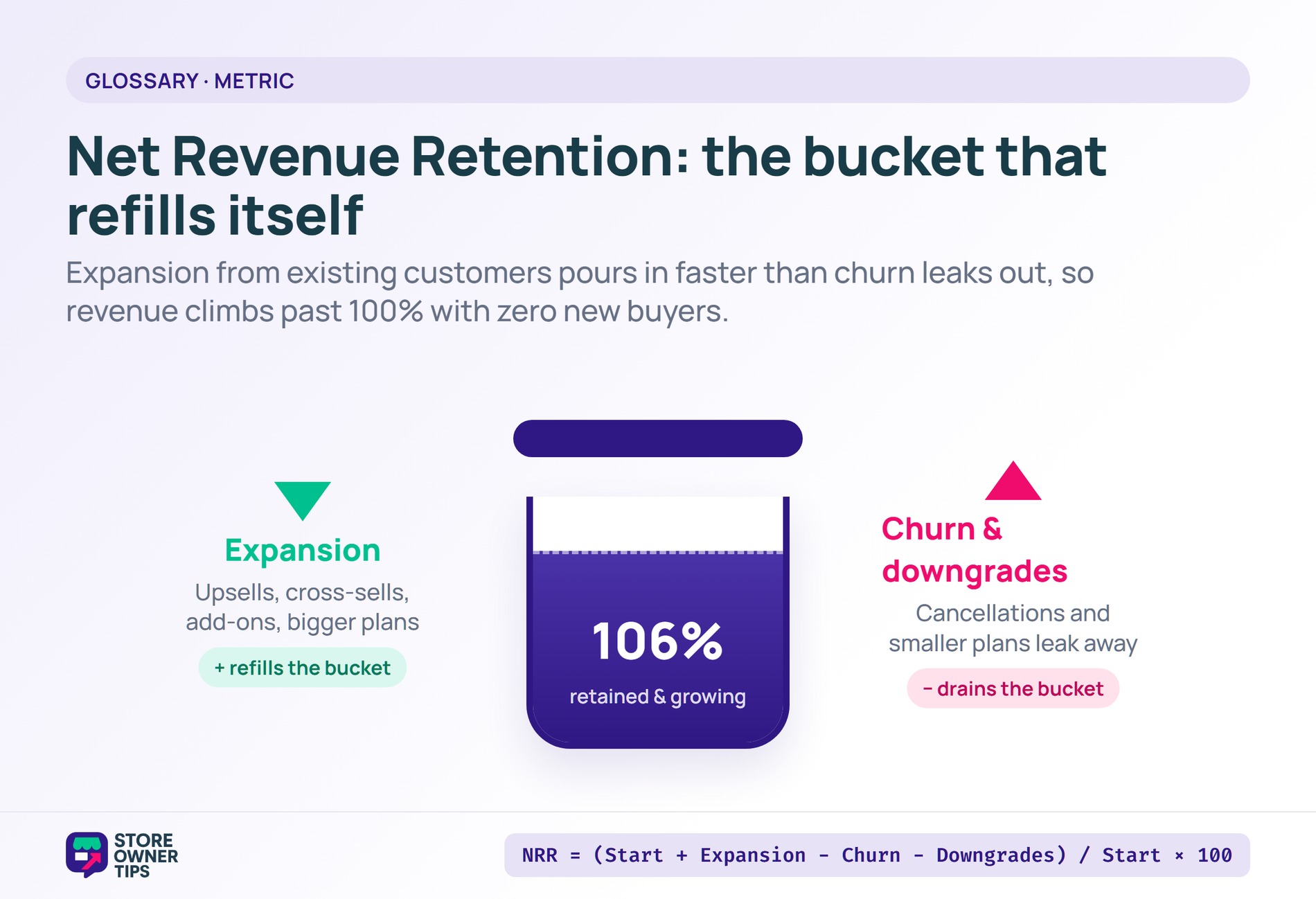
The metric relies on the constant push and pull of four specific revenue movements:
If your net retention sits exactly at 100%, your business is in perfect balance. The money you gain from upgrades covers the money you lose from cancellations.
If it dips below 100%, your business is shrinking from the inside. But above 100%, your existing customer base grows more valuable over time. That happens independent of your marketing efforts.
Business owners obsess over this number because of simple consumer psychology. Getting a stranger to trust your brand and pull out a credit card is hard. But an existing customer has already bypassed that friction. They already trust you.
Getting them to spend more relies on experience-led growth. You aren’t selling a promise anymore. You’re simply giving them more of a product they already love.
Tracking this data takes serious technical work behind the scenes. Standard spreadsheets just can’t keep up.
If you use a self-hosted platform like WooCommerce, the WordPress Action Scheduler quietly protects your net retention. A big threat is involuntary churn, when a customer’s card fails by accident. The Action Scheduler acts like an automated alarm clock. If a payment fails, it sets a quiet timer to retry the card later in the background.
If you use Shopify, the platform uses deep data structures and webhooks to track upgrades and downgrades. Think of a webhook like a digital tap on the shoulder. When a customer upgrades, Shopify instantly taps your database to update the revenue number.
Shopify also limits what outside apps can see. So developers often pull this raw webhook data into a separate database for accurate reports.
Similarly, Stripe uses dunning management and Smart Retries. Think of dunning management as a polite, automated debt collector. It uses machine learning to time each retry for when a bank is most likely to approve the card. It can even update expired card details automatically to keep your NRR safe.
Let’s walk through how this looks for a realistic online store. Imagine a mid-sized subscription apparel brand.
To measure their health, they group their buyers into cohorts. Think of a cohort like a graduating class. Everyone who signed up in January gets tracked together over time.
Let’s say the January cohort starts the month at exactly $100,000 in Starting MRR.
During the month, they face some standard e-commerce hurdles. Subscription e-commerce averages 3.4% monthly churn across voluntary and involuntary cancellations. This brand recovers some failed payments with automated dunning, which the apparel category tends to be good at. Even so, they permanently lose $5,000 to cancellations (Churned MRR).
A few more customers downgrade to a cheaper clothing box tier, costing the brand $2,000 (Contraction MRR).
To fight back, the brand launches an exclusive VIP cross-sell campaign. Several customers love the new styles and upgrade their boxes, adding $8,000 in new spending (Expansion MRR).
Here is how to calculate net revenue retention using the standard mathematical formula:

Plugging our apparel brand’s numbers into the NRR calculation:

By achieving a 101% net retention, the brand grew its baseline revenue by 1% on its own. That fully neutralized the financial hit from the customers who left.
A standard one-time-purchase brand usually sees an NRR around 30%. Elite subscription brands target an NRR between 110% and 130%. By hitting 101%, our apparel brand is on its way to steady, long-term growth.
When looking at your financial health, you shouldn’t read NRR in a vacuum. You need to compare it against a few alternative metrics to get the full picture.
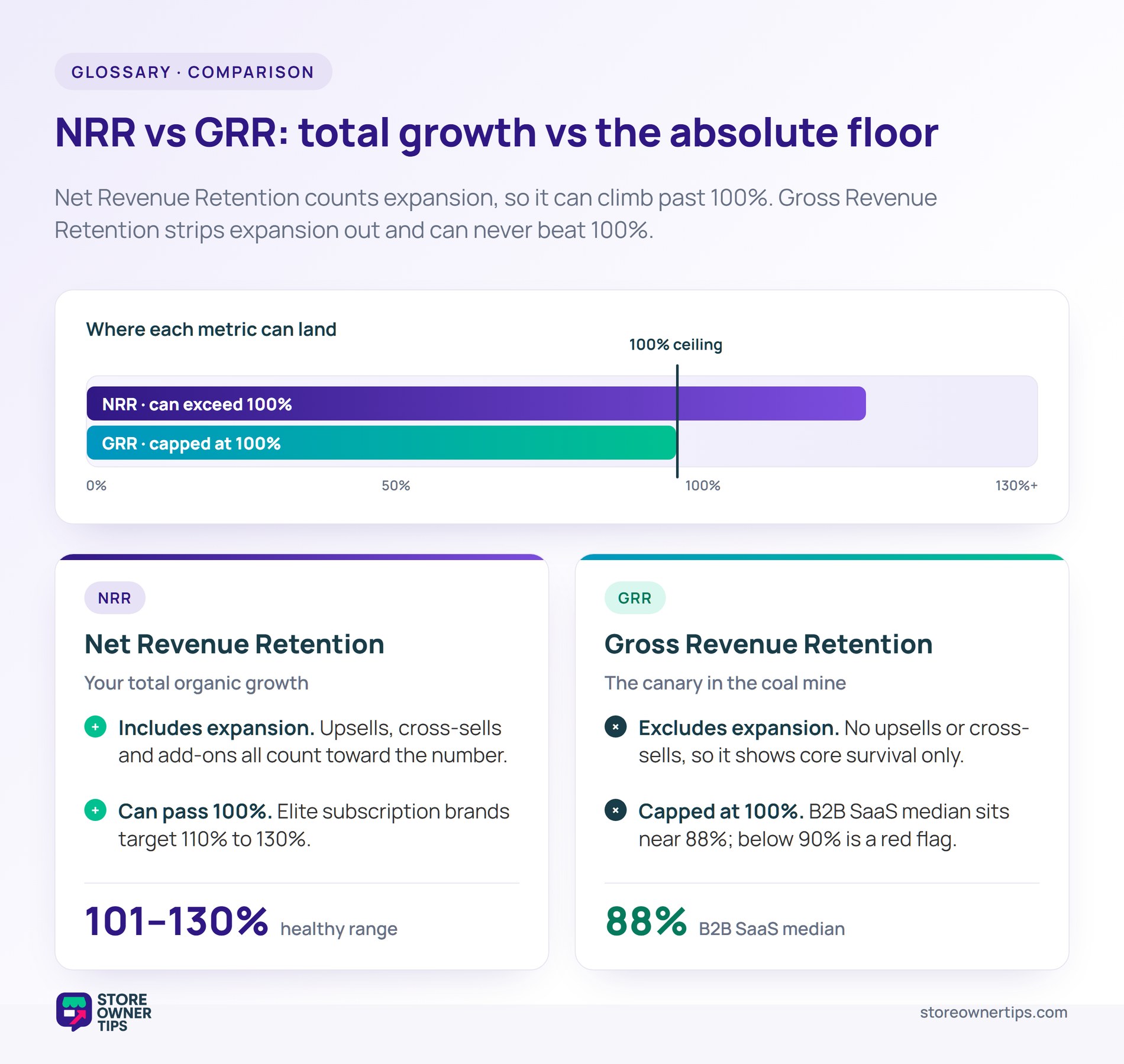
If NRR is your total growth, Gross Revenue Retention is your absolute floor. GRR focuses strictly on the revenue retained from your baseline, but it explicitly ignores all upsells, cross-sells, and expansions.

Because you can’t include upgrades, GRR can mathematically never exceed 100%. Analysts call GRR the “canary in the coal mine.” The median private B2B SaaS GRR sits around 88%.
If your GRR drops below 90%, treat it as a massive red flag. It means your core product is failing, and no amount of clever upselling can permanently hide it.
You will often hear investors use the term NDR. Don’t let this confuse you; NRR and NDR are the exact same mathematical formula. The difference is mostly in who is speaking. Private equity firms and VCs prefer “Dollar” to stress financial value, while operators prefer “Revenue.”
Some stores run on one-time purchases with no subscriptions or recurring billing. They don’t have a guaranteed “Starting MRR.” In that case, you can’t track net retention perfectly. Instead, track your Cohort Repeat Purchase Rate.
It measures how many buyers come back for a second or third order. It also tracks whether their average order value goes up or down.
Like any powerful business tool, focusing heavily on Net Revenue Retention comes with distinct advantages and real risks.
MRR just tells you how much money is in the bank right now. It hides the structural health of your business if you’re burning cash on acquisition. Technical founders rely on NRR because it proves product-market fit.
If your net retention is above 100%, existing customers are spending more through upgrades, seats, or usage. That growth outpaces the users who cancel. At 94%, growth feels hard because you’re refilling a leaky bucket. At 108%, the business naturally compounds.
Yes, but the benchmarks and mechanics change drastically. Without contractual recurring billing, baseline ecommerce NRR averages around 30%. That means a cohort tends to spend less in the periods after their first purchase.
E-commerce stores track net retention over longer periods, like Year 2 revenue against Year 1 for a cohort. To achieve a good net revenue retention above 100%, move one-time buyers into subscription replenishment models like Subscribe & Save. Add loyalty programs and high-value cross-sells. Done well, this creates negative churn, where expansion outweighs every loss.
Absolutely. Relying only on a blended NRR is a common, dangerous trap. A high net retention can be reached even if many small customers churn out. You just need a few big accounts to upgrade hard.
On the dashboard it looks brilliant, but the core product is failing most of the market. GRR caps at 100% and excludes all upsell and expansion revenue. It gives you an honest look at core customer survival. If NRR is 115% but GRR slips below 90%, expansion is hiding a real product-market fit problem.
Net Revenue Retention is the clearest truth-teller for your store’s long-term survival. Build an experience so good that existing buyers naturally spend more over time. Do that, and you break free from the costly cycle of endless acquisition.
So keep your current buyers happy and make upgrading an easy choice. Do both, and your business will organically compound for years to come.
Copyright © StoreOwnerTips.com. All Rights Reserved.
