Weekly ecommerce tips, deals & news.
A no-follow link is a standard web link with a tiny piece of invisible code added to it. This code explicitly tells search engines not to pass any ranking power or “trust” to the website you are linking to. Think of it like giving someone directions to a restaurant without actually recommending the food. It is the best way for store owners to link out to sponsored products or untrusted sites without hurting their own search engine rankings.
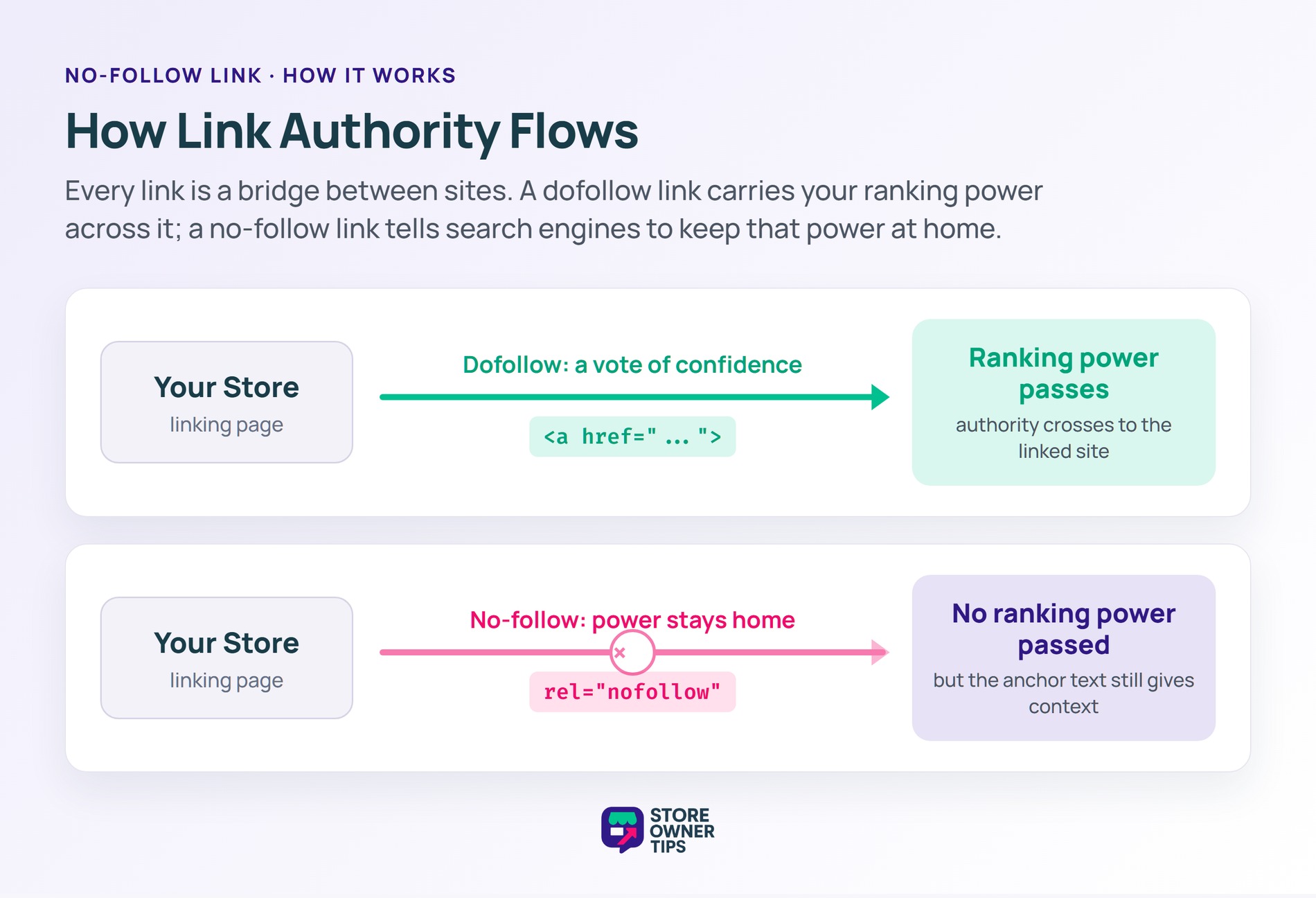
To really grasp how this works, we have to look at how search engines view the internet. Search engines use a massive scoring system. In this system, websites are “nodes” and links are the “edges” or bridges connecting them. By default, when you link to someone, you are casting a vote of confidence. You are passing a piece of your site’s authority over that bridge.
The mathematical engine that calculates this authority is called PageRank. To see how this ranking power is distributed, we can look at the simplified PageRank equation:
![PageRank equation: PR(A) = (1−d) + d [PR(T1)/C(T1) + ... + PR(Tn)/C(Tn)].](https://storeownertips.com/wp-content/uploads/2026/06/no-follow-links-formula-1024x258.png "no-follow-links-formula - Store Owner Tips")
In this formula, $PR(A)$ is the ranking power of the destination page. The value $C(T_i)$ represents the total number of outbound links on the linking page. Every time you add a standard link, it mathematically siphons off a fraction of your site’s authority and gives it away.
But what if you do not want to give that power away? In 2005, the web was drowning in comment spam. People were dropping links on thousands of blogs just to steal this ranking power. Search engines needed a fix, so they introduced the no-follow attribute. At the code level, it looks like this: rel="nofollow".
When a search engine robot—called a crawler—reads the Document Object Model (DOM) (which is just the foundational blueprint of your website’s code), it sees this tag. Originally, the crawler would drop the link from its math calculation entirely. Today, search engines treat it as a “hint.” They will not pass the math power, but they use the link’s text to understand the context of the page.
Let’s look at how this works in action. Imagine a mid-sized Shopify brand called Aura Outfitters. They sell outdoor apparel and generate $10 million a year. But lately, their organic search traffic is totally flat. They hire an expert to look at their code, and the results are shocking.
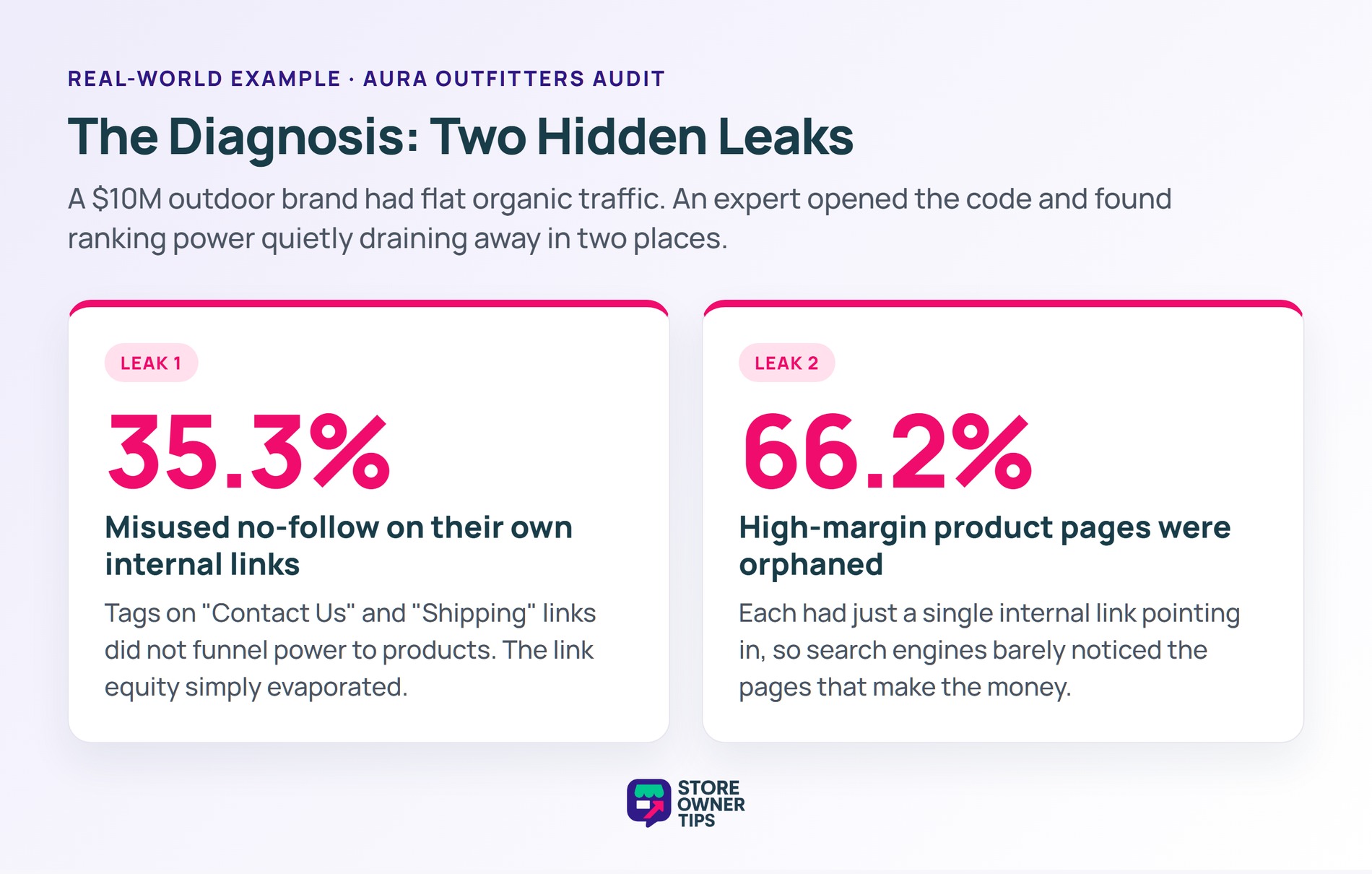
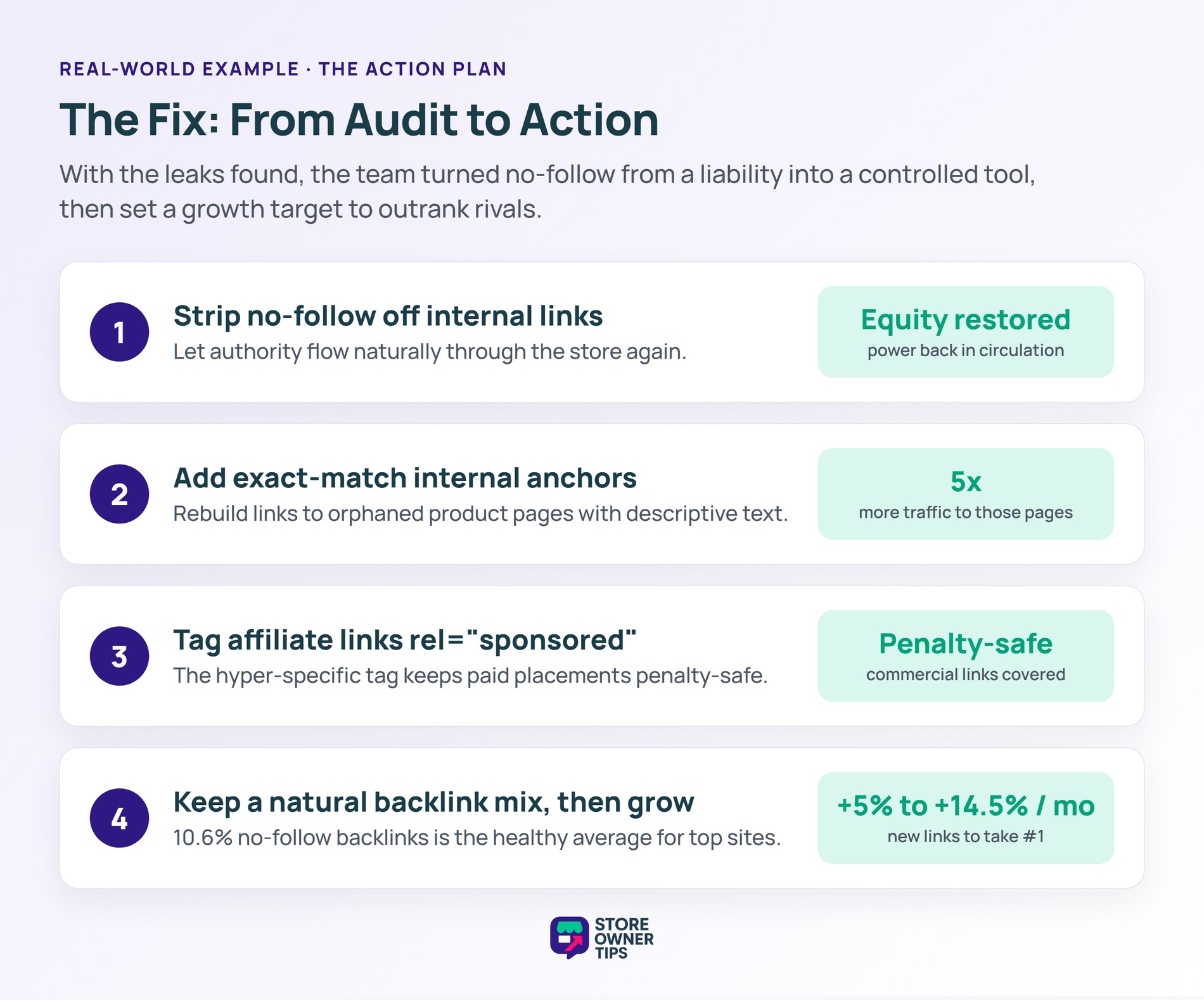
First, the expert finds that Aura Outfitters falls into the 35.3% of websites that are critically misusing the no-follow attribute on their own internal pages. A past developer added no-follow tags to their “Contact Us” and “Shipping” links, thinking it would funnel ranking power to their product pages. Instead, this link equity simply evaporated into thin air. The team quickly removes these tags to get the power flowing naturally again.
Next, the audit reveals that 66.2% of their high-margin product pages are “orphaned.” This means they only have a single internal link pointing to them. To fix this, the team builds new links using exact match anchor text (the visible, clickable words on a link). Industry data shows pages with exact match internal anchors get 5x more traffic.
Now, Aura Outfitters wants to launch a huge affiliate program to grow sales. To stay perfectly safe from search engine penalties, they decide to use the hyper-specific rel="sponsored" tag on all their affiliate links. Even though only 0.01% of websites currently use this exact tag, it guarantees they follow all the rules.
Finally, they look at the links pointing back to their store from other websites. They notice that 10.6% of their backlinks are no-follow. The team does not panic. This is the exact statistical average for the top 110,000 sites on the web. It makes their store look completely natural. To climb to the #1 spot, they calculate they just need to acquire new standard links at a pace of +5% to +14.5% per month to beat their main competitor.
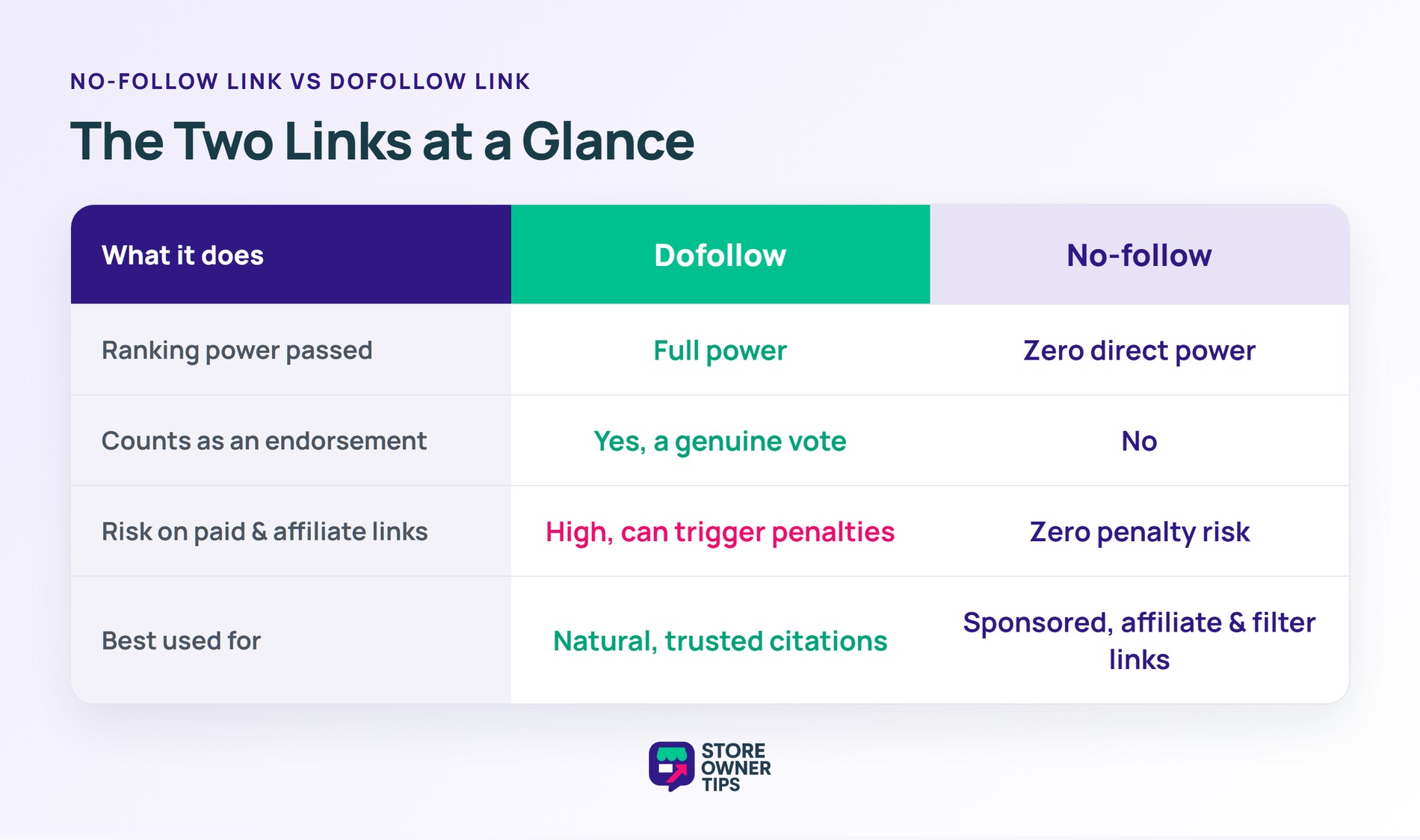
The direct opposite of a no-follow link is a “dofollow” link. There is actually no code that says rel="dofollow". “Dofollow” is just a slang term the industry uses for a normal, everyday web link.
A standard dofollow link passes full mathematical ranking power and trust to the destination. It is a genuine editorial endorsement. However, it carries extreme risk if you use it for paid placements or affiliate links. A no-follow link passes zero direct ranking power, but it carries zero risk of getting your site penalized for those commercial activities.
Using this code on your store comes with massive benefits, but it also carries some hidden dangers if used incorrectly.
rel="sponsored" version) on your affiliate links, you completely neutralize the risk of being blacklisted.Yes, they have a huge indirect impact. Having a mix of no-follow links makes your store look completely natural to search engines. Plus, if you get a no-follow link from a massive site like Wikipedia or Forbes, it can send thousands of real, paying customers straight to your checkout page. Search engines also read the text in these links to get clues about what your page is about.
A standard “follow” link is just a normal piece of HTML code that looks like this: <a href="https://example.com">. It passes pure ranking power to the destination. A “no-follow” link simply has one extra piece of instructions stuffed inside it: <a href="https://example.com" rel="nofollow">. That extra tag acts as a strict command to search engines not to pass any ranking power across that specific bridge.
You actually need to do both to execute a flawless technical defense. First, you add a noindex tag to those useless filter pages so they stay out of the search results entirely. However, robots will still waste their time crawling those pages unless you physically stop them. You must also add the rel="nofollow" code directly to the filter buttons in your sidebar to stop the robots at the source.
Understanding and controlling no-follow links is like installing a world-class security system for your online store. It protects your brand from devastating search engine penalties while forcing internet robots to prioritize your most profitable product pages. Mastering this invisible code is an absolute requirement for long-term, sustainable e-commerce growth.
Copyright © StoreOwnerTips.com. All Rights Reserved.
