Weekly ecommerce tips, deals & news.
Purchase intent, also known as buyer intent, is the measurable probability that a shopper will actually buy a product within a specific timeframe. Instead of guessing who might buy, e-commerce stores track exact behaviors—like adding items to a cart or searching for a discount—to separate casual window shoppers from ready-to-buy customers. When store owners track these behavioral signals, they can focus their marketing budgets exclusively on the people most likely to spend money.
In the e-commerce world, shoppers don’t arrive at your website with the same mindset. They go through a very specific mental journey.
First, they realize they have a problem (the awareness stage). Next, they start looking for brands and reading reviews (the interest and consideration stages). Finally, they reach the purchase stage, where they’re fully ready to trade their hard-earned cash for your product. When you look at specific digital signals, you can measure purchase intent to see exactly where a customer is on that journey.
This intent is highly fluid. A person searching for a broad topic has low purchase intent. But a returning shopper who searches for a specific product name and the word “discount” has extremely high purchase intent. Instead of treating every visitor exactly the same, smart stores use hidden tech to read these silent clues. This lets you show the right product to the right user at exactly the right time.
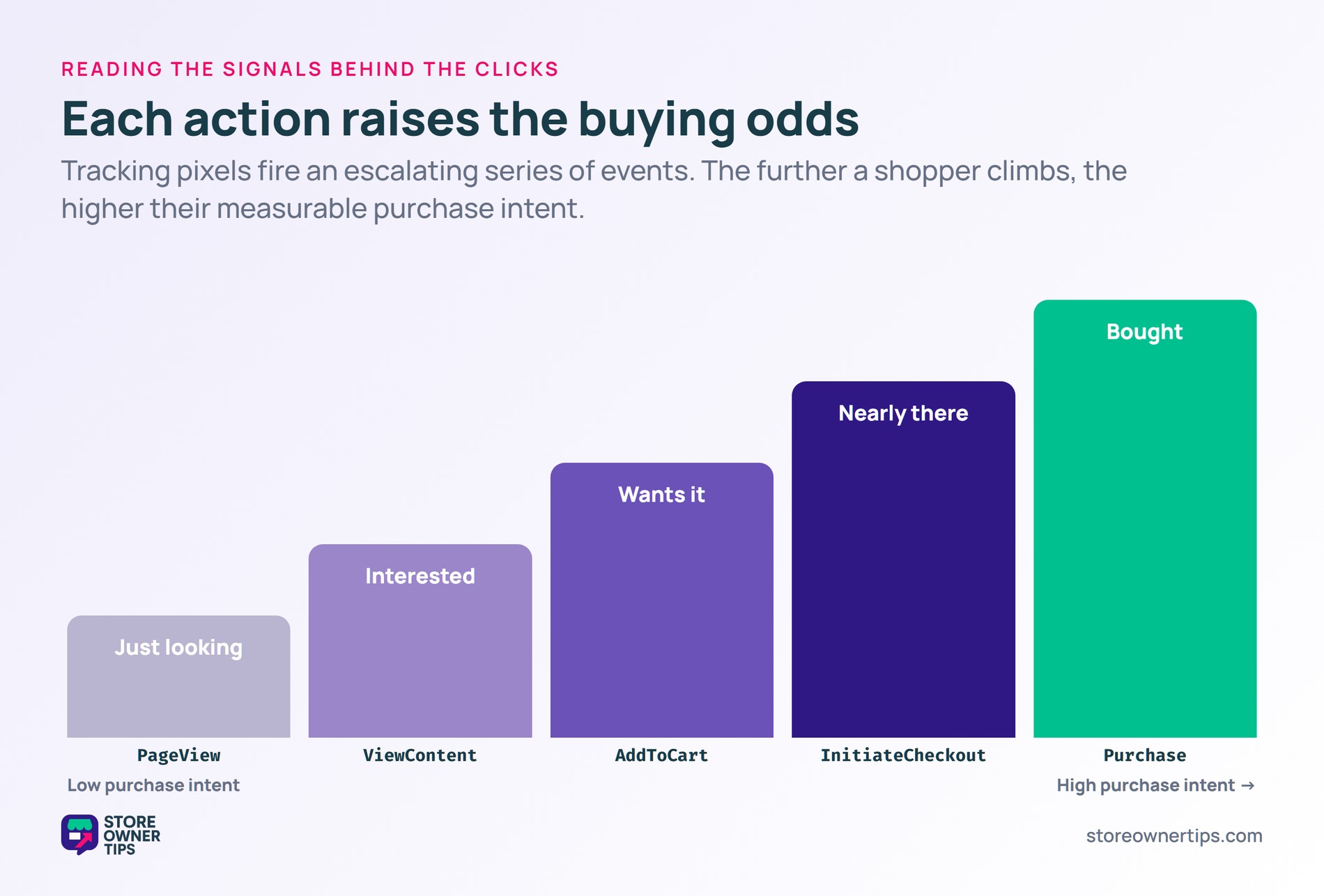
Beneath the shiny surface of platforms like WooCommerce and Shopify, there’s a complex engine tracking every click. This starts with tools like the Meta (Facebook) Pixel. Think of a tracking pixel like a digital store manager with a clipboard. When a user first lands on your site, the pixel notes a basic “PageView” event. This is just a traffic counter.
But as the user explores, the signals get stronger. When they look at a specific item, the system fires a “ViewContent” event. If they feel enough desire to click the buy button, an “AddToCart” event triggers. Moving to the checkout screen fires an “InitiateCheckout” event. Finally, a completed sale triggers a “Purchase” event. If a shopper hits the “AddToCart” step but never triggers a “Purchase” event, the system instantly knows there’s a roadblock (like high shipping costs) and can automatically send them an ad to fix it.
While pixels track what happens on the shopper’s screen, the best stores also use “server-side” tracking, specifically using tools called webhooks. Think of a webhook like a certified letter sent directly from one computer to another.
Why do we need this? If a customer buys a product but immediately closes their browser tab before the “Thank You” page loads, the front-end pixel might fail to fire. Your analytics will miss the sale. Webhooks solve this. They securely process the purchase data in the background, ensuring your records are perfectly accurate even if the customer’s internet cuts out right after they pay.
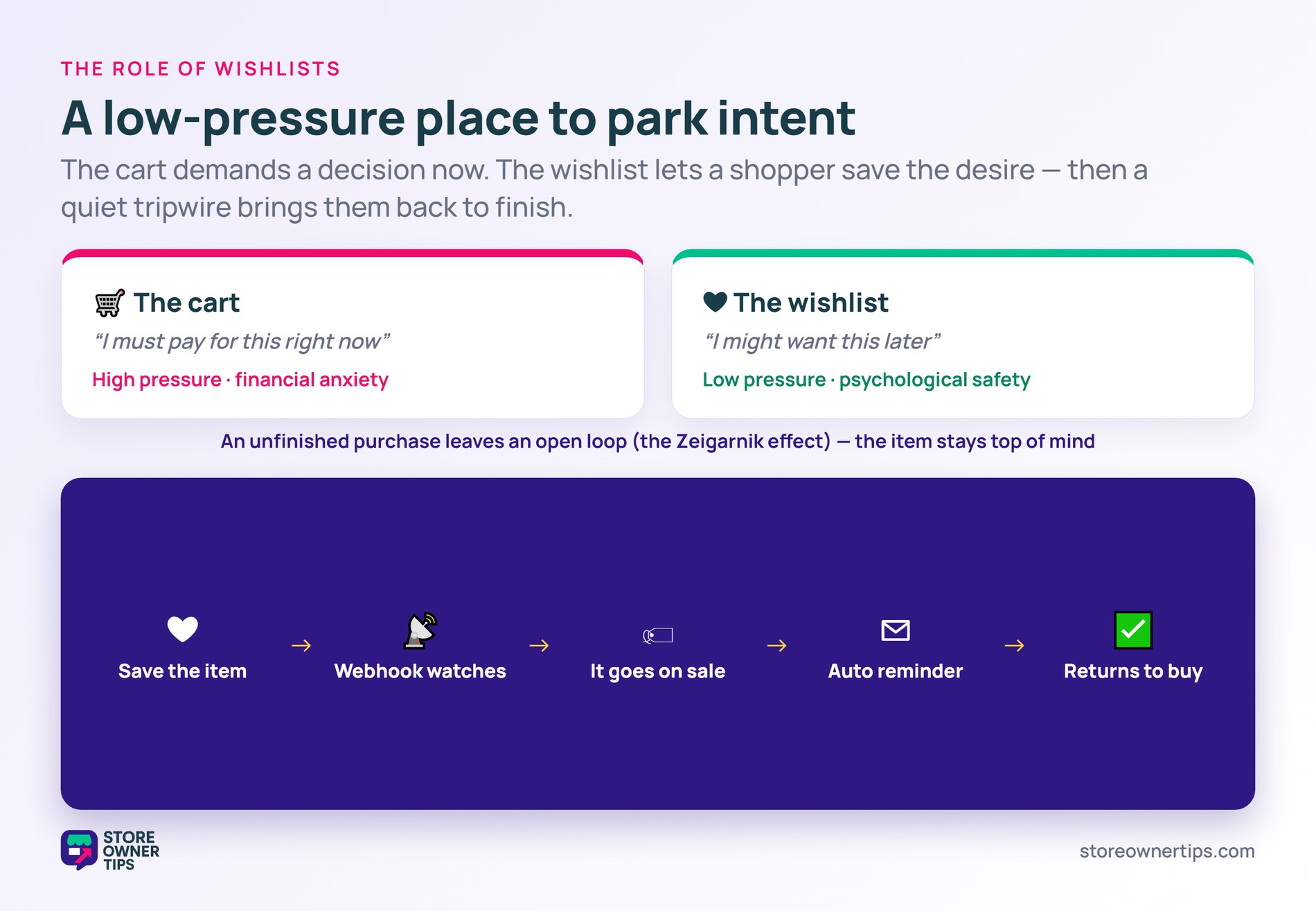
While a shopping cart represents a customer’s immediate intent to buy, the product wishlist captures a different, equally valuable type of desire. A wishlist acts like an “external memory” for your shoppers. In a world where people browse on their phones during a commute or compare ten different tabs at once, trying to remember a specific product takes a lot of mental energy.
When you let a shopper save an item for later, you instantly lower the pressure. The shopping cart says, “I must pay for this right now,” which can cause financial anxiety. The wishlist gently says, “I might want this later.” This creates Psychological Safety, giving the buyer a low-pressure space to think or check their budget without losing track of the item they love.
It also taps into something called the Zeigarnik Effect. This is a fancy way of saying that our brains hate leaving things unfinished. When a shopper saves an item to a wishlist instead of buying it, it creates an “open loop” in their mind. Basically, this is like a song that gets stuck in your head because you didn’t hear the last note. Because the purchase isn’t “finished” yet, that item stays at the front of their brain, making the shopper much more likely to return to your store later to “close the loop” and finally buy it.
To make this experience feel seamless, your store uses a few “behind-the-scenes” tricks to track this intent:
It’s important to understand that a wishlist represents planned intent, which is the opposite of an impulse buy.
While wishlists are a goldmine for data, they can backfi
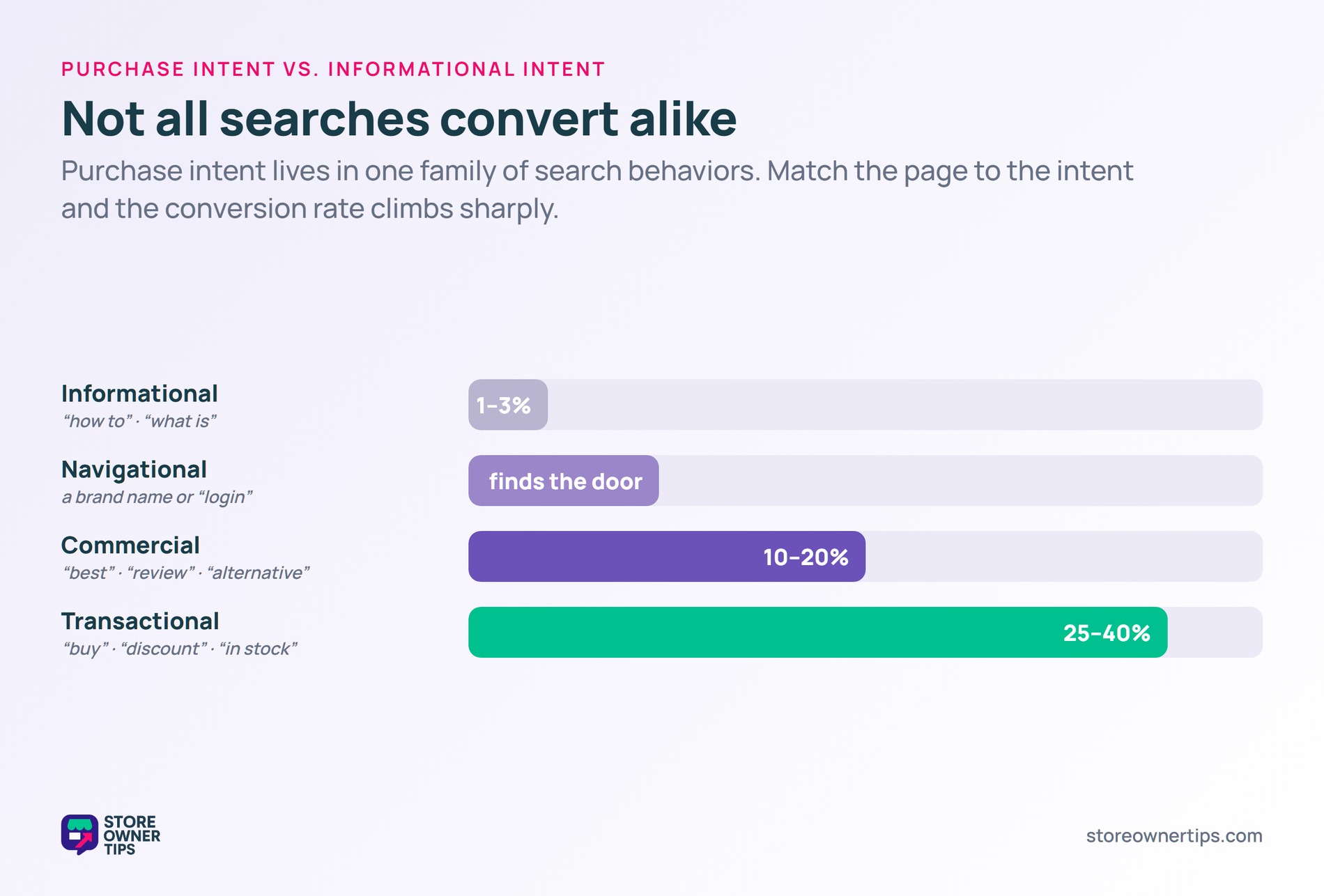
Purchase intent (also known as transactional intent) does not exist in a vacuum. It’s part of a larger family of search behaviors. Knowing the difference stops you from showing the wrong page to the wrong person.
Building a store around purchase intent separates the pros from the amateurs, but it comes with its own set of rules and risks.
To see how this works in action, imagine a mid-sized consumer electronics brand called “Aura Audio.” They sell premium noise-canceling headphones with an Average Order Value (AOV) of $250.
Historically, Aura Audio struggled. They relied on broad, generic ads across social media. Because they treated all traffic the same, their overall conversion rate was stuck at a dismal 1.4%. Worse, their shopping cart abandonment rate was a staggering 76%. Out of every ten people who added headphones to their cart, almost eight left without paying. Because they were wasting money on people with low purchase intent, it cost them $125 just to acquire a single customer. Their business was bleeding cash.
Aura Audio decided to overhaul their store using purchase intent data. First, they stopped blasting broad social media ads. They took 40% of that budget and spent it entirely on high-intent search keywords like “best noise-canceling headphones under $300.”
Next, they looked at their tracking pixels to find the exact point where shoppers were leaving. The data showed people were bailing out the second the shipping costs were calculated. To fix this, Aura Audio used intent-based personalization. If a user arrived from a high-intent search, the website instantly changed to show a “Free Next-Day Shipping” banner matched to their exact city.
Finally, they set up server-side webhooks to catch the people who still abandoned their carts. Exactly 30 minutes after a shopper left, the system sent an automated SMS text message offering a 10% discount to finish the order.
The results completely transformed the company. By only targeting high-intent users, their overall conversion rate nearly doubled to 2.7%. Removing the shipping friction dropped their cart abandonment rate down to 68%. The new SMS text sequence recovered 4.5% of the carts that previously would have been lost forever. Best of all, their Customer Acquisition Cost plummeted from $125 down to just $70. By reading the behavioral signals, Aura Audio turned an unpredictable website into a highly profitable machine.
To find what people want, experts recommend digging into community platforms. Reddit is great for finding broad customer frustrations, while Quora is excellent for finding high-intent buyers asking for specific product alternatives. When picking keywords, aim for “long-tail” phrases. A specific search like “buy men’s waterproof trail running shoes size 11” might have fewer searches, but because the user knows exactly what they want, they will convert at a massive 15% to 30% rate.
This usually happens because of a misconfiguration on your final checkout page. If your ads get sales but Meta shows zero, your ad costs will skyrocket. To fix this, download the Meta Pixel Helper Chrome extension and run a test purchase on your site. Ensure the “PageView,” “AddToCart,” and “Purchase” events all fire in order. If “Purchase” fails, the tracking script is likely missing from your final order confirmation page.
Setting up an abandoned cart flow is a mandatory requirement for any store. Someone abandoning a cart represents the absolute highest level of purchase intent—they literally had the item in their hands. Industry benchmarks show that a properly timed email or SMS text message will consistently recover between 3% and 5% of those lost carts. Over time, this recaptures huge amounts of highly profitable revenue without needing any extra ad spend.
Mastering purchase intent is the key to turning casual browsers into loyal customers. When you use tools like wishlists and smart tracking, you’re no longer guessing what people want—you’re building a store that adapts to their exact needs. This data-driven approach doesn’t just lower your ad costs; it creates a predictable, high-growth engine for your brand’s future.
Copyright © StoreOwnerTips.com. All Rights Reserved.
