Weekly ecommerce tips, deals & news.
Repeat contact rate is the share of support conversations where a customer comes back about the same problem. They asked once, got an answer, and still had to write again. The question was handled. It just was not finished.
Repeat contact rate works by counting problems rather than messages. One customer with one issue should produce one conversation. Anything beyond that is the metric.
Most stores never measure it, because their tools count the wrong unit. A reply sent looks like a job done.
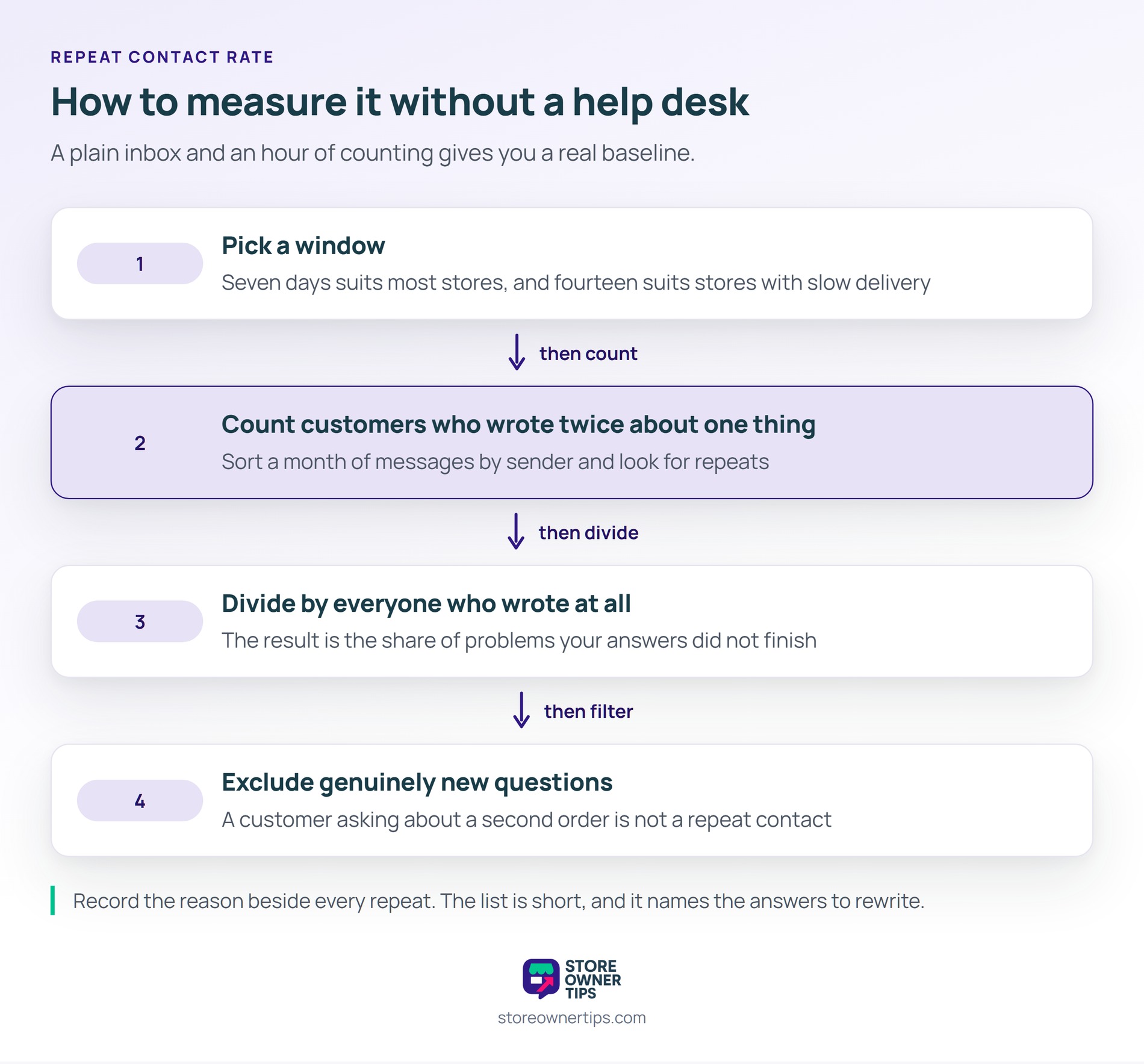
Pick a window first, because the number is meaningless without one. Seven days suits most stores, and fourteen suits stores with slow delivery.
Then count the customers who wrote more than once inside that window about one thing. Divide that by the total number of customers who wrote at all.
A plain inbox can do this. Sort a month of messages by sender and look for repeats. An hour of counting gives you a real baseline.
Exclude genuinely new questions from the same person. A customer asking about a second order is not a repeat contact.
Record the reason beside every repeat you find. The list is usually short, and it points straight at which answers to rewrite.
The first cause is an answer that is technically correct. Telling someone their parcel is in transit answers nothing they wanted to know.
The second is a promise with no date attached. Words like shortly and soon guarantee a follow up message. The customer has no way to know when to stop waiting.
Third comes the partial answer. Two questions arrive, one is addressed, and the other is quietly dropped. That single habit produces a surprising share of repeats.
Fourth is the reply that creates work. An answer sending the customer somewhere else to do something invites them back when it fails.
Most stores measure response time, because it is easy to pull from any inbox. The trouble is what it rewards.
A short holding reply improves your average response time immediately. It also guarantees at least one more message in the thread.
So a team can cut its response time in half while doing more total work. The dashboard improves and the inbox grows.
Measuring repeats alongside speed fixes the incentive. One number rewards answering quickly, and the other rewards answering properly.
A repeat contact costs the same to handle as the first one. It just has no chance of producing a sale. That is the whole economic case for measuring it.
The hidden cost sits in your capacity. A store with a third of its messages repeating is running a support team a third larger than it needs.
There is a customer side to it as well. Asking twice is the moment goodwill turns into irritation. People forgive a slow answer far more easily than a wasted one.
Worse, most unhappy customers never write a third time. They stop buying instead, which never appears in any support report.
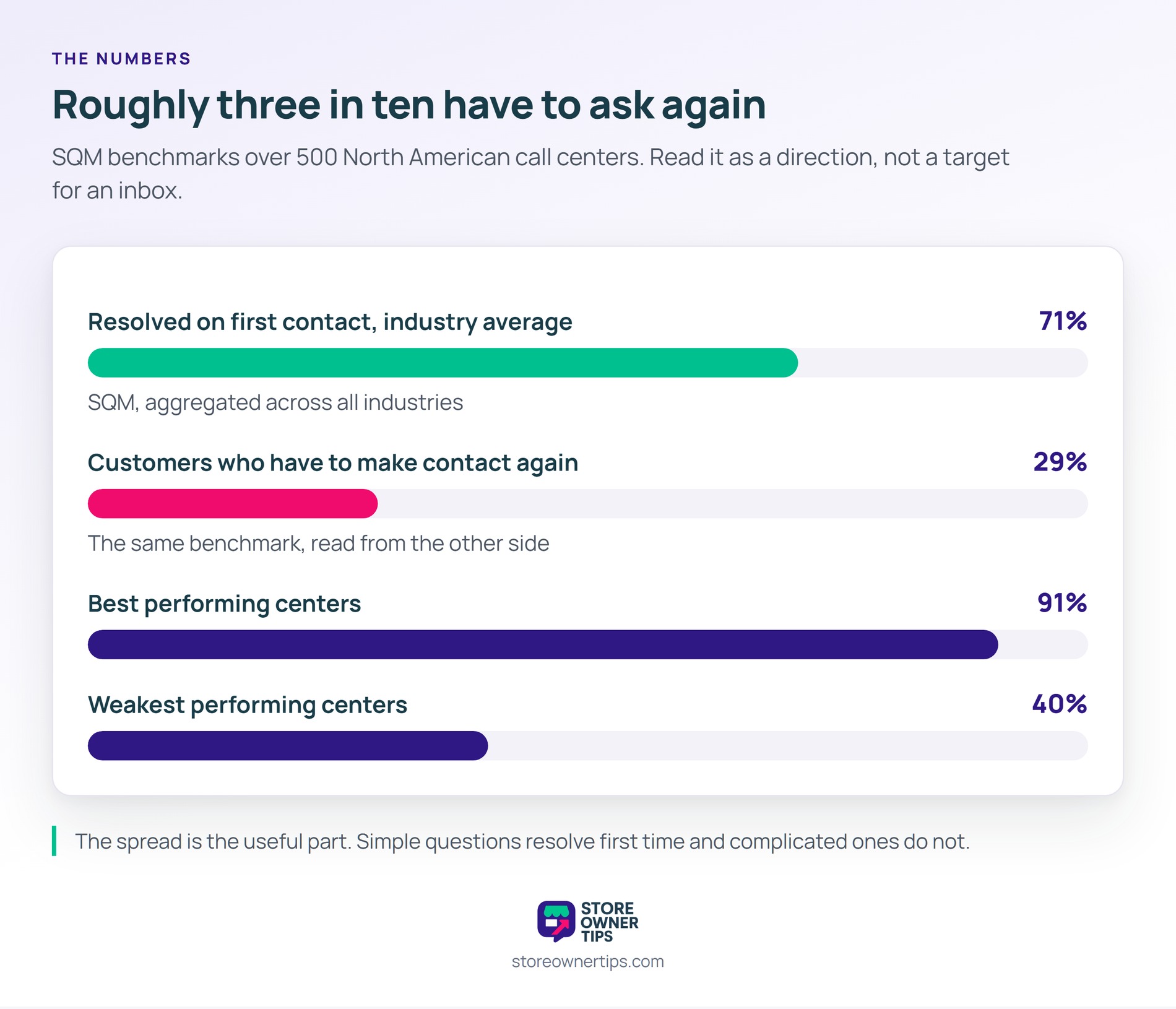
The published benchmarks come from call centers rather than online stores. Read them as a direction rather than a target for your inbox.
SQM benchmarks over 500 North American call centers on first contact resolution. It reports an industry average of 71%, with 29% of customers having to make contact again.
The spread is the interesting part. Performance across those centers runs from 40% to 91%. Simple questions resolve first time and complicated ones do not.
The cost of losing people this way is well established. Harvard Business Review notes that winning a customer costs 5 to 25 times more than keeping one. Repeat contacts are where keeping them quietly fails.
Delivery drives much of the volume. A Zebra shopper study found only 38% of shoppers completely trust retailers to fulfill orders as promised. Distrust of that size produces a lot of checking in.
A high repeat contact rate looks like a support inbox that never gets smaller. Here is a hypothetical example. Imagine a clothing store with one person on support.
In this scenario the store answers about 200 messages a month. The target is a reply within four hours, and the team hits it comfortably.
Nobody has ever counted how many of those messages are second attempts. The inbox is measured by how fast it empties.
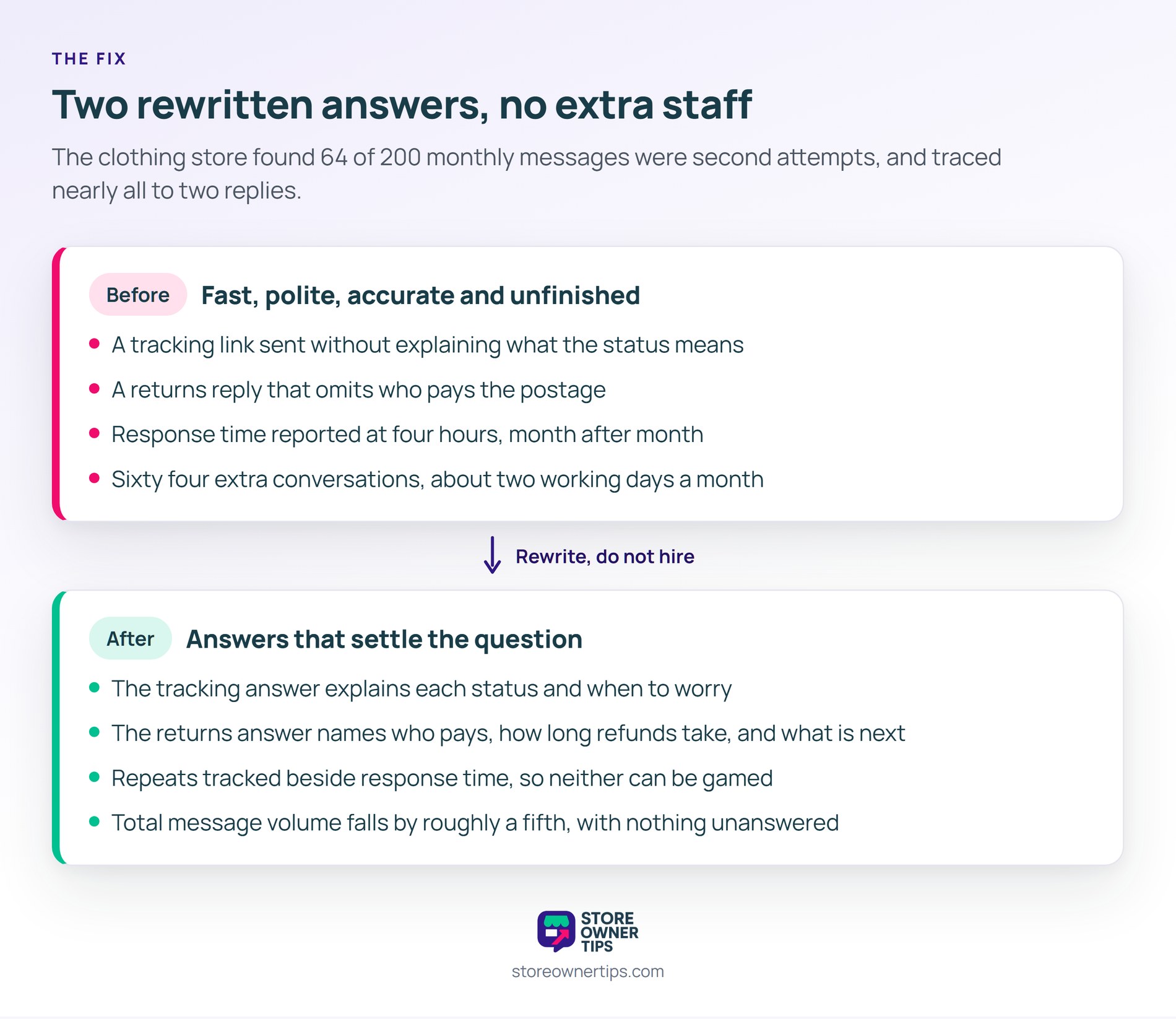
Someone finally sorts a month by sender. Of 200 messages, 64 came from people who had already written that week. The real repeat rate is close to a third.
Nearly all of them trace to two answers. The first is a tracking link sent without explaining what the status means. The second is a returns reply that omits who pays the postage.
Both replies were fast, polite and accurate. Both sent the customer straight back to the inbox.
Neither was ever flagged as a problem. The response time report showed four hours, month after month, and nobody had reason to look further.
Sixty four extra conversations is roughly two working days a month. That time was being spent on questions the store had already answered once.
So the store rewrites two replies rather than hiring anyone. The tracking answer now explains what each status means and when to worry.
The returns answer states who pays postage, how long refunds take, and what happens next. Every predictable follow up question is answered before it is asked.
Next the team adds the count to its weekly routine. Repeats are tracked beside response time, so one cannot be gamed against the other.
The measured result is worth stating plainly. Total message volume falls by roughly a fifth without a single question going unanswered.
They also move the common answers onto the site itself. StoreAgent covers that ground in its piece on AI customer service software. An answer available at two in the morning never becomes a repeat.
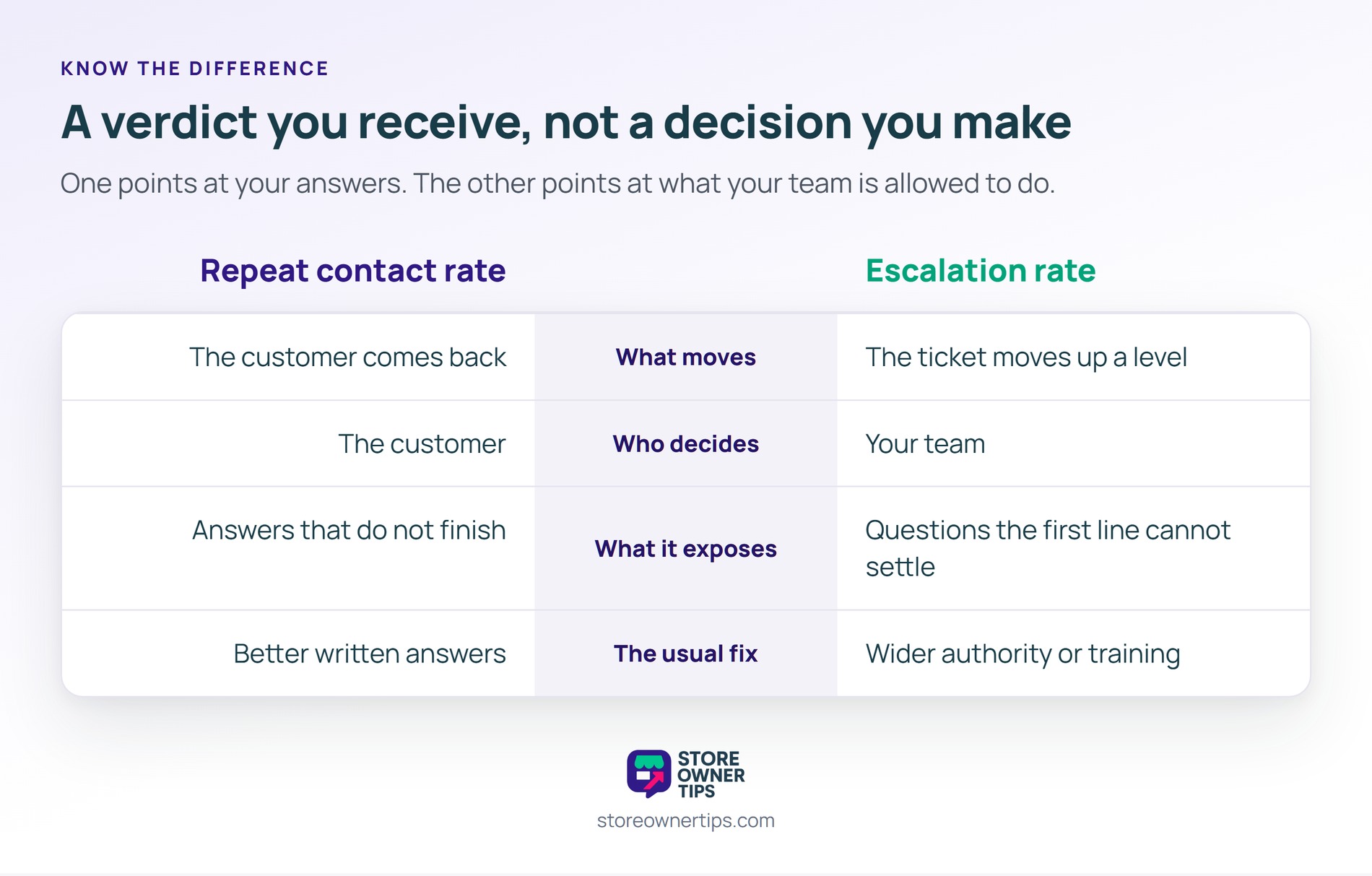
| What you’re comparing | Repeat contact rate | Escalation rate |
|---|---|---|
| What moves | The customer comes back | The ticket moves up a level |
| Who decides | The customer | Your team |
| What it exposes | Answers that do not finish | Questions the first line cannot settle |
| The usual fix | Better written answers | Wider authority or training |
Escalations are a decision you make and repeats are a verdict you receive. That difference matters when you pick what to fix. A rising escalation rate points at authority, since your team knows the answer but cannot give it. A rising repeat rate points at the answers themselves.
Compare yourself to last month rather than to a published figure. Call center benchmarks measure phone calls, and most stores answer email.
Anything above a quarter usually means a few answers need rewriting. The direction of travel matters more than the level.
Not by itself, and it can work the other way. A quick holding message improves your speed figure while adding a message to the thread.
Completeness is what lowers repeats. A slower answer that settles the question wins on total work.
Start with delivery and returns, because they generate most repeat contacts in retail. Both involve waiting, and waiting invites checking.
Add a date and a next step to each one. Most repeats are people who did not know what to expect.
Then check the same two answers a month later. If repeats on those topics have not fallen, the rewrite missed something.
Repeat contact rate matters because it is the only support number that measures whether you actually helped. Volume tells you how busy you were, and speed tells you how quickly you replied. In short, this one tells you whether the customer had to ask you twice.
Copyright © StoreOwnerTips.com. All Rights Reserved.
