Weekly ecommerce tips, deals & news.
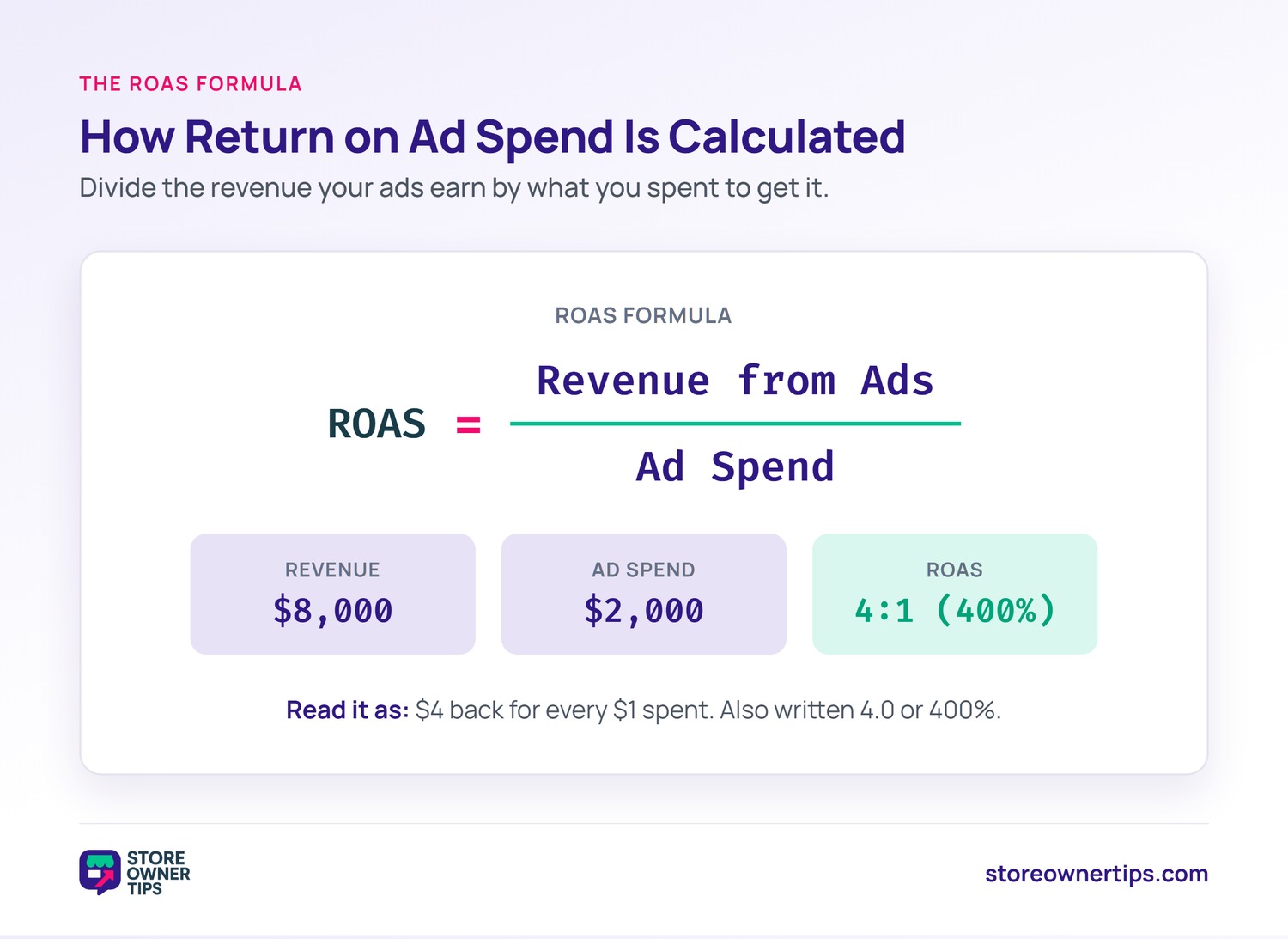
Return on ad spend, or ROAS, measures how much revenue you earn for every dollar spent on ads. You calculate it by dividing ad revenue by ad cost. A ROAS of 4:1 means $4 back for every $1 spent. It’s the go-to metric for judging whether your advertising is paying off.
The formula is simple. Divide the revenue from your ads by what you spent on them. Spend $2,000 and earn $8,000, and your return on ad spend is 4:1. People also write that as 4.0 or 400%.
You can measure return on ad spend per campaign, channel, or product. A blended ROAS covers all your ads at once. Channel-level ROAS shows which platforms actually pay off. The more granular the view, the smarter your budget decisions.
Track the inputs cleanly, though. Ad spend should include the full cost of running the ads. Revenue should match the window you care about, like a 7-day or 30-day view. Loose inputs make the whole number unreliable.
There’s no universal target, despite the common 4:1 rule of thumb. What’s good depends entirely on your margins and goals. A brand testing a new product might accept a low return on ad spend to gain customers. An established store usually wants more.
The honest answer is that good means profitable for you. A 3:1 ROAS can be great for a high-margin product. The same number can be a loss for a low-margin one. Benchmarks from other stores are a starting point, not a goal. Always read ROAS against your own cost structure.
Break-even return on ad spend is the point where ad revenue just covers costs. You find it by dividing 1 by your gross margin. A store with a 25% margin needs a 4:1 ROAS to break even. A 40% margin only needs about 2.5:1.
Margins are tighter than many owners think. Retail’s average net margin sits near 5.61%, which leaves little room for waste. That’s why a high ROAS can still lose money after every cost. Know your break-even before you set a target.
Return on ad spend only looks at ad revenue versus ad spend. It ignores the cost of the product, shipping, returns, and overhead. So a 4:1 ROAS can still leave you in the red. Profit lives after all those costs, not before.
This is the most common ROAS trap. Owners celebrate a high number while the bank balance shrinks. Treat ROAS as an efficiency gauge, not a profit report. Pair it with margin to see the real story.
A quick gut check helps. Multiply your ROAS by your margin to estimate real return. A 4:1 ROAS at a 25% margin roughly breaks even. Anything below that margin line is quietly bleeding cash.
Return on ad spend swings a lot by where the ad runs. Search ads often post a higher ROAS because they catch ready buyers. Top-of-funnel social ads usually post lower, since they build awareness first. Judging both by the same target is a mistake.
Campaign stage matters too. A prospecting campaign that finds new customers will show a lower ROAS. A retargeting campaign to warm shoppers will show a higher one. Blending them hides which job each ad is doing.
You can raise return on ad spend from two directions. Earn more per click, or spend less to get it. Tighter targeting cuts wasted spend on people who won’t buy. Better creative and offers lift the revenue side.
Feed quality matters for shopping ads especially. Clear titles and complete data help Google match you to ready buyers. AdTribes has a guide on Google Shopping feed optimization. A cleaner feed often improves ROAS without raising budget.
Post-click work counts too. A higher average order value means each sale returns more. Strong repeat buying stretches every ad dollar further. The landing page and checkout do as much as the ad itself.
The biggest mistake is treating return on ad spend as profit. A 4:1 number feels like a win, but margins decide if it really is. Always translate ROAS into actual dollars kept.
Another trap is optimizing only for the highest ROAS. Pushing for a 10:1 often means spending too little to grow. You can win the ratio and still lose the market.
A third is ignoring attribution. Different tools credit the same sale to different ads. If your tracking is loose, your ROAS is fiction. Settle on one attribution model and trust it.
Finally, don’t set one target for everything. A single store-wide goal punishes the campaigns doing harder jobs. Set the bar per campaign instead.
Your return on ad spend goal should shift with your stage. A brand-new product often runs at a lower ROAS on purpose. The aim is to win first customers and learn what converts. Early losses can be an investment, not a failure.
An established best-seller is different. It should clear your break-even ROAS with room to spare. Mature campaigns fund the experiments elsewhere. Match the target to the job each campaign is doing.
Return on ad spend doesn’t live alone. It works with acquisition cost and lifetime value. A low first-order ROAS can still pay off if customers come back. That’s why customer acquisition cost is read right alongside it.
Lifetime value sets how patient you can be. A healthy LTV to CAC ratio, which Shopify pegs at 3:1, gives room to spend. Stores with loyal buyers and a strong repeat purchase rate can run a lower ROAS. Stores with one-time buyers cannot.
Retention is the quiet ROAS multiplier. Acquiring a new customer costs five to 25 times more than keeping one. Every repeat order from an existing buyer needs no fresh ad spend. So loyalty effectively raises your blended ROAS over time.
Don’t forget the payback period either. A first-order loss is fine if the second and third orders repay it. Watch how long it takes to recover the ad spend. Faster payback means you can reinvest sooner.
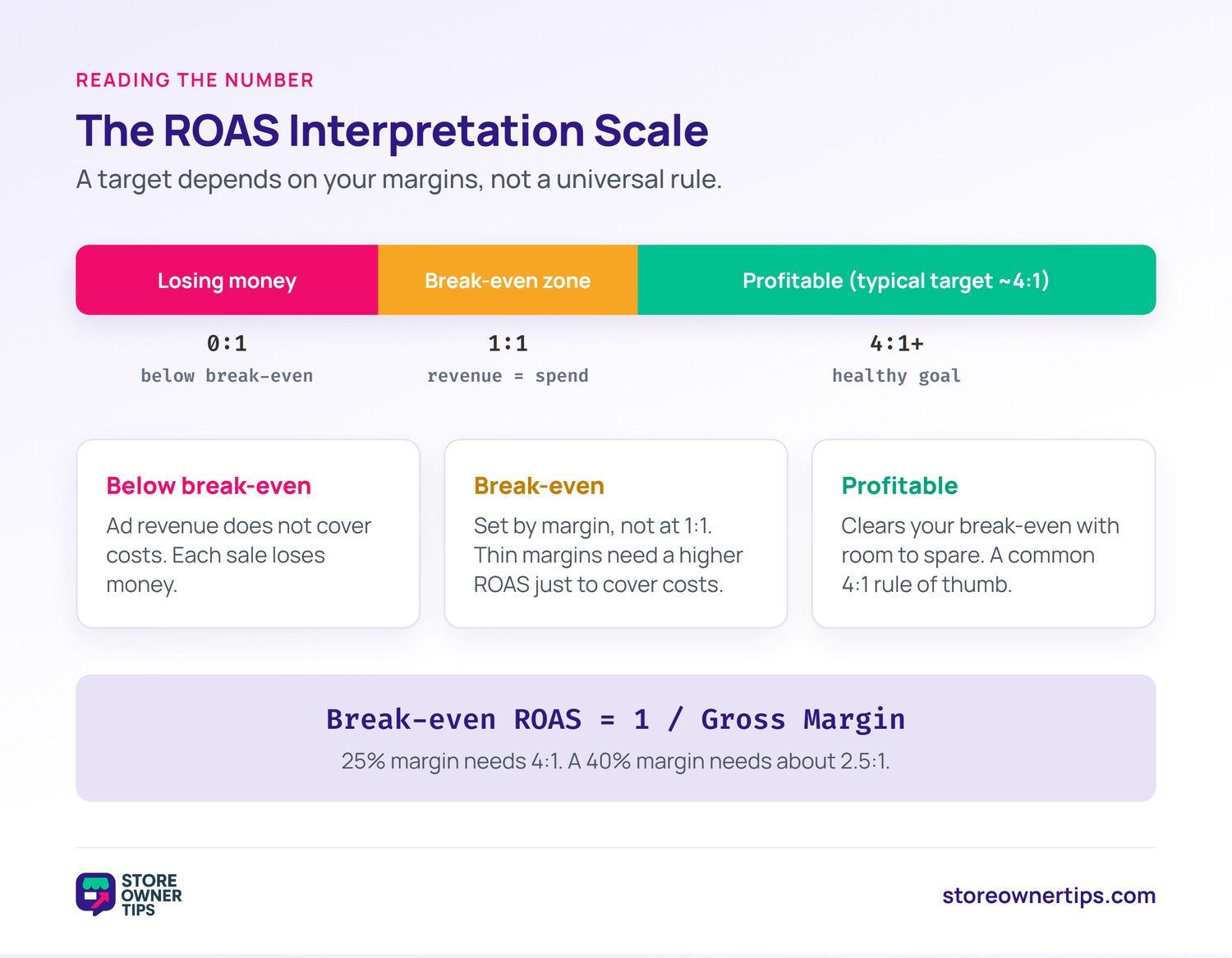
Imagine a store selling phone accessories. It spends $1,000 on ads and earns $4,000 in sales. That’s a 4:1 return on ad spend, which sounds great on paper. But the owner hasn’t checked margins yet.
Each $40 order costs $24 in product, packing, and shipping. That leaves $16 of margin per order, or 40%. With a 40% margin, break-even ROAS is 2.5:1. The 4:1 result clears that bar, so the ads are profitable.
Now picture a store with thin 20% margins. Its break-even ROAS is 5:1, since 1 divided by 0.20 is 5. The same 4:1 result now loses money on every sale. Same ROAS, opposite outcome.
Volume matters in this story too. The phone store could push spend higher and accept a slightly lower ROAS. If total profit grows, that trade can be worth it. Chasing the highest ratio sometimes caps your growth.
The lesson is to set a target from your margin. Run the margin math before you judge any campaign. The phone store should aim above 2.5:1. The thin-margin store must clear 5:1.
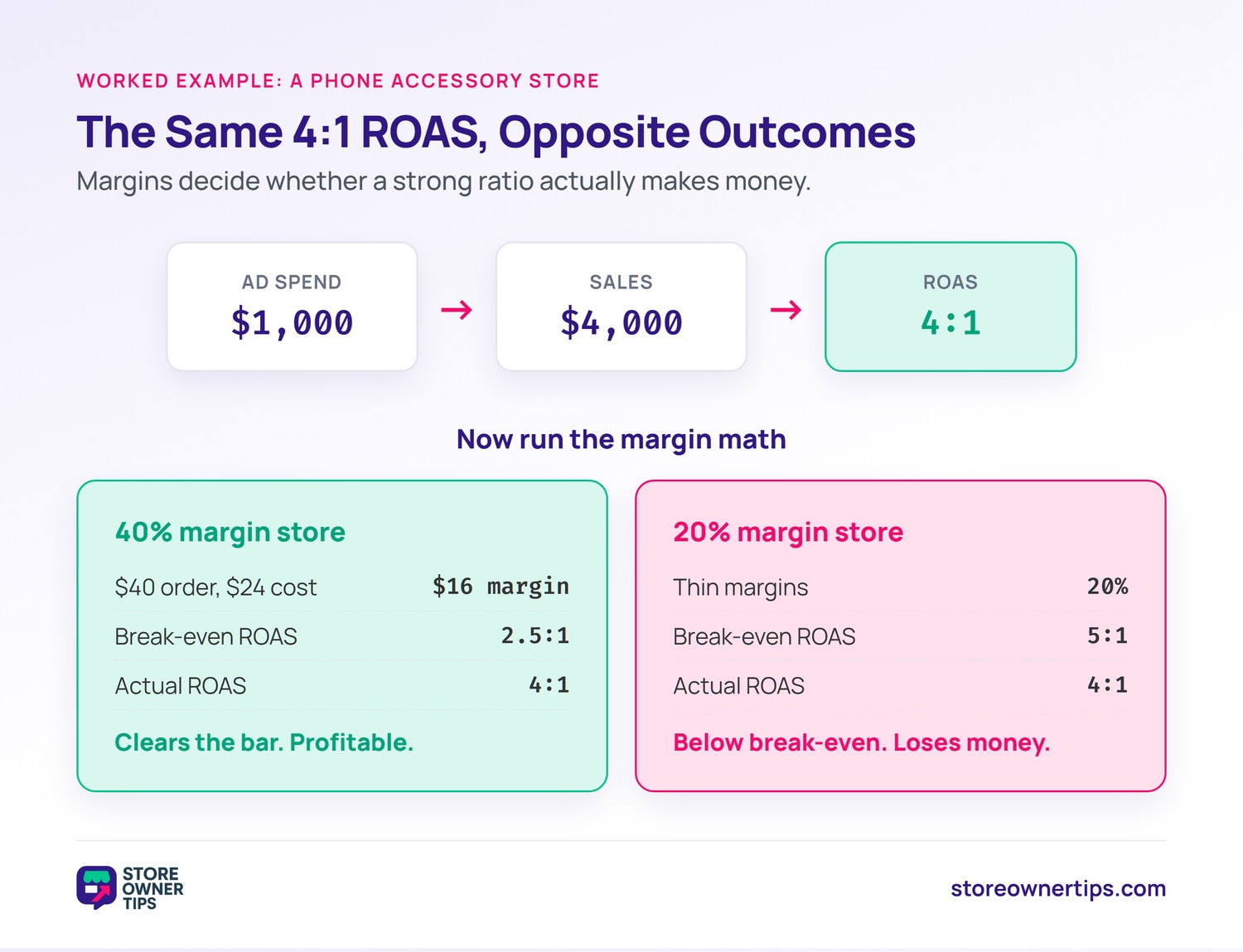
ROAS and ROI sound alike but answer different questions. ROAS measures revenue against ad spend only. ROI, or return on investment, measures profit against total cost. One is about efficiency, the other about the bottom line.
Use return on ad spend to compare campaigns quickly. Use ROI to judge whether the whole effort made money. A campaign can have a strong ROAS and weak ROI at once. You need both to steer a budget well.
A simple way to remember it: ROAS is top-line, ROI is bottom-line. ROAS asks if the ad pulled revenue. ROI asks if you actually came out ahead. Track ROAS daily, but judge success on ROI.
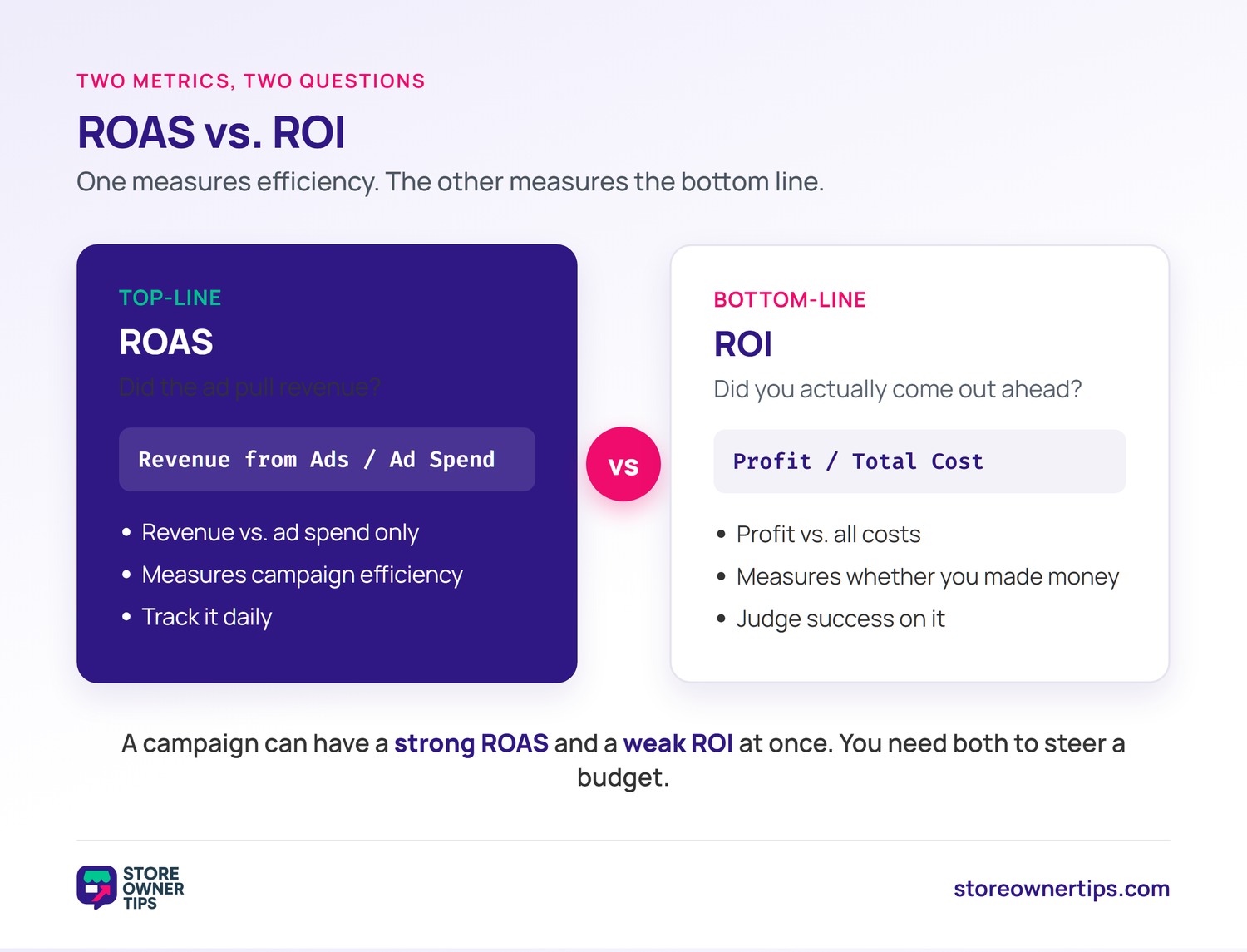
It depends on your margins, so there’s no single answer. A 4:1 ROAS is a common rule of thumb. But a high-margin store can thrive on less, while a thin-margin store needs more. Calculate your break-even first, then set a target above it.
Divide the revenue from your ads by the amount you spent. If you earn $5,000 from $1,000 in ad spend, your ROAS is 5:1. You can run it per campaign or across all ads. Most ad platforms report it for you.
Not always. A very high ROAS can mean you’re underspending and missing growth. Sometimes a lower ROAS with more volume earns more total profit. The right ROAS maximizes profit at the scale you want, not the biggest ratio.
ROAS shows whether your advertising earns more than it costs. On its own it can mislead, so always read it against your margins and lifetime value. Treated that way, it becomes one of the sharpest tools for spending smarter, not just more.
Copyright © StoreOwnerTips.com. All Rights Reserved.
