Weekly ecommerce tips, deals & news.
Year-over-year growth, or YoY growth, measures how a business metric changes compared to the same period one year earlier. You take this year’s number, compare it against last year’s, and express the difference as a percentage. It is the cleanest way to see if your store is truly growing, because it lines up matching seasons side by side.
Year-over-year growth answers one honest question. Is your store doing better than it was at this exact time last year? Most other comparisons cannot answer that cleanly. They get tangled up in seasons, holidays, and one-off events.
That is why analysts, investors, and store owners all lean on YoY first. It is the standard way the whole industry reports progress. When you read that online sales grew a certain percent, that figure is almost always year over year.
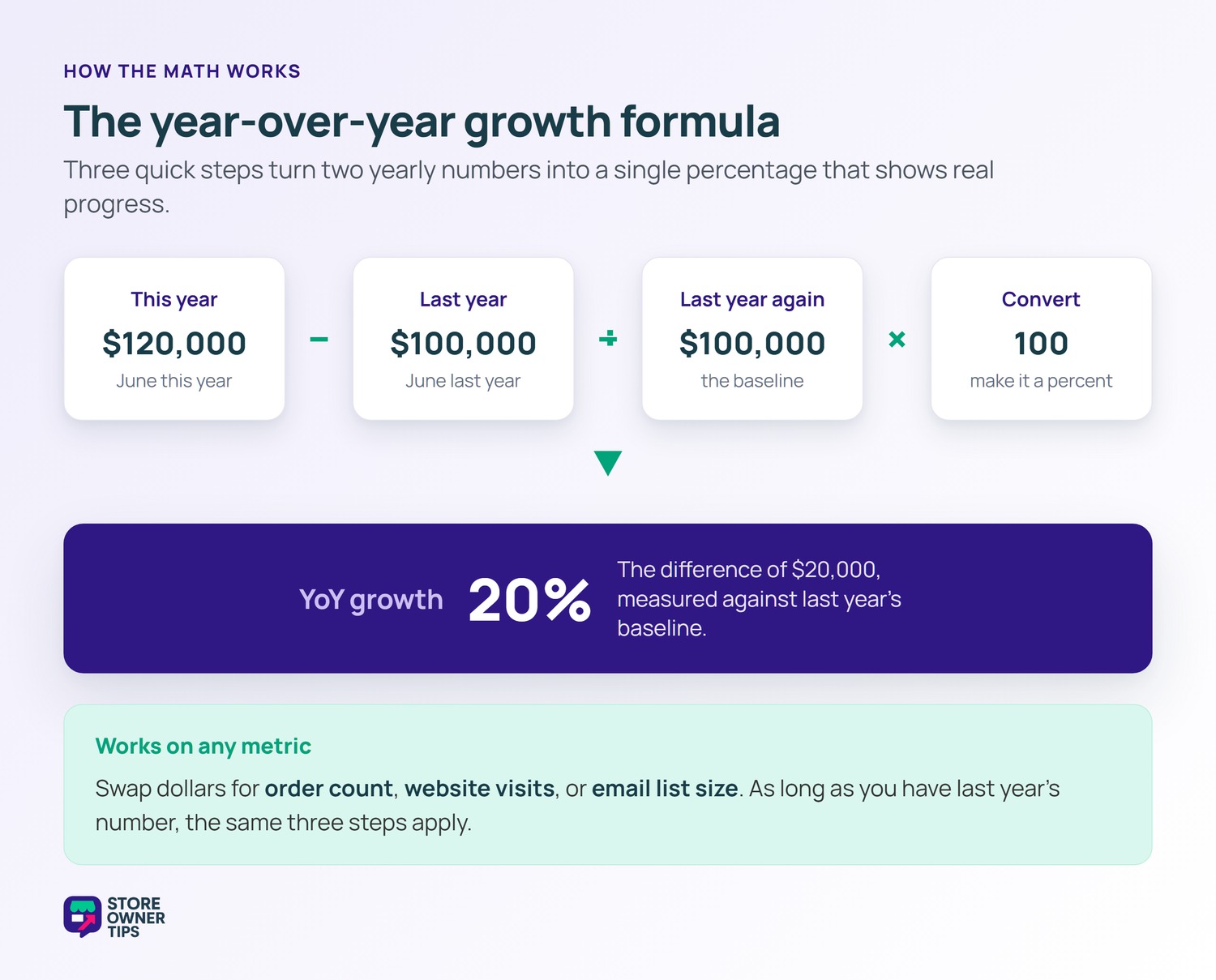
The math is short. Take this year’s value, subtract last year’s value, and divide that result by last year’s value. Then multiply by 100 to get a percentage.
Say you earned $120,000 this June and $100,000 last June. The difference is $20,000. Divide by $100,000 and you get 0.2, which is 20% YoY growth. Most analytics tools, including WooCommerce, do this math for you automatically.
The same formula works for any metric, not just money. You can run it on order count, website visits, or your email list size. As long as you have last year’s number, you can measure the change.
One thing to remember: YoY needs at least two years of data. A brand new store has nothing to compare against yet. For your first year, lean on month-over-month until you build a full year of history.
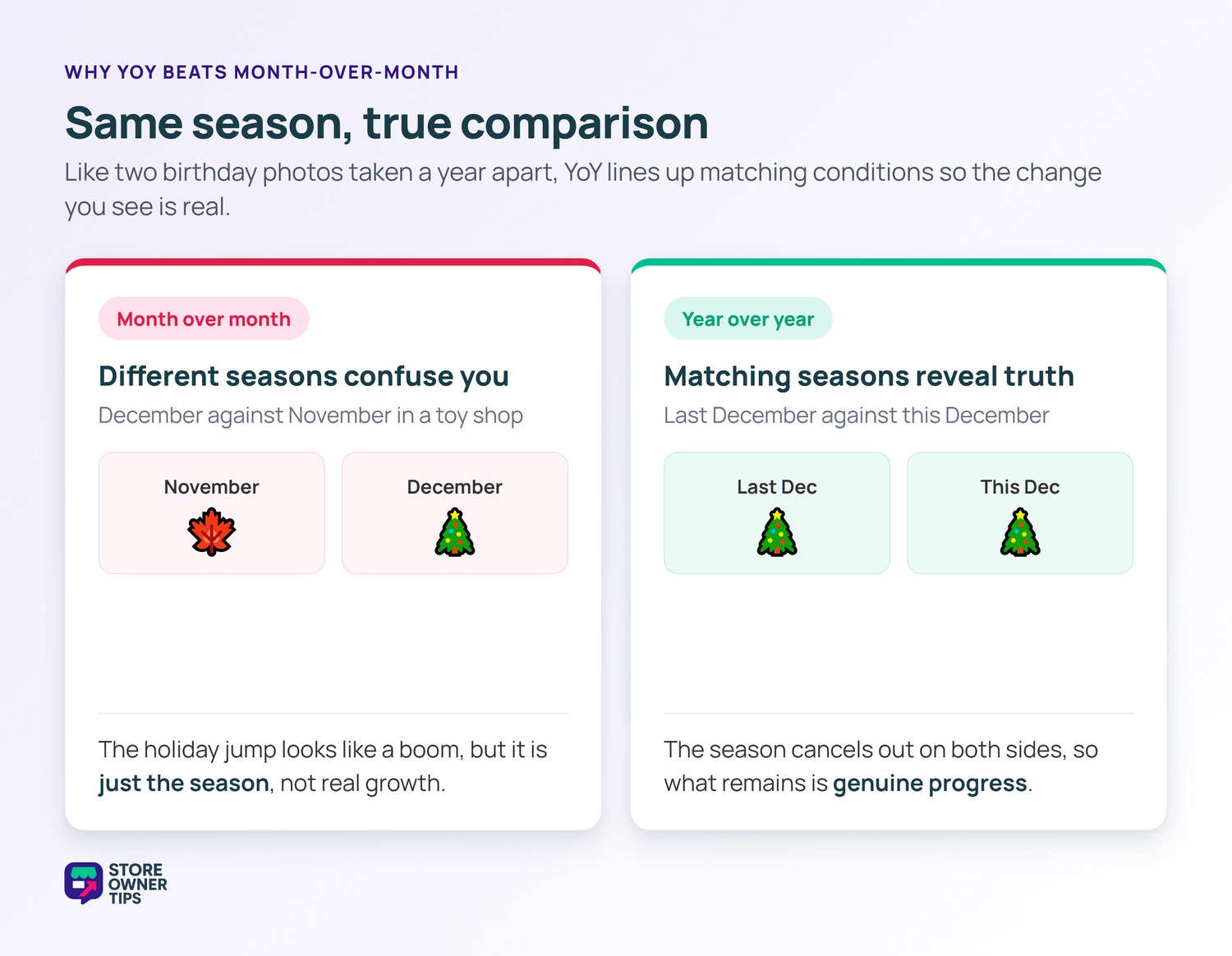
Think of YoY like comparing your height in two yearly photos taken on your birthday. Both photos show the same lighting and the same pose, so the change is real. Month-over-month is more like comparing photos from summer and winter, where the clothes alone make you look different.
For seasonal stores, this matters a lot. A toy shop always sells more in December than in November. That jump is not real growth, it is just the holidays. By contrast, comparing this December to last December strips the season out and shows true progress.
This is also why YoY is the metric that tracks the whole industry. The U.S. Census Bureau reports that e-commerce sales rose 9.8% in early 2026 compared to the same quarter a year before. That single number tells the story without seasonal noise.
There is no single magic number, but the wider market gives you a yardstick. Online retail as a whole has grown in the high single digits recently, and e-commerce now makes up 16.9% of all U.S. retail sales. Beating that pace means you are taking share, not just riding the tide.
A useful sign of strength is outpacing total retail. E-commerce grew 9.3% in late 2024 while overall retail crawled along far slower. If your store tops the e-commerce average, you are doing well.
Still, healthy growth depends on your stage and niche. A young store might post 50% YoY growth simply because it started small. By contrast, a large, established store posting steady double-digit gains is impressive.
So treat the market average as a floor, not a finish line. The real goal is consistent growth that beats the wider e-commerce pace over several years. One great quarter is nice, but a steady trend is what builds a business.
Imagine a mid-sized coffee roasting brand called Ember & Oak. The owner wants to know if the business is really growing or just busy. So she pulls up her year-over-year numbers instead of guessing.
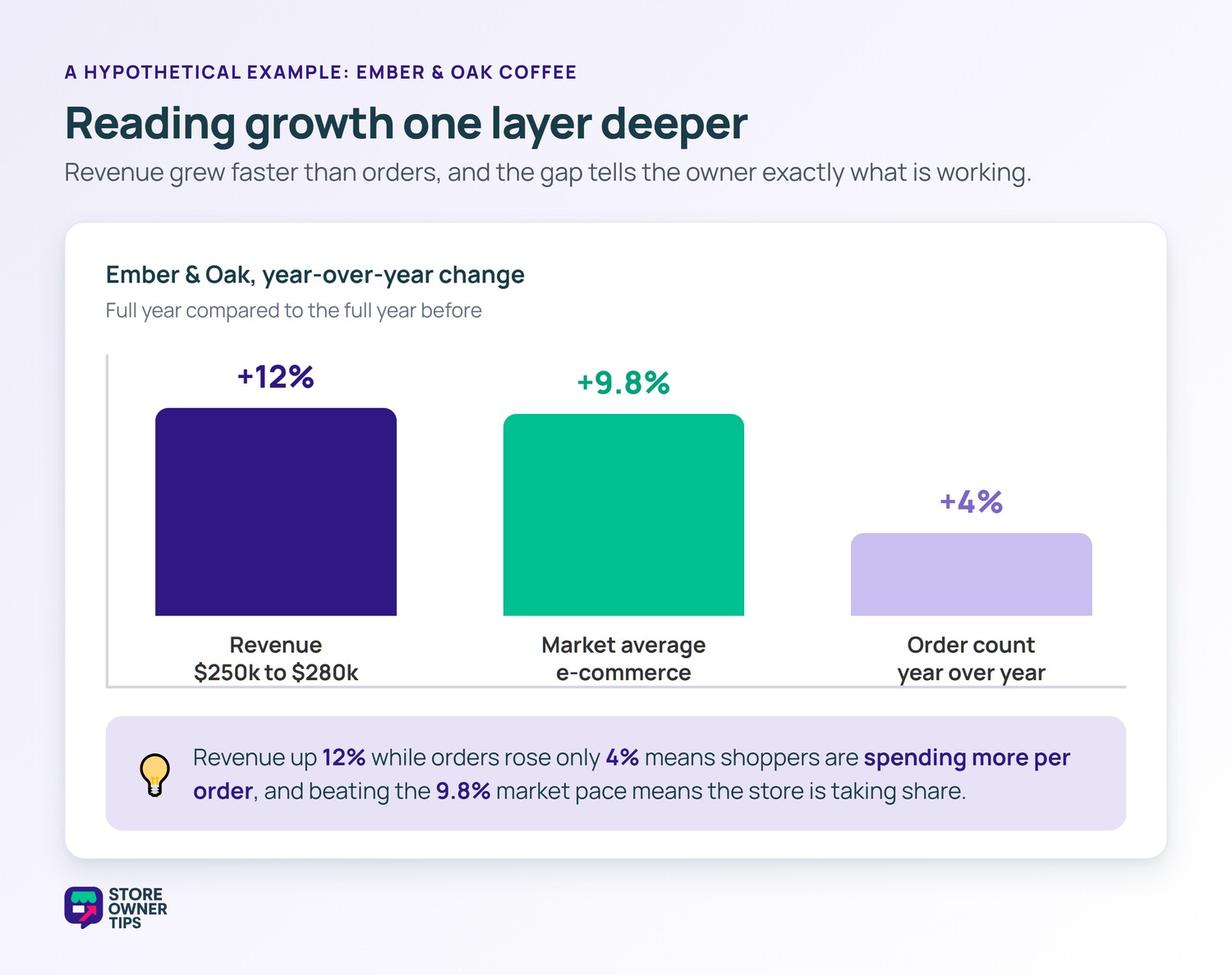
Last year, Ember & Oak earned $250,000 in annual revenue. This year, the same store earned $280,000. The owner already knows December is always her biggest month, so a month-to-month view would be misleading.
Instead, she compares the full year against the full year before. That keeps the holiday rush on both sides of the equation. The seasons cancel out, and only real growth remains.
The difference is $30,000. Divided by last year’s $250,000, that is 12% YoY growth. The wider e-commerce market grew roughly 9.8% over a similar window, so Ember & Oak is beating the field.
That context changes her decisions. Because she is outpacing the market, she reinvests in stock and ads with confidence. Without YoY, she might have panicked over a slow summer that was perfectly normal.
She also digs one level deeper into the numbers. Her order count grew only 4% year over year, but revenue grew 12%. That gap tells her shoppers are spending more per order, a healthy sign.
Finally, she checks traffic year over year to see what is driving the gains. Visits rose in step with sales, so her growth looks sustainable. If revenue had jumped while traffic stayed flat, she would worry the spike was a fluke.
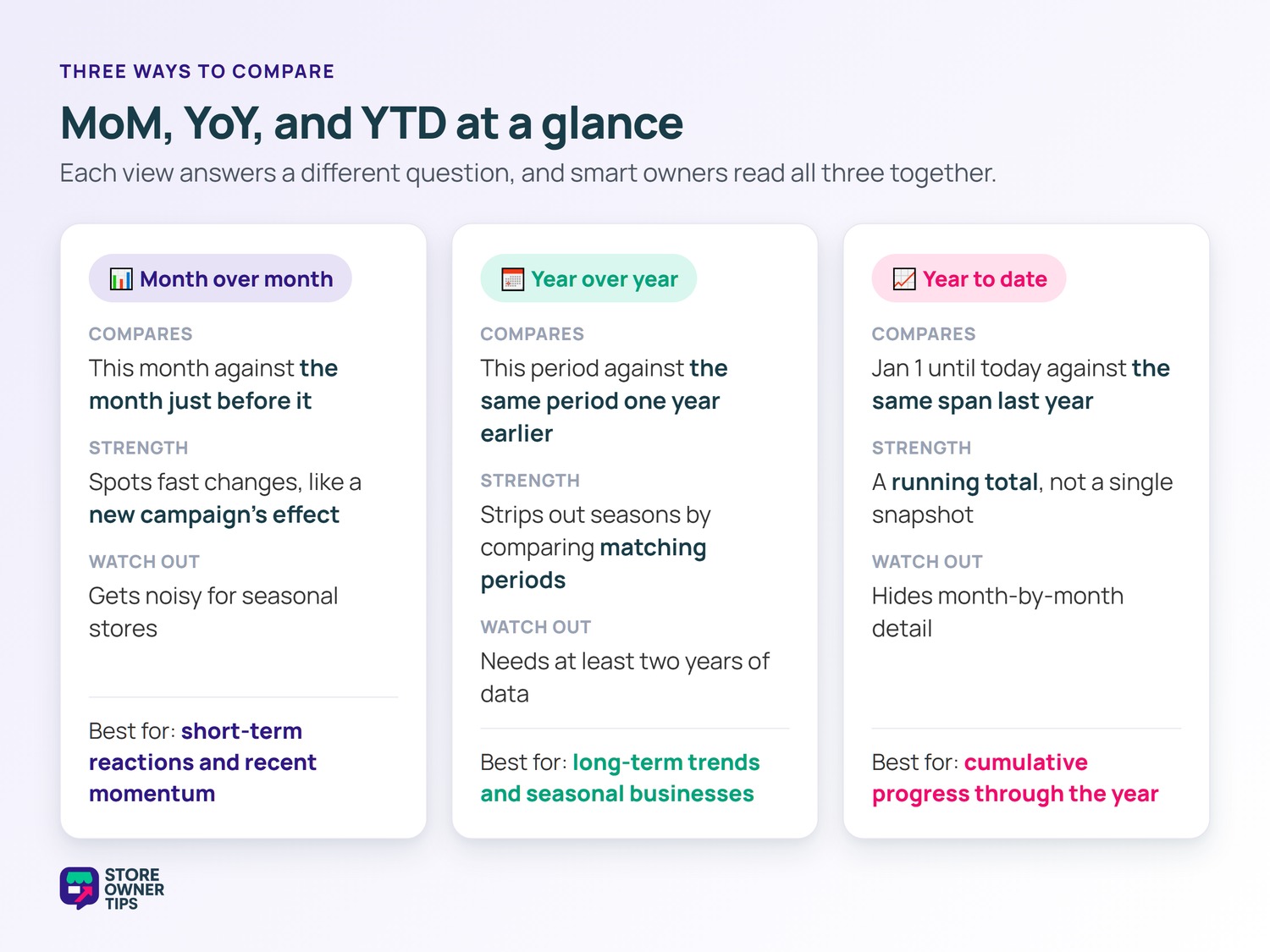
These two metrics answer different questions, and smart owners use both. Month-over-month (MoM) compares this month to the one just before it. It is great for spotting fast changes, like the effect of a new campaign.
However, MoM gets noisy for seasonal stores. A drop from December to January looks scary but is totally normal. Year-over-year smooths that out by comparing matching seasons instead.
There’s also a third view called year-to-date, or YTD. It adds up everything from January 1 until today and compares it to the same span last year. Think of it as a running total rather than a single snapshot.
With that in mind, use:
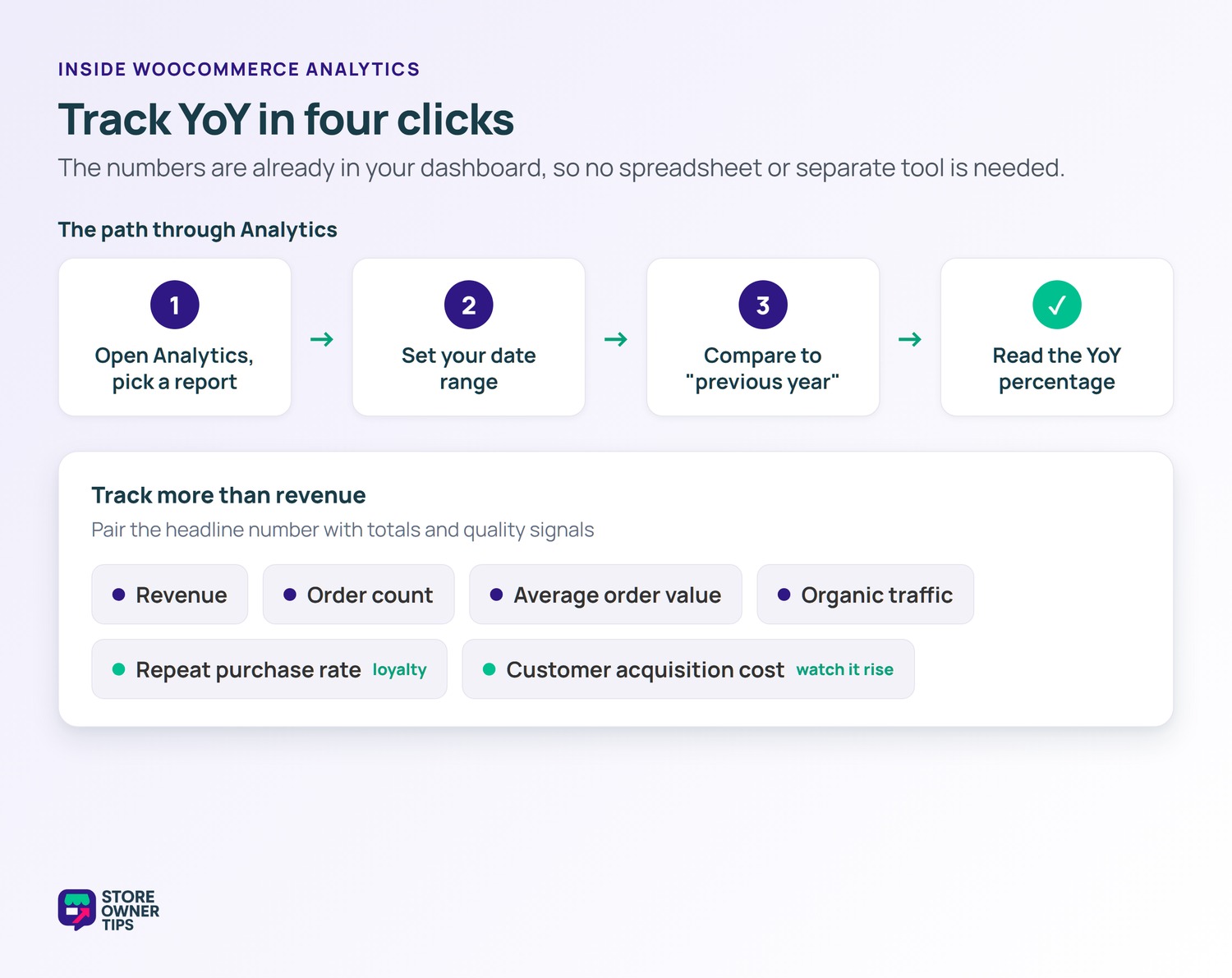
WooCommerce builds year-over-year tracking right into its Analytics reports. You do not need a spreadsheet or a separate tool to get started. The numbers are already in your dashboard.
Open Analytics, then pick a report like Revenue or Orders. Set your date range using the date picker at the top. WooCommerce offers an option to compare your chosen range to the previous period or previous year.
Choose “previous year” to see a true YoY view. The report then shows a comparison line on the graph and the percentage change on the summary cards. That percentage is your year-over-year growth, calculated for you.
Revenue is the headline, but it is not the only thing worth tracking year over year. Watch your order count, average order value, and traffic too. Pairing revenue growth with organic traffic trends shows whether marketing is actually working.
You should also watch quality metrics, not just totals. A rising repeat purchase rate year over year signals loyalty. Meanwhile, a climbing customer acquisition cost can quietly eat into your gains.
The trick is to check YoY on a regular schedule, not just once. Many owners review it monthly and again at the close of each quarter. That rhythm catches slowdowns early, while there is still time to react.
It also helps to write down the “why” behind big swings. A new product launch, a viral post, or a supply delay can all move the numbers. Notes turn raw data into a story you can actually learn from.
For deeper analysis, you can export the report data to a spreadsheet. From there, you might chart several years of growth side by side. That long view reveals trends a single comparison can hide.
Subtract last year’s value from this year’s value. Then divide the result by last year’s value and multiply by 100. The answer is your YoY growth as a percentage.
Year-over-year growth compares the same season in two different years. This cancels out predictable swings like holiday rushes or summer slumps. As a result, you see real growth instead of seasonal noise.
There is no single right answer, but the market sets a baseline. Online retail recently grew in the high single digits, near 9.8% year over year. Beating that pace means you are gaining ground on competitors.
Year-over-year growth is the truest measure of whether your store is really expanding. It strips out seasons and shows the long-term trend that drives smart decisions. Track it inside WooCommerce Analytics, compare your pace to the market, and you will always know where you stand.
Copyright © StoreOwnerTips.com. All Rights Reserved.
