Weekly ecommerce tips, deals & news.
Every few months, a friend or client asks me to settle the WooCommerce vs Shopify debate.
Usually they’ve read a comparison article that made the decision feel obvious in one direction or the other. Those articles are rarely honest. They’re either written by hosting companies that want you on WooCommerce, or app developers paid by Shopify to push you that way.
The answer isn’t obvious. It depends on factors most comparison articles skip. Specifically, these include total cost of ownership at scale, your SEO strategy, and how much you plan to customize your store over the next five years.
Here’s the WooCommerce vs Shopify comparison I’d give to a friend.
Let’s get the short answer out of the way.
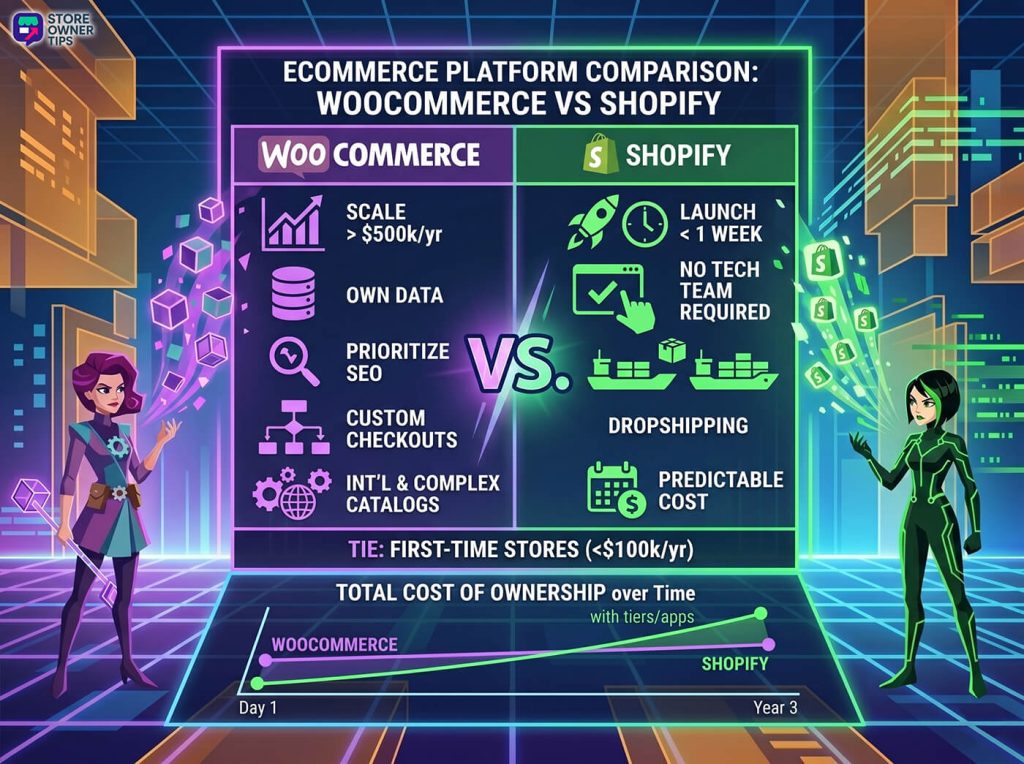
The most important thing this comparison will cover: the total cost of ownership math changes significantly as you grow. What’s cheapest on day one often becomes most expensive at year three.
Most comparison articles list Shopify’s plan prices ($29-399/month and WooCommerce as “free.” Both are misleading.
Here’s the real 5-year TCO math for a store doing $10k/month:
If using a third-party payment processor instead of Shopify Payments, add another 2% × $600k volume = $12,000 in Shopify transaction fees over 5 years. Total with third-party processor: $36,490.
For a $10k/month store over 5 years, the platforms end up roughly equivalent in total cost. However, the distribution is different. Shopify fees scale with revenue. WooCommerce costs are mostly fixed.
Where the math tilts strongly toward WooCommerce: Stores doing $50k+/month. At that volume, Shopify’s percentage fees become significant. A store doing $50k/month pays roughly $17,400/year in Shopify platform and payment fees. WooCommerce’s equivalent all-in cost is around $6,000/year.
One thing we commonly see? Basically, store owners underestimate Shopify’s transaction fees at launch. Then, they realize at $30k-50k/month that they’re paying $1k+/month in fees alone. At that volume, WooCommerce + managed hosting usually costs 50-70% less.
When looking at WooCommerce vs Shopify for ease of use, Shopify wins decisively for first-time store owners.
Shopify also handles server maintenance, security updates, and scaling automatically. On the other hand, WooCommerce requires you (or your host) to manage those.
For technical store owners or agencies, the gap closes significantly. A WooCommerce expert can set up a store nearly as fast as a Shopify store. However, for complete beginners, Shopify is the faster path.
In the WooCommerce vs Shopify design debate, WooCommerce wins on flexibility, but not by as much as it used to.
Shopify’s theme system has improved dramatically with Online Store 2.0. You can now customize sections, blocks, and templates visually without code. Most Shopify themes support enough customization for typical stores.
WooCommerce’s advantage is unlimited. With a theme like Astra Pro or Divi, you can customize any element of any page. There are no restrictions on page templates, custom post types, or page builder integration.
If you want a store that looks exactly like your brand’s existing website, WooCommerce is easier. If you’re happy picking from a theme library with moderate customization, Shopify works fine.
WooCommerce has meaningful SEO advantages that become significant at scale.
Shopify uses a fixed URL pattern: /products/product-name and /collections/category-name. You can fully customize the handle (slug) after each prefix, but the /products/, /collections/, and /pages/ prefixes themselves can’t be changed or removed.
WooCommerce defaults to /product/ and /product-category/ prefixes. With custom code, or a plugin like Permalink Manager or Custom Permalinks for WooCommerce, you can remove or restructure these—such as /product-name (no prefix) or /category/product-name.
Both platforms support schema markup. WooCommerce with AIOSEO Pro or Yoast SEO gives you more granular control over product schema, category schema, and custom schema types.
Shopify stores benefit from Shopify’s CDN, which is excellent out of the box. Meanwhile, WooCommerce speed depends entirely on your hosting. A WooCommerce store on managed hosting (Kinsta, Nexcess) can be significantly faster than an equivalent Shopify store. On shared hosting, however, it’ll be slower.
WooCommerce (which runs on WordPress) has a native blogging platform that’s more flexible than Shopify’s. For stores that do serious content marketing, this matters.
WooCommerce wins on SEO at scale. Shopify is fine for stores doing basic SEO. Serious content marketing and technical SEO strategies are much easier in WooCommerce.
Shopify has the larger official app store (17,000+ apps as of 2026) with better quality control. WooCommerce has access to 60,000+ WordPress plugins, but quality varies.
In the WooCommerce vs Shopify app battle, both ecosystems cover the common ecommerce needs (reviews, email, SEO, payments, shipping, subscriptions) with multiple options. The main differences:
Long-term, WooCommerce plugins are cheaper but require more maintenance. Shopify apps are more expensive but simpler.
The WooCommerce vs Shopify debate often gets decided right here. This is the most expensive category to get wrong. After all, your platform dictates which payment methods you can offer without eating into your margins.
For a store doing $100k/year using Stripe:
At higher volumes, the gap grows significantly.
Both platforms support multi-currency, but implementation differs.
Shopify Markets handles multi-currency, multi-language, localized checkout, and regional payment methods natively. It’s well-designed and easy to set up. Available on all Shopify plans.
WooCommerce supports multi-currency through plugins (Aelia, WOOCS, CURCY) and multi-language through plugins (WPML, TranslatePress). Setup is more involved but offers more flexibility. For example, you can handle currencies, languages, and regional pricing rules independently.
For stores selling primarily in 1-3 countries, Shopify’s built-in solution is easier. Meanwhile, for stores selling globally with complex regional pricing, WooCommerce’s plugin ecosystem wins.
Both platforms scale to very large stores. The failure modes differ.
Shopify scaling failures: Shopify handles traffic spikes well (their infrastructure is excellent). The failure mode is cost: app stacks become expensive, Shopify Plus (starts at $2,300/month on a 3-year term, or $2,500/month on a 1-year term) is required for advanced features
WooCommerce scaling failures: WooCommerce’s failure mode is usually hosting. Cheap hosting breaks first. Stores doing $500k+/month need serious managed hosting ($500+/month) or enterprise hosts (WP Engine, Kinsta at higher tiers). Database optimization becomes important.
Both platforms successfully run stores doing $10M+/year. Neither is inherently limited at scale.
When comparing WooCommerce vs Shopify, data ownership is an underrated difference that could save your business in the long run.
WooCommerce is self-hosted. You own your database, customer data, order history, and content. If you want to move hosting, migrate to another platform, or export everything, you can, easily.
Shopify is hosted. Your data lives on Shopify’s servers. You can export data, but some things (like app-specific data, custom checkout configurations, and Shopify-specific features) don’t migrate cleanly if you decide to leave.
For stores where data portability matters (compliance, international regulations, acquisition potential), WooCommerce’s ownership model is a real advantage.
For stores under $5k/month in sales, they’re roughly equivalent. However, for stores under $30k/month, WooCommerce is usually 10-30% cheaper. Furthermore, for stores over $50k/month, WooCommerce is typically 40-70% cheaper because Shopify’s percentage-based fees scale with revenue.
Yes, especially for first-time store owners. Shopify handles hosting, security, and updates automatically. WooCommerce requires more setup work but offers more long-term flexibility.
WooCommerce has meaningful SEO advantages: URL structure control, advanced schema options, more flexible content marketing. Both platforms can rank well. WooCommerce has more headroom for advanced SEO strategies.
Yes. Tools like Cart2Cart and LitExtension handle most of the migration.
Shopify has the larger official app store with better quality control. WooCommerce has more options overall but variable quality. Functionally, both cover the common ecommerce needs.
WooCommerce core is free. You’ll still pay for hosting, domain, SSL, theme, and likely some premium plugins. A realistic minimum-viable WooCommerce store costs $200-500/year.
Here’s the honest truth: for most first-time store owners under $100k/year with simple products, both WooCommerce and Shopify work. Pick based on whether you value ease of setup (Shopify) or long-term flexibility and lower costs at scale (WooCommerce).
Here’s what to do next:
If you’re weighing WooCommerce vs Shopify for a new store, my recommendation for most growing businesses is WooCommerce. After all, the flexibility, SEO advantages, and lower TCO at scale make it the smarter long-term choice. The extra setup time pays itself back within the first year for most stores.

Copyright © StoreOwnerTips.com. All Rights Reserved.
