Giving Tuesday is a global day of giving held on the Tuesday after US Thanksgiving. It follows Black Friday and Cyber Monday, and it asks people to donate, volunteer, or back a cause. For an online store, it’s a chance to tie sales to a donation and show what the brand stands for.
Giving Tuesday works as a shared day when people, nonprofits, and businesses all focus on giving back at once. Nonprofits run fundraising appeals, and shoppers donate money, goods, or time. Online stores join by pledging part of the day’s sales or matching what their customers give.
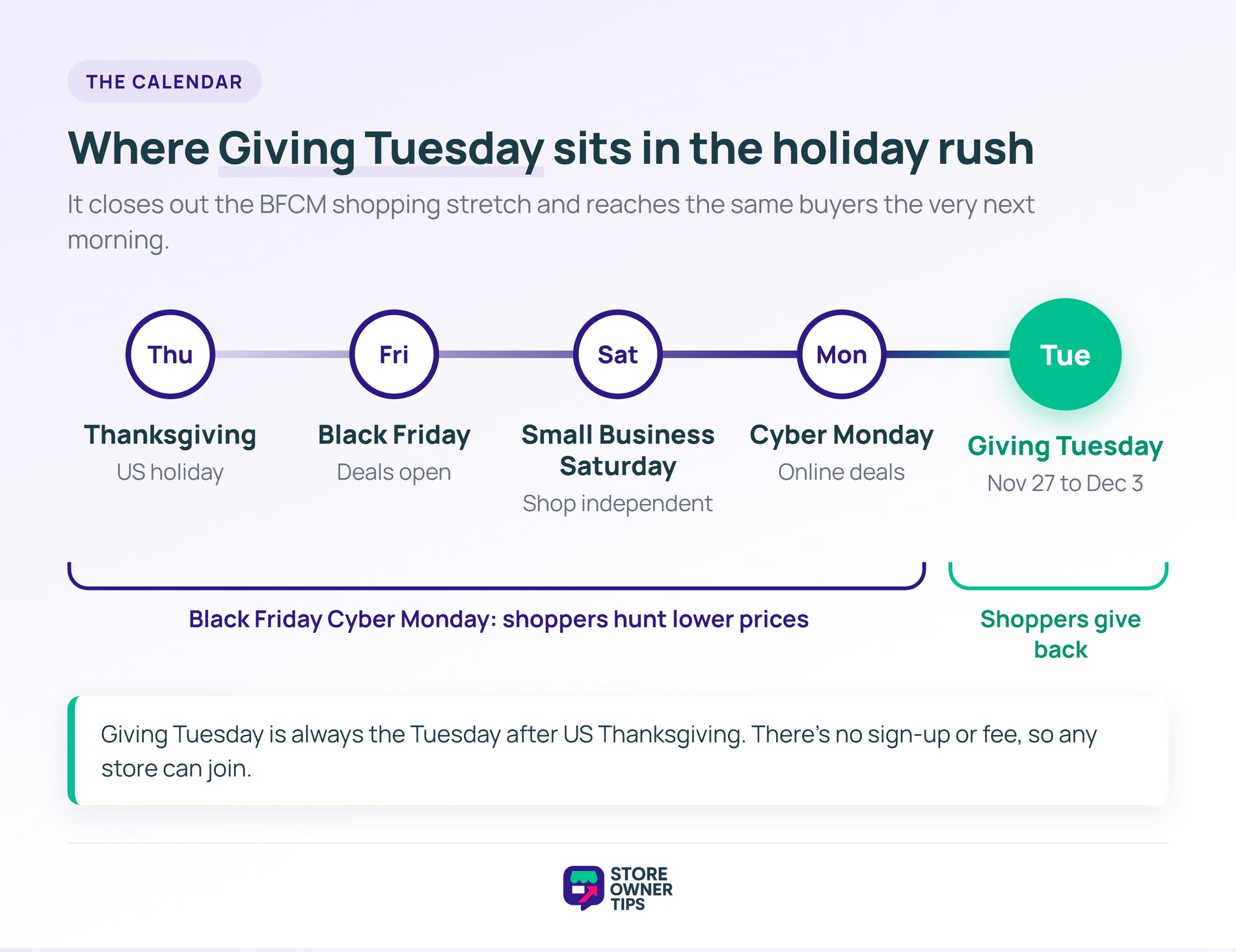
Giving Tuesday has no central sign-up or fee. Any person or business can take part, which is why the day spreads so widely on social media and email. The movement began in 2012 as a way to balance the season’s spending with generosity.
Giving Tuesday falls on the Tuesday after US Thanksgiving, which puts it between November 27 and December 3. It closes out the run of shopping days known as Black Friday Cyber Monday (BFCM). That stretch includes Small Business Saturday, the day that nudges people to buy from independent shops.
Giving Tuesday arrives while shoppers are still in buying mode. The National Retail Federation counted a record 202.9 million shoppers from Thanksgiving Day through Cyber Monday. Adobe Analytics tracked $14.25 billion in US online spending on Cyber Monday alone. Giving Tuesday reaches many of those same people the very next morning.
Online stores take part in Giving Tuesday by linking each order to a donation. Think of it like a tip jar at a coffee counter. The shopper buys what they came for, and a little extra goes somewhere good.
Common formats on a WooCommerce store include:
Most stores reuse the pieces they built for a Cyber Monday promotion: a banner, a short email, and a countdown. A Giving Tuesday offer usually runs for just 24 hours, much like a flash sale. Marketplace owners can rally vendors around a shared cause and get every seller pitching in.
A cause makes shoppers act because the purchase now does two jobs at once. The buyer gets the product and the good feeling of helping. It works like a school bake sale. People happily pay more for a cookie when the money goes to a good cause.
Economists have measured this effect. A study of identical eBay products found that charity-linked listings sold for prices 6% higher, on average, than non-charity listings. The authors found that bidders in charity auctions bid earlier, which pushed other bidders to bid harder.
Timing helps too. After a weekend of buying, many shoppers like a purchase that gives something back. Giving Tuesday hands them that reason on a single, well-known day.
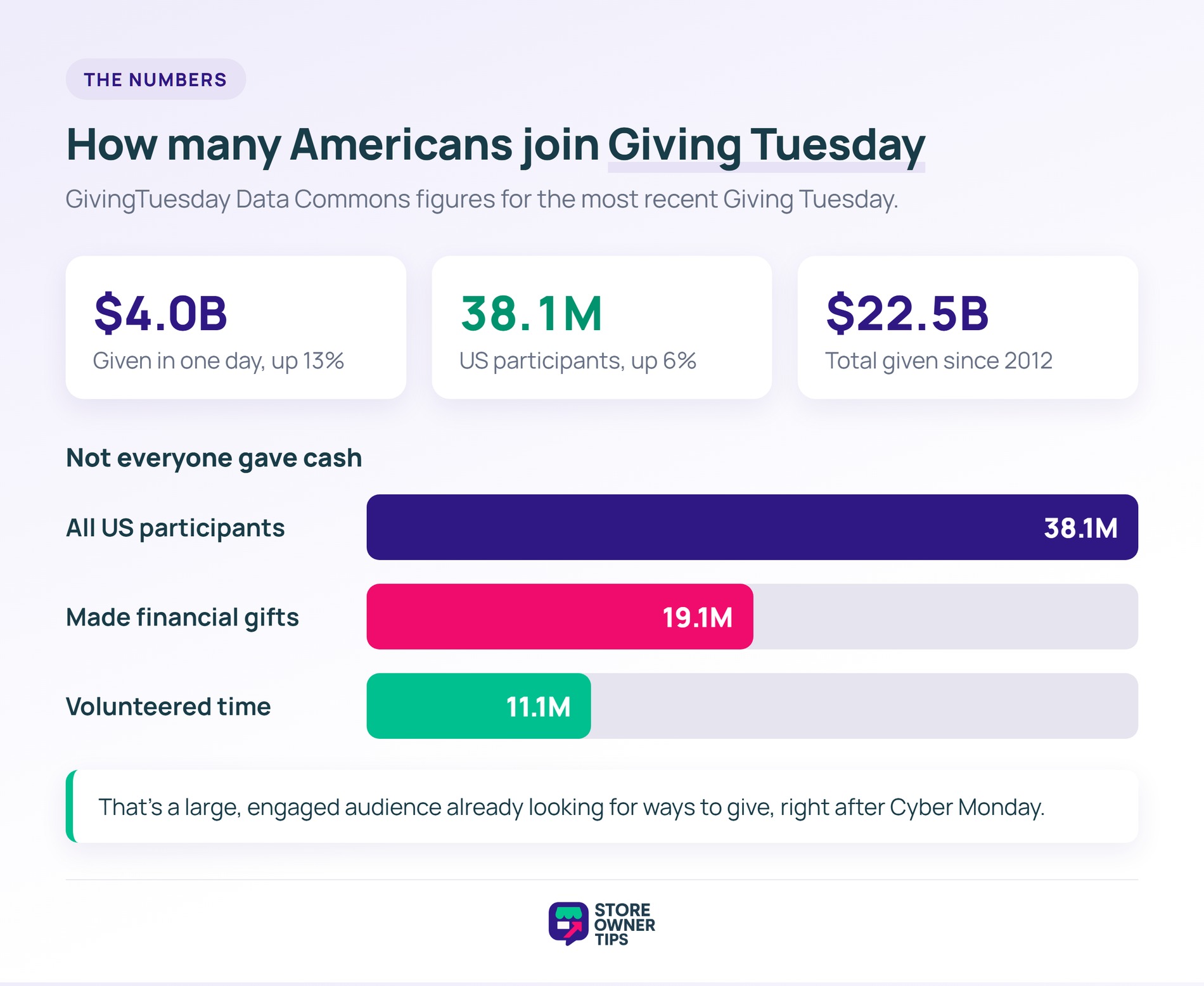
The GivingTuesday Data Commons is the movement’s own research arm. It estimates that Americans gave $4.0 billion on the most recent Giving Tuesday. That figure was up 13% on the year before. The same report counted 38.1 million US participants, a 6% rise.
Not everyone gave cash. The Data Commons found 19.1 million people made financial gifts, while 11.1 million volunteered their time. Since the first Giving Tuesday in 2012, the group puts total donations at $22.5 billion.
For store owners, these figures show a large, engaged audience that’s actively looking for ways to give. A clear, honest Giving Tuesday offer meets those shoppers where they already are.
Giving Tuesday in practice looks like a one-day pledge that turns ordinary orders into donations. Here’s a hypothetical example. Picture Saltmarsh Supply Co., a small WooCommerce store selling coastal home goods and outdoor gear.
Saltmarsh Supply Co. pledges 10% of every Giving Tuesday order to a local beach cleanup charity. The owner gets the charity’s written approval to use its name. Next, the team adds a site-wide banner and a short product page explaining the pledge.
On Monday evening, the store emails its list with the subject line “Tomorrow, your order helps clean our beaches.” The store adds an optional $2 round-up product at checkout. No discount runs, so the cause stays the headline.
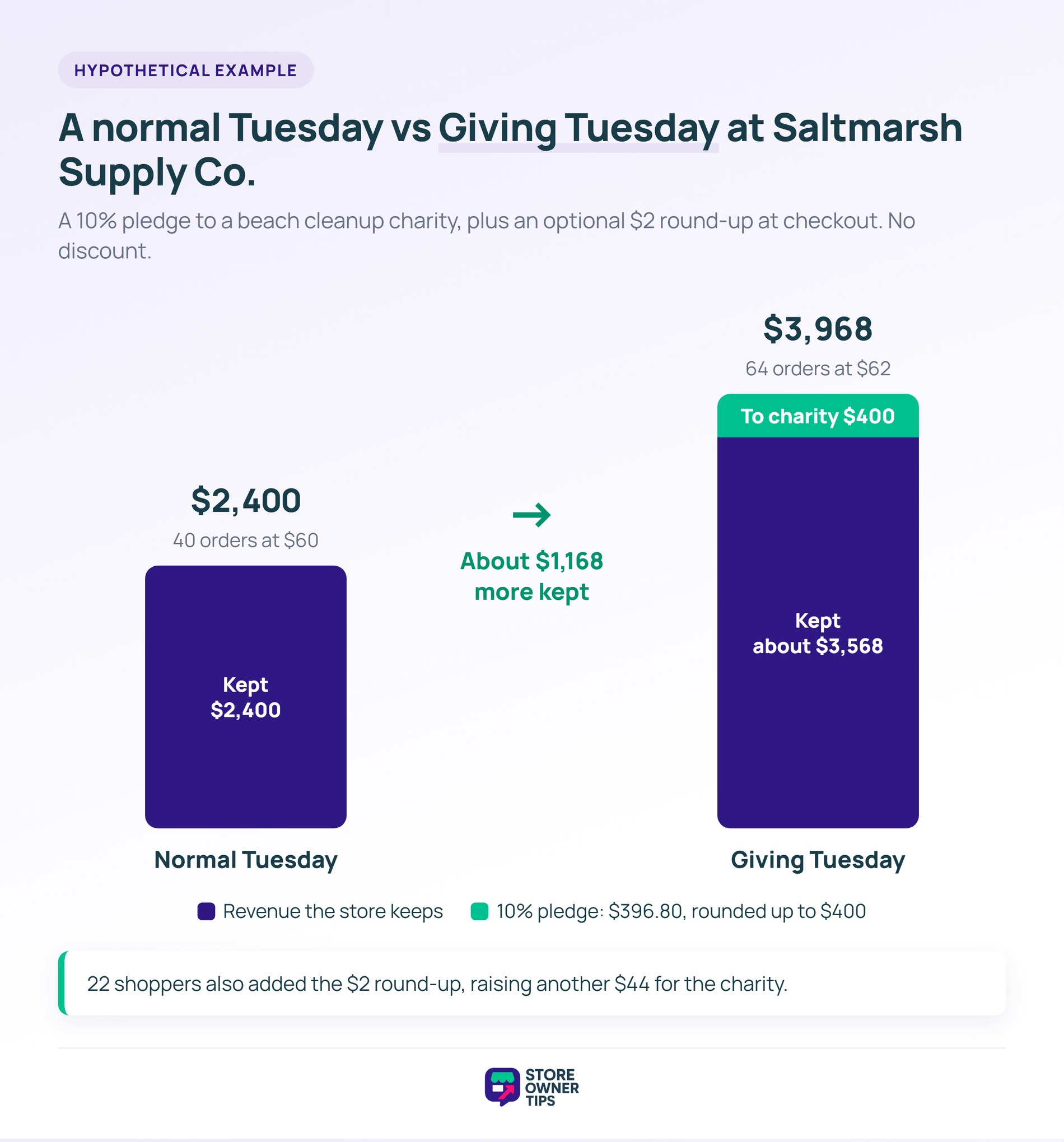
On a normal Tuesday, Saltmarsh Supply Co. takes about 40 orders at an average of $60. That’s roughly $2,400 in revenue. On Giving Tuesday, the store takes 64 orders at an average of $62, for $3,968 in sales.
The 10% pledge comes to $396.80, which the owner rounds up to $400. Meanwhile, 22 shoppers add the $2 round-up, raising another $44 for the charity. After the donation, Saltmarsh still keeps about $3,568, around $1,168 more than a normal Tuesday.
A week later, the store posts the donation receipt and a thank-you email with photos from the cleanup. That proof matters, because it shows customers the promise was real. Several buyers reply that they’ll shop again next year.
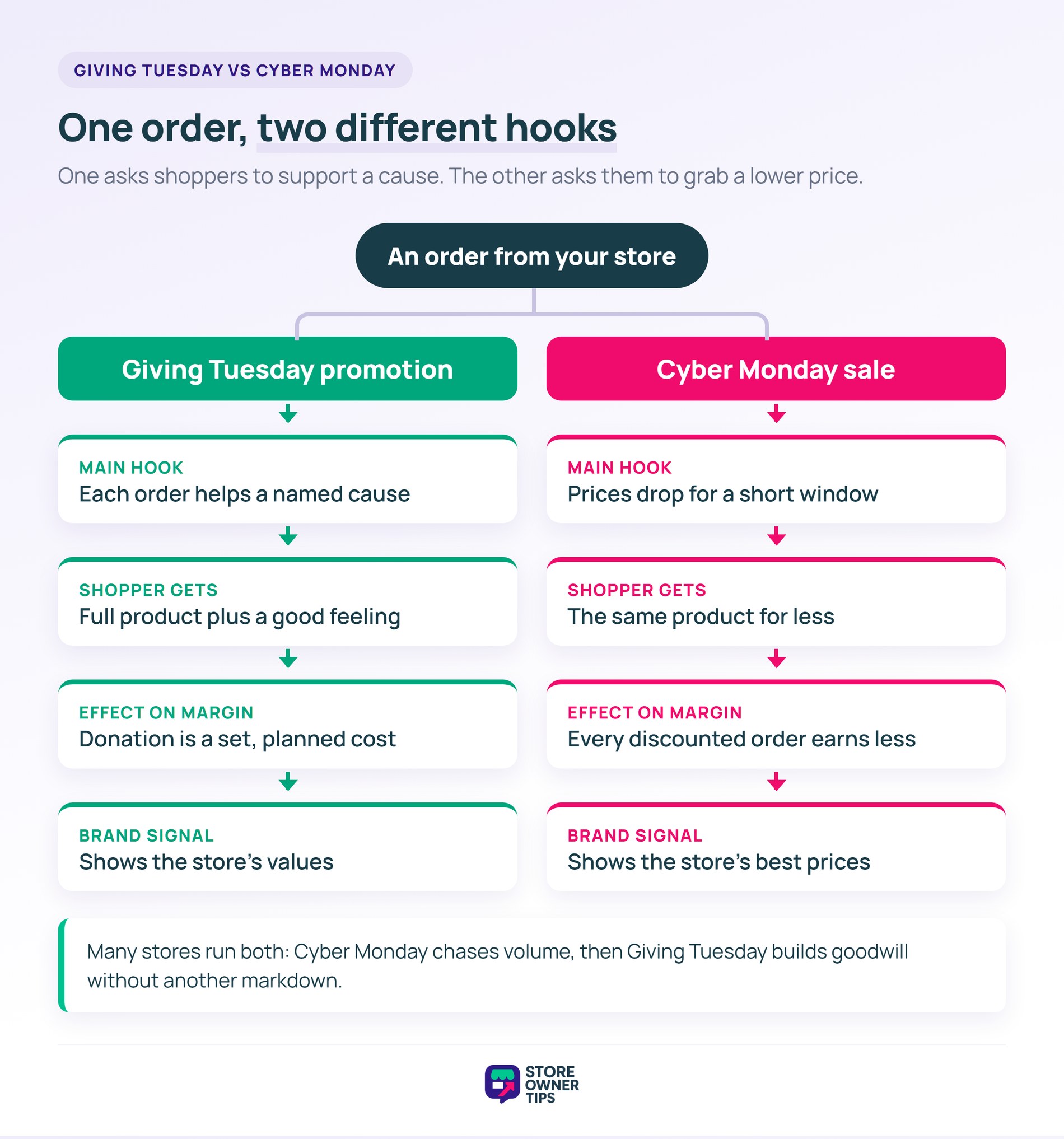
Giving Tuesday asks shoppers to support a cause, while a Cyber Monday sale asks them to grab a lower price.
| What you’re comparing | Giving Tuesday promotion | Cyber Monday sale |
|---|---|---|
| Main hook | Each order helps a named cause | Prices drop for a short window |
| What the shopper gets | Full product plus a good feeling | The same product for less |
| Effect on margin | Donation is a set, planned cost | Every discounted order earns less |
| Brand signal | Shows the store’s values | Shows the store’s best prices |
Many stores run both, one day after the other. The Cyber Monday sale chases volume, and Giving Tuesday builds goodwill without another markdown. Add Giving Tuesday to your holiday sales calendar so it gets its own email and isn’t an afterthought.
Giving Tuesday brings goodwill and steady margins, but it needs honesty and some extra admin to pay off.
Giving Tuesday fits neatly into an after-Black Friday task list. It gives you one more reason to contact shoppers before the holiday rush. Some stores even donate a gift card to a charity’s raffle as an extra gesture.
Giving Tuesday is the Tuesday after US Thanksgiving, so it always lands between November 27 and December 3. In 2026, Giving Tuesday falls on December 1. The date moves each year because Thanksgiving is the fourth Thursday of November. Plan your emails a week or two ahead, since the day comes right after a busy shopping weekend.
Yes, a for-profit business can take part in Giving Tuesday, and many stores do. The usual formats are donating a share of sales, matching customer donations, or giving staff time to volunteer. The key is to name the charity, the exact amount, and the time window. A specific promise like “10% of today’s sales” earns more trust than “we’re giving back.”
A discount on Giving Tuesday is optional, and many stores skip it entirely. Shoppers have just seen four days of deals, so a donation offer stands out more than another markdown. If you run both, keep the discount small so the cause stays the headline. Otherwise, the promotion reads like a leftover Cyber Monday sale with a charity label attached.
Giving Tuesday matters because it gives online stores a way to sell during the holidays without cutting prices again. A clear, honest pledge builds trust that lasts beyond one season. Over time, that trust turns first-time buyers into loyal customers.
Copyright © StoreOwnerTips.com. All Rights Reserved.
