A back-to-school sale is a retail promotion that runs from about July to early September. It’s timed to the start of the new school and college year. Stores discount what students need for class, such as supplies, clothing, shoes, electronics and dorm gear. The timing in this entry reflects the Northern Hemisphere, mainly the US, since most sources are US-based.
A back-to-school sale works by discounting class essentials during the weeks when families are already shopping for the new year. The store doesn’t have to create demand. Every family with a student gets a supply list, and the deadline is the first day of class. Your job is to be the easiest, best-value place to finish that list.
Think of it like a hardware store before a long weekend of home projects. People already know what they need. The store that has it in stock, at a fair price, gets the sale.
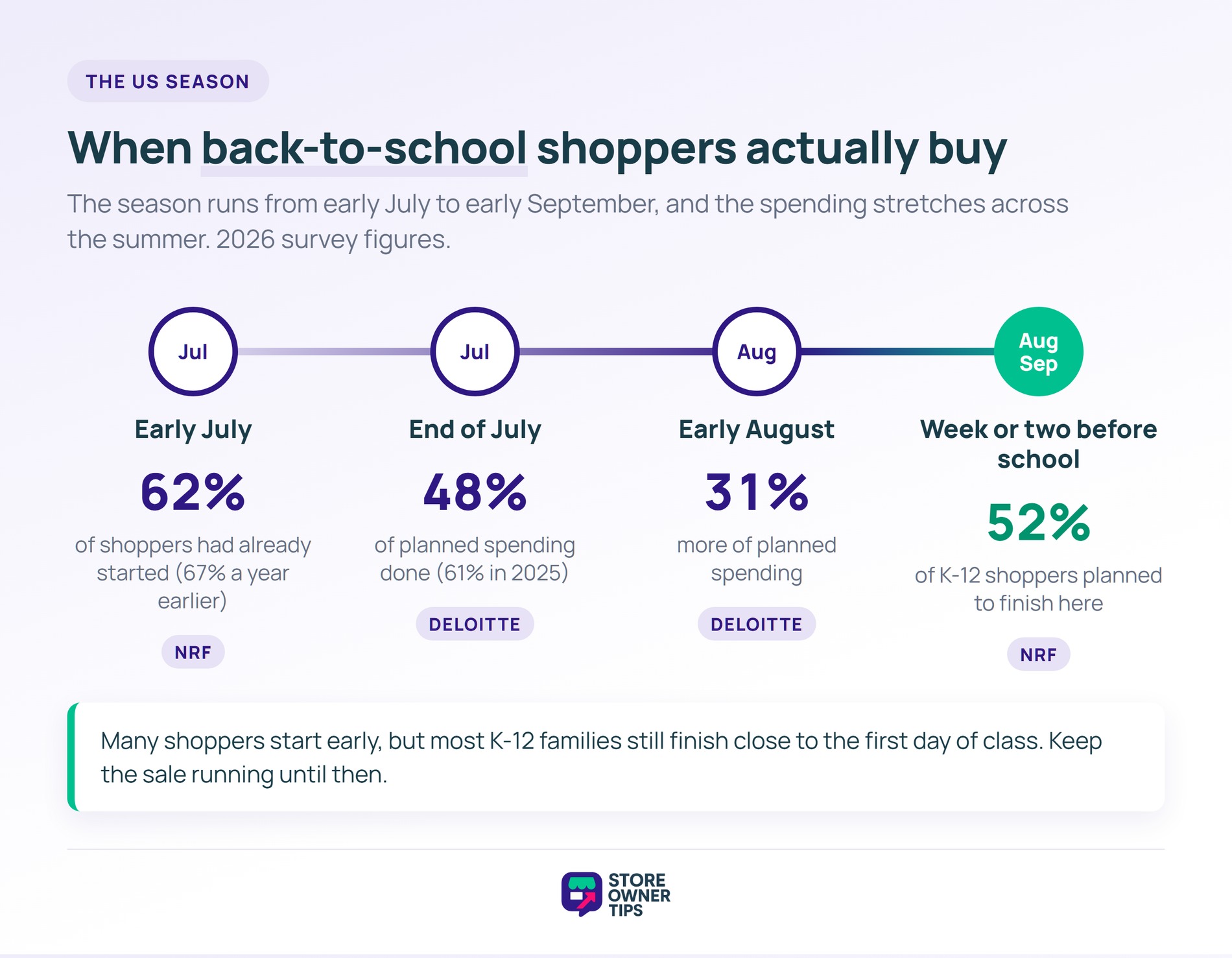
The back-to-school season in the US runs from early July to early September. Many shoppers start well before August. NRF found 62% of shoppers had already started by early July 2026, down from 67% a year earlier.
The spending still stretches across the summer. Deloitte’s 2026 survey expected 48% of planned spending by the end of July, down from 61% in 2025. It expected another 31% in early August. NRF also found that most K-12 shoppers (52%) planned to finish in the week or two before school starts.
The Southern Hemisphere runs on a different clock. In Australia and New Zealand, the school year starts in late January or early February. So a back-to-school sale there lands in their summer, right after the holidays.
Three groups shop a back-to-school sale: parents of K-12 kids, college students and their families, and teachers. Parents buy supplies, clothes, shoes and a growing amount of tech. College shoppers add dorm furnishings, food and personal care items to the mix.
Teachers are the group many stores forget. AdoptAClassroom.org’s survey of 3,700 K-12 teachers found they spent $895 out of pocket on average during the 2024–2025 school year. That makes teachers repeat buyers of bulk pens, paper, storage bins and classroom decor.
Back-to-school shoppers mostly buy electronics, clothing, shoes and school supplies. College shoppers also spend heavily on dorm and apartment gear. Because buyers work from a list, the offers that work best make finishing that list cheaper or faster.
Deals clearly move this crowd. NRF’s August 2026 update found that 48% of purchases were driven by coupons, sales or promotions on average. On WooCommerce, core coupons handle simple percentage or fixed discounts, while kits and tiers usually need a plugin.
The numbers say back-to-school is one of the biggest retail events of the year in the US. NRF’s 2026 survey projected K-12 families would spend $863.86 each, for a record $43.3 billion. College shoppers planned $1,437.79 each, pushing that total to $103.5 billion. NRF says that’s the first time college spending passed $100 billion.
Electronics led K-12 budgets at $293.11 per family. Meanwhile, only half of K-12 shoppers (50%) planned to buy online, down from 55% the year before. NRF surveyed 7,677 consumers from July 1 to 8, 2026.
Deloitte’s 2026 survey of 1,207 parents gives a lower figure of $557 per child. That gap comes from method, not error, since Deloitte counts per child and NRF counts per household. Both agree shoppers are price-conscious.
A back-to-school sale in practice is a spring planning job followed by a summer selling window. Here’s a hypothetical example. Imagine a small WooCommerce store called Pennywhistle Paper & Pack. It sells notebooks, pens, backpacks and lunch boxes to US families and teachers.
In April, the owner pulls last year’s July to September sales. The store sold 900 backpacks and 2,400 notebooks in that window. Backpacks sold out in early August, which cost sales during the busiest weeks. A guide on managing out-of-stock products helps the owner set reorder points this time.
So the owner orders 1,100 backpacks and keeps notebooks at 2,400. The plan also adds three kits: elementary, middle school and a teacher desk bundle. The kits use stock the store already carries, so there’s little extra seasonal inventory risk.
Deloitte’s timing data shows about half of planned spending lands by the end of July. So Pennywhistle launches in mid-July instead of mid-August. The owner marks the dates on a sales calendar with three email sends.
The kits do the heavy lifting. Kit orders average $62, compared with $24 for single-item orders. Backpacks stay in stock through August, and the store sells 1,040 of them. That’s 140 more than the year before, mostly from the weeks it was sold out last time.
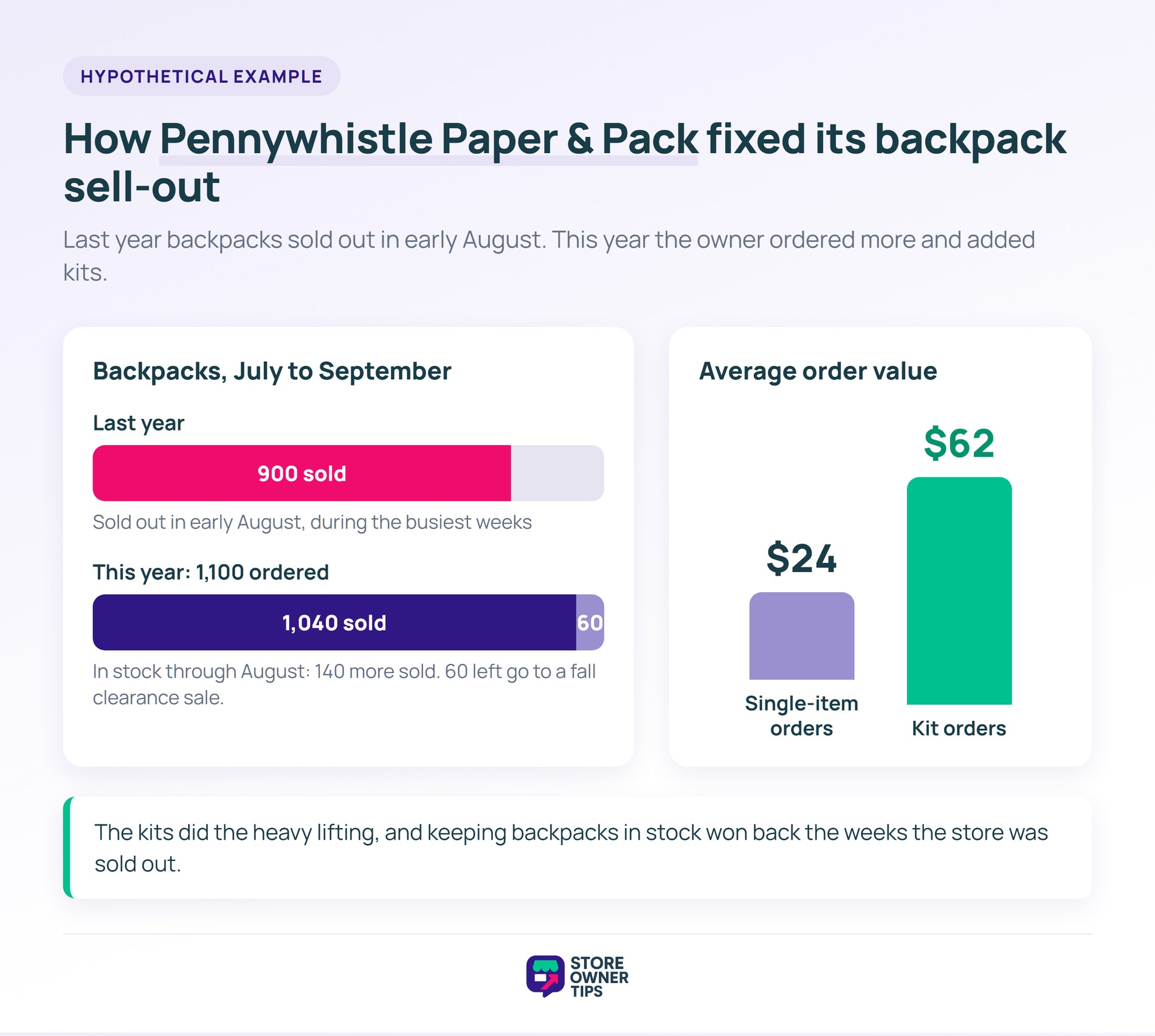
In September, 60 backpacks and some notebooks are left over. The owner moves them into a fall clearance sale before holiday stock arrives. Next spring, the plan starts from these real numbers instead of a guess.
| What you’re comparing | Back-to-School Sale | Holiday Sale |
|---|---|---|
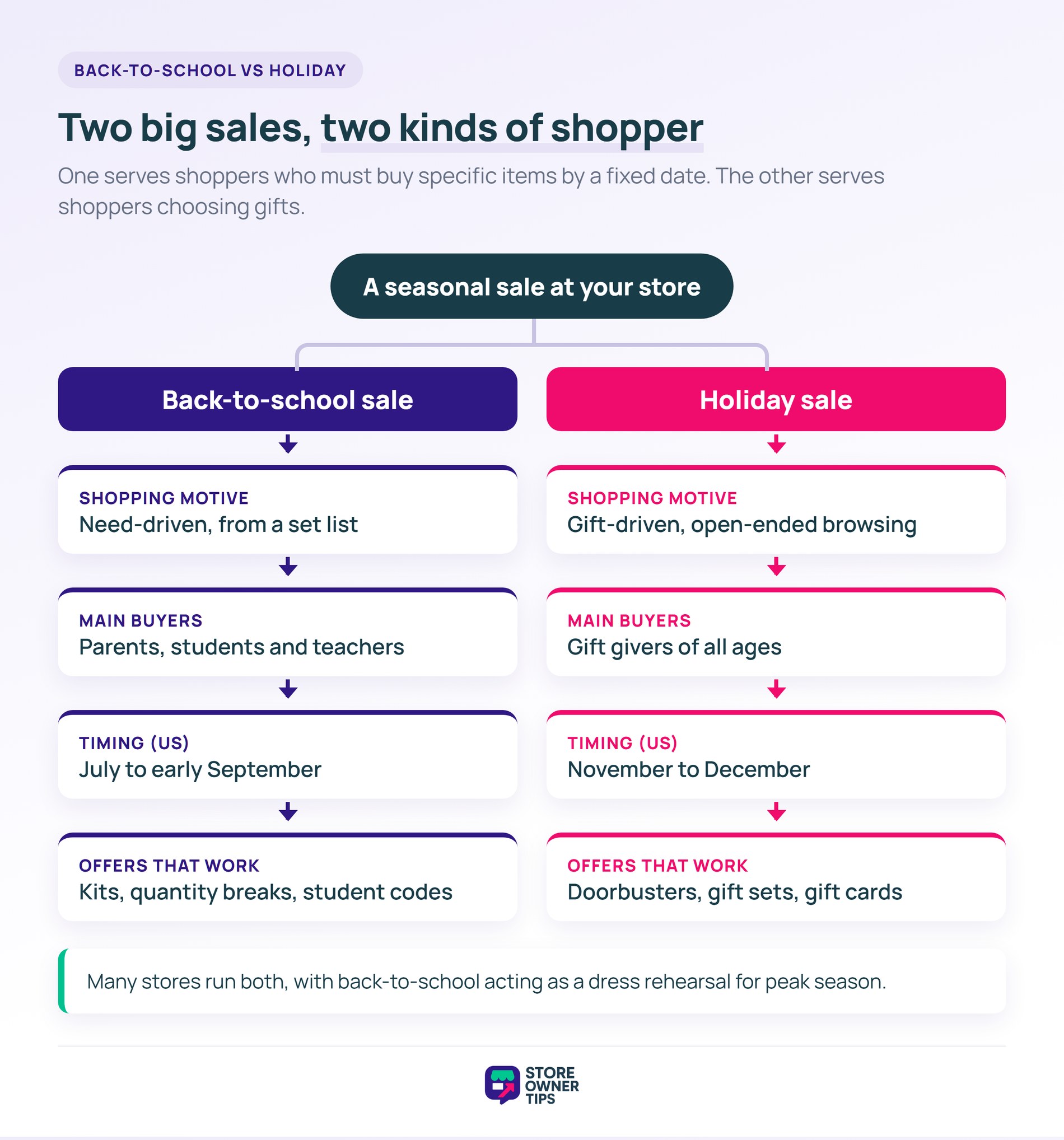
| Shopping motive | Need-driven, from a set list | Gift-driven, open-ended browsing |
| Main buyers | Parents, students and teachers | Gift givers of all ages |
| Timing (US) | July to early September | November to December |
| Offers that work | Kits, quantity breaks, student codes | Doorbusters, gift sets, gift cards |
A back-to-school sale serves shoppers who must buy specific items by a fixed date. A holiday sale serves shoppers choosing gifts, so inspiration and presentation matter more. Many stores run both, with back-to-school acting as a dress rehearsal for peak season.
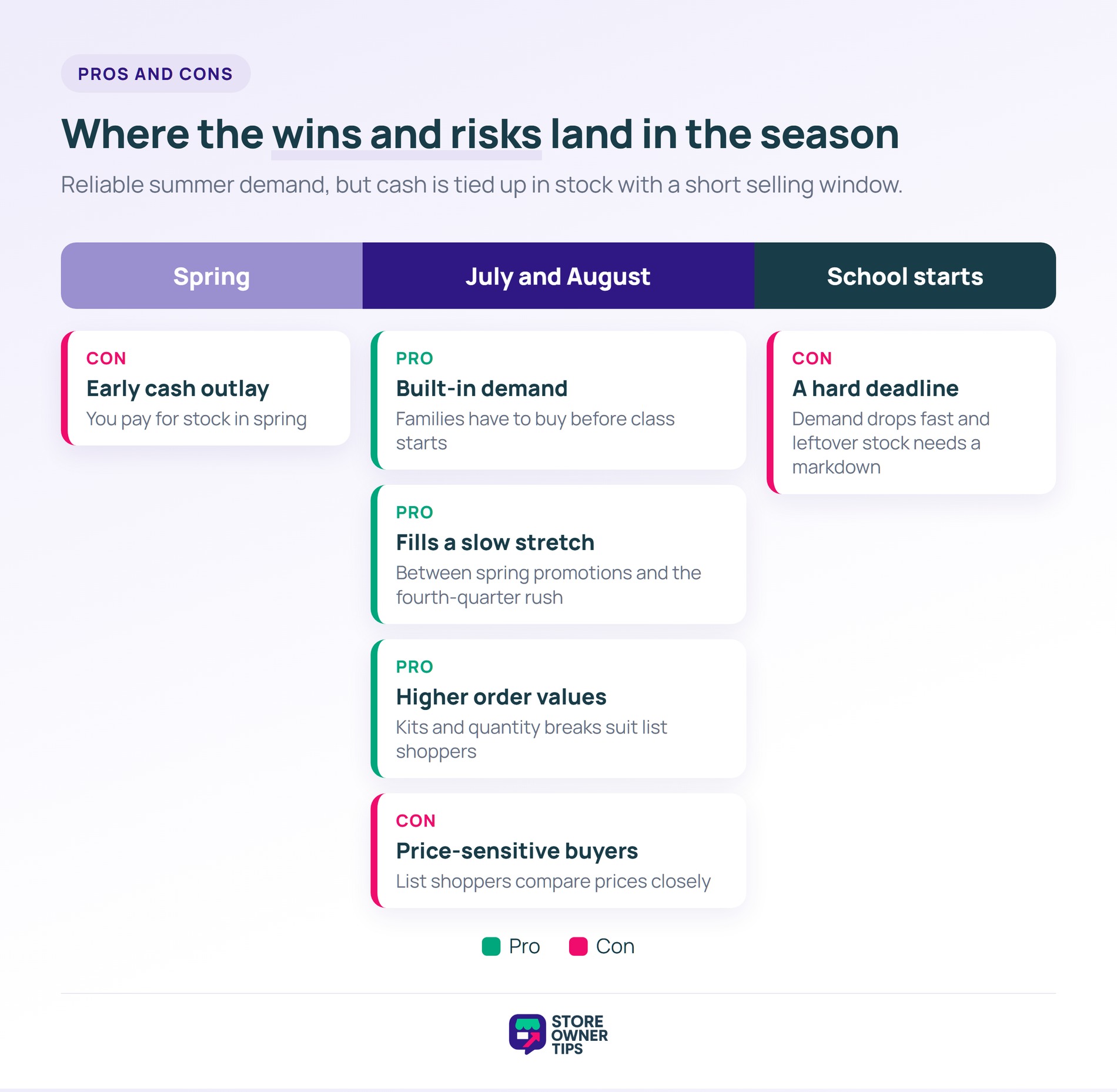
A back-to-school sale brings reliable summer demand, but it also ties up cash in stock with a short selling window.
In the US, back-to-school sales usually start in early July and run until classes begin in August or early September. Many shoppers start even earlier and use June sales events to get ahead. Most still finish in the week or two before school starts, so keep the sale running until then.
Electronics, clothing, shoes and school supplies are the biggest back-to-school categories for K-12 families. College shoppers also spend a lot on dorm or apartment furnishings, food and personal care items. For a small store, bundled kits of everyday supplies are often the easiest win.
Plan a back-to-school sale about three months ahead, starting in April or May. That leaves time to review last year’s sales, order stock and build kits. It also gives you time to schedule emails before shoppers start buying in July.
A back-to-school sale matters because it reaches shoppers who must buy, on a deadline you can plan around. Run well, it fills the summer gap and builds a list of repeat buyers. It also gives you a low-risk test of stock, offers and emails before the holiday season.
Copyright © StoreOwnerTips.com. All Rights Reserved.
