Weekly ecommerce tips, deals & news.
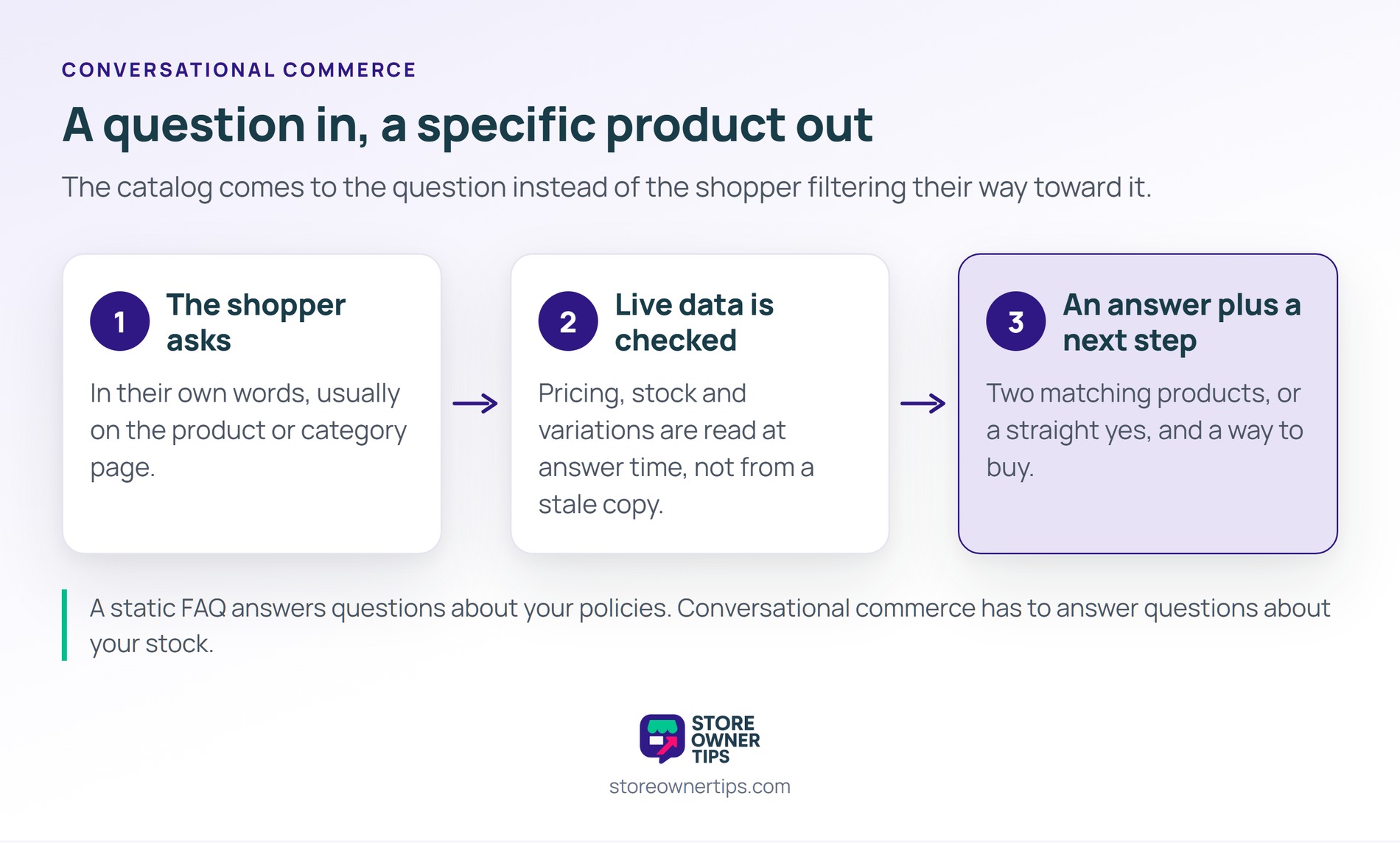
Conversational commerce is selling through dialogue rather than through browsing. A shopper asks a question in chat and gets an answer plus a next step. It covers on-site chat, messaging apps and voice. So your catalog comes to the question instead of the other way round.
Conversational commerce works by turning a shopper’s question into an answer they can act on. First the system reads what was actually asked. Then it checks your live store data and replies with a specific product or fact.
The conversation can start in several places. Each one shapes what the shopper is likely to ask.
In practice on-site chat carries most of the commerce. The shopper is already on the product page. So the question is about this item rather than your store.
A static FAQ answers questions about your policies. By contrast, conversational commerce has to answer questions about your stock.
StoreAgent’s WooCommerce AI chat page puts it plainly. Pricing and stock are checked live at answer time.
So a shopper asking whether the large comes in navy needs a real lookup. Therefore an answer assembled from a scraped copy of your site is a liability rather than a feature.
Three jobs sit inside a shopping conversation. Only one of them looks like customer support.
All three happen before the order, which is why purchase intent is the useful lens. Also, a question asked and answered marks a moment your product page did not cover.
A conversation is only as good as what it can read. Three inputs decide the quality of every answer.
Turning loose phrasing into a query is where natural language processing earns its place. Meanwhile a large language model handles the hundred ways one question gets asked.
A conversation can hurt as easily as it helps. Three failures come up repeatedly, and none of them are technical.
So the sensible default is quiet until asked. Also, a conversation that cannot answer needs an obvious route to a person.
Therefore treat the opening prompt as a design decision rather than a setting. In practice a small, ignorable entry point outperforms an interruption.
Consumer habits have moved faster than most catalogs. Pew Research found 49% of US adults now use AI chatbots, up from 33% in 2024.
At scale the volume is real. Klarna reported its assistant handling 2.3 million conversations in one month, with resolution falling from 11 minutes to under two.
Also, adoption on smaller stores is earlier. StoreAgent, our own store chat, reports 500+ active installations.
Still, none of those figures measure revenue earned through conversation. In practice that number lives in your own analytics, tagged and compared like any other channel.
Note the gap running through all of this. Chatbot usage is measured well, while chat-driven revenue is barely measured at all. So the honest position is that adoption is proven and attribution is not.
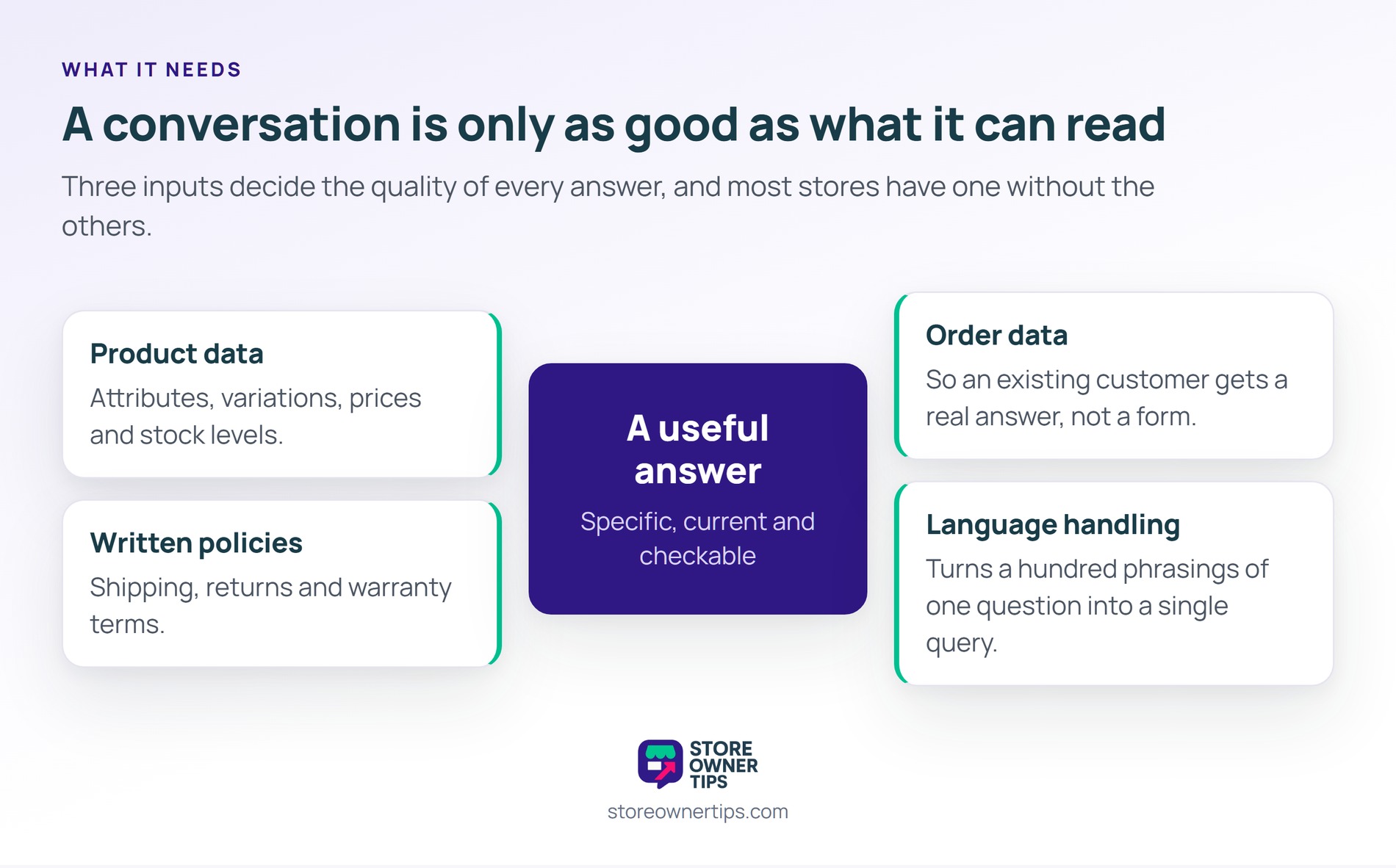
Here’s a hypothetical example. So picture a lighting store where most visitors land on a category page and leave without opening a single product.
Their filters cover wattage, finish and price. First a shopper wants a pendant that clears a low ceiling.
No filter covers drop length. Consequently she guesses, opens three products and leaves. Meanwhile the analytics record a bounce with no reason attached to it.
They add chat to category and product pages, reading live attributes. Then the same question gets a direct answer naming two matching products.
Then sessions that include a conversation start converting better than sessions without one. Instead of guessing at the reason, they can now read the questions themselves.
Those questions turned out to be the more valuable output. In short, the chat log became a list of the filters they were missing.
Also, the chat could only answer from data that already existed. Drop length sat in the description text rather than an attribute, so early answers stayed vague.
Therefore somebody had to fill in 90 attribute fields by hand. Even so, that work would have improved the filters anyway. The conversation just made the gap impossible to ignore.
They also learned nothing from the shoppers who never asked anything. So the quiet majority stayed exactly as unexplained as before. Even so, the questions they did get were worth more than the bounce rate ever was.
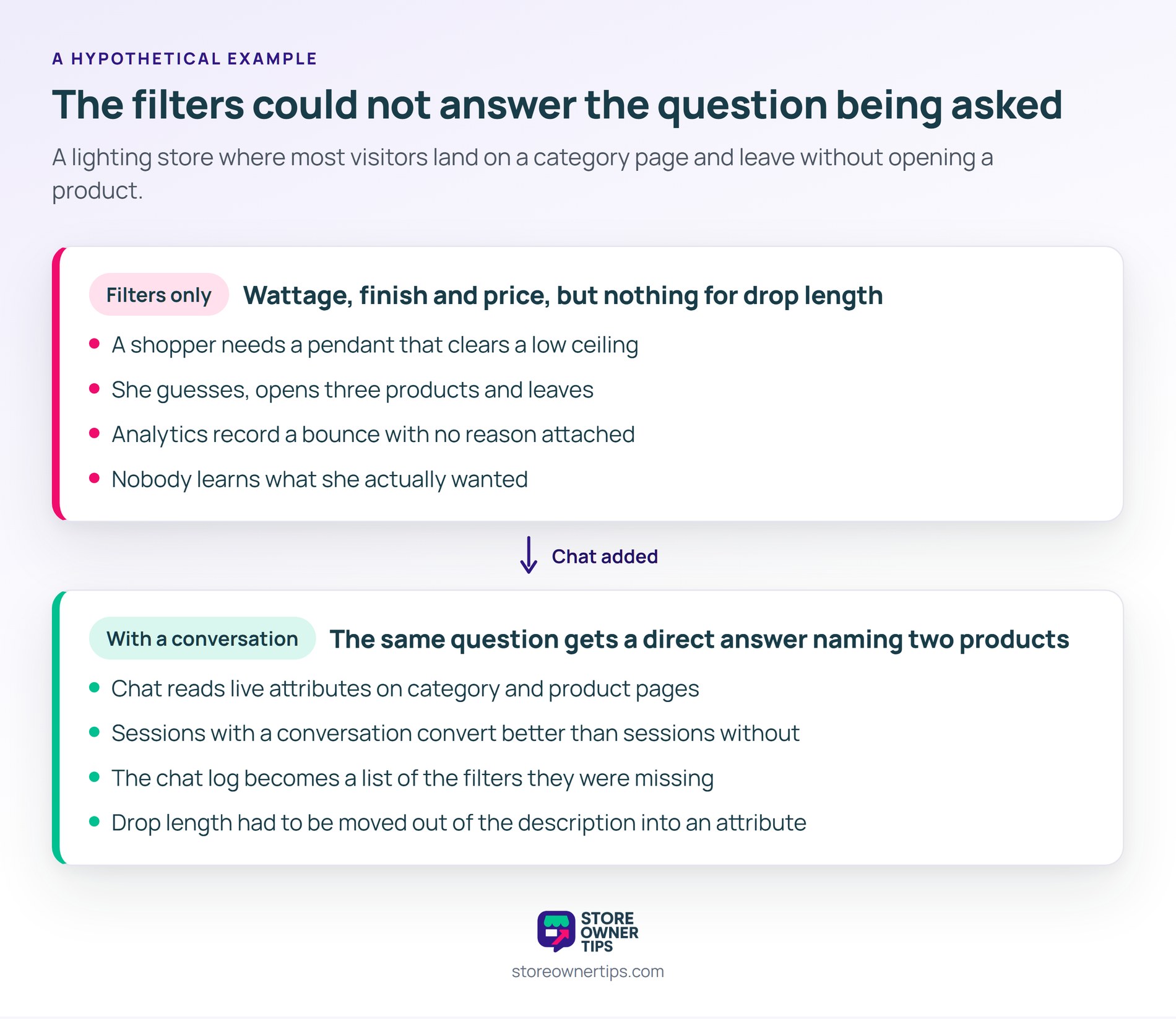
| What you’re comparing | Conversational commerce | Social commerce |
|---|---|---|
| Where the sale happens | Inside a dialogue | Inside a social platform |
| What drives it | A question | A feed or a post |
| Who starts it | The shopper | The merchant or a creator |
| What it needs | Live product and order data | Reach and content |
| Main strength | Answering a specific doubt | Creating demand |
The two overlap whenever a conversation happens inside a social app, which is common enough. Still, they solve different problems. Social commerce creates the interest, while conversational commerce closes the gap between interest and confidence.
Also, both differ from zero-click commerce, where the answer reaches the shopper without them visiting your store at all.
Most stores end up running both, feeding one with the other. A social post creates the question, and the conversation answers it. Consequently the two are worth measuring together rather than against each other.
No. A chatbot is one tool that can deliver it. Conversational commerce is the broader idea that a sale can happen through dialogue. That might run through site chat, a messaging app or voice.
It helps most where the choice is confusing, not where the catalog is large. A store with 40 technical products can gain more than one with 4,000 obvious ones. The test is whether shoppers ask things your filters cannot answer.
Start with the questions themselves, because they name your catalog’s gaps. Then tag conversations as a channel so you can compare conversion against sessions that never chatted. Revenue per conversation is the figure worth watching after that.
Conversational commerce matters because a filter can only answer questions you thought to build. A shopper’s real question is usually narrower than anything you shipped.
So the conversation covers that last gap between interest and purchase. Meanwhile it hands you a written list of everything your product pages failed to say.
Copyright © StoreOwnerTips.com. All Rights Reserved.
