Weekly ecommerce tips, deals & news.
Overselling happens when your store accepts and confirms an order for stock you cannot actually ship. The sale looks complete to the shopper. Behind the scenes, the item is already gone.
What follows is a cancellation, a refund, or a partial shipment. Overselling is almost always a timing problem rather than a counting problem. In practice, most stores hit it during a busy sale, or when they sell on more than one channel.
Overselling works because your stock number and your sales channels never update at exactly the same moment. Think of your stock count as a whiteboard in a busy kitchen. In practice, orders arrive faster than anyone can walk over and rub out the old number.
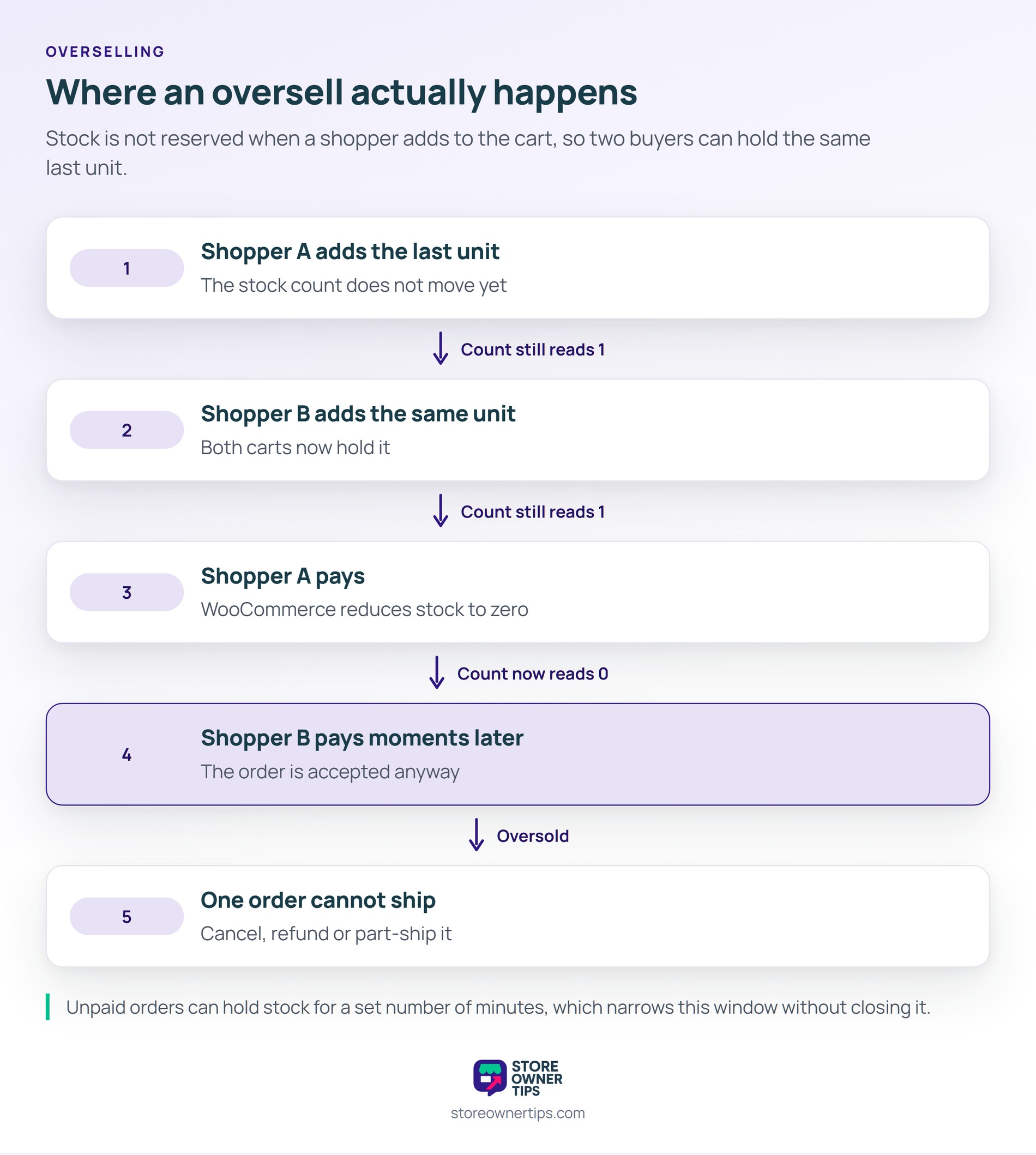
WooCommerce reduces stock when an order is placed, not when a shopper drops an item in the cart. So two people can hold the last unit in their carts at once. Even so, whoever checks out second still gets a confirmation email.
A slow payment step widens that window further. That said, WooCommerce can hold stock for unpaid orders for a set number of minutes. The hold lives in the WooCommerce inventory settings and is measured in minutes.
Orders stuck in a pending state are the ones that quietly leak stock. Good inventory management depends on that hold lasting long enough for real payments to clear.
Variable products add another layer. Tracking stock at the parent level, rather than per variation, lets one popular size drain the number for every size. As a result, the count says three left, and all three are a colour nobody wants.
Overselling gets far more likely the moment your products live in more than one place. Each channel keeps its own copy of your stock number. Still, that copy is only ever as fresh as the last sync.
Product feeds usually refresh on a schedule rather than instantly. So a marketplace listing can still advertise an item you sold an hour ago. For example, a feed refreshing once a day leaves a 24-hour window where two channels disagree. Careful handling of out-of-stock products in your feeds keeps those windows small.
Then there is the reverse direction. A marketplace sale has to travel back to your store before your storefront knows about it. Meanwhile stores doing serious multichannel selling reserve a buffer of units per channel for this exact reason.
An oversell forces you to pick between three bad options. First, you can cancel and refund. Next, you can ship the order partially. Otherwise you offer a substitute and hope the shopper accepts it.
All three options start with an apology. Still, the refund itself is the cheapest part. Cart abandonment already averages 70.22% across e-commerce, so completed orders are scarce. As a result, an oversell throws away one of the few carts that survived checkout.
Marketplaces treat it more harshly than your own store does. They track seller-caused cancellations, and they can throttle accounts that log too many. A partial shipment carries its own cost, because one order becomes two postage charges. Your own refund rate also climbs for a reason unrelated to product quality.
Overselling attacks something shoppers already doubt. Zebra Technologies runs an annual Global Shopper Study. One edition surveyed more than 5,000 shoppers, store associates and retail decision-makers. Only 38% of shoppers completely trusted retailers to fulfil online orders as promised.
By contrast, the same study found retail decision-makers were far more confident about that promise. That gap is the useful part. Store owners tend to treat an oversell as a rare accident.
Shoppers treat it as confirmation of what they already suspected. A broken delivery promise is slow and expensive to rebuild.
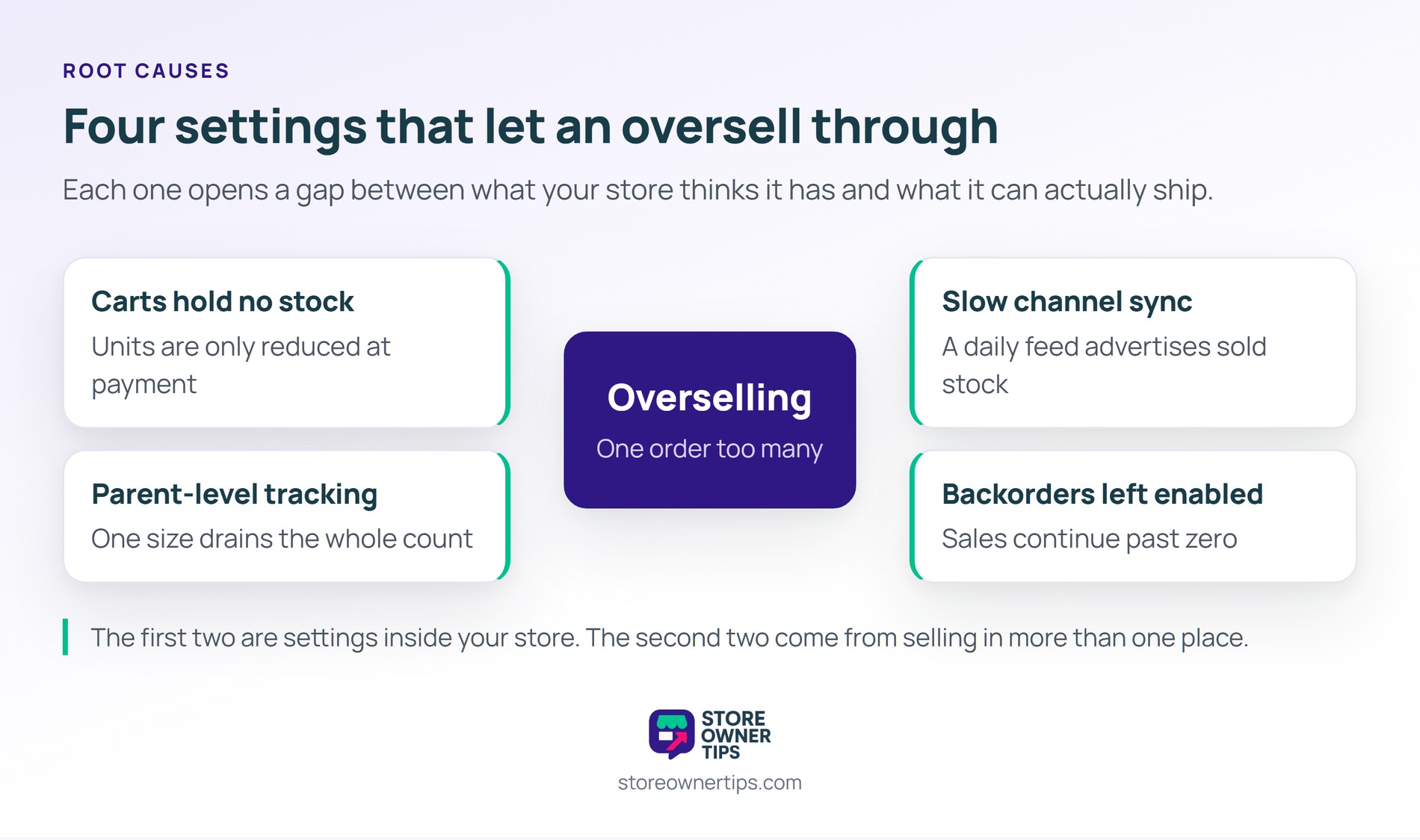
Overselling in practice usually starts with one popular product and a busy weekend. Here is a hypothetical example. Imagine a mid-sized outdoor gear store selling a merino base layer for $90.
The store lists the base layer on its own site and in a feed that refreshes daily. Stock is tracked at the product level, not per size. In short, there are 40 units left across four sizes, and medium is what everybody wants.
Then a weekend promotion drives a burst of traffic. The store takes 46 orders for the base layer in two days. Thirty-one of those orders are for medium, and the store only ever had 12 mediums.
Nineteen shoppers get a confirmation for a size that does not exist. So the store cancels and refunds all 19 orders. That hands back $1,710 in revenue it had already counted as won.
Then there is the support load, because every one of those 19 people writes in. Meanwhile the refunds also unwind whatever ad spend produced those orders. Six of the 19 had never bought from the store before. Their first experience of the brand was a promise that got withdrawn.
Two changes remove almost all of the risk. First, the store moves stock tracking down to the variation level. So medium now carries its own count of 12 units.
Next, it drops the feed refresh to hourly and holds two units per size as a buffer. Finally, a low-stock alert fires at five units so restocking starts early. Even so, the store still loses a few sales during the rush.
The same weekend now plays out differently. Medium sells out at 10 units and shows as unavailable. As a result, the remaining 21 shoppers pick another size or leave. In short, the store loses some sales instead of unmaking them afterwards.
| What you are comparing | Overselling | Backordering |
|---|---|---|
| Who chooses it | Nobody, it is an accident | The store, deliberately |
| What the shopper sees | A normal in-stock order | A stated wait before they buy |
| Effect on the delivery promise | Breaks a promise already made | Sets the promise up front |
| Setting behind it | A stale or shared stock count | Backorders enabled per product |
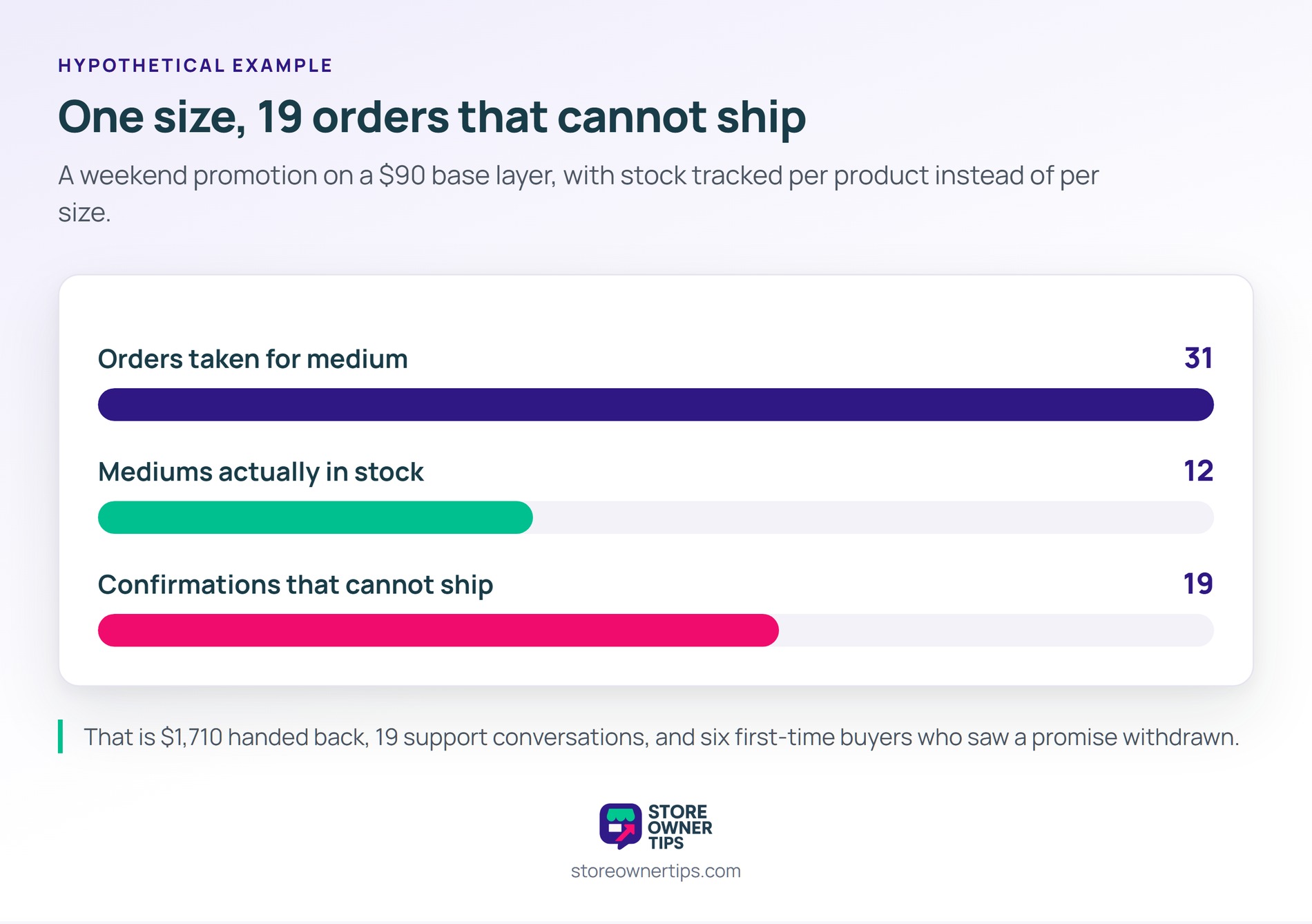
Overselling and backordering both mean selling stock you do not physically hold. The difference is consent. A backorder states the wait before the shopper pays, so nobody feels misled.
Backordering also lets you keep selling a popular line while a restock is in transit. By contrast, an oversell tells the shopper afterwards, which is what costs you the customer.
Start by turning stock management on and tracking every variation separately. Then set a hold time for unpaid orders, so pending checkouts reserve their units. Keeping a small safety stock buffer on fast movers covers the rest.
If you sell elsewhere too, shorten your sync interval, because a daily refresh is far too slow. The full stock management settings for WooCommerce are worth reviewing before your next promotion.
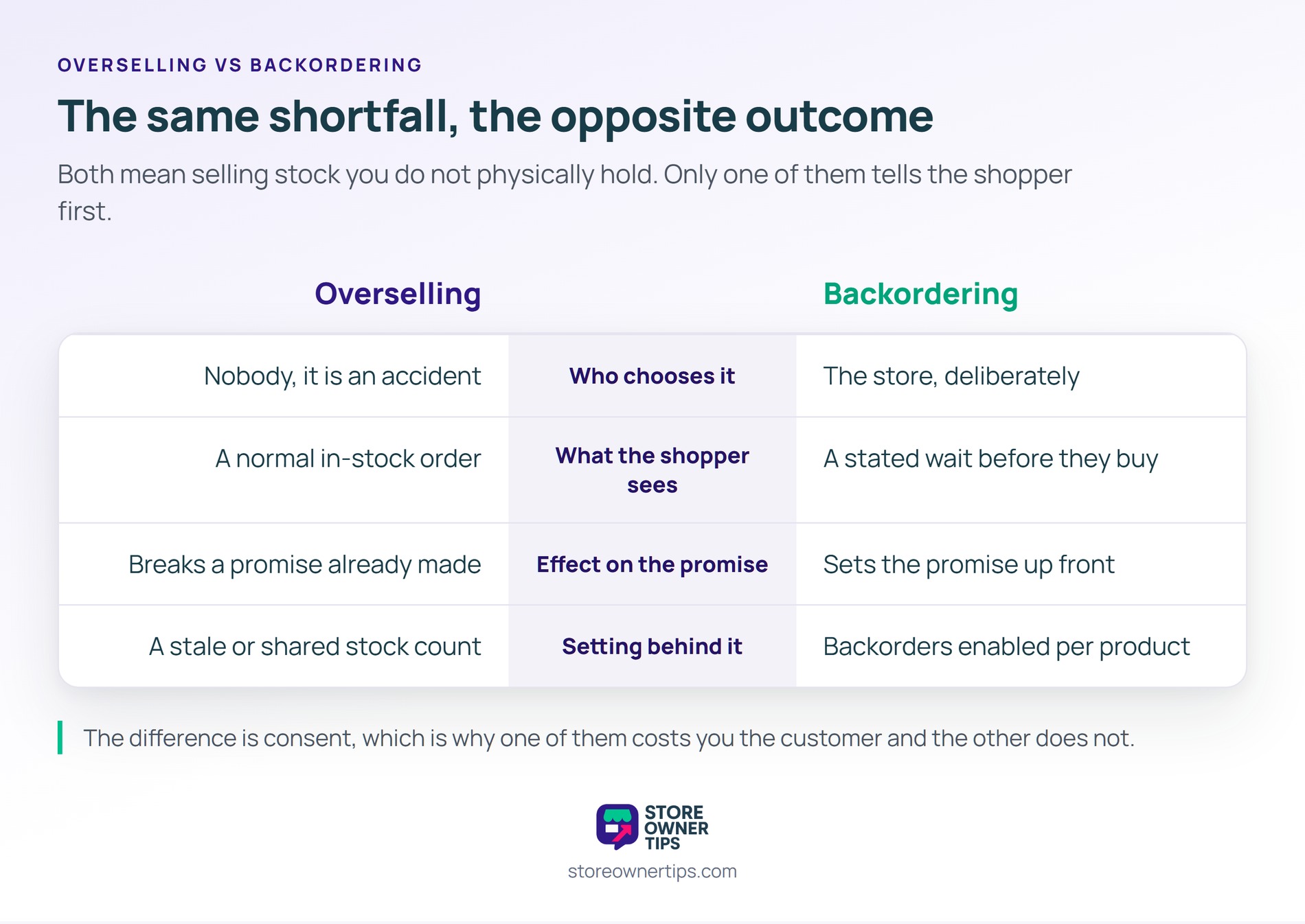
There are four usual culprits. First, stock management may be switched off for that product, so no count is enforced. Next, backorders may be enabled, which permits the sale on purpose.
The item may also be tracked at parent level while the shortage sits in one variation. Finally, another channel may have sold the last unit before your store heard about it.
Ship what you have if the order holds several items and the missing one is minor. Then refund the missing line immediately, rather than making the shopper chase it. For a single-item order, a cancellation with a fast refund beats an unrequested substitute. Either way, tell the customer before your system does.
Overselling matters because it destroys the most expensive asset your store owns: a customer who already decided to buy. Acquiring a new customer runs five to 25 times more than keeping an existing one. So an accurate stock number is among the cheapest retention tools you have.
In short, every oversell you prevent is revenue you never have to win twice.
Copyright © StoreOwnerTips.com. All Rights Reserved.
