Weekly ecommerce tips, deals & news.
Agentic Commerce is online shopping where an AI agent acts for the shopper. The agent can search, compare, and even buy products on its own. The person sets a goal, and the AI handles the steps. For online stores, it means your next customer may be a piece of software, not a human clicking around.
In agentic commerce, the shopper hands a task to an AI agent. They might say, find me a budget tent under $150 and buy it. The agent then carries out each step on its own.
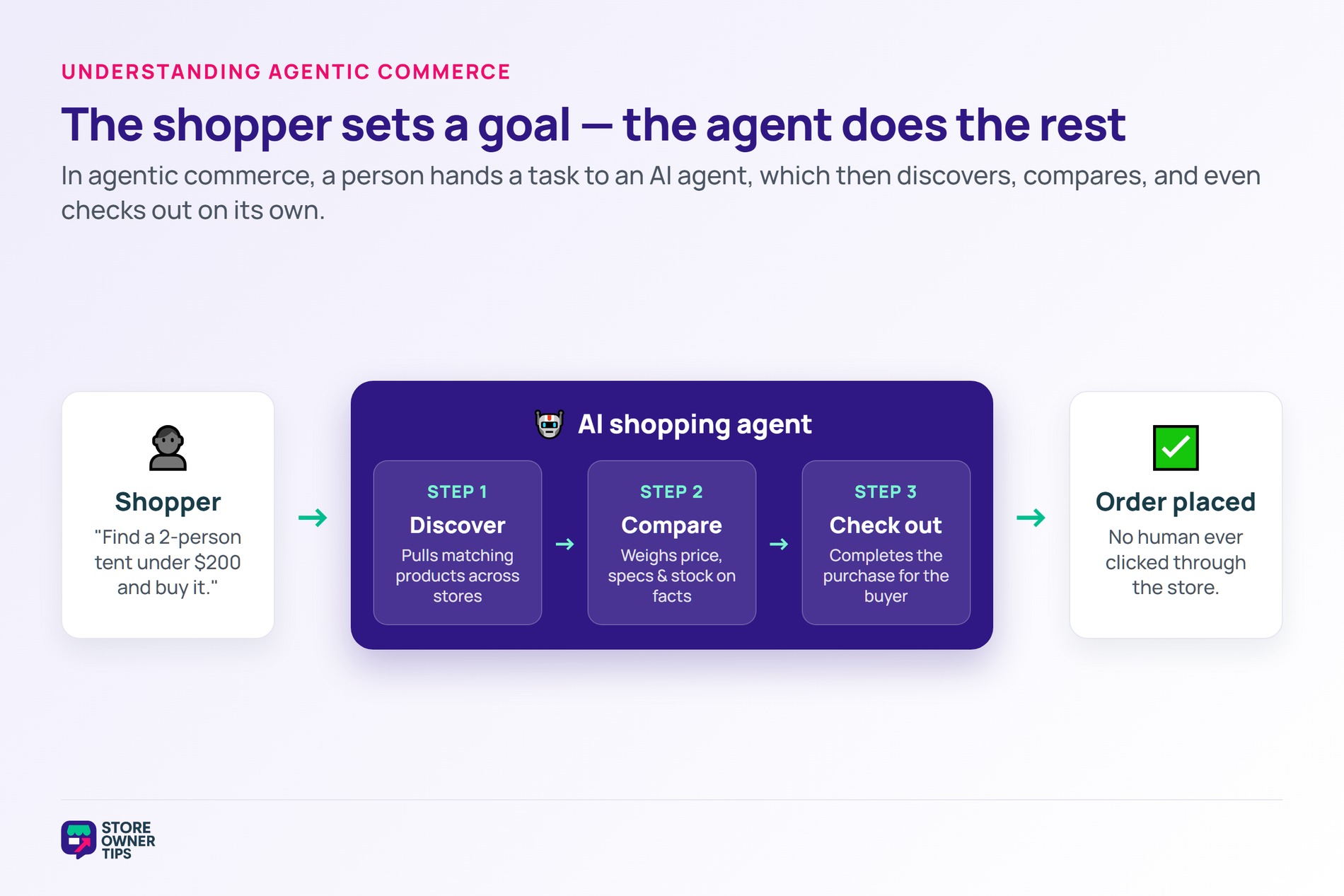
Think of it like sending a trusted assistant to the shops. You give them a budget and a goal, then wait. They come back having done the work for you.
This pushes the human further from the click. It is the next step beyond zero-click commerce, where answers replace browsing. Here, an agent replaces the shopper’s hands entirely.
An agent reads product data the way a machine does. It scans prices, specs, stock, and reviews across many stores at once. Then it weighs them against the shopper’s goal.
First, the agent discovers candidates that fit the request. Next, it compares them on hard facts, not flashy design. Finally, it shortlists the best match and moves toward a purchase.
Discovery often starts from a feed or a public page. The agent gathers each item’s core facts in a single sweep. Then it lines them up side by side, like a buyer’s spreadsheet.
Comparison is where messy stores lose out. If an agent cannot find a price, it skips that product. So a missing detail can quietly cost you the sale.
Some agents can complete the buy too. They may move through a conversational checkout or a standard one. As a result, the smoother your flow, the better your odds.
Clear, structured data is what wins here. An agent cannot be charmed by a pretty banner. Instead, it rewards stores whose details are easy to read and compare.
Think of structured data as a neatly labeled spec sheet. A product recommendations setup and a clean feed both hand agents the facts in a tidy form. Most product-feed tools export your catalog into formats machines parse instantly.
A well-built product data feed lists each item’s price, stock, and key specs. Product schema markup does the same job on your pages. Together, they make your catalog legible to any agent that visits.
An agent-readable storefront exposes its facts in plain, machine-friendly form. Prices, variants, and stock should live in code, not buried in images. Avoid hiding key details inside scripts an agent may skip.
This is where generative engine optimization meets store building. The same clean structure that helps AI answers also helps AI buyers. A simple LLMs.txt file can even guide agents to your best pages.
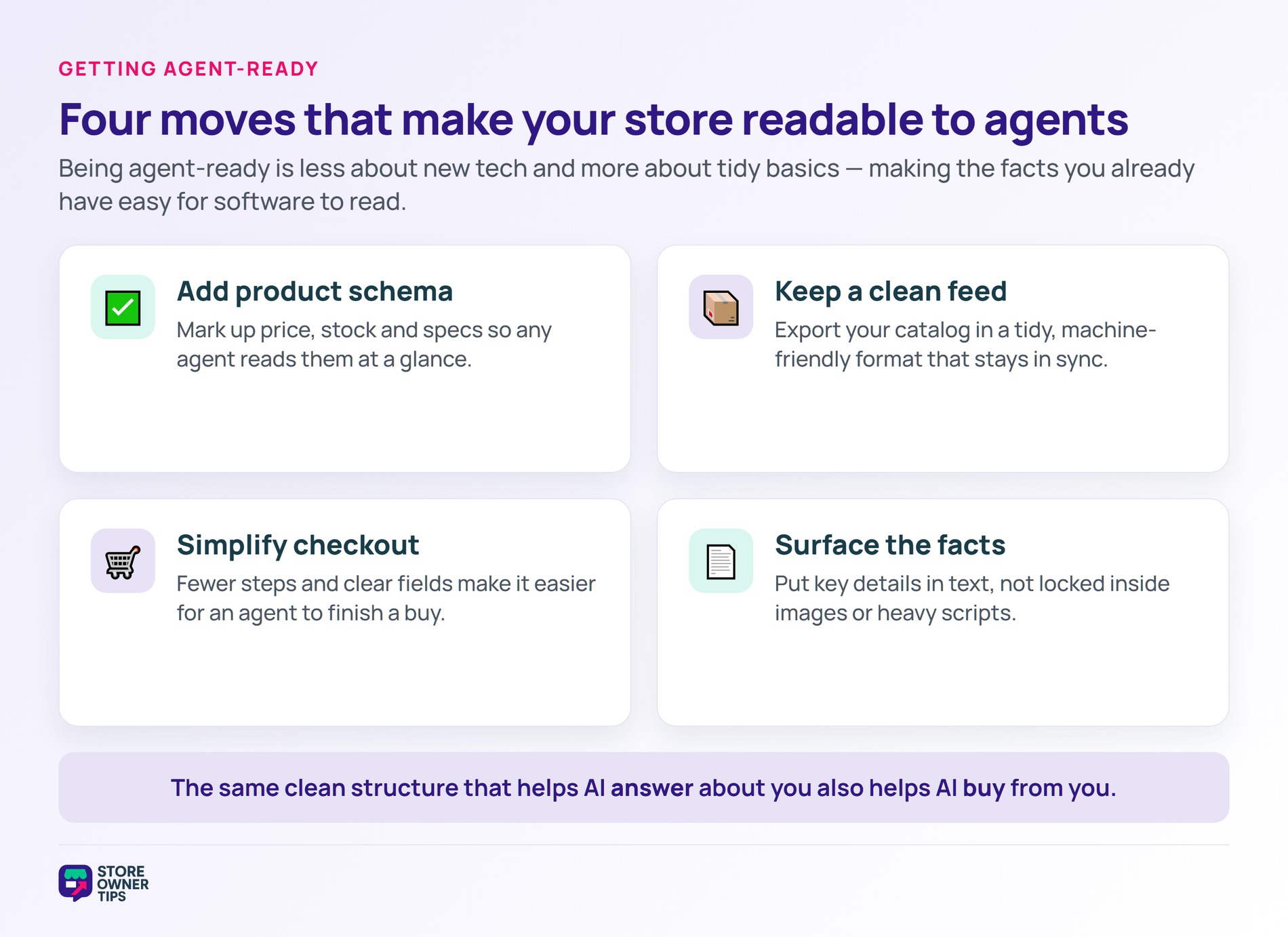
Getting agent-ready is less about new tech and more about tidy basics. You do not need to rebuild your store from scratch. Instead, you make the facts you already have easy to read.
Start with the data an agent looks for first. Then layer in the structure that helps it trust your store. A short checklist keeps the work focused and simple.
The groundwork is already in place. ChatGPT reached 100 million users in about two months, the fastest-growing internet app at the time. Meanwhile, these same tools are gaining the power to act, not just answer.
Shopping behavior is already shifting. Traffic to U.S. retail sites from generative AI sources jumped 1,200% in early 2025 versus mid-2024. Agents will only deepen that trend.
Being readable to machines is the key prep. Research shows clean, structured content can lift AI visibility by up to 40%. In short, the clearer your data, the more often agents pick you.
There is a fairness upside here too. An agent does not care about ad budgets or slick design. It rewards the store with the best fit and the clearest facts.
That levels the field for smaller stores. A lean WooCommerce shop with tidy data can win an agent’s pick. The work you do now compounds as more shoppers lean on agents.
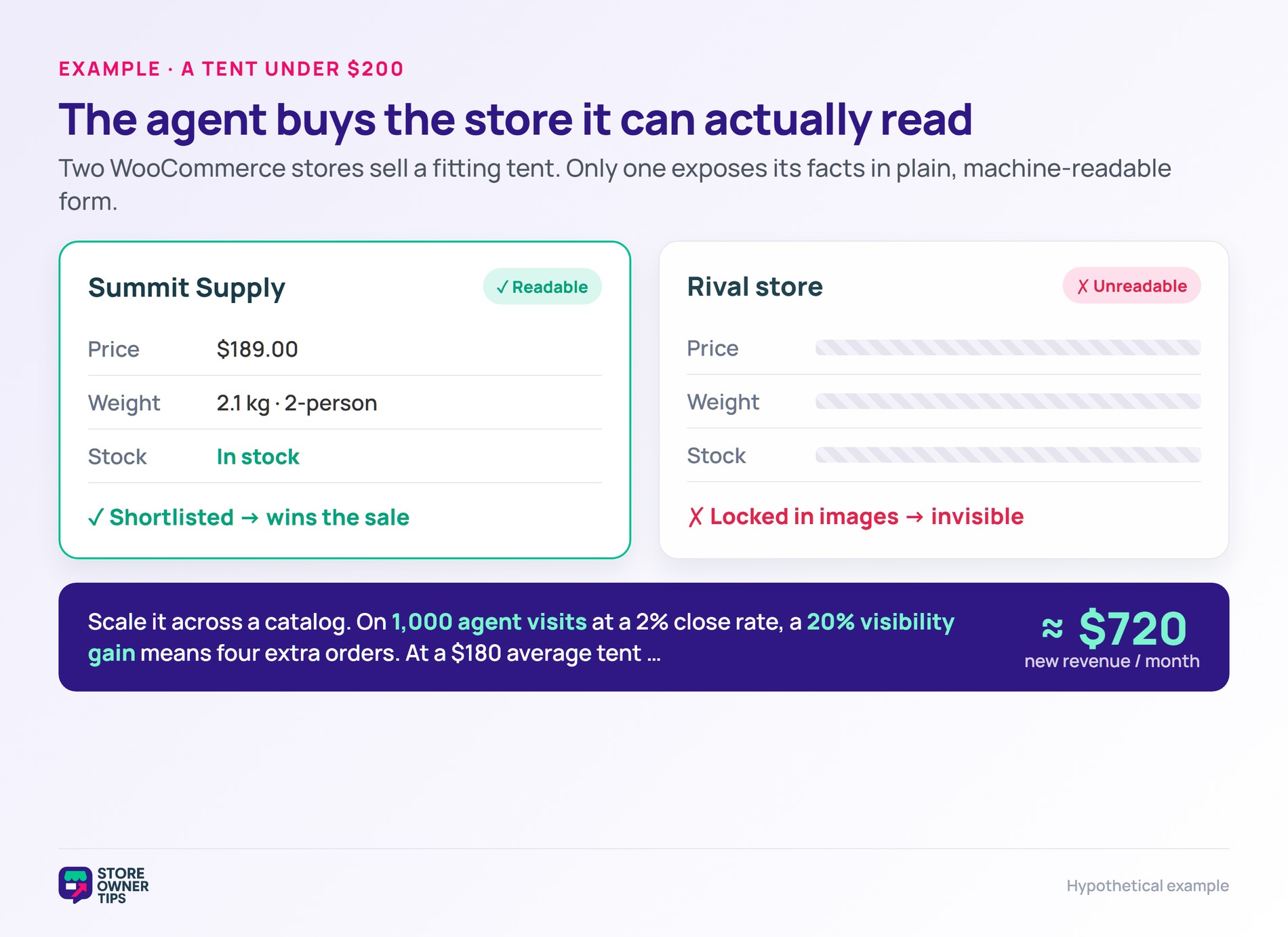
Imagine a WooCommerce store called Summit Supply that sells camping gear. A shopper tells an AI agent to find a two-person tent under $200. The agent sets off to compare options.
Summit Supply has clean product data and clear specs. A rival store hides key details inside images and scripts. As a result, the agent can read Summit but struggles with the rival.
The agent starts by pulling a list of two-person tents. It checks price, weight, and stock for each one. Then it ranks them against the shopper’s exact request.
The agent quickly understands Summit’s tent and its price. It matches the shopper’s budget and weight needs. Summit makes the agent’s shortlist with ease.
The rival’s tent is a better deal, but the agent cannot parse it. Without clear data, that product is effectively invisible. So Summit wins the sale by being readable.
Now scale that across a catalog. If structured data lifts agent visibility by even part of that 40% ceiling, the math adds up fast. On 1,000 monthly agent visits at a 2% close rate, a 20% visibility gain means four extra orders. At a $180 average tent, that is roughly $720 in new monthly revenue.
The lesson scales beyond one tent. Every product with clean data becomes a candidate an agent can pick. Every product with messy data drops out of the running.
No human ever browsed Summit’s site for this order. The whole purchase ran through an agent. In the end, clean data closed the deal.
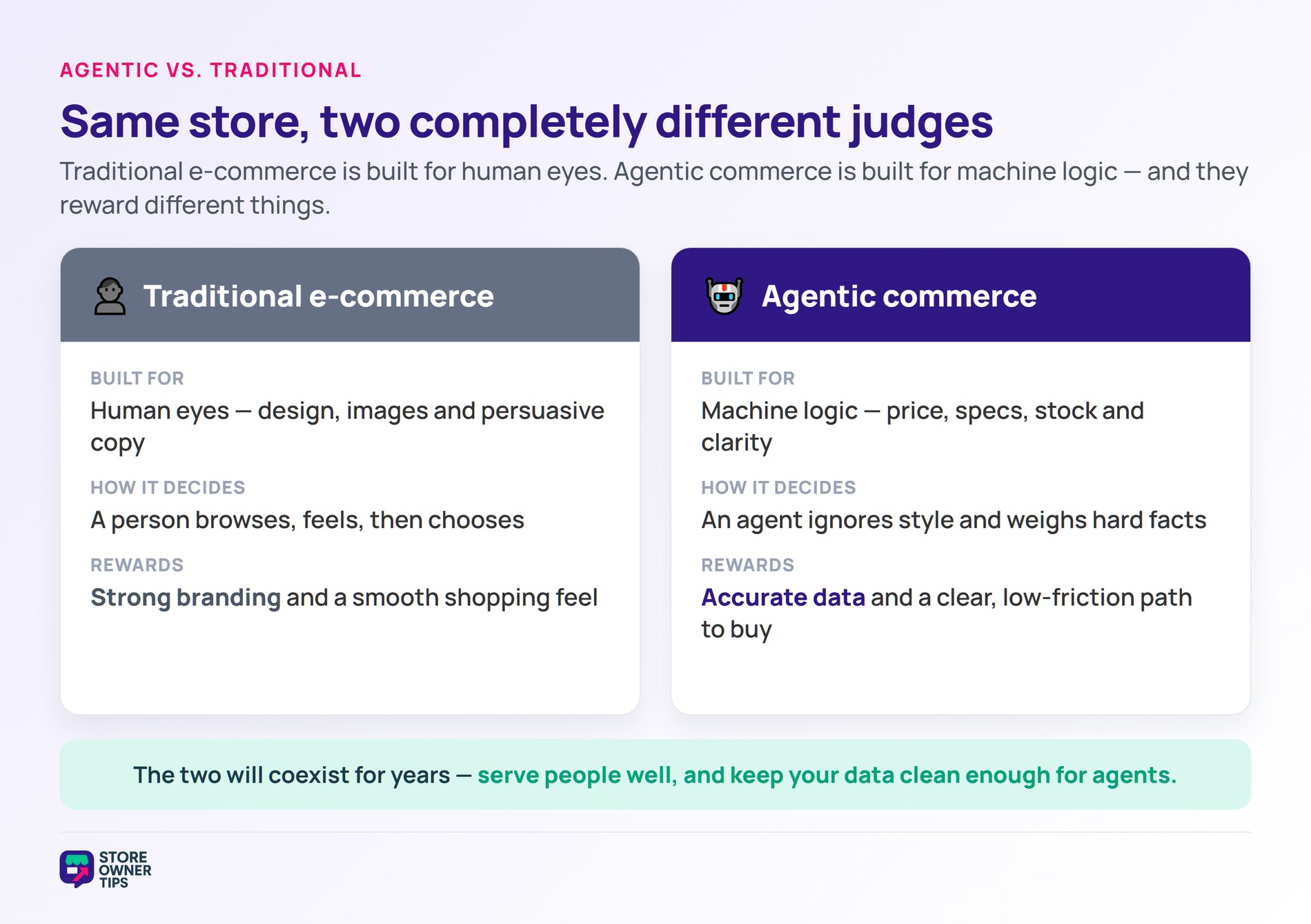
Traditional e-commerce is built for human eyes. It leans on design, images, and persuasive copy. A person browses, feels, and then decides.
By contrast, agentic commerce is built for machine logic. An agent ignores style and weighs hard facts. It cares about price, specs, stock, and clarity.
The biggest gap is what each one rewards. Traditional stores reward strong branding and a smooth shopping feel. Meanwhile, agentic flows reward accurate data and a clear, low-friction path to buy.
The two will coexist for a long time. Humans still shop directly every day. The smart move is to serve people well while keeping your data clean enough for agents.
It is early but moving fast. AI tools are gaining the ability to browse and act. Full autonomous buying is still maturing across the industry. Preparing now means you are ready as it grows.
Focus on clean, structured product data. Make prices, specs, and stock easy to read. Add product schema and keep your checkout simple. The clearer your store, the easier an agent can choose and buy from it.
Not entirely, and not soon. Many people enjoy browsing and deciding for themselves. Agents will handle routine or research-heavy buys. Stores should plan to serve both for years to come.
Agents lean toward clear, comparable items at first. Think replenishables, gear with hard specs, and simple repeat orders. These buys hinge on facts more than feel. Complex or emotional purchases will stay human for longer.
Yes, agents are platform-neutral by design. They read whatever data a store exposes, on WooCommerce or Shopify alike. What matters is clean structure, not the platform name. So good data prep helps you on any system.
Agentic commerce points to a future where AI agents shop on behalf of people. Winning their business is less about design and more about clean, readable data. Make your prices, specs, and structure crystal clear now, and your store will be ready when the agents come knocking.
Copyright © StoreOwnerTips.com. All Rights Reserved.
