A Boxing Day sale is a discount event held on December 26, the day after Christmas. It started in the UK and spread to Canada, Australia and New Zealand, where Boxing Day is a public holiday. Stores use it to catch shoppers spending gift cards and swapping unwanted gifts. It’s also a fast way to clear leftover holiday stock.
A Boxing Day sale works by cutting prices on December 26, when shoppers have gift money and goods to return. The store sets its discounts ahead of time, then lets them switch on automatically. The timing is the whole point, because demand looks very different the day after Christmas.
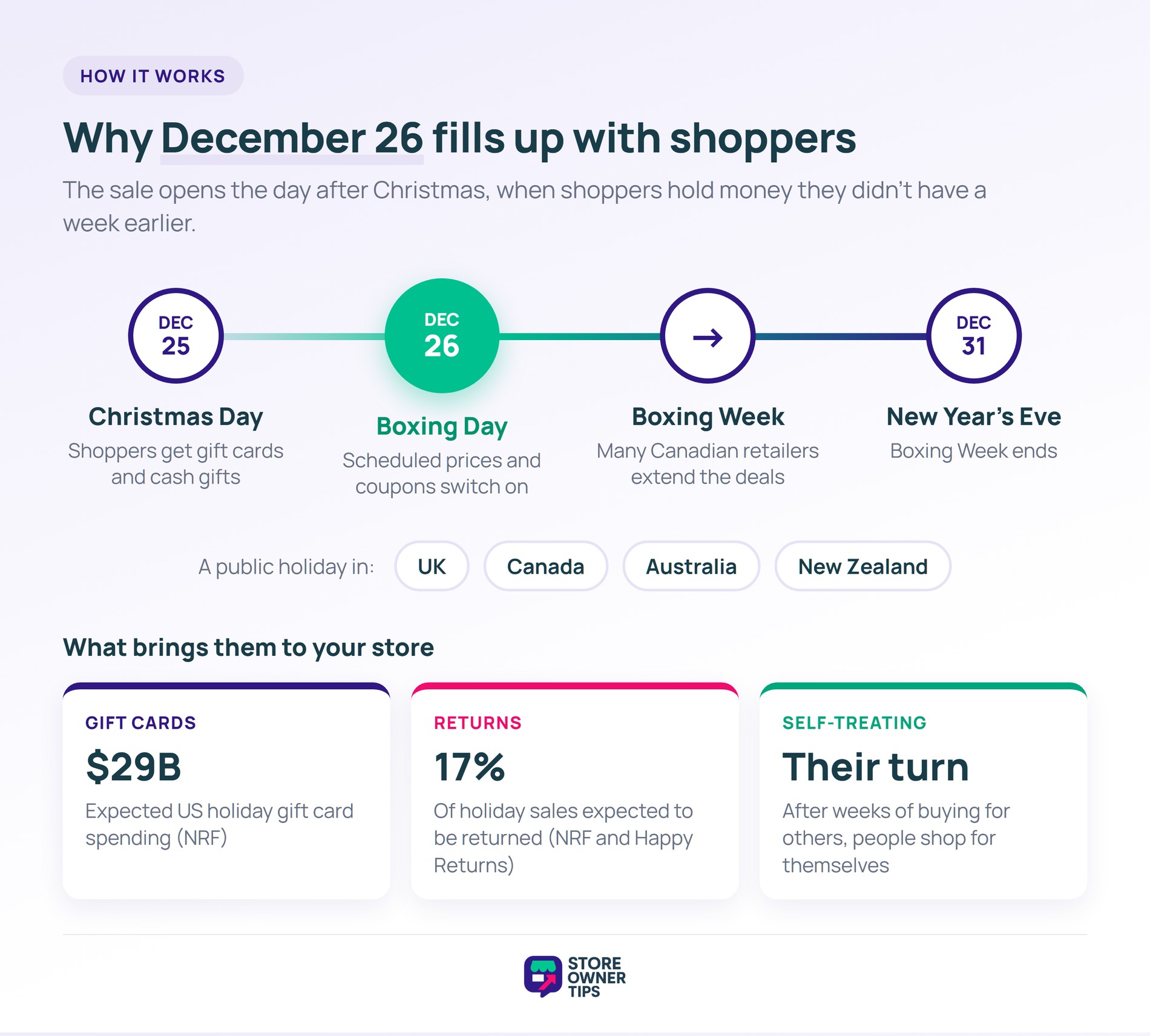
Boxing Day began in Britain as the day employers gave workers and tradespeople a “Christmas box” of money or gifts. Most historians trace the name to that custom, though church alms boxes are another common explanation. The holiday later spread across the Commonwealth.
Today, Boxing Day is a public holiday in the UK, Canada, Australia and New Zealand. Over time, the day off turned into one of the biggest shopping days of the year in those countries. In Canada, many retailers extend the deals into “Boxing Week,” which runs until New Year’s Eve.
Shoppers show up on December 26 because they’re holding money they didn’t have a week earlier. In the US alone, the NRF expected holiday gift card spending to reach $29 billion. The same survey found 43% of shoppers planned to buy at least one gift card. Every one of those cards needs a place to be spent.
Returns add a second wave of visits. US retailers expect 17% of holiday sales to be returned, according to the NRF and Happy Returns. A shopper swapping a wrong-sized sweater is already on your site with buying intent. A good holiday return policy turns that visit into an exchange instead of a refund.
Psychology matters too. After weeks of buying for others, people finally shop for themselves. A Boxing Day sale gives them permission to treat themselves at a lower price.
Online stores run a Boxing Day sale with scheduled prices and time-limited coupons. In WooCommerce, the “Schedule” link beside a product’s sale price sets start and end dates. Think of it like a shop clerk who swaps every price tag at midnight while you sleep.
WooCommerce runs those dates on the timezone set in your site’s general settings. That detail matters when you sell to the UK and Australia, which are many hours apart. Many stores also offer store credit on returns, so the money stays in the shop. Store credit works like a gift card the store hands back instead of cash.
Product choice decides whether the sale pays off. Deep cuts on bestsellers you could sell at full price in January just give money away. Most stores discount seasonal inventory first, such as decorations, gift sets and winter lines. For channel and promotion tactics, see these holiday marketing tips for WooCommerce stores.
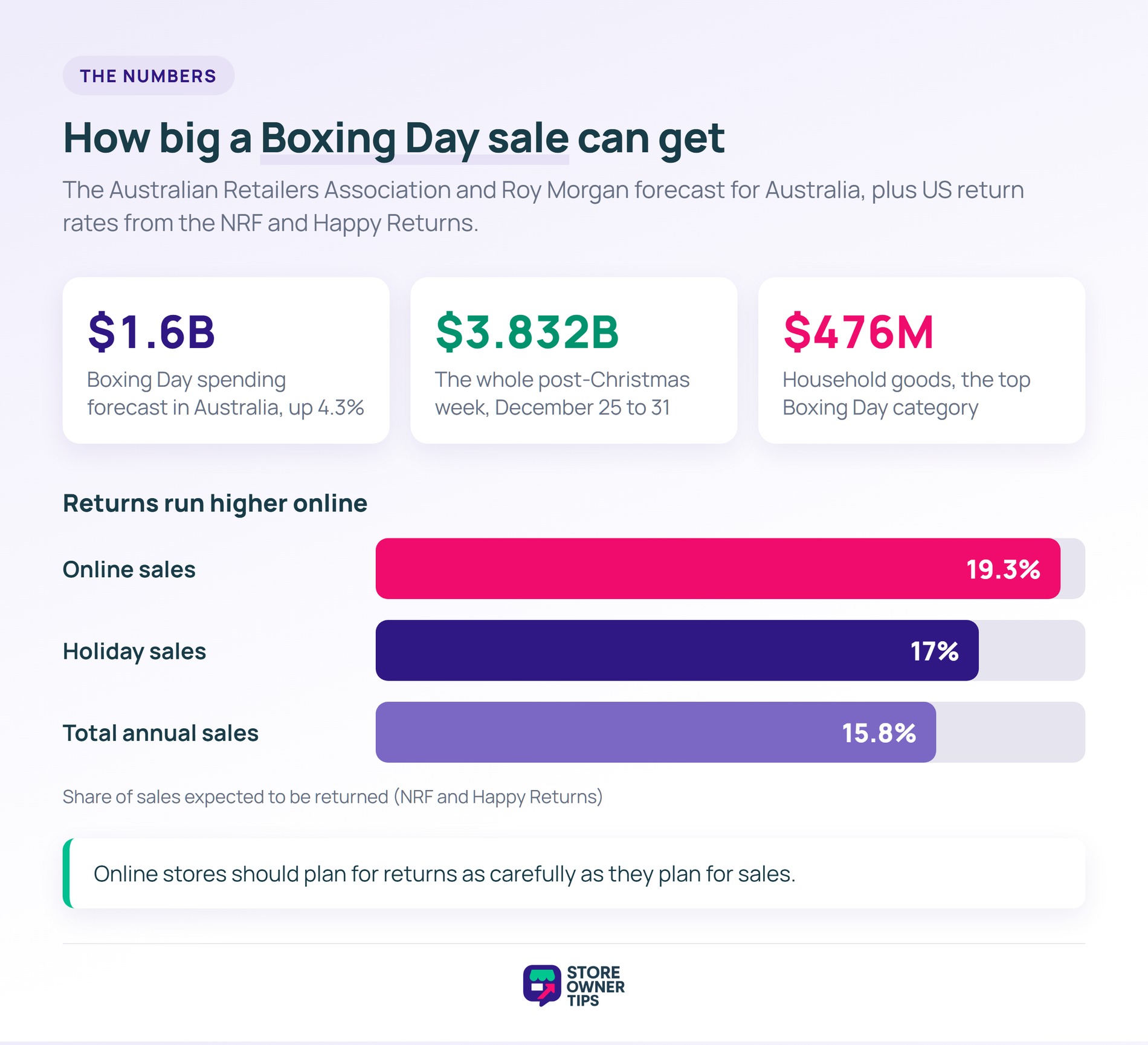
The numbers show Boxing Day is one of the largest single shopping days where it’s observed. The Australian Retailers Association and Roy Morgan forecast around $1.6 billion in Boxing Day spending in Australia. Their forecast put the day up 4.3% on the previous year.
The same ARA and Roy Morgan forecast valued the whole post-Christmas week, December 25 to 31, at $3.832 billion. Household goods led the Boxing Day categories at $476 million. That’s useful for homewares and kitchen stores planning their biggest discounts.
Returns run higher online, which shapes how online stores should plan. The NRF and Happy Returns report estimates 19.3% of online sales will be returned. By comparison, retailers expect 15.8% of total annual sales to come back.
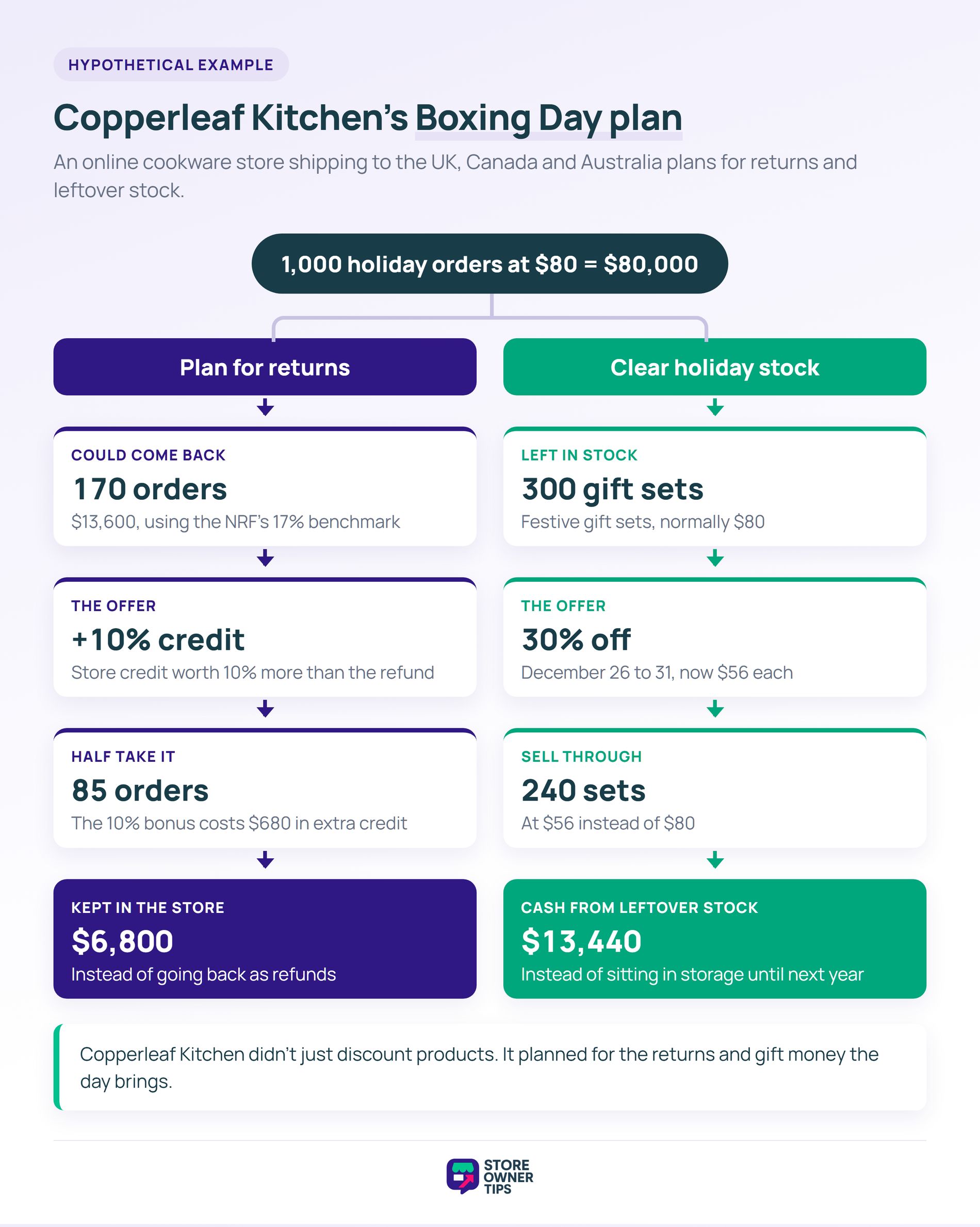
A Boxing Day sale in practice pairs discounts on leftover stock with a plan for gift card and return traffic. Here’s a hypothetical example. Imagine Copperleaf Kitchen, an online cookware store that ships to the UK, Canada and Australia.
Copperleaf Kitchen sold 1,000 holiday orders in December, averaging $80 each. That’s $80,000 in holiday revenue. Using the NRF’s 17% benchmark, about 170 orders, or $13,600, could come back after Christmas.
The owner also has 300 festive gift sets left in stock. The store schedules 30% off those sets from December 26 to 31. The owner checks how a UK midnight start lands for shoppers in Sydney and Toronto.
Next, it adds a rule: returns made that week can take store credit worth 10% more than the refund. Finally, it emails customers on Christmas night with a preview of the sale.
Say half of those 170 returns take the store credit offer. That keeps 85 orders, worth $6,800, inside the store instead of going back as refunds. The 10% bonus costs Copperleaf Kitchen $680 in extra credit.
The gift sets sell through at $56 instead of $80. If 240 sets sell, that’s $13,440 in cash from stock that would have sat in storage until next year. Many credit shoppers also spend more than their credit, which lifts order values further.
The lesson is simple. Copperleaf Kitchen didn’t just discount products; it planned for the returns and gift money the day brings. Mapping the sale onto an ecommerce holiday sales calendar early makes that planning easier.
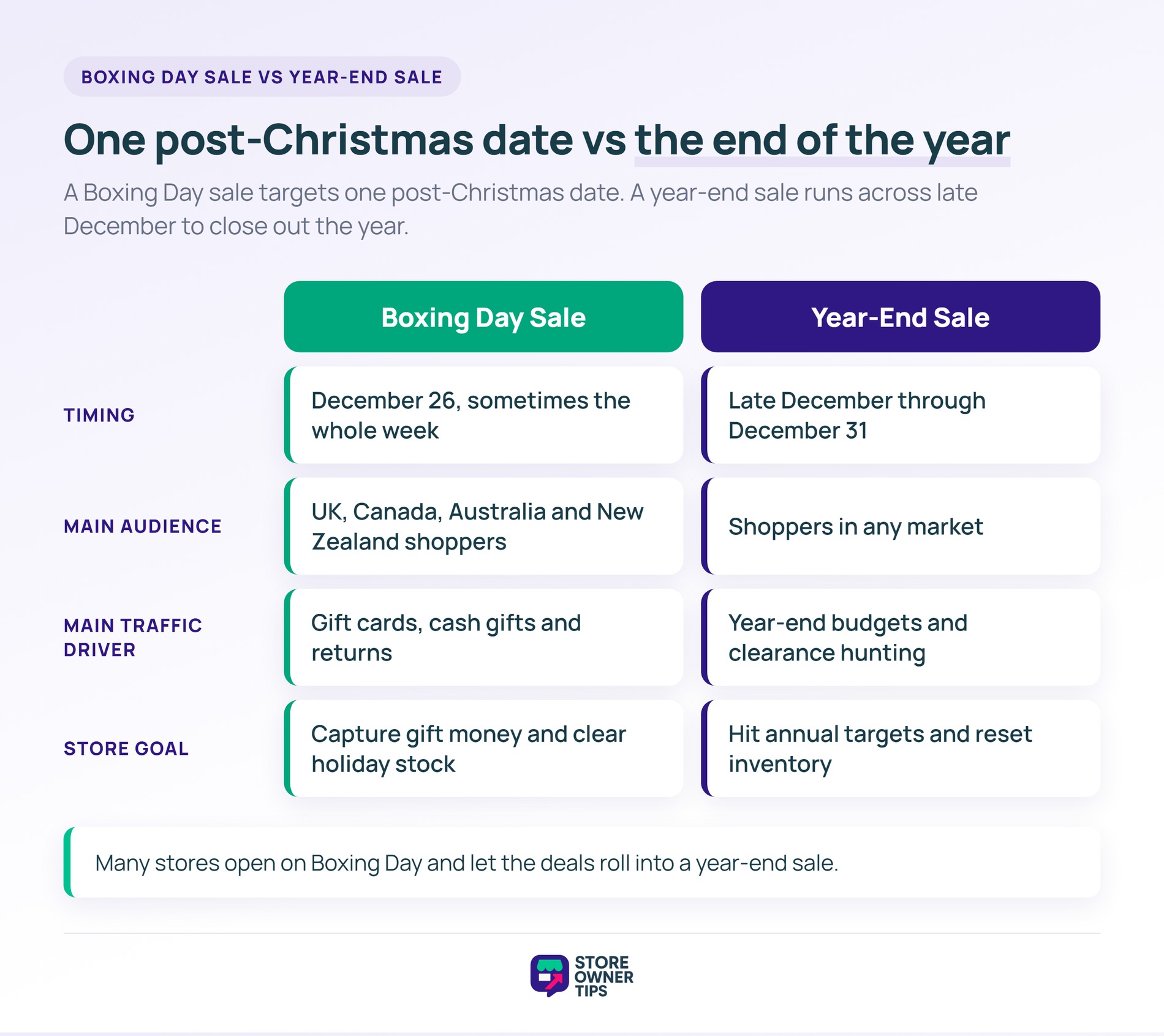
A Boxing Day sale targets one post-Christmas date. A year-end sale runs across late December to close out the year.
| What you’re comparing | Boxing Day Sale | Year-End Sale |
|---|---|---|
| Timing | December 26, sometimes the whole week | Late December through December 31 |
| Main audience | UK, Canada, Australia and New Zealand shoppers | Shoppers in any market |
| Main traffic driver | Gift cards, cash gifts and returns | Year-end budgets and clearance hunting |
| Store goal | Capture gift money and clear holiday stock | Hit annual targets and reset inventory |
Pick a Boxing Day sale if you sell into Boxing Day countries or carry lots of holiday stock. Choose a year-end sale if your customers are mostly elsewhere. Many stores open on Boxing Day and let the deals roll into a year-end sale.
A Boxing Day sale brings strong demand and a fast way to clear stock, but it can squeeze margins.
When returns pile up and customers get upset, a clear customer recovery plan helps you keep them.
Boxing Day is named after the British custom of giving workers “Christmas boxes” of money or gifts on December 26. Another common explanation points to church alms boxes opened for the poor that day. The name has nothing to do with the sport of boxing. Either way, the name points to giving, not shopping, and the big sales tradition came much later.
US stores rarely call it Boxing Day, since December 26 isn’t a holiday there. Many US retailers do run after-Christmas sales on the same date for the same reasons.
An online store with customers in Canada or the UK can use the Boxing Day name for those shoppers. Some stores send a Boxing Day email to their Canadian, UK and Australian lists. Their US customers get a plain after-Christmas sale message on the same day.
A Boxing Day sale usually lasts from one day to a full week. A one-day sale creates urgency, while a Boxing Week sale gives gift card holders more time. Many stores run the week, then end it before New Year’s Day.
Whatever length you pick, set clear end dates on every scheduled price and coupon. Otherwise, a forgotten discount can keep running well into January and eat your margins.
A Boxing Day sale matters because it turns post-Christmas gift money and returns into new revenue. It also clears holiday stock before it loses value. For stores selling into Boxing Day countries, it deserves the same planning as Black Friday Cyber Monday.
Copyright © StoreOwnerTips.com. All Rights Reserved.
