Weekly ecommerce tips, deals & news.
ChatGPT shopping is product discovery that happens inside a conversation instead of a search results page. A shopper describes what they need, and ChatGPT surfaces specific products with prices and availability. So merchants get included by sending a structured product feed to OpenAI. In practice, it is a new storefront you never designed and cannot style.
So the work is not layout, it is data quality.
For twenty years, online shopping started with a search box. A shopper typed keywords, scanned ten blue links, and clicked into a store. In practice, ChatGPT shopping removes most of that journey.
Instead, the shopper describes a problem and gets a shortlist. So your product either appears in that shortlist or it does not exist.
The audience is no longer early adopters. Pew Research Center found that 44% of U.S. adults have used ChatGPT. Meanwhile, that figure has risen every year since 2023.
Frequency matters as much as reach. Pew also reports that about a quarter of Americans use chatbots daily. Daily use is what turns a curiosity into a shopping habit.
The queries look nothing like keywords. Somebody types a paragraph about a small kitchen, a tight budget, and a left-handed partner. Then they expect three sensible options back.
That phrasing is the important shift. In practice, long, constraint-heavy requests reward products with detailed attributes recorded. By contrast, a listing with a name and a price has almost nothing to match against.
This pattern already has a name in search. It sits alongside zero-click commerce, where the answer arrives without a visit to your site. The consequence is that your analytics see less, not more.
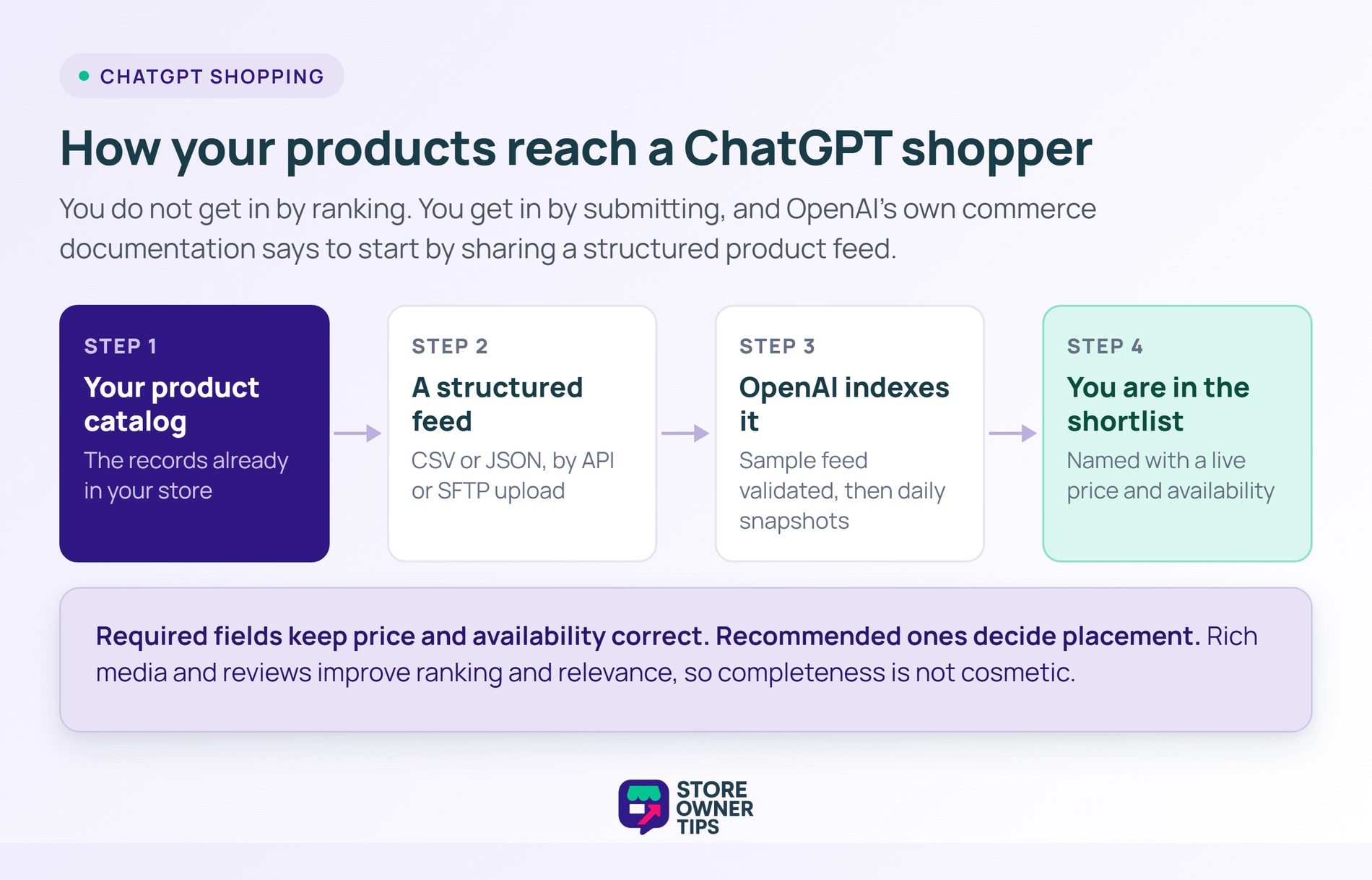
You do not get in by ranking, you get in by submitting. OpenAI’s commerce documentation is direct about the first step. It says to start by sharing a structured product feed.
That feed is a machine-readable copy of your catalog. OpenAI’s documentation describes it as a secure, regularly refreshed feed in CSV or JSON. It carries identifiers, descriptions, pricing, inventory, media, and fulfillment options.
Think of it like handing a supplier catalog to a personal shopper. They can only recommend what is written in the pages you gave them. So anything missing simply never gets suggested.
Required fields exist to keep price and availability correct. Meanwhile, the documentation notes that recommended attributes like rich media and reviews improve ranking and relevance. So completeness is not cosmetic, it is placement.
Feeds are delivered by API or by file upload to an SFTP server. After an initial sample feed is validated, merchants provide daily snapshots. In practice, that cadence rules out a hand-maintained spreadsheet.
All of this is the same discipline as any product data feed. Your catalog is still the source, and the feed is still a formatted copy. For a WooCommerce walkthrough, see this guide to building a ChatGPT product feed.
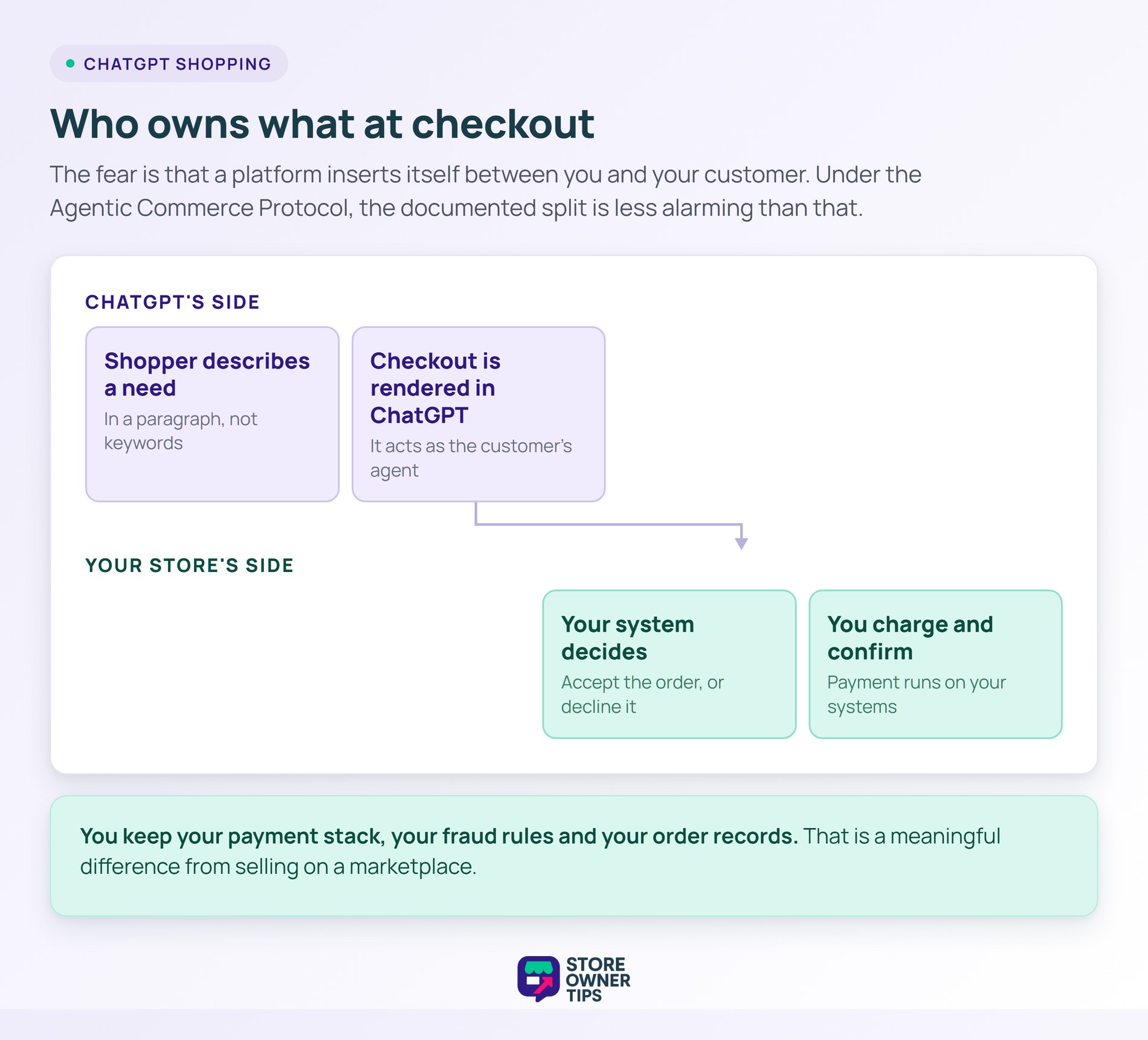
This is the part store owners worry about most. The fear is that a platform inserts itself between you and your customer. In practice, the documented design is less alarming than that.
Under the Agentic Commerce Protocol, ChatGPT acts as the customer’s agent. It can render a checkout experience inside its own interface. However, the checkout state and payment processing occur on the merchant’s systems.
OpenAI’s documentation is explicit about who decides. It sends the merchant the information, and the merchant determines whether to accept or decline the order. The merchant also charges the payment method and confirms the order.
So you keep your payment stack, your fraud rules, and your order records. That is a meaningful difference from selling on a marketplace. This model sits closer to agentic commerce than to a rented storefront.
The wider context is that e-commerce keeps taking share. It reached 16.9% of total U.S. retail sales in a recent quarter, on Census Bureau figures. A new discovery surface inside that channel is not a small thing.
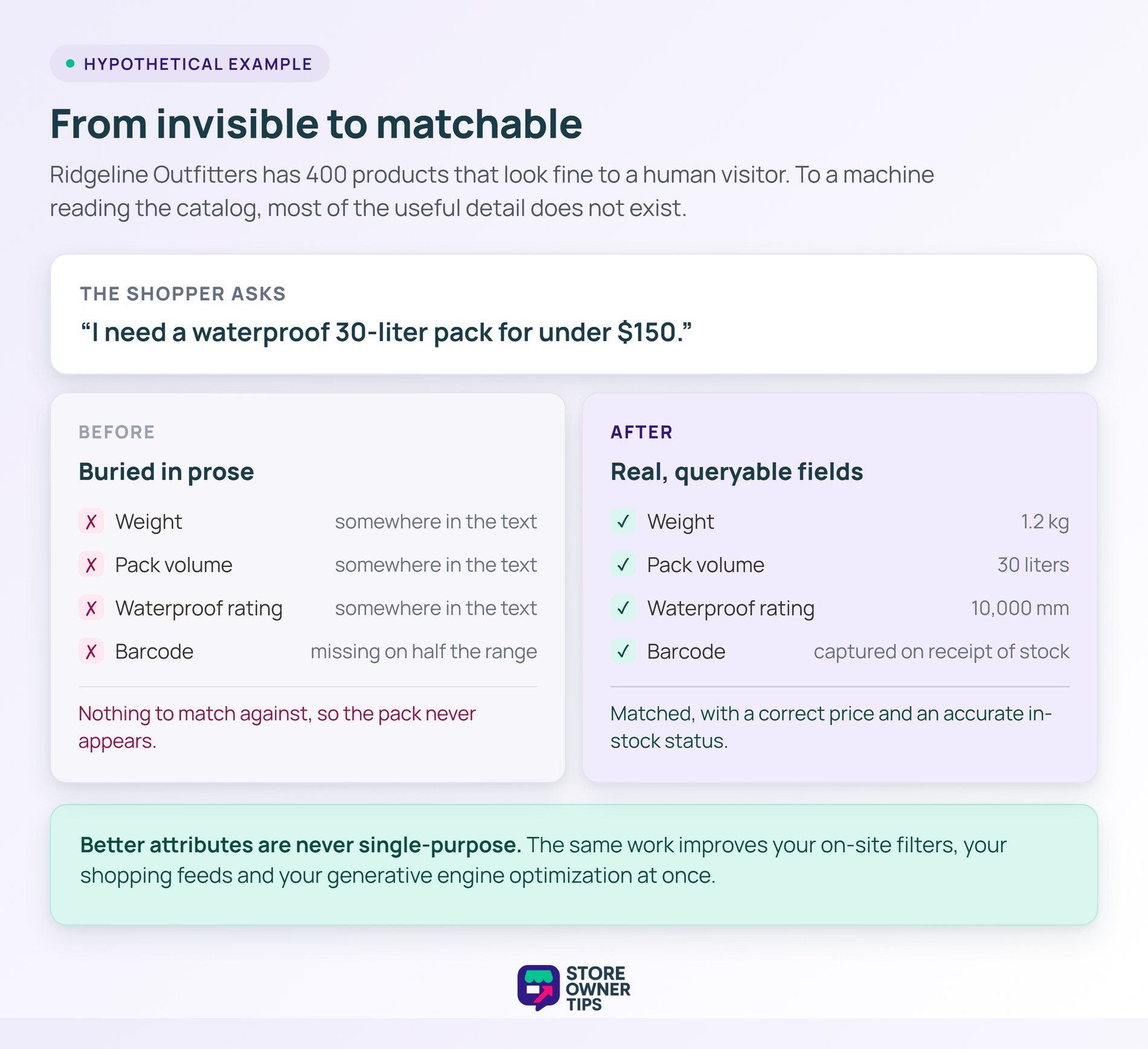
Imagine a store called Ridgeline Outfitters that sells hiking gear. It has around 400 products and a modest but loyal following. The owner keeps hearing about AI shopping and has done nothing about it.
The catalog looks fine to a human visitor. Every product has a photo, a price, and a short paragraph of description. Shoppers who land on the site convert reasonably well.
Underneath, the data is thin. Weight, waterproof rating, pack volume, and gender fit live inside prose, not in fields. Meanwhile, no barcode is recorded on roughly half the range.
None of that hurts the website at all. However, it makes the catalog nearly useless to any machine reading it. A request for a waterproof 30-liter pack under $150 cannot be matched.
The owner starts with attributes, not with the feed. First, weight, volume, waterproof rating, and fit become real fields on every product. Barcodes get captured for everything that has one.
Descriptions get rewritten to answer questions rather than sell. They state what the pack does not do as well as what it does. That honesty is what makes an assistant willing to recommend it confidently.
Only then does the feed get built and submitted. It runs on a daily schedule, because prices and stock move constantly. A sample feed goes first for validation, then the daily snapshots begin.
Now that 30-liter waterproof request has something to match. The pack appears with a correct price and an accurate in-stock status. Previously, it was invisible to the entire conversation.
There is a measurement catch worth naming upfront. Traffic from this surface is hard to attribute cleanly, and some of it never touches your site. So the owner tracks assisted revenue and direct visits, not a tidy channel report.
The same work pays off elsewhere too. Better attributes improve on-site filters, shopping feeds, and generative engine optimization at the same time. In short, none of this effort is single-purpose.
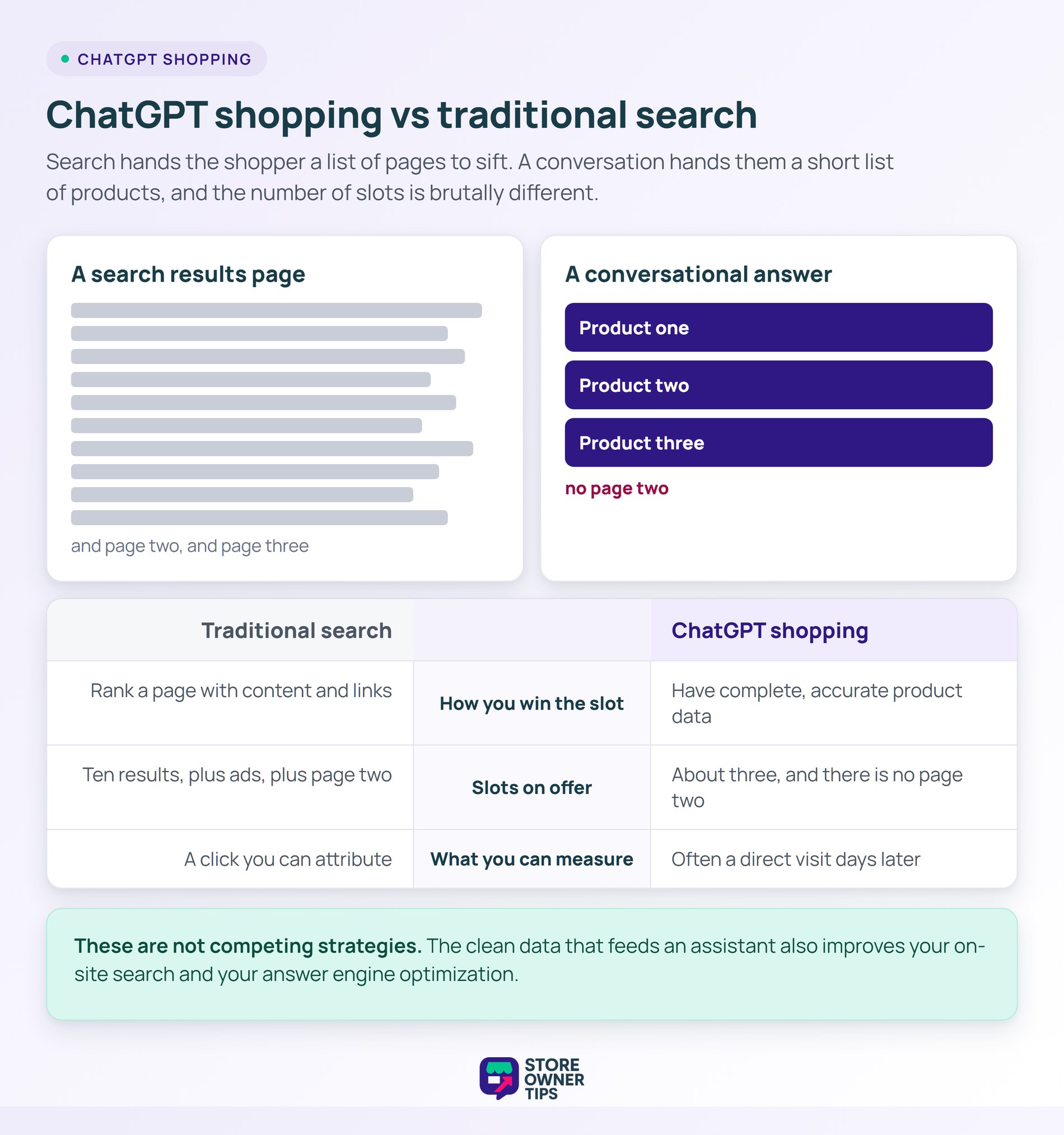
Traditional search hands the shopper a list of pages. By contrast, ChatGPT shopping hands them a short list of products. That difference reshapes almost everything about how you compete.
In search, you win by ranking a page. Content, links, and technical health decide whether that page appears. Meanwhile, in ChatGPT shopping you win by having accurate, complete product records.
The number of slots is also brutally different. A search results page shows ten options plus ads. A conversational answer often shows three, and there is no page two.
Attribution differs just as sharply. Search sends a click you can measure, while an assistant may send a shopper who arrives later and directly. So your reporting gets blurrier even when sales improve.
These are not competing strategies, though. The same clean data that feeds an assistant also improves your on-site search and your answer engine optimization. Treat it as one job with several payoffs.
For product results with live price and availability, yes. OpenAI’s own documentation says to start by sharing a structured product feed. That feed is how your catalog gets indexed accurately.
Your brand can still be mentioned without one. An assistant may reference your site from general web content it has read. However, a mention is not the same as an accurate, purchasable listing.
No, and the documentation is unusually clear about this. Checkout state and payment processing happen on the merchant’s systems. You decide whether to accept the order and you charge the card.
A checkout experience can still be rendered inside the assistant’s interface. So the shopper may not visit your site during the purchase. Even so, the order, the payment, and the customer data are yours.
Imperfectly, and you should plan for that. For example, some shoppers arrive by direct visit days after the conversation. Others complete a purchase without a recognizable referral at all.
Watch the blunt signals instead of chasing a clean attribution model. Direct traffic, branded search, and total revenue trends will move before any report does. Meanwhile, treat brand mentions and citations as a leading indicator.
ChatGPT shopping rewards the least glamorous work in e-commerce. Complete attributes, accurate stock, honest descriptions, and a feed that refreshes daily are the whole strategy.
So the stores that win here will be the ones that fixed their product data. That work pays off across every other channel at the same time.
Copyright © StoreOwnerTips.com. All Rights Reserved.
