Weekly ecommerce tips, deals & news.
A free gift with purchase adds a complimentary item to an order once the shopper meets a condition. The trigger is usually a spend threshold, a specific product, or a coupon code. Crucially, the gift is a different item from the one being bought.
It rewards the purchase rather than discounting it.
Most promotions work by lowering a number. A free gift works by adding something instead, which is a genuinely different lever. However, stores reach for the discount out of habit.
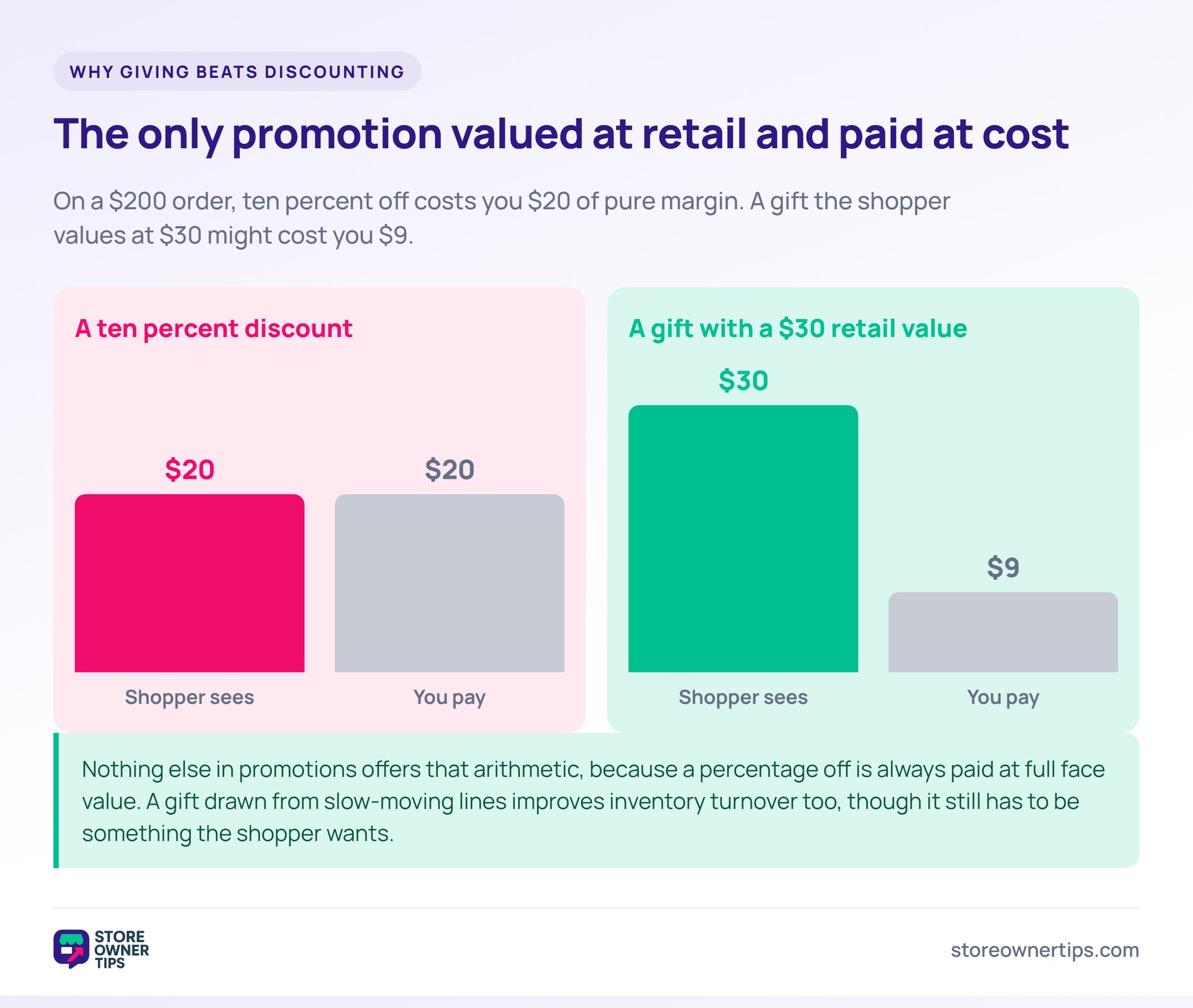
The difference matters most on your margin.
A ten percent discount on a $200 order costs you $20 of pure margin. A gift with a $30 retail value might cost you $9. So the shopper perceives more and you pay less.
That gap exists because the gift is valued at retail and paid for at cost. Nothing else in promotions offers that arithmetic. Meanwhile, a percentage off is always paid at full face value.
Stock choice matters here as well. A gift drawn from slow-moving lines also improves inventory turnover. Even so, it must still be something the shopper wants.
There is a positioning argument too. Discounts teach shoppers what your product is really worth, and they remember. By contrast, a gift leaves the price untouched and reads as generosity.
Behavioral research supports the instinct as well. Giving something first triggers a sense of obligation, which is the reciprocity principle at work. So the gift buys goodwill a discount never does.
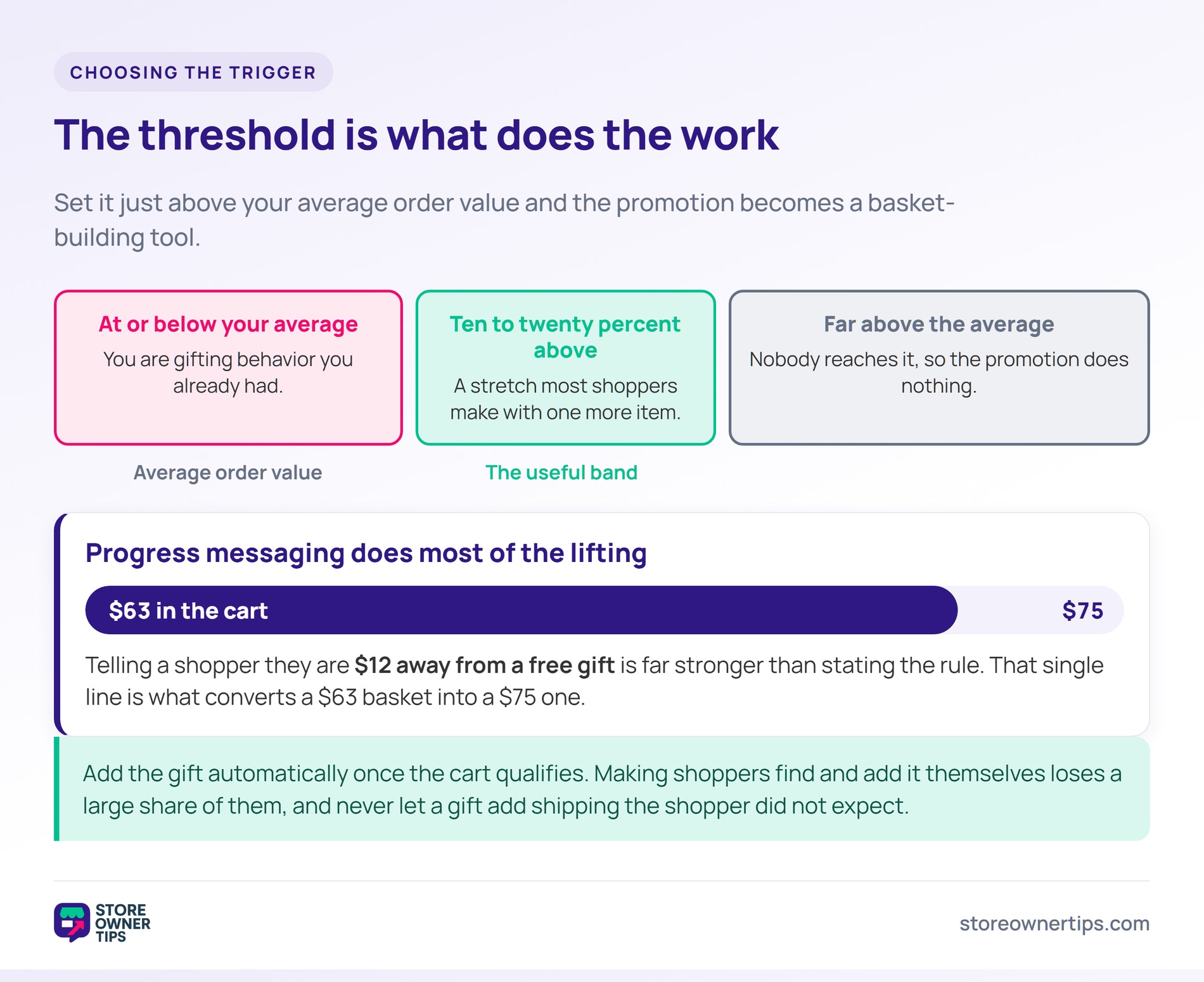
The most common trigger is a spend threshold. Spend $75 and the gift appears, which turns the promotion into a basket-building tool. So place the threshold just above your average order value.
Set it at your average and you are gifting behavior you already had. Set it far above and nobody reaches it. In practice, ten to twenty percent above the average is the useful band.
The same threshold logic drives upselling generally. You are asking for one more item, not a bigger commitment.
Product triggers work differently. Buying a camera unlocks a free memory card, which is really cross-selling with the friction removed. Meanwhile, that pairing also reduces returns, because the customer has what they need.
Whatever the trigger, the rule that fires it is a cart condition. Think of it like a vending machine that drops a bonus item once you put in enough coins. The machine has to be visibly working, or nobody plays.
A gift nobody sees is just a cost. Announce the offer on the product page and again in the cart. The cart is where the threshold becomes real.
Progress messaging does most of the lifting. Telling a shopper they are $12 away from a free gift is far stronger than stating the rule. In practice, that single line is what converts a $63 basket into a $75 one.
Add the gift to the cart automatically once it qualifies. Making shoppers find and add it themselves loses a large share of them. Meanwhile, an item appearing on its own feels like a reward.
Late surprises are the thing to avoid. Baymard Institute puts the average documented cart abandonment rate at 70.22%. Extra costs are the top fixable reason, at 40% of abandonments. So never let a gift add shipping the shopper did not expect.
Imagine a skincare store called Verity selling cleansers and serums. Its typical order is $62. Previously it ran a fifteen percent sitewide discount every quarter.
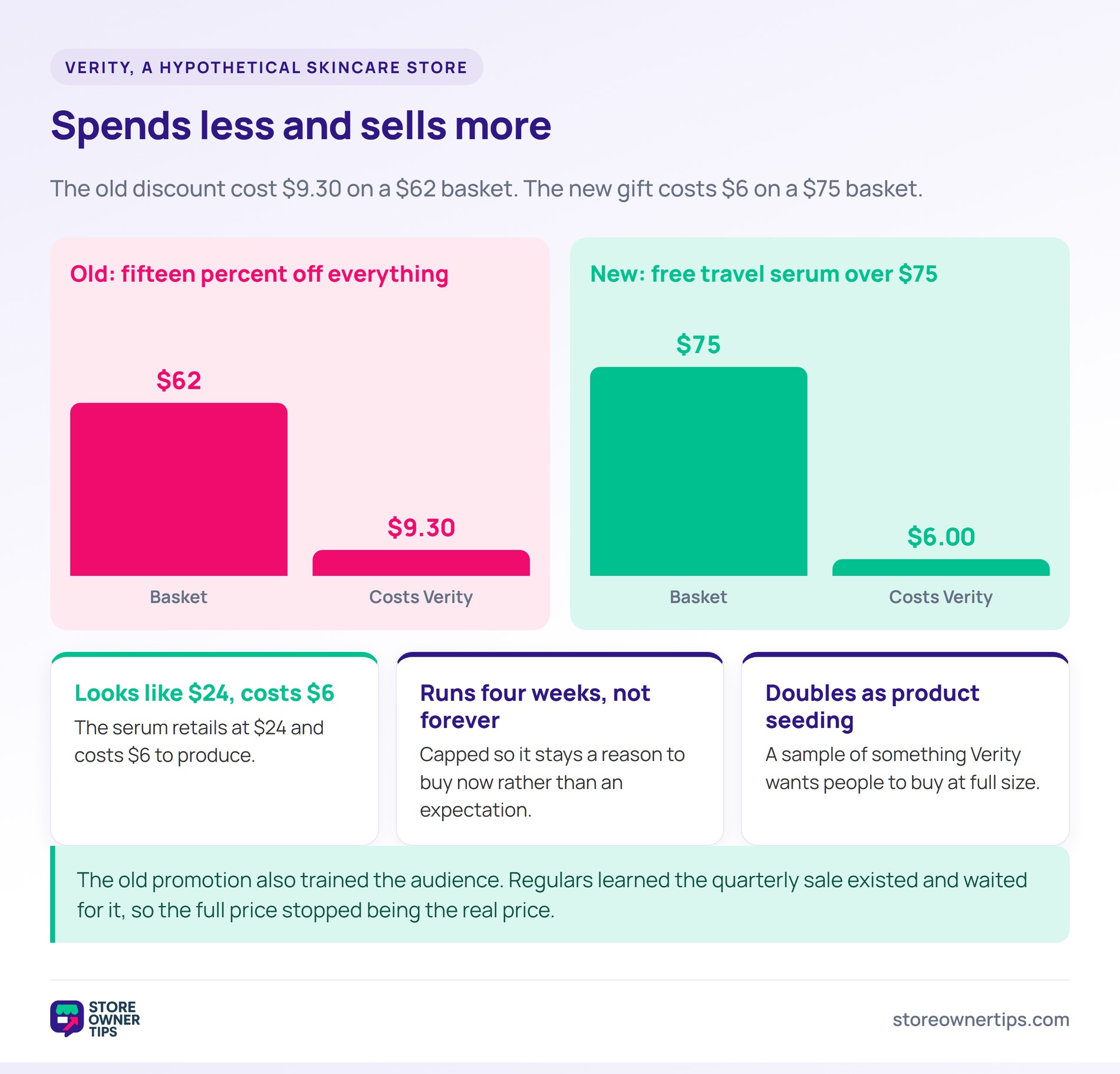
Fifteen percent off a $62 order costs Verity $9.30 in margin. That comes off every order, including the ones that would have happened anyway. So the promotion pays people not to change behavior.
It also trains the audience. Regulars learn the quarterly sale exists and wait for it. Over time, the full price stops being the real price.
Verity switches to a free travel-size serum on orders over $75. The serum retails at $24 and costs $6 to produce. So the offer looks like $24 and costs like $6.
The threshold sits about twenty percent above the $62 average. Shoppers at $62 now see a message saying they are $13 away. Meanwhile, the gift adds itself once they cross the line.
Compare the two on a qualifying order. The old discount cost $9.30 on a $62 basket. The new gift costs $6 on a $75 basket, so Verity spends less and sells more.
Verity also caps the promotion. The gift runs four weeks rather than permanently, so it stays a reason to buy now. Otherwise it becomes an expectation baked into every order.
The serum choice is deliberate as well. It is a sample of a product Verity wants people to buy at full size. So the promotion doubles as product seeding.
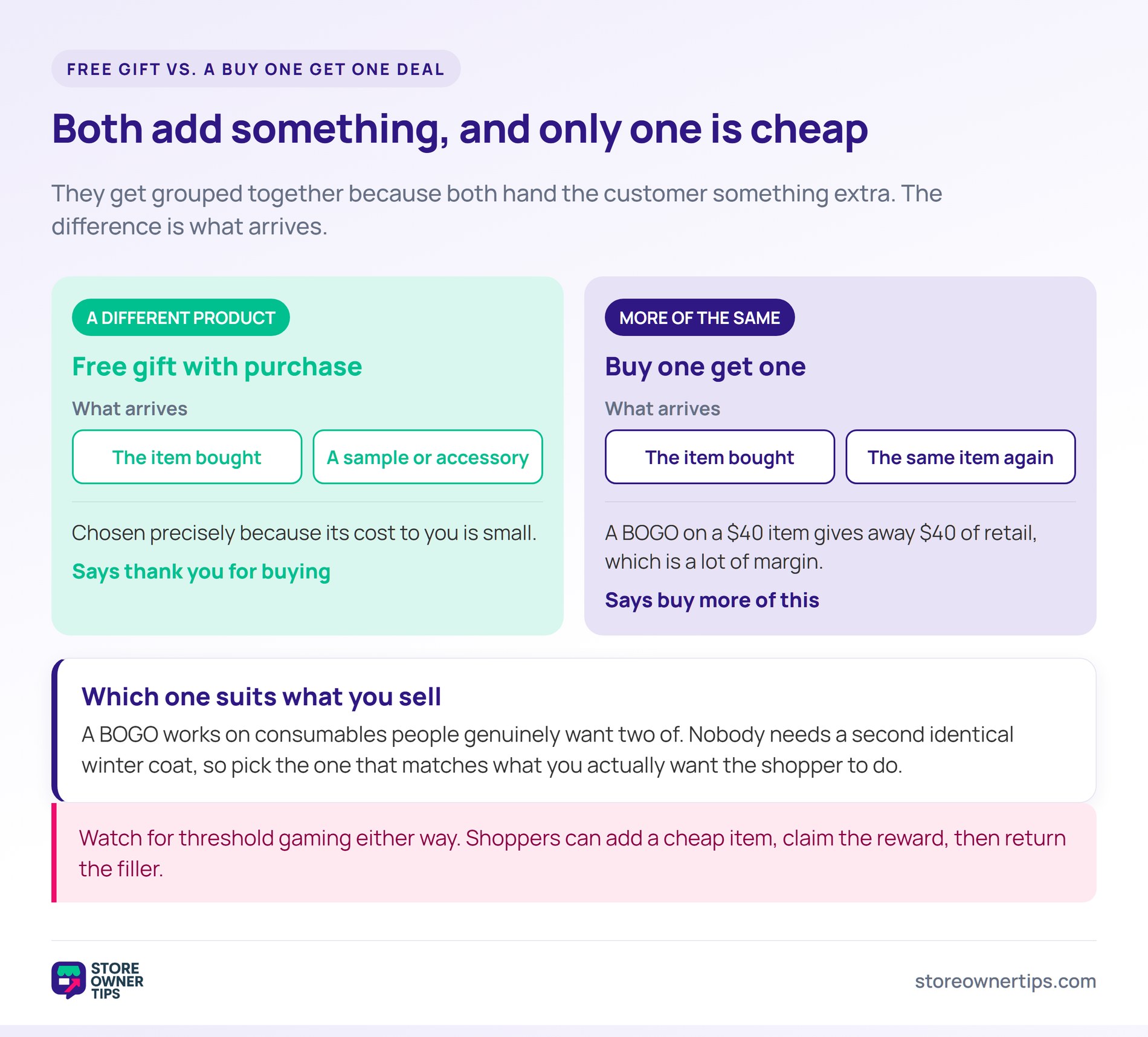
Both hand the customer something extra, so they get grouped together. The difference is what arrives. A free gift is a different product, while a BOGO gives more of the same one.
That changes who each one suits. A BOGO coupon works on consumables people genuinely want two of. Meanwhile, nobody needs a second identical winter coat.
The cost profile differs too. A BOGO on a $40 item gives away $40 of retail, which is a lot of margin. By contrast, a gift is chosen precisely because its cost is small.
They also send different signals. BOGO says buy more of this, and a free gift says thank you for buying. So pick the one that matches what you actually want the shopper to do.
Something desirable, light and cheap for you to supply. Samples, travel sizes and accessories all fit that description. Meanwhile, they cost a fraction of their perceived value.
Avoid using the promotion to clear stock nobody wants. Shoppers can tell, and the gift then cheapens the order. For example, an unwanted item in the box reads as a warehouse clear-out.
Just above your average order value, not at it. A threshold your typical basket already clears gives the gift away for nothing. So look at the distribution of order values, not just the average.
The sweet spot is a stretch most shoppers can make with one more item. Ten to twenty percent above the average usually achieves that. Then show progress toward it in the cart.
Measure the result against the promotion it replaced, tracking order value and margin. Meanwhile, a plain discount code version gives you a clean comparison.
Yes, in almost every case. Requiring a shopper to find and add the gift themselves loses a lot of them. So let the rule drop it into the cart the moment it qualifies.
Offer a choice only when it genuinely helps, such as picking a shade or a scent. Even then, keep the options to two or three. Meanwhile, more choice at checkout tends to slow people down.
A free gift gives you a promotion shoppers value at retail and you fund at cost. Your price never moves. The threshold is what turns it from a giveaway into a basket-builder.
So pick a gift people actually want, set the bar just above your average order, and add it automatically. For the setup, see this guide to offering a WooCommerce free product with purchase.
Copyright © StoreOwnerTips.com. All Rights Reserved.
