Weekly ecommerce tips, deals & news.
Lead time is how long it takes from placing an order to having the goods ready to sell. It covers the supplier’s processing, production and transit, plus your own receiving. In practice, it is the waiting period every other inventory decision is built around.
So if you do not know your lead times, you cannot know when to reorder.
Most store owners treat lead time as a single figure a supplier once mentioned. That figure then gets buried in an email and never questioned again. However, it is doing far more work than that.
Nearly every stock decision you make is really a bet on it.
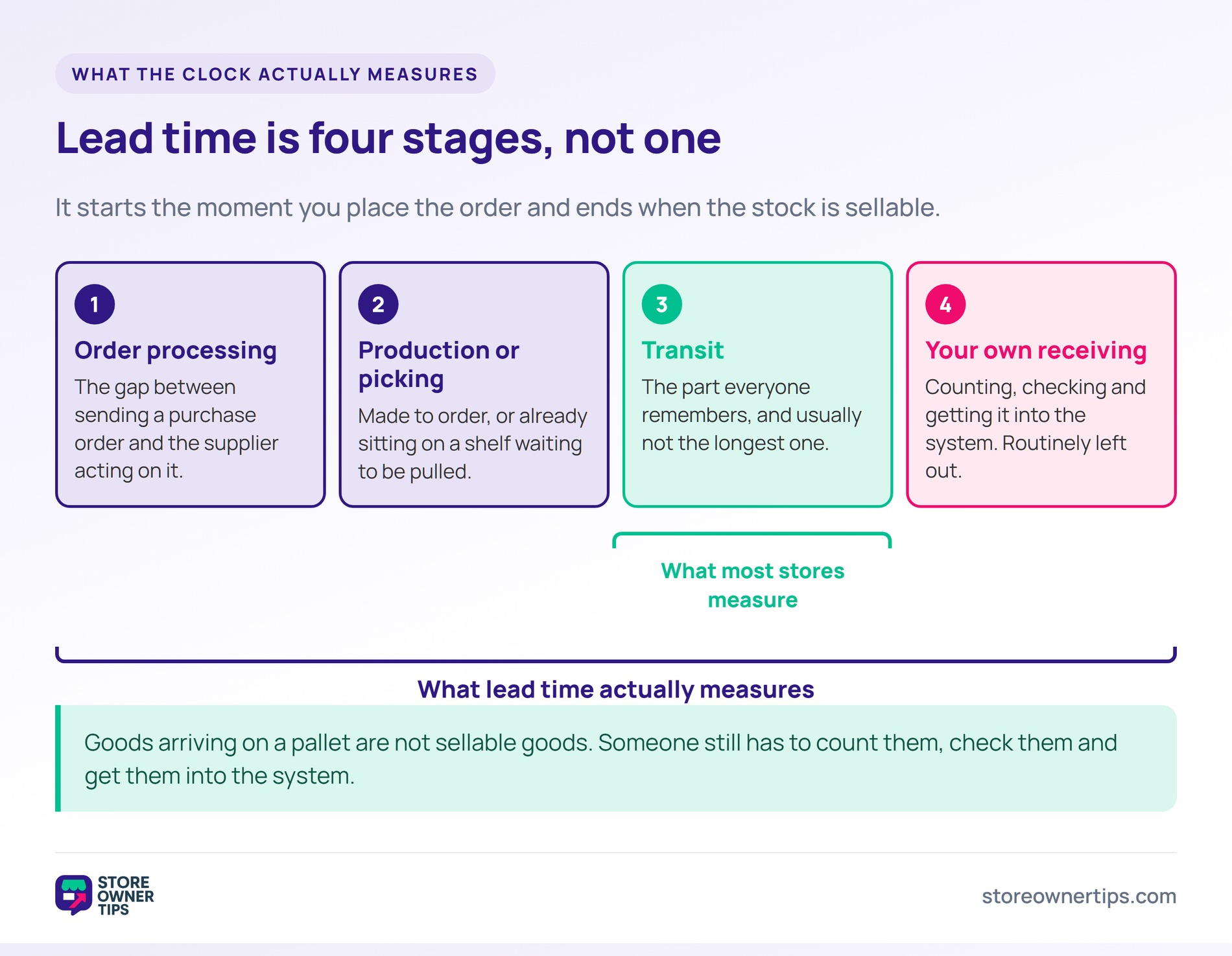
Lead time is not just shipping. First, there is order processing. That is the gap between sending a purchase order and the supplier acting. That alone can be days if approvals are involved.
Next comes production or picking, depending on whether the item is made to order or sitting on a shelf. Then comes transit, which is the part everyone remembers. Finally there is your own receiving.
That last stage is the one stores routinely leave out. Goods arriving on a pallet are not sellable goods. Someone still has to count them, check them and get them into the system.
Think of it like cooking a meal for guests. The oven time matters, but so does the shopping, the prep and the plating. So measuring only transit is like timing only the oven.
Suppliers quote averages, and averages hide the days that hurt you. A fourteen-day average built from deliveries of ten, twelve and twenty is not really fourteen days. In practice, the twenty-day case is the one that empties your shelf.
So plan against the longer end of the range rather than the middle. That gap between average and worst case is exactly what safety stock exists to absorb.
Lead times also move with conditions outside your control. The ISM Manufacturing PMI report puts its Supplier Deliveries Index at 58.9 percent in a recent month. A reading above 50 means deliveries are slowing across the board.
Even so, the most useful data is your own. Log the actual days on every purchase order you place. After a dozen orders you will know more than any quoted figure tells you.
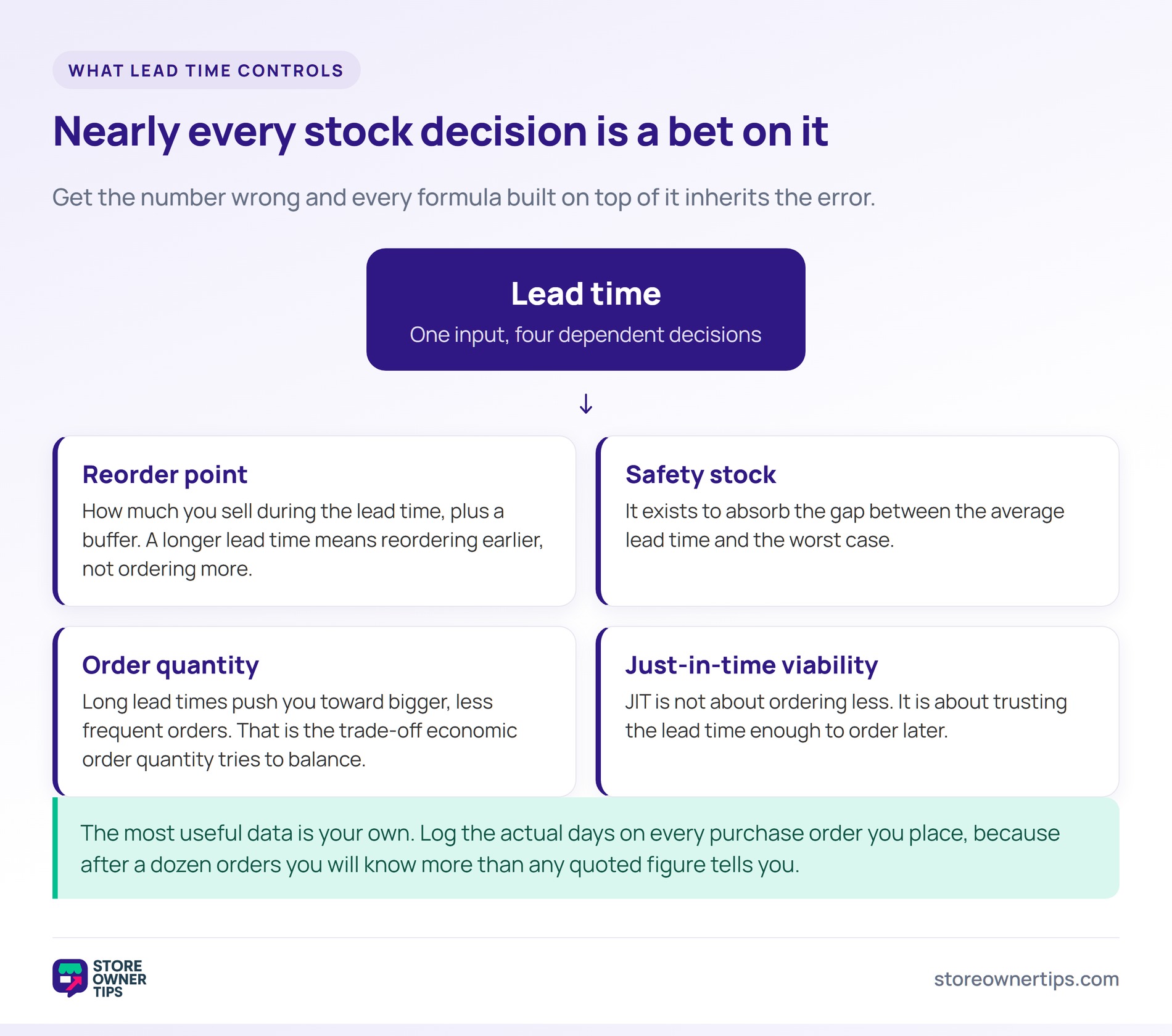
Its biggest job is setting your reorder point. That trigger is simply how much you sell during the lead time, plus a buffer. So a longer lead time means reordering earlier, not ordering more.
It also shapes how much you order at once. Long lead times push stores toward bigger, less frequent orders, which is the trade-off economic order quantity tries to balance. Meanwhile, short and reliable lead times allow leaner stock.
That is why just-in-time inventory depends so heavily on it. JIT is not really about ordering less. It is about trusting the lead time enough to order later.
The scale of the channel makes the discipline worth it. U.S. merchant wholesalers moved $11.38 trillion in a recent survey year. Meanwhile, e-commerce accounted for 33.3% of merchant wholesaler sales.
Start by asking the supplier which stage is longest. Most store owners assume it is transit when it is usually production or processing. So the fix is often scheduling rather than freight.
Forecasting is the cheapest lever available. A supplier who knows roughly what you need can build ahead of your purchase order. So they are not starting from scratch. In practice, a rolling forecast can remove more days than any courier upgrade.
Order size matters too. Meeting a supplier’s minimum order quantity sometimes moves you into an earlier production run. Meanwhile, tiny frequent orders can leave you at the back of the queue.
Finally, consider a second source for anything critical. One supplier for a make-or-break component means their delay is automatically your backorder. Even a small secondary supplier caps that risk.
Imagine a candle maker called Wick & Wax that buys glass jars from one supplier. Jars are the constraint on everything it sells. Previously the owner reordered whenever the shelf looked low.
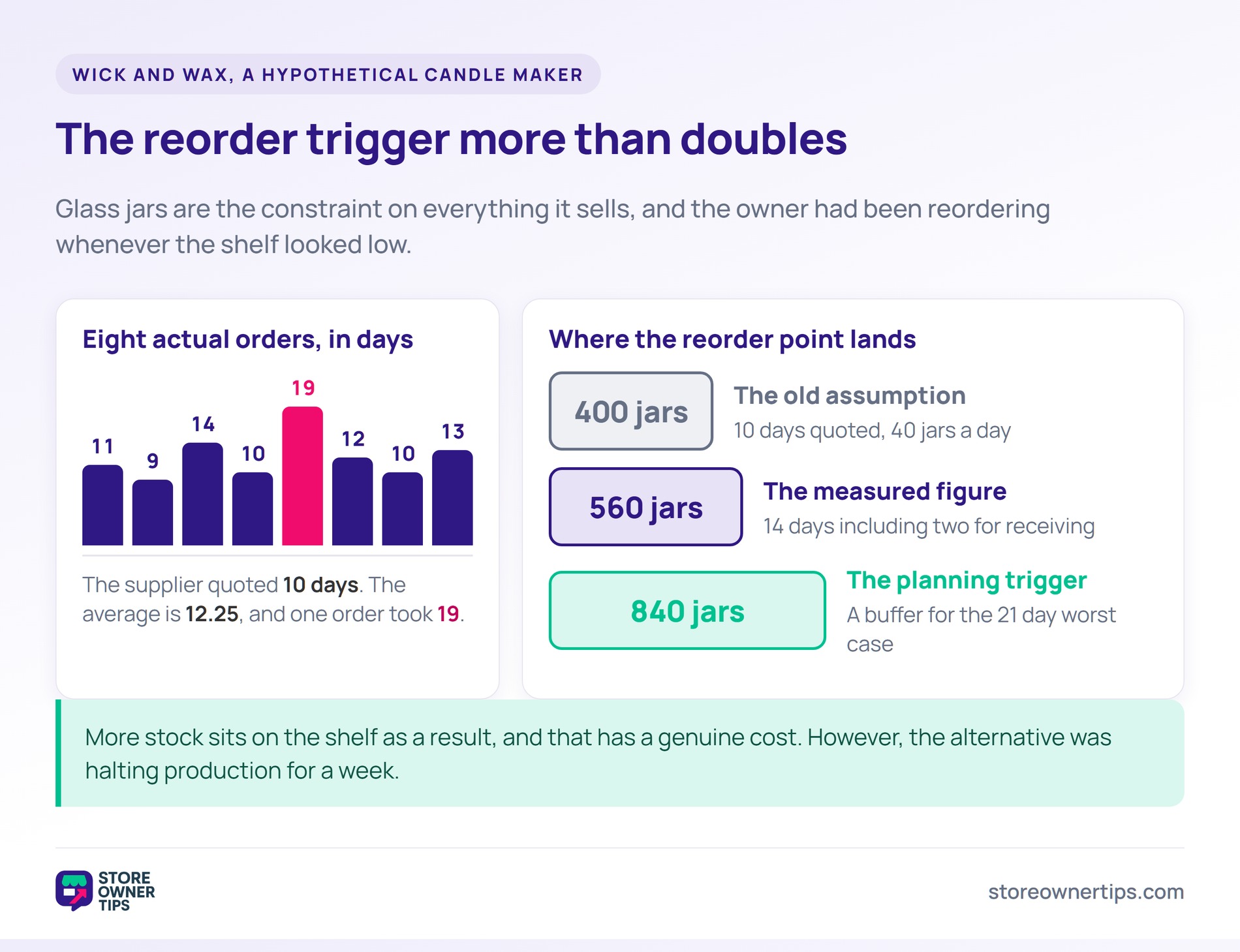
The supplier quotes ten days. So the owner logs the last eight orders and checks. The actual figures are 11, 9, 14, 10, 19, 12, 10 and 13 days.
The average works out at 12.25 days, not ten. More importantly, one order took 19 days. That single outlier is the one that would have stopped production.
The owner also adds two days for receiving and inspecting. So the planning figure becomes roughly 14 days on average, with a 21-day worst case. Neither number matches what the supplier said.
Wick & Wax uses 40 jars a day. At the old ten-day assumption, the reorder point was 400 jars. That was already too low before any buffer was added.
Using 14 days instead gives 560 jars. Adding a buffer for the 21-day worst case pushes the trigger to 840. So the owner now reorders at 840 jars rather than 400.
More stock sits on the shelf as a result, and that has a genuine cost. However, the alternative was halting production for a week. For a maker with no substitute jar, that trade is easy.
The owner also tracks how long stock then sits, which is a days sales of inventory question. Then lead times get published to wholesale buyers. Stockists planning a holiday range can now order in time. Previously they simply guessed and blamed the maker when stock ran out.
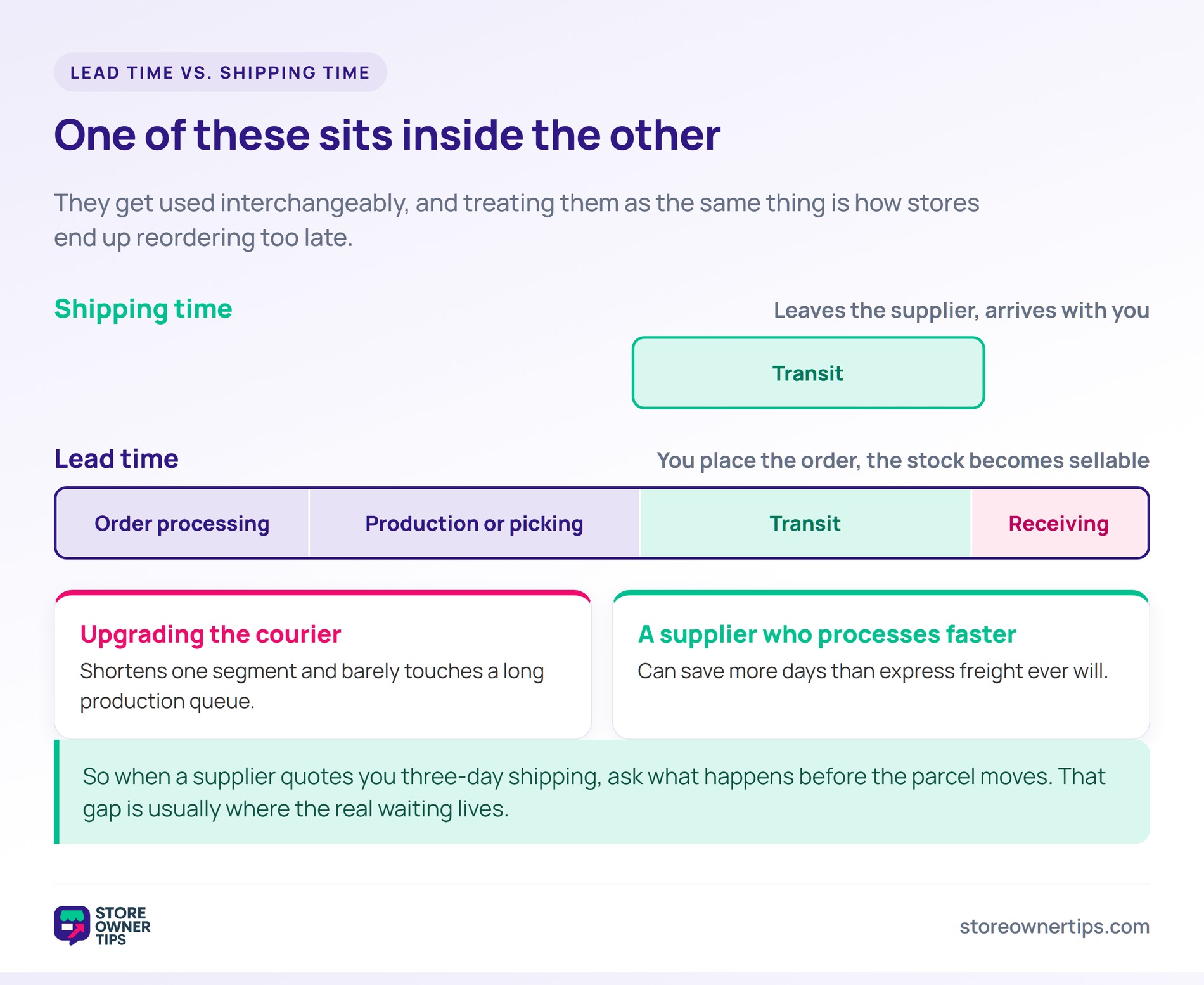
These get used interchangeably and they are not the same thing. Shipping time is one stage inside lead time. It starts when the goods leave the supplier and ends when they arrive.
Lead time wraps around that. It begins the moment you place the order and ends when the stock is sellable. So it includes processing, production and your own receiving.
The distinction matters because the two behave differently. A courier upgrade shortens shipping time and barely touches a long production queue. Meanwhile, a supplier who processes orders faster can save more days than express freight ever will.
So when a supplier quotes you “three-day shipping”, ask what happens before the parcel moves. That gap is usually where the real waiting lives.
Record two dates on every purchase order. Note the day you sent it and the day the stock became sellable. The gap between them is your true lead time.
After eight or ten orders you will have something usable. Take the average, but also note the longest one you saw. For example, a supplier averaging twelve days with a nineteen-day outlier needs planning for nineteen.
Yes, and honestly. A trade buyer planning a season needs a date they can build around. Vague reassurance is worse than a longer number they can trust.
Publishing it also cuts the emails asking where an order is. Show the expected wait on the product row alongside stock, especially for made-to-order lines. In practice, buyers forgive a long wait far more readily than a surprise.
Not necessarily, and this is a common confusion. A longer lead time means reordering earlier, which raises your trigger point. The order quantity is a separate decision.
Order size is driven by what each order costs you to place and hold. So a long lead time with cheap frequent ordering can still mean small orders. Meanwhile, an expensive ordering process pushes you toward larger batches.
Lead time is the quiet input behind every stock decision you make. Most stores are using a number their supplier guessed years ago. Measure your own, plan against the long end, and include your receiving.
Then publish it where buyers can see it. For a practical way to show waits on wholesale products, see this guide to custom stock statuses in WooCommerce.
Copyright © StoreOwnerTips.com. All Rights Reserved.
