Weekly ecommerce tips, deals & news.
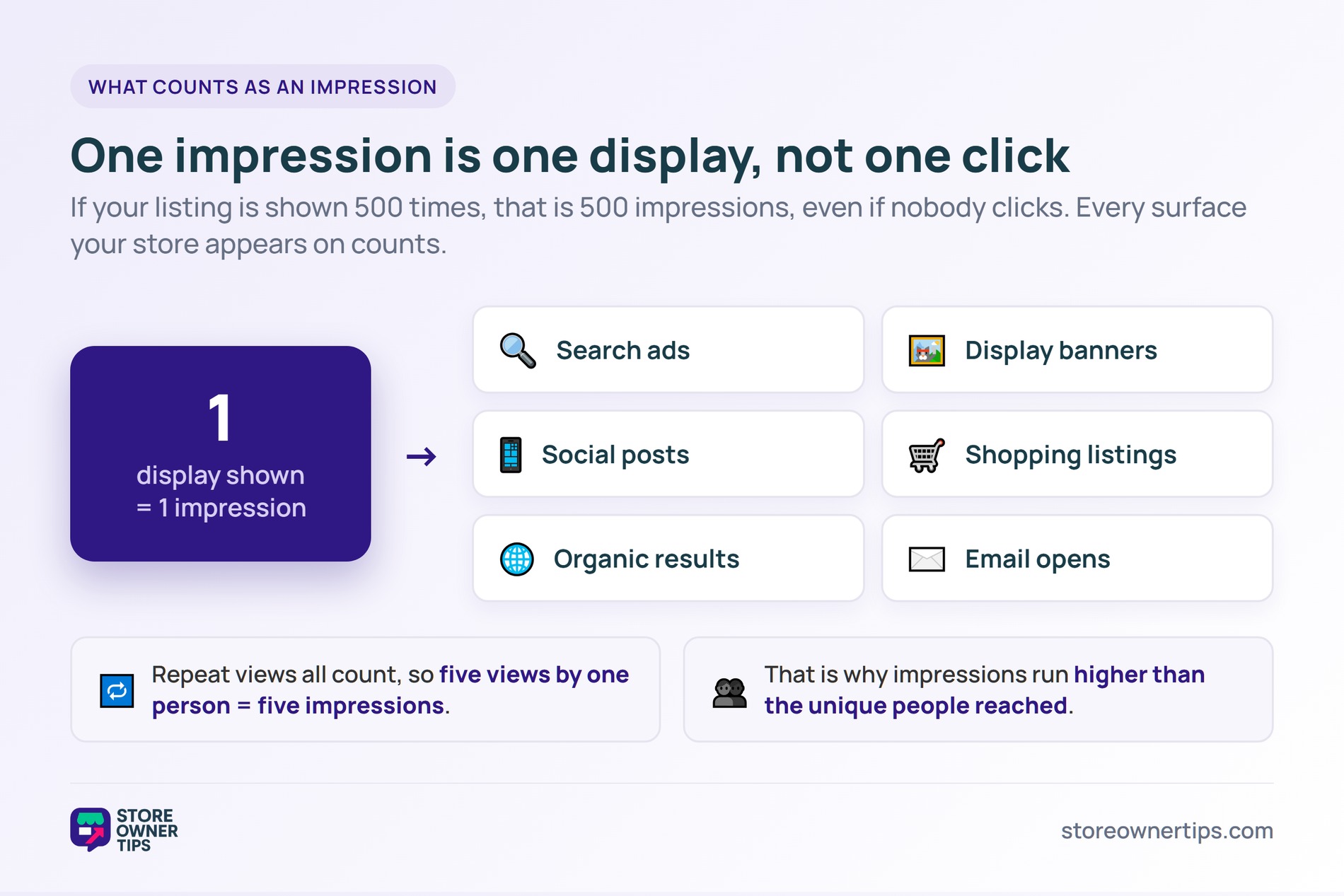
An impression is one instance of your content, ad, or listing being shown to a person. It counts the display, not the action. So if your product ad appears on a search page 500 times, that is 500 impressions, even if nobody clicks. Impressions measure reach and visibility, and they form the base that clicks and conversions are built on.
An impression is the simplest unit of digital visibility. Think of a billboard on a busy road. Every car that drives past and could see it is one “impression.” The billboard does not know who looked or who turned in to the shop. It only knows how many cars passed.
Online ads and listings work the same way. The platform records that your message appeared in front of a possible viewer. That single record is the building block for almost every other marketing metric you track.
Most platforms count an impression the moment your content is served. Google states that an impression is counted each time your ad is shown on a results page or partner site. This covers search ads, display banners, social posts, and Shopping listings.
It also applies to organic results. When your page shows in search, that is an impression too. So impressions are not only a paid metric. They track every place your store earns visibility, whether you pay for it or not.
One catch is repeat views. If the same person sees your ad five times, that still counts as five impressions. This is why impressions almost always run higher than the number of unique people reached.
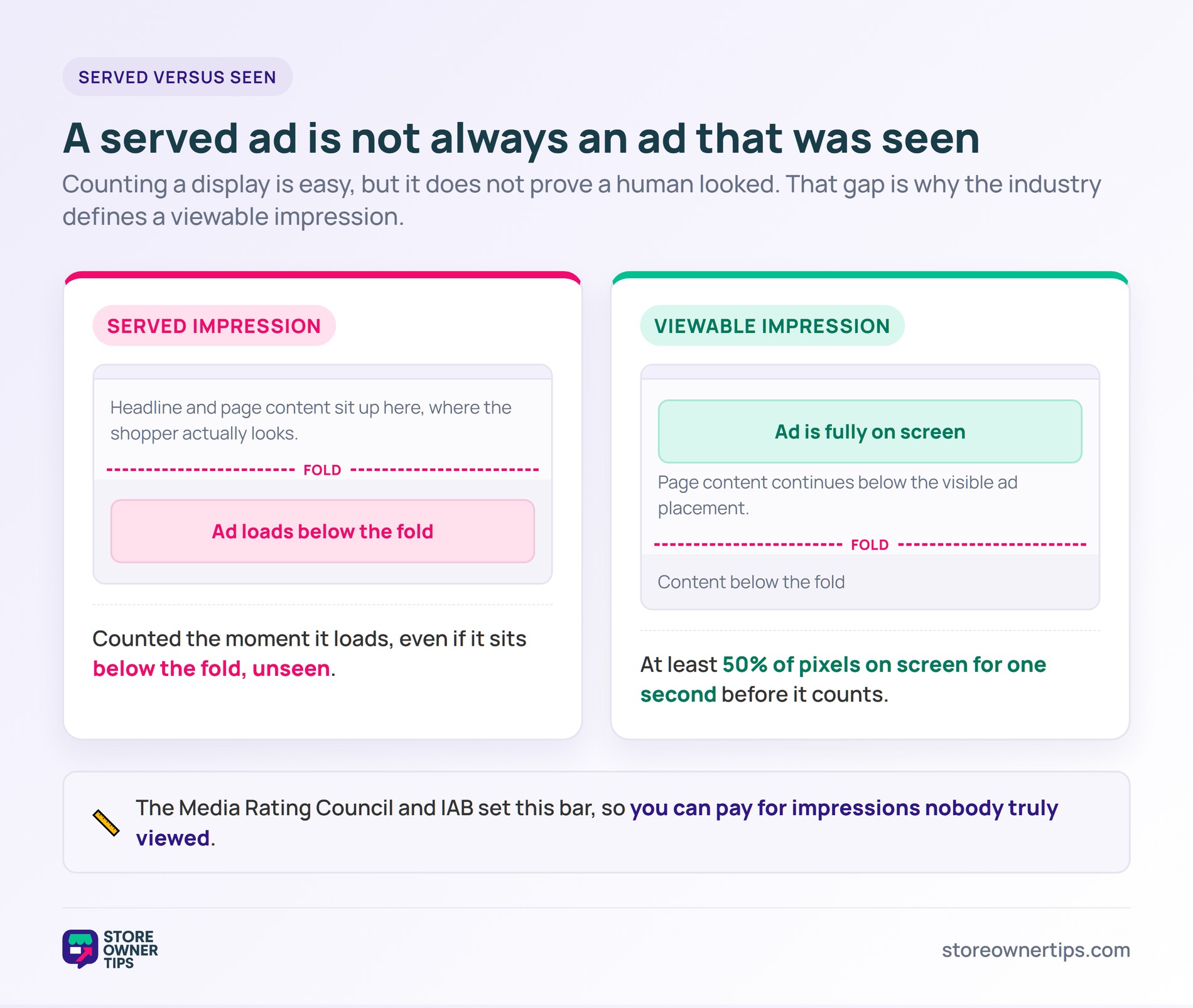
Here is the gap. A served impression does not mean a human actually saw it. An ad can load below the fold, where the user never scrolls. To close this gap, the industry created the “viewable impression.”
The Media Rating Council and the IAB set the standard. A display ad is viewable when at least 50% of its pixels are on screen for one continuous second. Video ads carry a tougher bar. This matters because you can pay for impressions that nobody ever truly viewed.
Many ad platforms sell visibility on a cost-per-mille model, or CPM. “Mille” is Latin for thousand, so CPM is simply the price you pay for one thousand impressions. Think of it like buying eyeballs in bulk.
This model suits awareness campaigns, where the goal is reach rather than instant clicks. By contrast, click-focused campaigns often use cost-per-click pricing. Knowing which model you are paying for keeps your budget honest.
The pricing choice also shapes how you judge success. On a CPM buy, a low cost per thousand views looks efficient. But cheap impressions mean little if they never lead to clicks or sales further down the funnel.
Impressions sit at the top of your funnel. No impression means no click, and no click means no sale. So watching them tells you if your reach is growing or shrinking over time.
They also help you read other metrics in context. A drop in clicks could mean weak ads, or it could just mean fewer impressions. Splitting the two tells you whether to fix your reach or fix your message. For deeper analysis, store owners pair impressions with conversion rate.
Almost every marketing dashboard reports impressions. Google Ads shows them for paid campaigns, and Search Console shows them for organic listings. Social platforms and email tools track them too.
The key is to read each one in its own context. An organic search impression and a display ad impression are not the same quality of view. Always check how a given platform defines the count before you compare numbers across channels.
Imagine a mid-sized brand called Brewhaus Coffee Roasters. They run a WooCommerce store and sell whole-bean coffee. They launch a Google Shopping campaign for their new single-origin line.
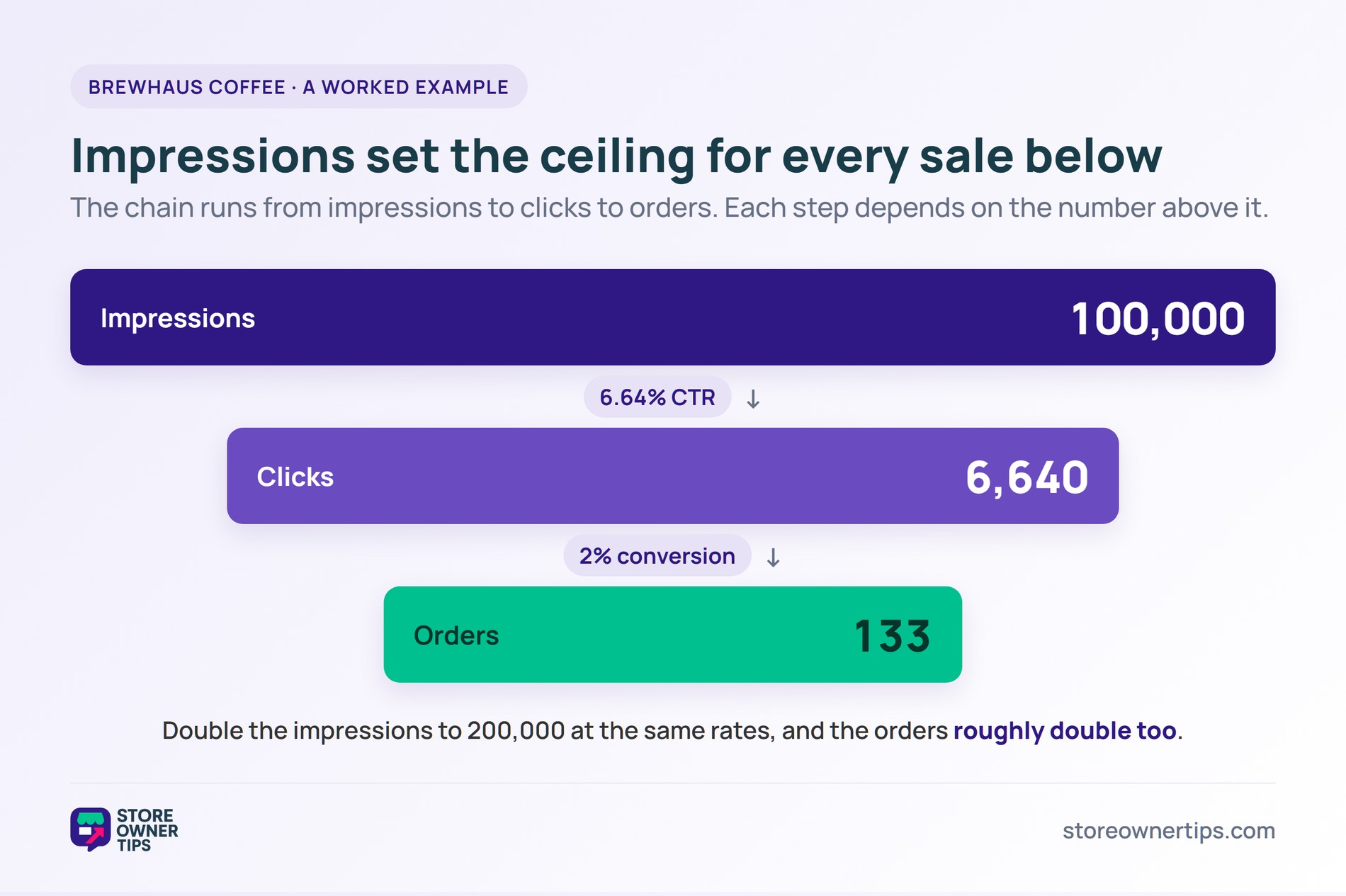
In the first month, Brewhaus earns 100,000 impressions. That means their product listings were shown 100,000 times across search and partner sites. It feels like a big number, and it is a real measure of reach.
But impressions alone do not pay the bills. The next question is how many of those views turned into visits. That is where click-through rate enters the math.
The average Google Ads click-through rate sits near 6.64%, based on a study of over 13,000 campaigns. At that rate, 100,000 impressions would yield about 6,640 clicks.
Now apply a modest 2% store conversion rate. Those 6,640 visitors would produce roughly 133 orders. So the chain runs from impressions, to clicks, to sales. Each step depends on the one before it.
This is why Brewhaus cannot ignore the top of the funnel. If they double their impressions to 200,000 and keep the same rates, their orders roughly double too. The base number sets the ceiling for everything below it.
But scaling has limits. If they push reach to a poor-fit audience, CTR can fall and costs can climb. A strong Google Shopping feed is one common way to win quality listing impressions, not just more of them.
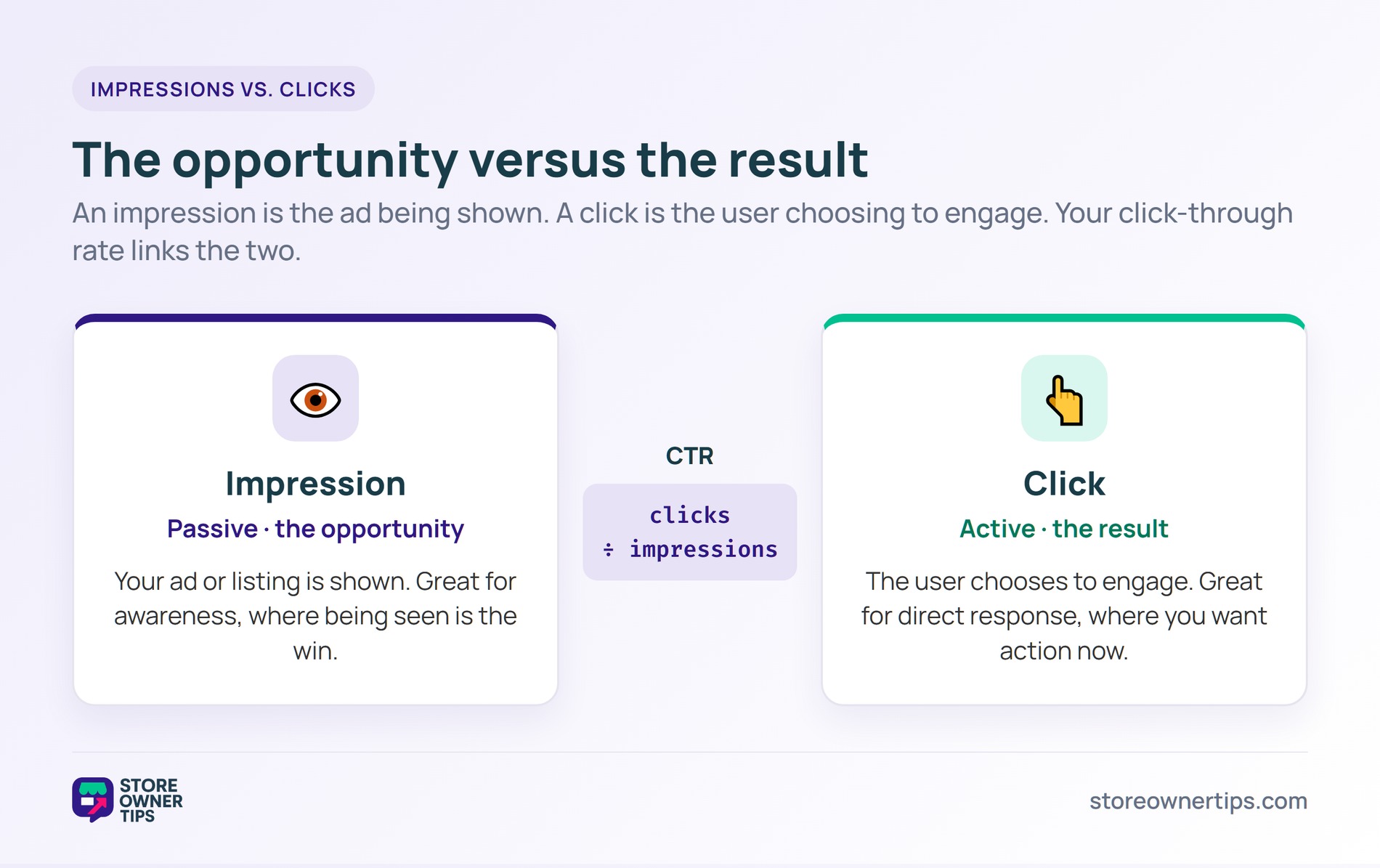
People often confuse these two, but they sit at different points in the journey. An impression is passive, it is the ad being shown. A click is active, it is the user choosing to engage.
Put simply, an impression is the opportunity, and a click is the result. You can have huge impressions with few clicks, which signals weak relevance. The link between them is your click-through rate, the share of impressions that became clicks.
The two metrics also serve different goals. Impressions suit brand awareness, where being seen is the win. Clicks suit direct response, where you want action now. Most healthy campaigns watch both, since strong reach with weak clicks still wastes spend.
Impressions count every time your content is shown, including repeat views. Reach counts the unique people who saw it. So one person who sees your ad three times equals three impressions but one reach. Impressions will always be equal to or higher than reach.
Yes. In Google Search Console, an impression is logged each time your page appears in results. This is separate from paid ads. Tracking organic impressions helps you see your visibility in organic traffic, especially if you win a featured snippet.
Not always. More impressions help if they reach the right people. But raw volume shown to a poor-fit audience just wastes budget. Quality of audience matters more than the size of the number alone.
Impressions are the foundation of digital visibility, the first step before any click or sale. On their own they prove little, but they set the ceiling for everything that follows. Track them next to clicks and conversions, and you will know whether to grow your reach or sharpen your message.
Copyright © StoreOwnerTips.com. All Rights Reserved.
