Weekly ecommerce tips, deals & news.
Just-in-Time (JIT) Inventory is a strategy where you order stock only when you need it. Instead of filling a warehouse with products in advance, you buy small amounts that arrive right before customers want them. The goal is simple: hold as little inventory as possible while still fulfilling every order on time.
JIT started on Toyota’s factory floors in Japan in the 1970s. The carmaker wanted to stop wasting money on parts that sat around waiting to be used. So it built a system where parts arrived exactly when the assembly line needed them.
Think of it like a restaurant kitchen. A good kitchen doesn’t cook 200 meals before anyone walks in. It starts cooking each dish when an order comes in. That way nothing spoils, and the cooks aren’t buried in food no one ordered.
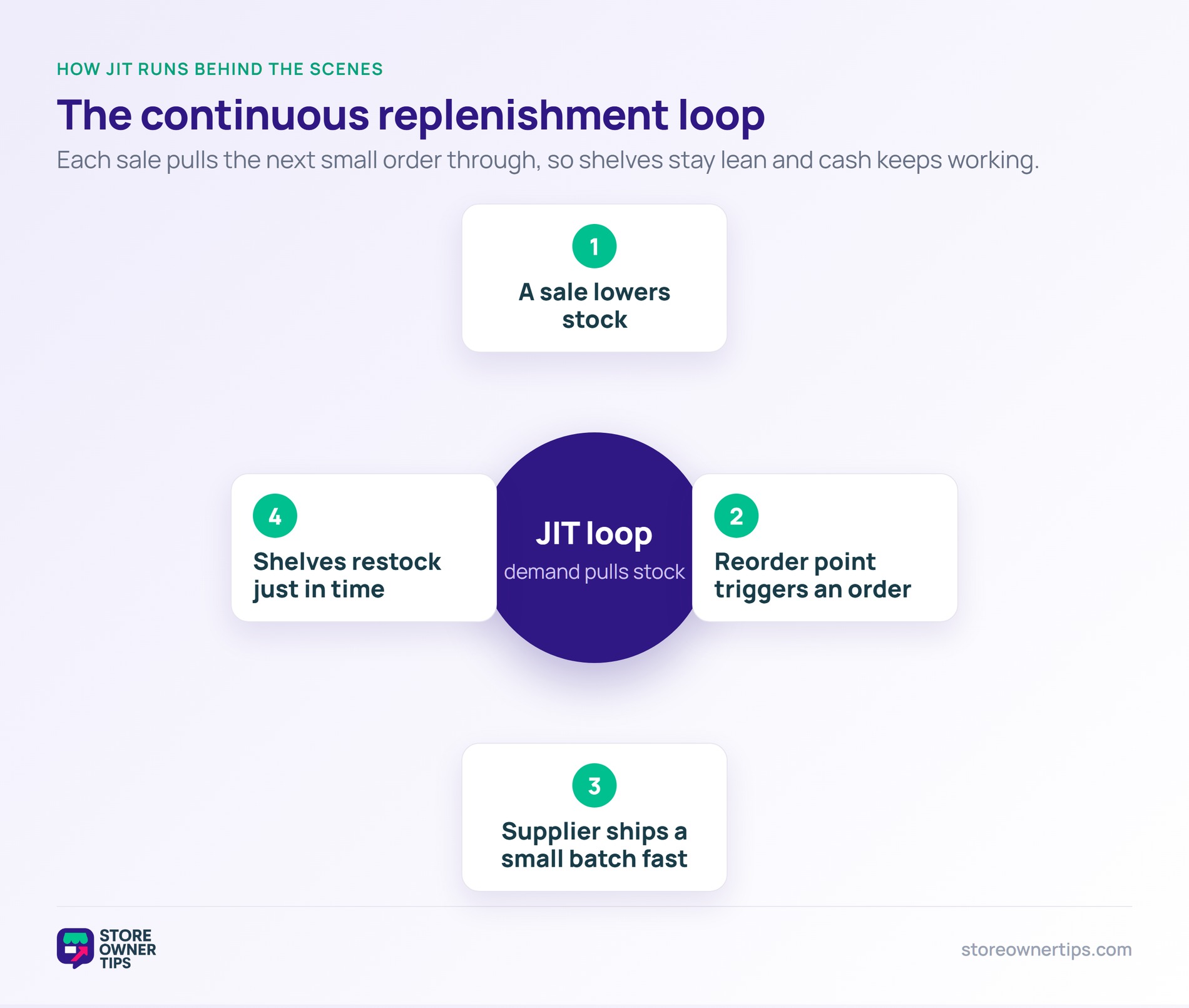
That same logic now powers modern inventory management for online stores. You keep shelves lean and let demand pull new stock in. As a result, your money isn’t trapped in boxes.
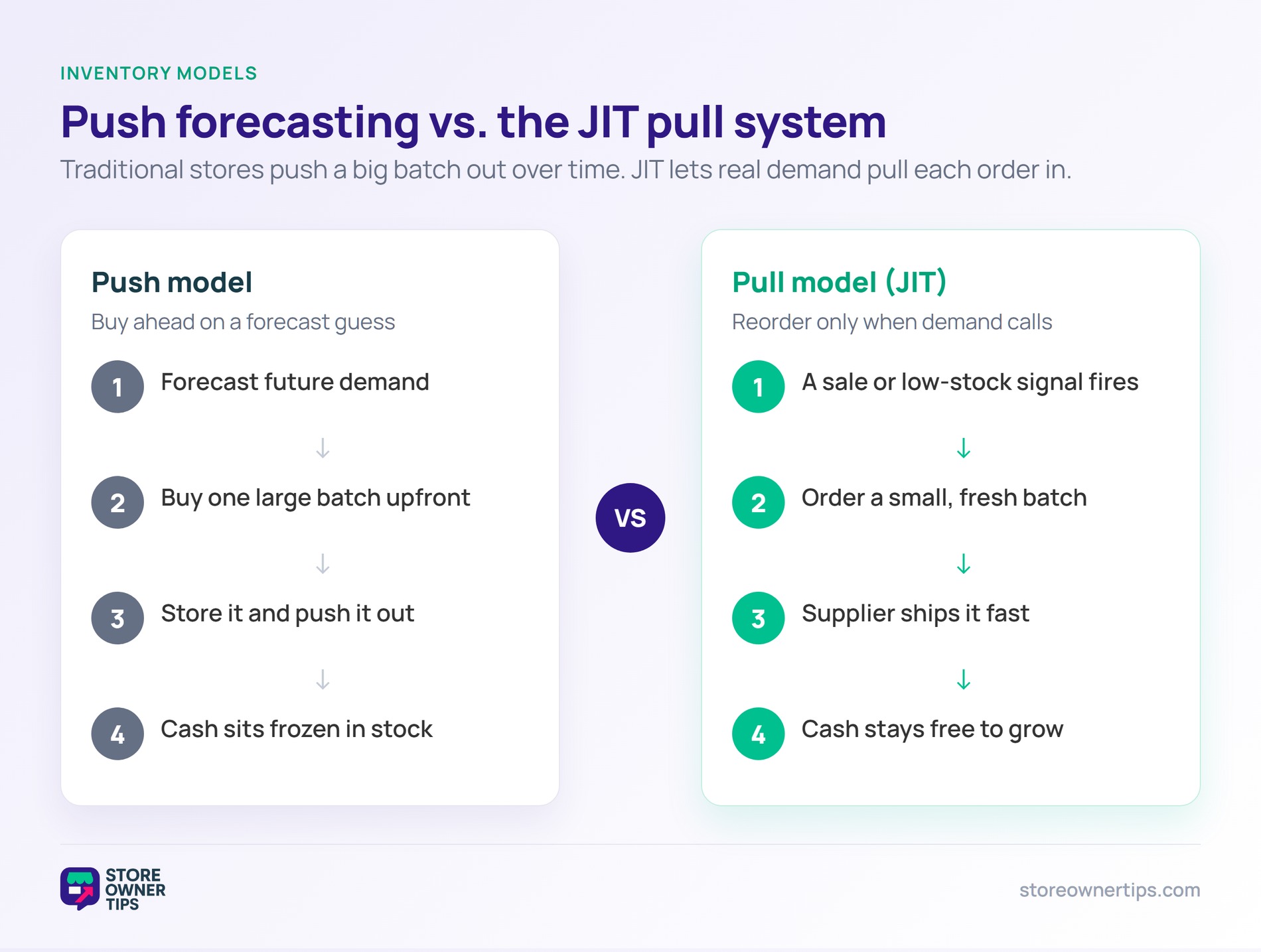
Most traditional stores use a “push” model. They forecast demand, buy a big batch, and push it out to customers over time. JIT flips that into a “pull” model, where a sale or a low-stock signal triggers the next order.
On WooCommerce, you can lay the groundwork for this with built-in tools. The product inventory settings let you track stock, set a low-stock threshold, and get alerts. When stock dips, that’s your cue to reorder.
The whole model rests on tight supplier relationships and fast shipping. You need partners who deliver small batches quickly and on schedule. Strong demand forecasting and supplier partnerships turn JIT from a gamble into a reliable system.
A key tool here is the reorder point. That’s the stock level that triggers your next order. Setting a smart reorder point gives suppliers enough lead time to deliver before you run dry.
The psychology here is about freeing up cash and reducing risk. Every product sitting in storage is money you can’t spend on ads, new products, or growth. JIT keeps that cash working instead of gathering dust.
It also lowers the fear of buying the wrong thing. When you order in small batches, a flop costs you a little, not a lot. That makes it easier to test new products without betting the whole budget.
On top of that, lean stock fights dead stock. Dead stock is product that just won’t sell and slowly loses value. The less you order ahead, the fewer items you’re stuck marking down or tossing later.
For many store owners, that mix of freed cash and lower risk is the whole appeal. You stay nimble instead of weighed down by a warehouse. In short, JIT lets a small team punch above its weight.
JIT lives or dies on accurate stock counts. If your records say you have 50 units but the shelf holds 30, your reorder timing breaks. So your quantity on hand must match reality at all times.
You also need to know your lead times cold. Lead time is how long a supplier takes to deliver after you order. Pair that number with your sales speed, and you can reorder at just the right moment.
Many stores back this up with a backorder option for popular items. A backorder lets a customer buy now and wait a short time for delivery. That way a brief stockout doesn’t cost you the sale.
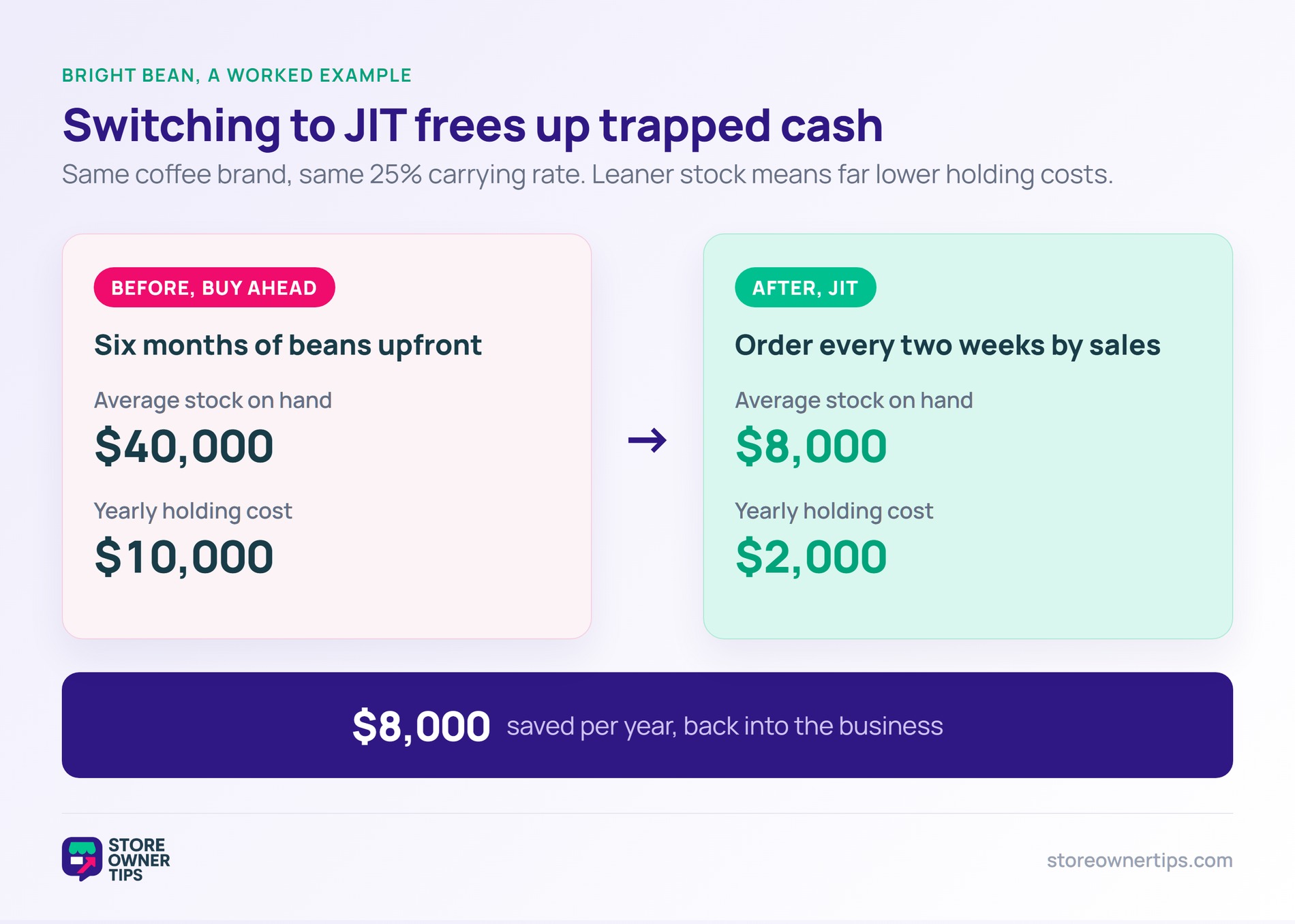
Imagine a mid-sized coffee roasting brand called Bright Bean. It sells a popular seasonal blend online. In the past, Bright Bean bought six months of beans upfront to play it safe.
That meant roughly $40,000 in beans sitting in storage at any time. Holding stock isn’t free, though. Carrying costs typically run 20% to 30% of inventory value each year.
At 25%, that $40,000 in beans costs Bright Bean about $10,000 a year just to hold. That money covers storage, insurance, and beans that go stale before they sell.
Bright Bean switches to JIT. It now orders beans every two weeks based on recent sales. Average stock on hand drops from $40,000 to about $8,000.
At the same 25% carrying rate, that smaller pile costs only $2,000 a year to hold. That’s an $8,000 saving that goes straight back into the business. Plus, far fewer beans go stale.
The trade-off is risk. If a roaster ships late, Bright Bean could run dry. That matters because 21% of shoppers head to a competitor when an item is out of stock. So Bright Bean keeps a small buffer of safety stock just in case.
To make this work, Bright Bean leans on data, not luck. It watches recent sales and sets a clear reorder point for each blend. When stock hits that line, a new order goes out automatically.
The brand also picks a roaster that ships within a few days. That short lead time is what makes JIT safe to run. Without a fast, steady supplier, the math would fall apart.
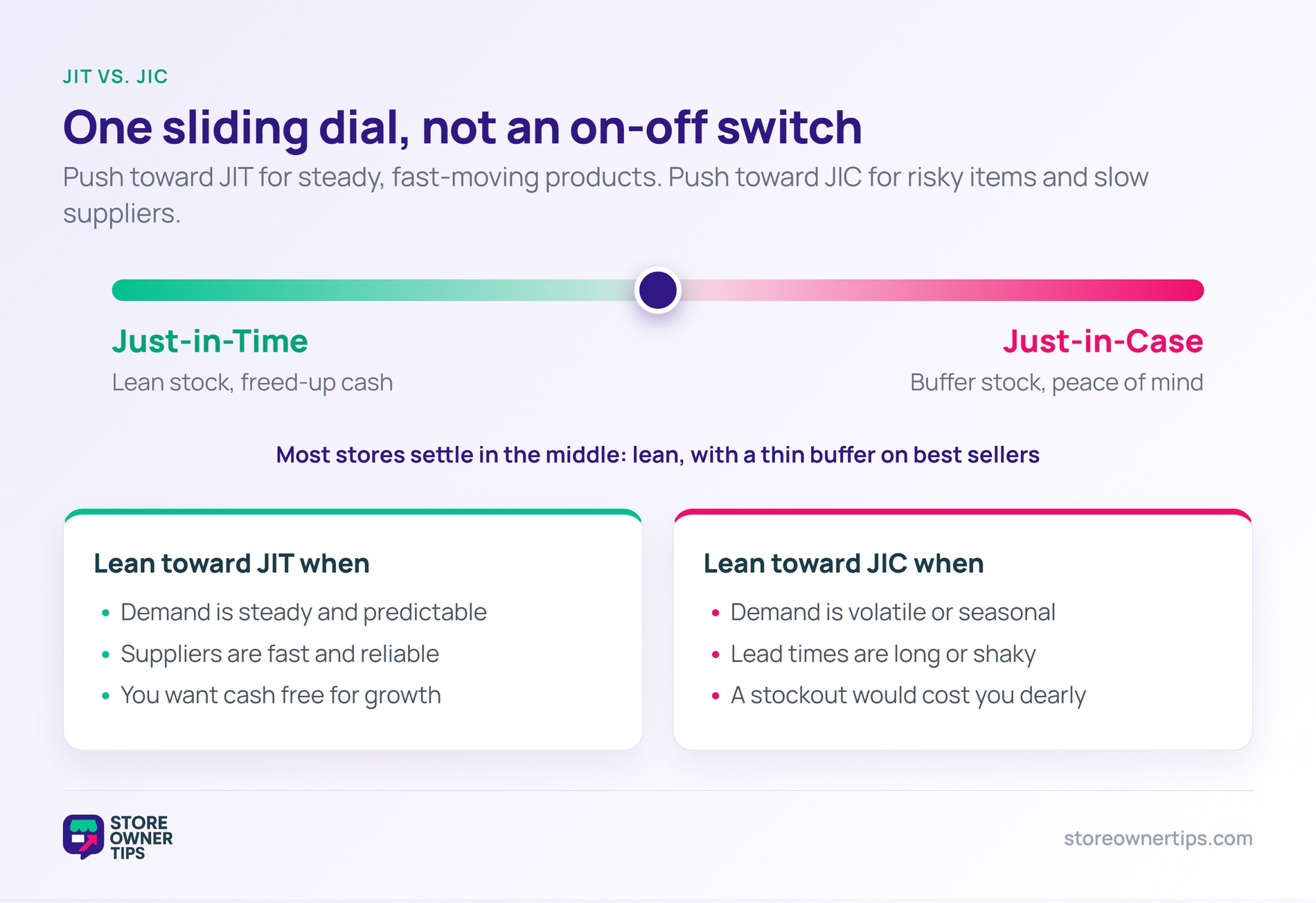
Just-in-Case (JIC) is the direct opposite of JIT. With JIC, you stockpile extra inventory as a cushion against surprises. With JIT, you keep stock as lean as possible and reorder only when needed.
JIC trades higher holding costs for peace of mind. You’re less likely to run out, but more of your cash sits frozen in stock. It also raises the odds of dead stock that never sells.
JIT trades that cushion for efficiency and freed-up cash. It shines in stable, predictable markets with reliable suppliers. By contrast, JIC fits stores with unpredictable demand or long, shaky lead times.
Most stores land somewhere in the middle. They run lean like JIT but hold a thin layer of buffer stock for their best sellers. In short, the right mix depends on how steady your demand and your suppliers really are.
Think of it as a sliding dial, not an on-off switch. Push the dial toward JIT for steady, fast-moving products with reliable supply. Push it toward JIC for risky items, slow shippers, or sudden seasonal demand.
It can be, if your demand is steady and your suppliers are reliable. JIT frees up cash that small stores badly need for growth. However, it leaves little room for error. Many small stores start with a light buffer of stock and tighten toward JIT over time.
The trick is to watch your data closely. Reorder before you cut your stock too fine.
The biggest risk is running out of stock. Since you hold so little, a supplier delay or demand spike can empty your shelves fast. That hurts because 39% of consumers have left without buying after hitting an out-of-stock item. A small safety buffer helps soften that blow.
With JIT, you still hold a little stock and ship orders yourself. With dropshipping, you hold zero stock and a supplier ships each order for you. JIT gives you more control over quality and speed. Dropshipping removes inventory entirely, but you give up that control.
Just-in-Time inventory helps you grow with less cash tied up in stock and less waste on your shelves. It rewards stores with steady demand, sharp forecasting, and dependable suppliers. Used wisely, with a thin safety net for your best sellers, JIT keeps your money working instead of sitting still.
Copyright © StoreOwnerTips.com. All Rights Reserved.
