Weekly ecommerce tips, deals & news.
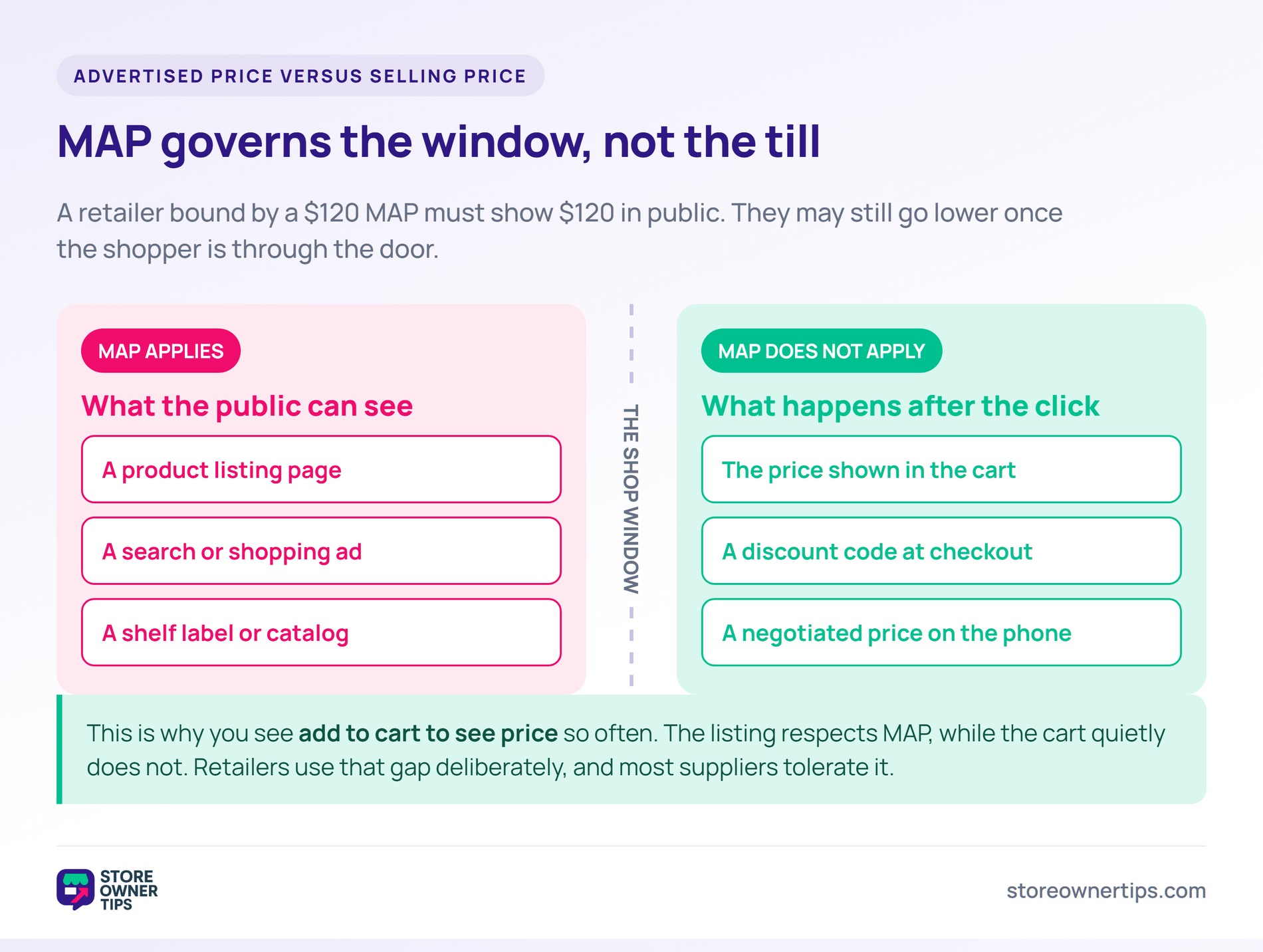
A minimum advertised price, or MAP, is the lowest price a supplier allows a retailer to advertise a product for. It governs the advertised number, not the price the shop finally sells at. So a retailer can quietly go lower in a cart or over the phone, but not on a public listing.
In short, MAP protects what everyone can see, which is where price wars actually start.
Suppliers publish a suggested retail price and hope everyone respects it. In practice, one discounter can pull an entire wholesale channel down. MAP exists because hoping is not a strategy.
It puts a floor under the advertised price, and it does so without dictating the final sale.
This is the distinction people miss, so it is worth being precise. Advertising means the price shown publicly on a listing, an ad or a shelf label. Selling means what the customer is actually charged.
MAP only reaches the first of those. A retailer bound by a $120 MAP must show $120 in public. However, they may still discount in the cart, apply a discount code, or negotiate privately.
That is why you see “add to cart to see price” so often. The listing respects MAP, while the cart quietly does not. Retailers use that gap deliberately, and most suppliers tolerate it.
Think of it like a dress code rather than a curfew. It governs what shows in public, not what happens behind a closed door. So MAP is about visible consistency, not total control.
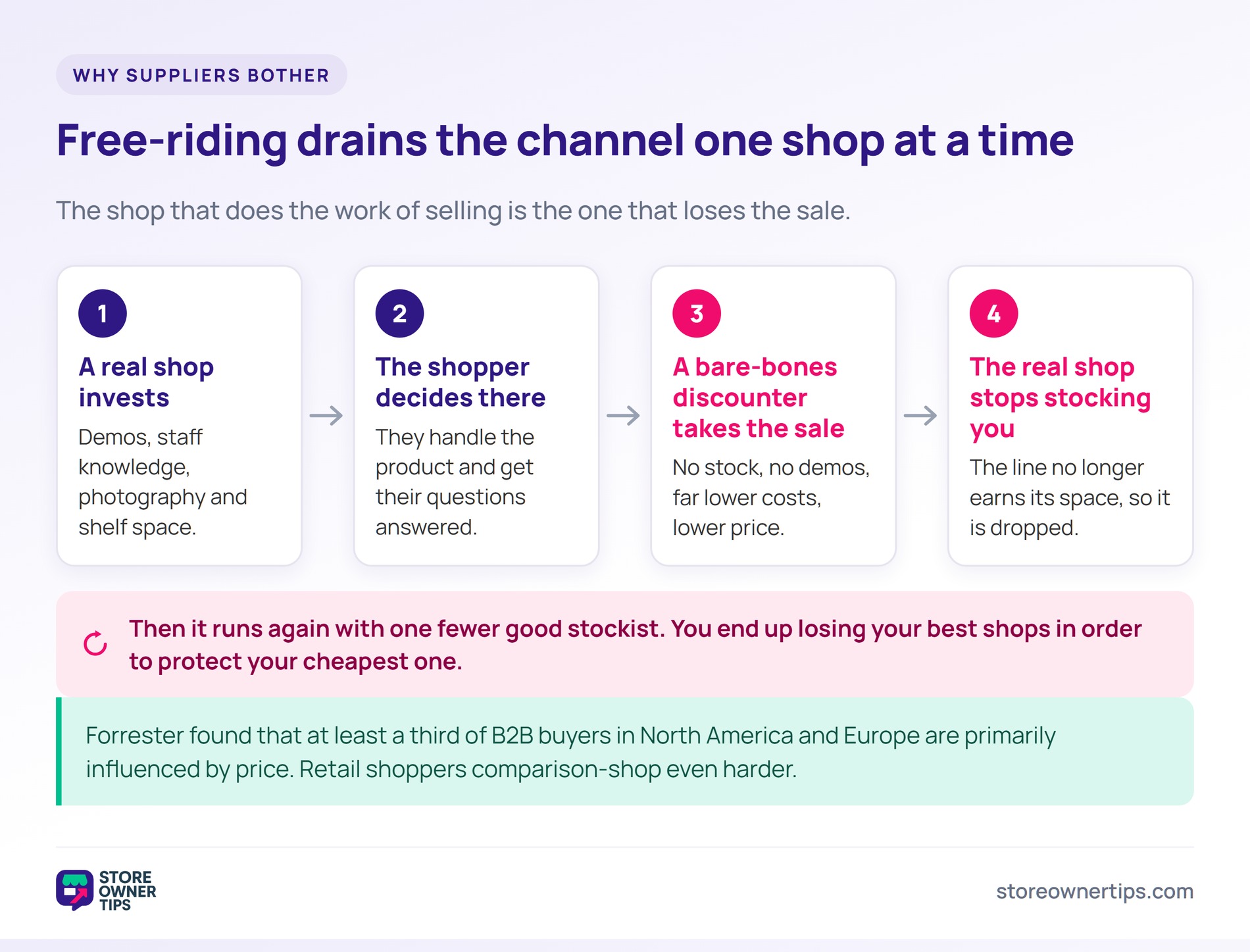
First, the core problem is free-riding. One shop invests in demos, staff knowledge and photography, and a bare-bones discounter takes the sale. Over time, the wholesale customers who add value stop stocking you.
Price sensitivity makes that risk real. Forrester found that at least a third of B2B buyers in North America and Europe are primarily influenced by price. Meanwhile, retail shoppers comparison-shop even harder.
Next, there is a brand argument. A product permanently advertised at half its usual price stops looking like a premium product. So the discount becomes the position rather than a promotion. That is the opposite of a price skimming strategy.
The channel is large enough for this to matter. U.S. merchant wholesalers moved $11.38 trillion in a recent survey year. In practice, most suppliers of any size are managing several resellers at once.
Anything that touches resale prices touches competition law. In the United States the Supreme Court held in Leegin that Dr. Miles should be overruled, so vertical price restraints are judged by the rule of reason. They are no longer automatically illegal.
Rule of reason is not a green light. It means a court weighs the actual competitive effects if challenged. Meanwhile, state laws and other countries can be considerably stricter.
This is why MAP is usually written as a unilateral policy. The supplier announces the terms and declines to supply anyone who ignores them. Crucially, that is different from negotiating a price agreement with each retailer.
None of this is legal advice, and a glossary cannot be. Get a lawyer to review the policy before you publish it. The cost of that review is small next to an antitrust problem.
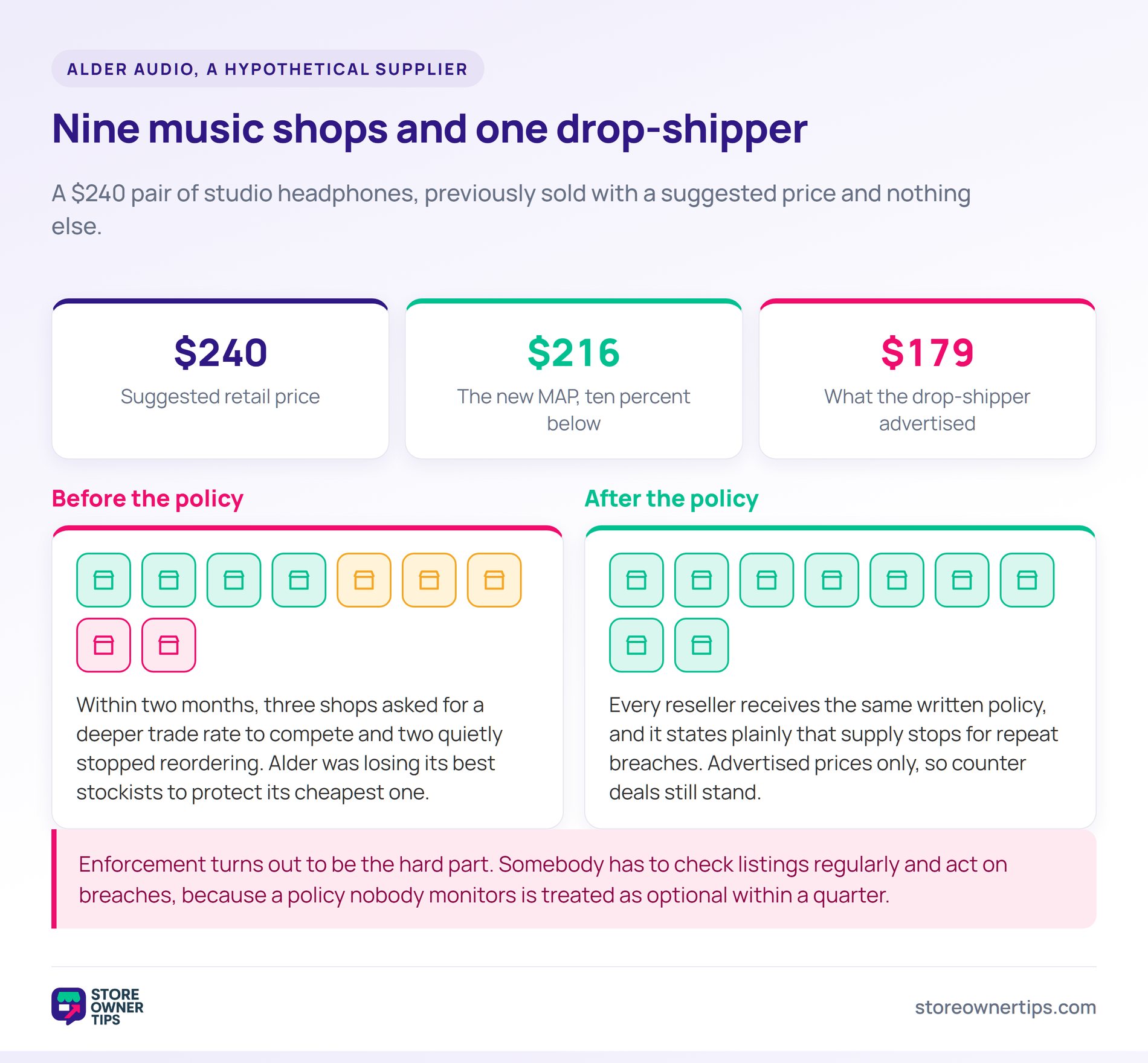
Imagine a supplier called Alder Audio selling a $240 pair of studio headphones. It supplies nine independent music shops. Previously it published a suggested price and nothing else.
One reseller starts advertising the headphones at $179. It carries no stock, offers no demos and simply drop-ships. So its costs are far lower than a real shop’s.
Within two months the effects show up. Three shops ask for a deeper trade rate to compete. Two others quietly stop reordering, because the line no longer earns its shelf space.
Alder Audio is now losing its best stockists to protect its cheapest one. That is the exact failure MAP is designed to prevent.
So Alder publishes a MAP of $216, ten percent below the suggested price. Every reseller receives the same written policy. It states plainly that supply stops for repeat breaches.
The policy governs advertised prices only. A shop can still offer a loyal customer a better deal at the counter. So retailers keep their commercial freedom where it does not damage the channel.
Alder also holds its own site at the suggested price. That matters more than the policy document. A supplier who undercuts its resellers has no standing to police anyone else.
Still, enforcement turns out to be the hard part. Somebody has to check listings regularly and act on breaches. In practice, a policy nobody monitors is treated as optional within a quarter.
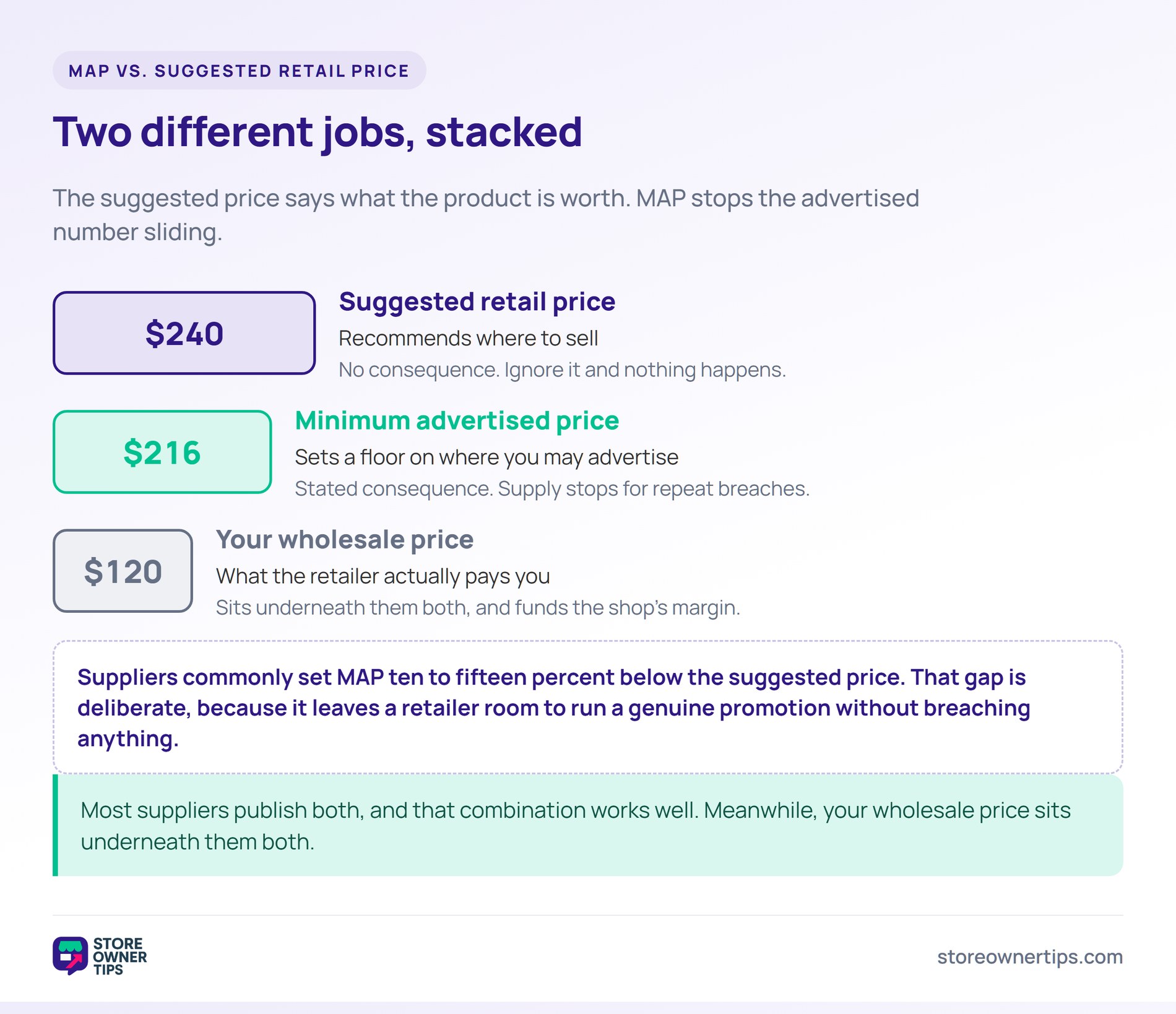
These two get confused constantly, and they do very different jobs. A suggested retail price recommends where to sell. MAP sets a floor on where you may advertise.
The suggested price is aspirational and carries no consequence. Ignore it and nothing happens, beyond an awkward conversation. By contrast, MAP normally comes with a stated consequence.
They also sit at different levels. Suppliers commonly set MAP somewhere below the suggested price, leaving room for genuine promotions. So a retailer can still run a sale without breaching anything.
Most suppliers publish both, and that combination works well. The suggested price says what the product is worth, while MAP stops the advertised number sliding. Meanwhile, your wholesale pricing sits underneath them both.
In the United States, unilateral MAP policies are widely used and generally treated as lawful. The Leegin decision moved vertical price restraints to the rule of reason. However, that means they are assessed case by case rather than blessed in advance.
Other jurisdictions differ, sometimes sharply. Some states and countries take a much harder line on resale pricing. So treat a lawyer’s review as part of the cost of having a policy.
Consistently and unemotionally. A policy applied to one reseller and not another is worse than no policy. So document breaches, warn once, and follow through the same way every time.
Most breaches are careless rather than hostile. An old ad, a stale feed or a third-party listing causes plenty of them. For example, a marketplace repricer can breach MAP with nobody deciding to.
Below your suggested price, with enough room for a real promotion. Setting MAP at the suggested price bans discounting entirely, which retailers resent. A gap of roughly ten to fifteen percent is common.
Check the floor against the retailer’s economics as well. If MAP leaves a shop no margin after their own costs, they will simply stop stocking the line. Meanwhile, the discounter you were worried about carries on.
MAP is how a supplier protects the retailers who actually do the work of selling. It controls the advertised number rather than the final price, which is a narrower power than most people assume.
So write it as a clear policy, get it reviewed, monitor it, and hold your own prices too. For the margin math underneath it, see this guide to boosting wholesale margins.
Copyright © StoreOwnerTips.com. All Rights Reserved.
