Weekly ecommerce tips, deals & news.
An order management system (OMS) is software that tracks every order from placement through delivery and payment. It pulls orders from all your sales channels into one place. Rather than replacing your store, it sits above it and becomes the single record everyone works from.
An order management system works by collecting orders from every channel and giving each one a status it moves through. In practice, orders arrive from your store, a marketplace, a phone call or a wholesale form. Then the system tracks each one along the same path to delivery and payment.
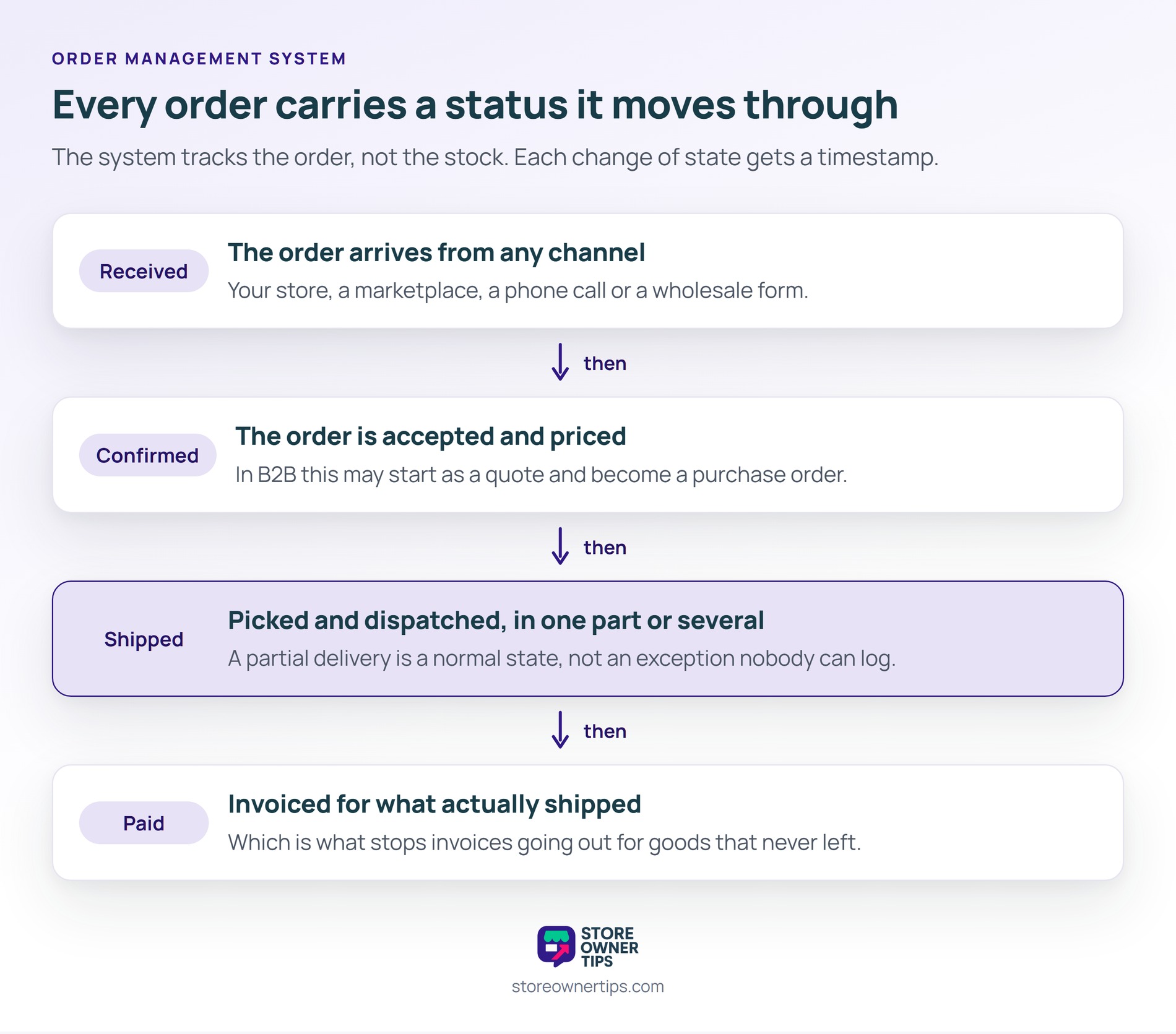
First, picture an air traffic control screen. Every aircraft in the region shows up on one display, with its position and where it is heading.
An order management system is that screen for your orders. So an order half-picked in the warehouse and an order awaiting payment both appear, clearly marked. Meanwhile nobody has to ask three people where something is.
The analogy carries the real benefit too. Controllers do not fly the planes, and an OMS does not pick the boxes. Instead it makes sure nothing is quietly lost.
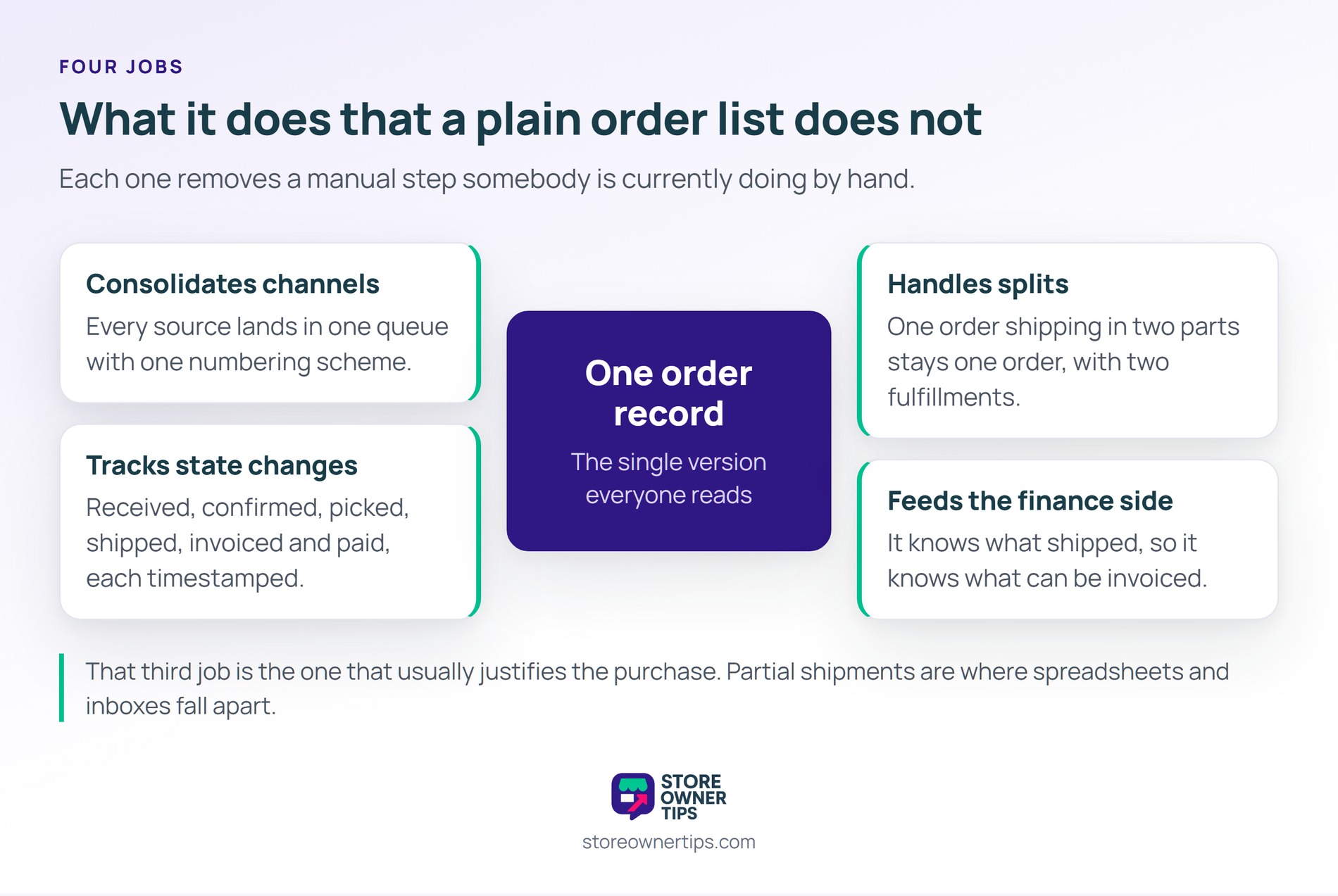
An order management system does four jobs that a plain order list does not. In practice, each one removes a manual step somebody is currently doing.
That third job is the one that usually justifies the purchase. Partial shipments are where spreadsheets and inboxes fall apart. Therefore any store shipping in stages feels the benefit immediately.
An order management system matters more in wholesale than in retail, because a B2B order is rarely simple. Wholesale Suite frames the discipline in its guide to B2B order management in WooCommerce.
A retail order is usually paid, packed and gone the same week. By contrast, a wholesale order might start as a quote and become a purchase order. Then it ships in two parts and gets paid on net terms weeks later.
Consequently the order has a life measured in weeks, not hours. That whole sequence is what quote-to-cash describes, and an OMS is where it is tracked.
An order management system is frequently confused with two neighboring tools, and buying the wrong one is expensive. The distinctions are simple once stated.
Still, the boundaries blur in practice, because many products bundle several of these. So judge a tool by which job it does well rather than by the label on the box.
The orders these systems track represent an enormous flow of trade. Digital Commerce 360 reports US manufacturing and wholesale distribution sales of $15.12 trillion in a recent year. In practice, very little of that is a single-shipment, pay-at-checkout transaction.
The payment side confirms the delay an OMS has to track. B2B ACH payments rose 10% to roughly 8.1 billion transactions, which is a world of invoicing after delivery. Meanwhile Wholesale Suite, our own B2B plugin, reports 20,000+ active installations.
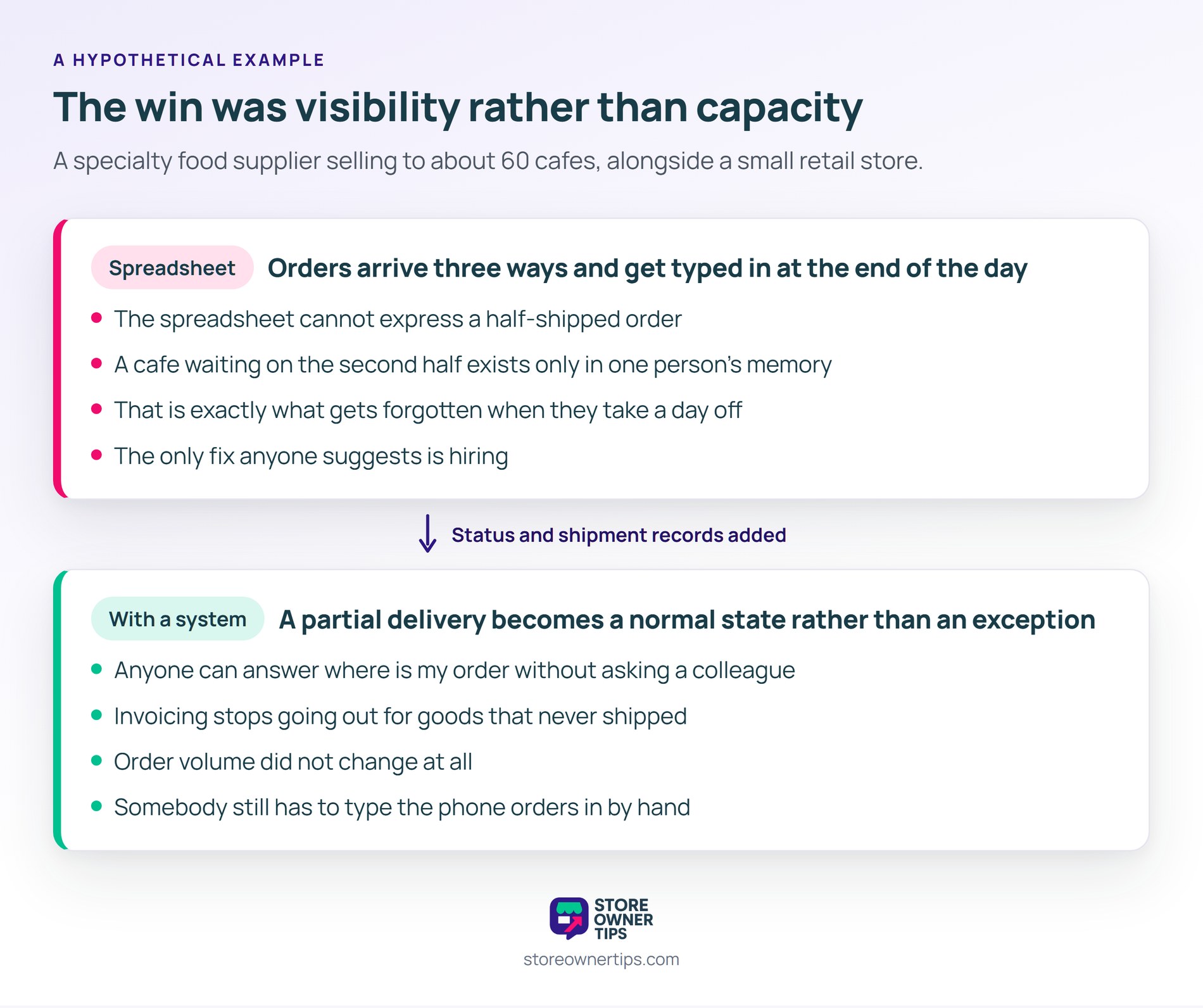
Here’s a hypothetical example. So picture a specialty food supplier selling to about 60 cafes, alongside a small retail store.
Orders arrive three ways: the website, email, and phone calls taken by whoever answers. First those get typed into a shared spreadsheet at the end of each day.
The spreadsheet cannot express a half-shipped order. So a cafe waiting on the second half of a delivery exists only in one person’s memory. Consequently that is exactly what gets forgotten when they take a day off.
They move to a system where every order carries a status and a shipment record. Then a partial delivery becomes a normal state rather than an exception nobody can log.
Two things improve immediately. Anyone can answer “where is my order” without asking a colleague. Meanwhile invoicing stops going out for goods that never shipped.
Notably, order volume did not change at all. Instead the same volume stopped costing them a daily reconciliation. In short, the win was visibility rather than capacity.
Still, the change left real problems untouched, and that is worth saying plainly. The system knew what had shipped. Yet it could not warn them that a popular flour was running low.
Somebody also still had to type the phone orders in by hand. An order management system removes the guessing, not the data entry. So the daily typing job survived the upgrade completely.
Therefore the honest summary is narrow. Their questions got faster answers, while their total workload barely moved. Even so, nobody wanted to go back.
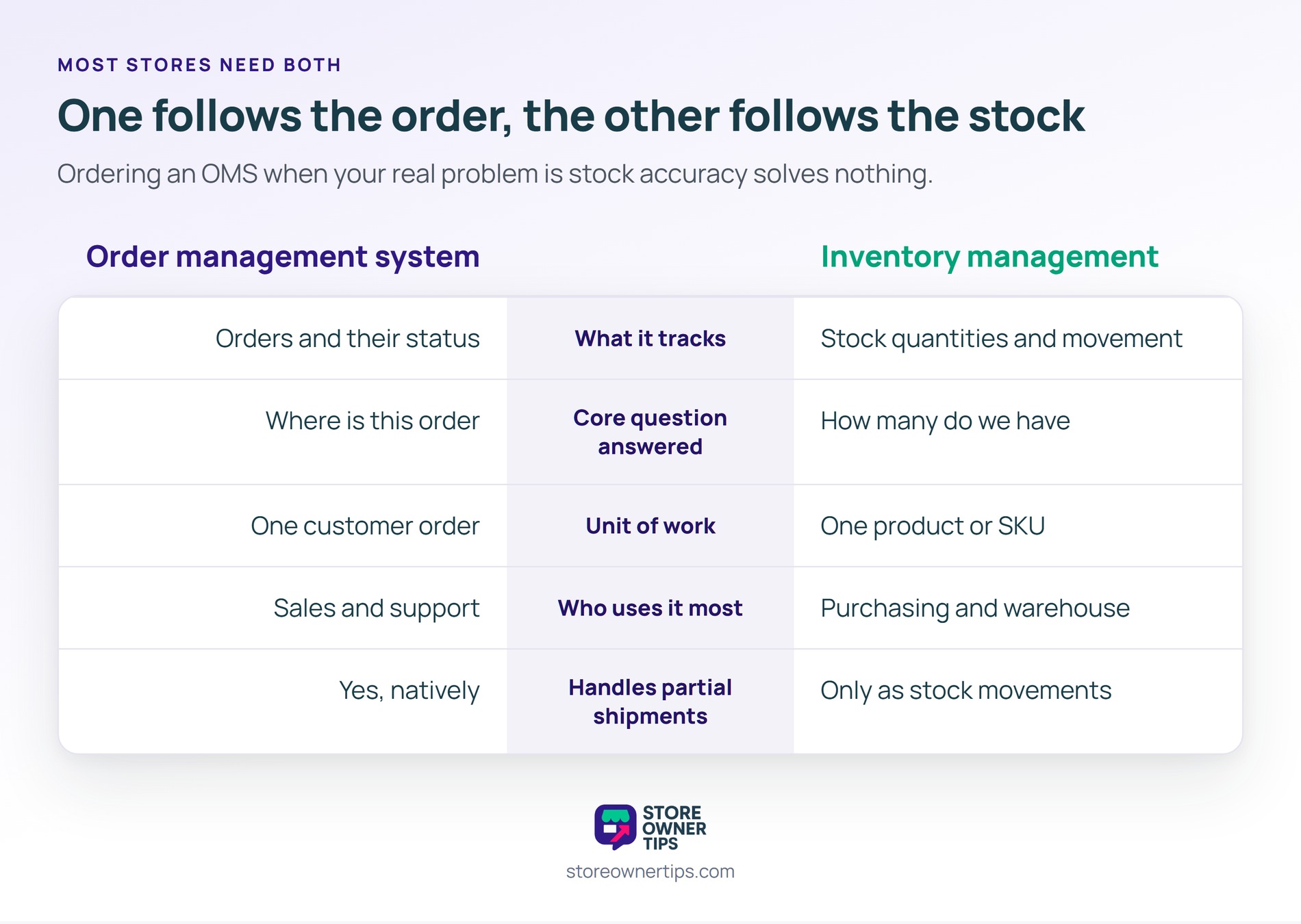
| What you’re comparing | Order management system | Inventory management |
|---|---|---|
| What it tracks | Orders and their status | Stock quantities and movement |
| Core question answered | Where is this order | How many do we have |
| Unit of work | One customer order | One product or SKU |
| Who uses it most | Sales and support | Purchasing and warehouse |
| Handles partial shipments | Yes, natively | Only as stock movements |
An OMS and inventory management answer different questions about the same event, which is why stores end up needing both. Still, ordering an OMS when your real problem is stock accuracy solves nothing. Therefore name the question that is costing you time before choosing a tool.
Usually when orders start arriving through more than one channel, or when partial shipments become normal. Volume matters less than complexity. A store with 20 straightforward orders a day may need one less than a supplier with five complicated ones.
No. Your storefront still captures the order, and the OMS receives it alongside orders from everywhere else. Think of it as the layer where order fulfillment is coordinated rather than a new place to sell.
No, although an ERP usually contains order management inside it. An OMS is focused on the order lifecycle, while an ERP spans finance, purchasing and often manufacturing. Smaller stores generally want the focused tool rather than the whole suite.
An order management system matters because order state is the thing customers actually ask about. Ultimately, a store that cannot answer “where is my order” without a phone call burns staff time. Software answers that question for free. That cost grows quietly with every channel you add.
Meanwhile the same record helps people who never speak to a customer. Warehouse staff see what to pick, and finance sees what to bill. In practice that shared view is the whole point.
Copyright © StoreOwnerTips.com. All Rights Reserved.
