Weekly ecommerce tips, deals & news.
QR code shopping is the use of scannable, two-dimensional barcodes to connect physical items directly to online checkout pages. When a shopper scans a QR code with their phone camera, they are instantly taken to a specific digital destination, like a pre-loaded shopping cart or a product details page. This technology skips the clunky mobile search process, turning real-world objects—like product packaging or store signs—into fast, frictionless points of sale.
To really grasp why this technology is taking over e-commerce, you have to look at a massive shift happening in the global supply chain called Sunrise 2027. For over 50 years, the retail world relied on the 1D linear barcode—the classic Universal Product Code (UPC). But the UPC is extremely limited. It can only hold a basic product identification number (a GTIN) to look up a price.
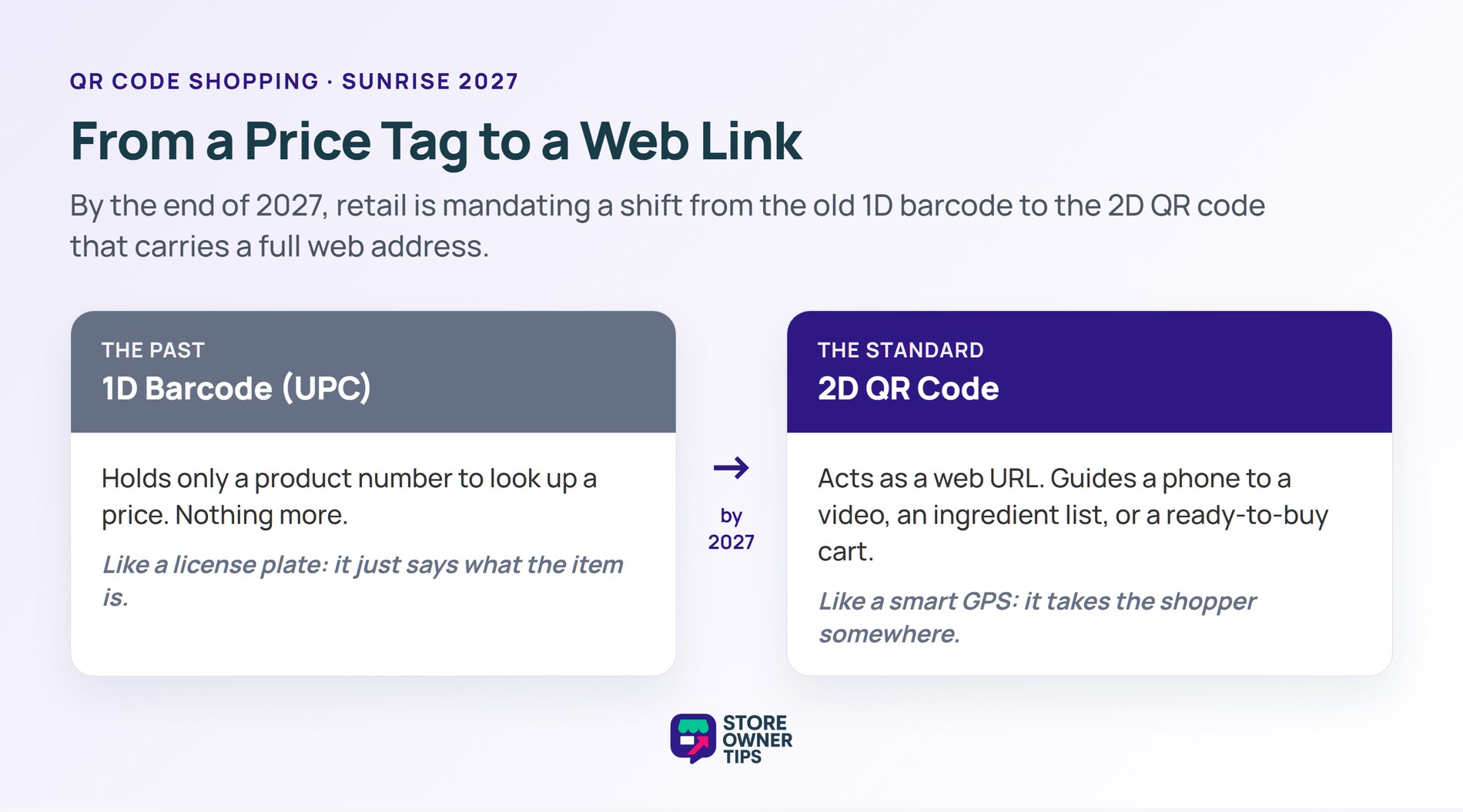
By the end of 2027, the retail industry is mandating a shift to 2D barcodes, powered by the GS1 Digital Link standard. These new codes are high-density matrices that store vast amounts of data and act as standard web URLs.
Think of a traditional 1D barcode like a simple license plate—it just tells the store system what the item is. A modern 2D QR code is more like a smart GPS device. It can guide the store’s checkout scanner to the price, but it can also guide a shopper’s phone straight to an online video, an ingredient list, or an active shopping cart.
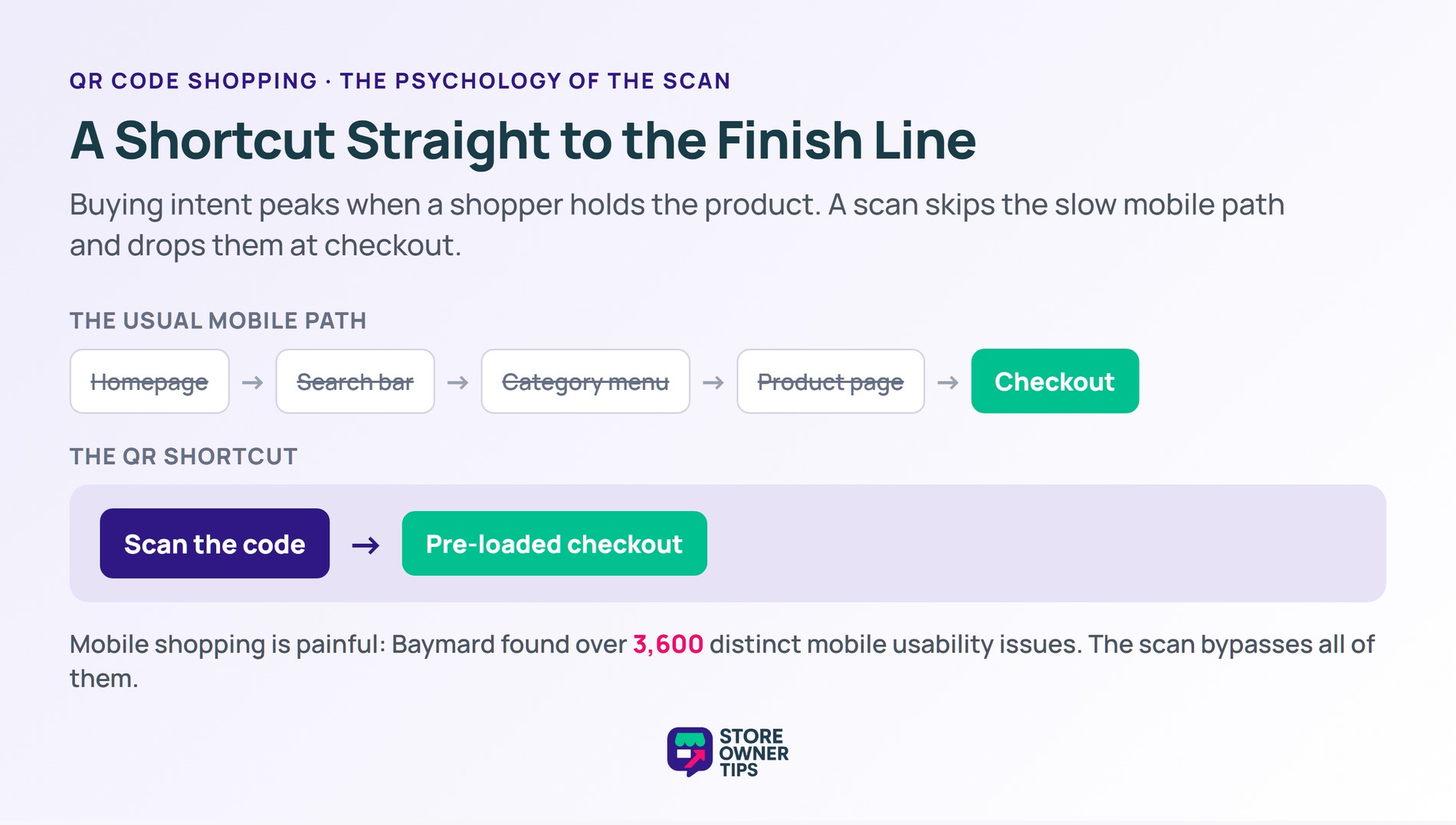
Why do we need this digital bridge? Because shopping on a mobile phone is incredibly frustrating. The Baymard Institute studied thousands of hours of mobile shopping and found over 3,600 distinct usability issues. People hate dealing with hidden filter menus and tiny checkout buttons. In fact, most shoppers just use their mobile cart as a placeholder to look at items, not to actually buy them.
QR code shopping solves this by acting as a psychological bypass. When a shopper holds a physical product or sees a billboard, their buying intent is at its absolute highest. Scanning a code skips the homepage, the search bar, and the category menus. It drops the shopper right at the finish line.
Imagine standing in a long line at a theme park, and suddenly being handed a VIP fast-pass that walks you straight to the front of the ride. That’s exactly what a direct-to-checkout QR code does for mobile shopping.
Behind the scenes, e-commerce platforms do a lot of heavy lifting to make this smooth. On Shopify, for example, their Shopcodes app uses dynamic routing. It also automatically handles tricky formatting. If you want a QR code to apply a discount code with a space in it, like “SAVE 10%”, standard web browsers would break that link. Shopify automatically percent-encodes those spaces (turning it into a messy string of code like SAVE%252010%2525) so the camera scanner reads it flawlessly.
WooCommerce uses a different approach, relying on modular plugins. If someone scans a code using the native WooCommerce mobile app on an Android phone, the system uses Google’s ML Kit to instantly read the camera data. If they use an iPhone, it uses Apple’s Vision framework. They even use QR codes for complex things like restaurant table booking systems or event ticket check-ins.
Finally, payment gateways like Stripe handle the actual money through asynchronous payment processing.
Think of an asynchronous payment like ordering food at a busy restaurant with a buzzer. You place the order by scanning the code. You then complete the payment on your own phone using your banking app. Meanwhile, the store’s cash register just waits patiently for a digital “buzzer” to go off, confirming you paid, before finalizing the sale.
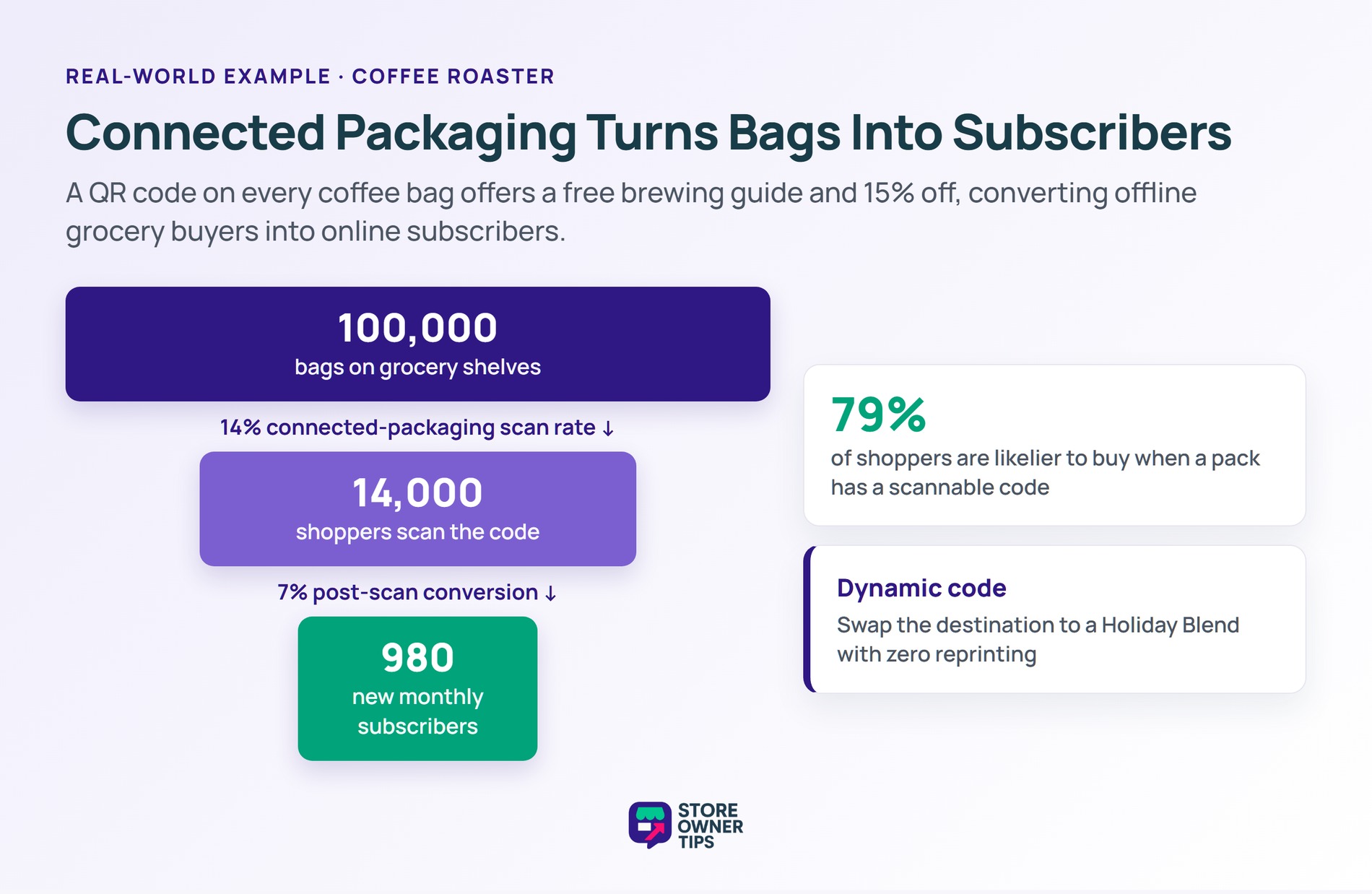
Imagine a mid-sized coffee roaster brand that sells physical bags of whole beans in major grocery stores. They want to turn anonymous grocery store buyers into loyal, direct-to-consumer online subscribers. To do this, they print a QR code on the back of every coffee bag.
Because we know from industry data that 79% of consumers are more likely to buy a product if it features a scannable code offering more information, this simple addition immediately builds trust on the shelf. Let’s say this brand ships 100,000 bags of coffee to grocery stores across the country.
The brand uses a specific strategy called “connected packaging” by offering a scanning reward. They promise a free brewing guide and a 15% discount on monthly bean deliveries if the buyer scans the bag.
In some reported connected-packaging campaigns, scan rates have reached a rate of roughly 14%. Out of the 100,000 bags sold, 14,000 customers scan the QR code while standing in their kitchen brewing their morning coffee. The QR code skips the brand’s homepage and drops the customer directly into a pre-loaded checkout screen for a monthly coffee subscription.
Because the friction is so low, they see a reported 7% post-scan conversion rate, in line with one case study. That means 980 customers instantly sign up for a monthly online subscription directly from a bag they bought offline. The brand tracks all of this perfectly because they attached specific tracking tags to the QR code’s link.
To make this completely future-proof, the coffee brand uses a dynamic QR code. When the winter season arrives, the brand doesn’t want to offer a standard brewing guide anymore. They want the code to point to their new “Holiday Blend” promotion. Because the code is dynamic, the owner just logs into their dashboard and changes the destination link. Instantly, all 100,000 physical bags sitting in grocery stores update their routing. They don’t have to spend a single dime reprinting their packaging.
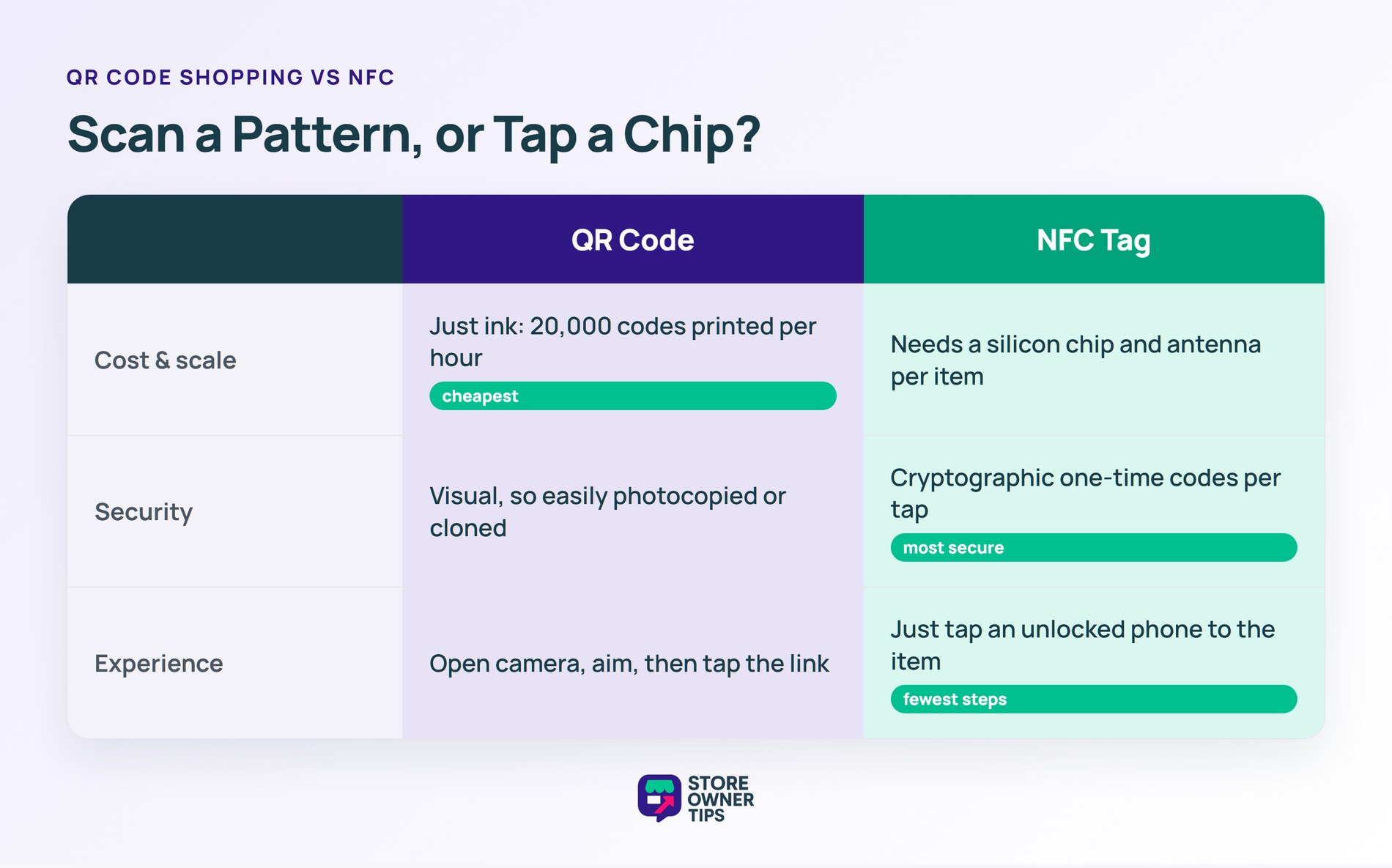
When trying to connect physical items to digital stores, QR codes have one main competitor: Near Field Communication (NFC). While both do the exact same job, they work in completely different ways.
QR codes use a camera to read a printed, visual pattern. NFC uses radio frequencies operating at 13.56 MHz to wirelessly transmit data at high speeds.
NFC is like a secret handshake—you have to be right next to the person and physically touch hands to make the connection. QR codes are like a billboard—you can see and read them from far away, but anyone else can look at them, too.
Yes, a vast majority of them use a deceptive bait-and-switch model. They force you to create a dynamic QR code that relies on their private servers to work. Once you print the code on expensive signs or packaging, they shut the link down. They then hold your physical marketing assets hostage, demanding a steep monthly subscription fee to fix the broken link. Stick to official platform tools or self-hosted scripts.
LED screens cause optical interference. The blank spaces between the tiny screen lights confuse your phone’s camera. To fix this, you need an “LED-friendly” design. Lower the data density of the code to the absolute minimum (a 21×21 grid), change the solid black squares into rounded dots, and use a bright yellow background. This reduces the light glare and helps the camera easily read the code.
It depends on how you built it. If you made a static QR code, the web address is permanently baked into the ink pattern. If you change the link, the code breaks forever and you must reprint. However, if you use a dynamic QR code, the printed pattern actually points to a middleman routing server. You can log into your dashboard, update the final destination link, and all your old packaging will instantly point to the new webpage.
QR code shopping transforms every physical object your brand creates into a high-speed, interactive digital storefront. By adopting this technology today, you are not just wiping out mobile checkout friction; you are actively future-proofing your business for the massive global supply chain shifts arriving over the next few years.
Copyright © StoreOwnerTips.com. All Rights Reserved.
