Weekly ecommerce tips, deals & news.
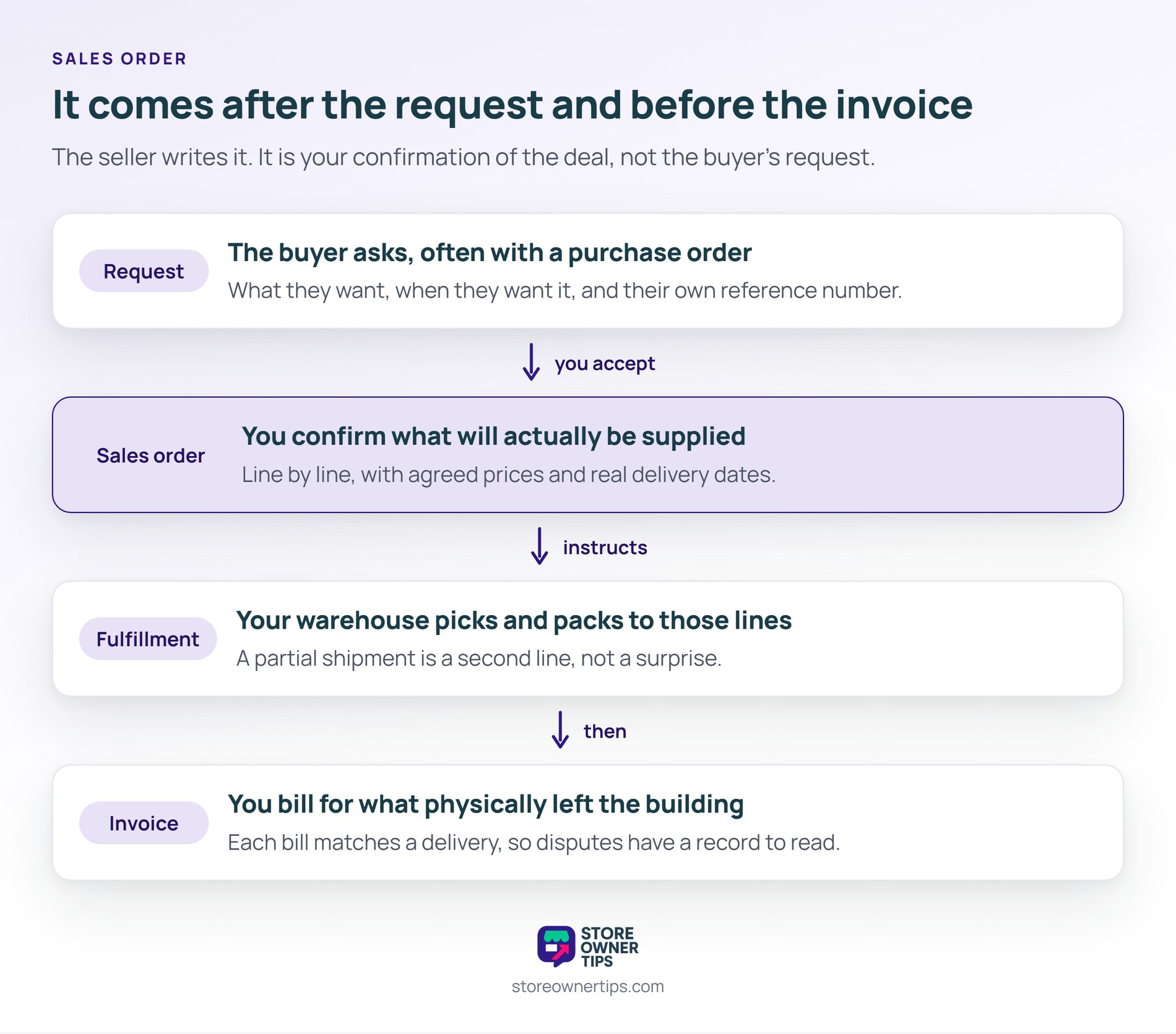
A sales order is the document a seller creates to confirm exactly what they have agreed to supply. It is written by the seller, after the buyer has asked to buy something. In wholesale, it sits between the buyer’s request and the invoice. It then becomes the internal instruction to pick, pack and ship.
A sales order works by turning a buyer’s request into your own binding record of what you will supply. The buyer asks. Then you confirm, in writing, on your own terms. That confirmation is the sales order, and everything downstream refers back to it.
First, think of ordering at a busy takeaway counter. You call out what you want, which is your request. Then the staff read it back to you and print a ticket.
So that printed ticket is the sales order. It is the shop’s own record of what they agreed to make, in their own words. Meanwhile the kitchen works from the ticket, never from what they thought they heard.
In practice, a sales order occupies one specific slot in a wholesale transaction. Still, the documents around it each do a different job, which is why they get confused.
This whole sequence is what the trade calls quote-to-cash. Notably, the sales order is the pivot in the middle. Everything before it is negotiation, and everything after it is execution.
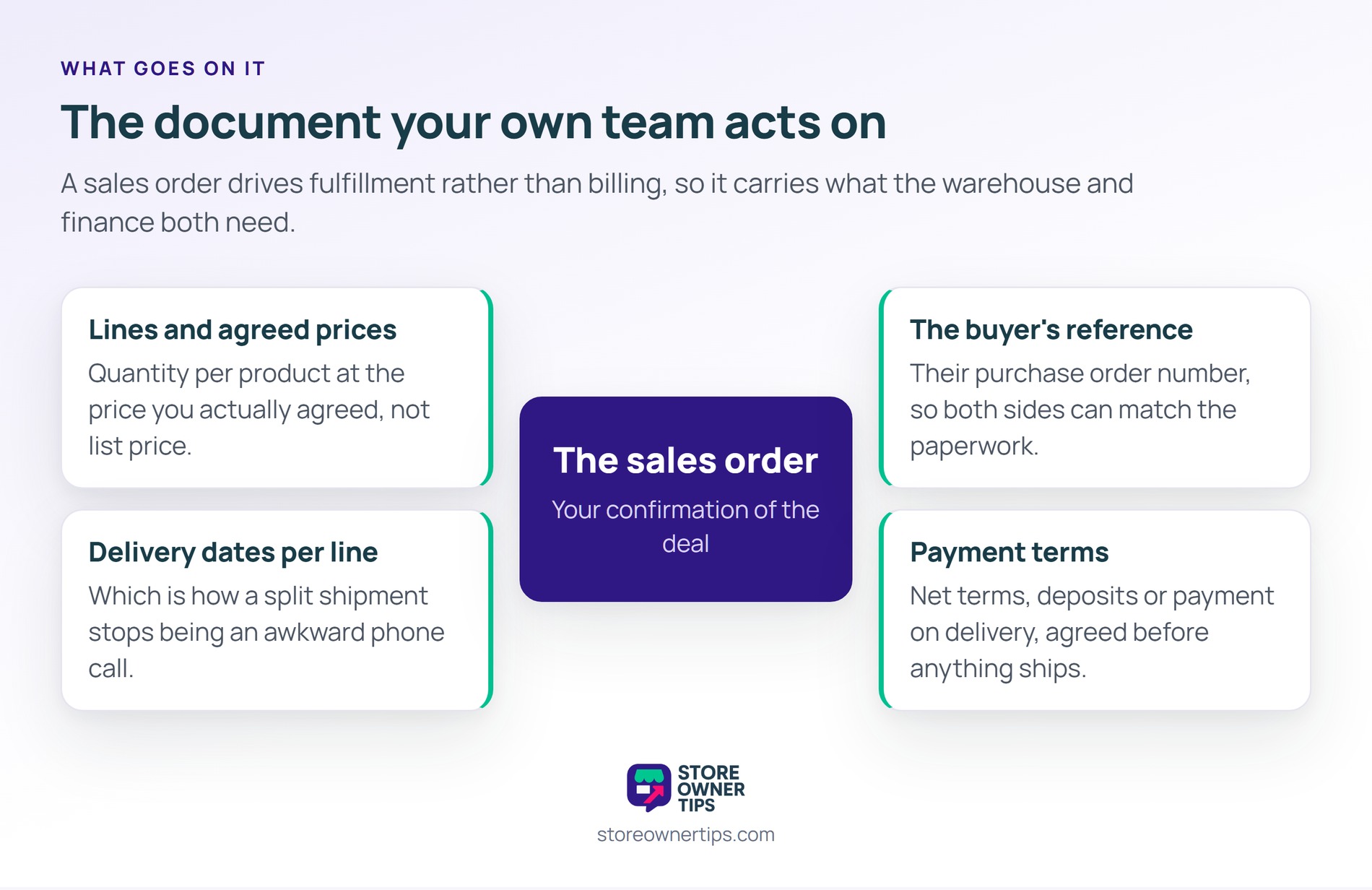
A sales order records the specifics you are committing to, not merely the products. In practice, the useful ones carry more than a line-item list.
Notably, that fourth item matters more than it looks. Without the buyer’s reference, your invoice can sit unpaid in their system for weeks. Therefore capturing it at sales-order stage is the cheapest thing you can do for cash flow.
Sellers raise a sales order to fix the terms before anything ships. After all, a buyer’s request is what they want. Your sales order is what you have agreed to, which is not always identical.
The usual trigger for adopting them is a partial shipment. Once you start splitting deliveries, or holding stock for one account, memory stops being enough. Consequently the sales order becomes the only place the agreed split is written down.
Meanwhile, credit is the second trigger. If a buyer pays weeks after delivery, then the gap between agreeing and billing widens. Therefore something has to hold the terms steady across that gap.
Meanwhile, in WooCommerce, wholesale buyers typically do not pay at checkout at all. Wholesale Suite documents this pattern in its guide to taking orders without payment. The order lands in a status you can act on, and billing follows separately.
Sales orders are the routine paperwork of an enormous sector, not a niche one. Digital Commerce 360 reports that US manufacturing and wholesale distribution sales reached $15.12 trillion in a recent year. Therefore nearly every one of those transactions was confirmed by a document like this.
Payment follows the same deferred rhythm. B2B ACH payments climbed 10% to roughly 8.1 billion transactions. That fits a world of invoicing after delivery.
Meanwhile the pattern is not limited to large distributors. Wholesale Suite, our own wholesale plugin, reports 20,000+ active installations on its free listing.
Here’s a hypothetical example. Picture a small roastery that sells coffee beans wholesale to independent cafes.
First, a cafe emails an order for 40 kilos of one blend and 20 of another. They want it all delivered on the first of next month. Also, they quote their own reference number.
However, the roastery has only 25 kilos of the first blend roasted and ready. Even so, the rest needs another week. So the request and the reality do not match.
Instead of shipping short and explaining afterwards, the roastery raises a sales order. It confirms 25 kilos of the first blend on the first of the month. Then it lists the remaining 15 kilos as a second line, shipping a week later.
Plus, the document carries the cafe’s reference number and the agreed price per kilo. Consequently the cafe knows about the split before it happens. Nobody is surprised by a partial delivery.
Then, when the first delivery goes out, the roastery invoices for 25 kilos only. Next, the second invoice follows a week later for the remaining 15. In short, each bill matches what physically left the building.
Two weeks later a dispute would have been unwinnable without that record. Instead, both sides read the same confirmed lines. In short, the sales order turned an awkward conversation into a scheduling note.

| What you’re comparing | Sales order | Purchase order |
|---|---|---|
| Who writes it | The seller | The buyer |
| What it states | What will be supplied | What is being requested |
| When it appears | After the request is accepted | At the start of the deal |
| Who acts on it | Your warehouse and finance team | The buyer’s approver |
| Direction of commitment | You commit to the buyer | Buyer commits to spend |
A sales order and a purchase order describe one transaction from opposite sides of the table. In fact, both can exist for one deal, and often should. If you only ever see purchase orders, you are working from the buyer’s version of events rather than your own.

No. A sales order confirms what you have agreed to supply, before anything ships. By contrast, an invoice comes afterwards and asks for payment for what shipped. The useful rule is that you invoice what you delivered, not what was ordered.
Usually yes, because the two documents say different things about the same deal. First, their purchase order records what they asked for. Your sales order records what you agreed to supply, which may differ on quantity or date. Without your own version, any disagreement is judged on their paperwork.
Not always. In practice, if orders are small and paid immediately, an invoice alone is enough. That said, once you ship partial deliveries or offer credit terms, the lack of a sales order starts costing time. Most stores adopt them at the point where memory stops being reliable.
A sales order matters because it is where a wholesale deal stops being a conversation. Instead, it becomes a commitment. It protects both sides by stating what will actually arrive. Ultimately, stores that skip it end up arbitrating from memory instead of from a record.
Copyright © StoreOwnerTips.com. All Rights Reserved.
