Weekly ecommerce tips, deals & news.
The scarcity principle is the rule that people want things more when supply feels limited. It’s why “Only 2 left in stock” or “Sale ends tonight” can turn a hesitant browser into a buyer. Online stores use it to spark urgency, lift conversions, and close sales faster.
The trick is keeping the limits real. Fake scarcity erodes trust the moment shoppers spot it. The safest version is grounded in real inventory or timing.
The scarcity principle traces back decades in behavioral science. Robert Cialdini grouped it with five other persuasion levers in his book Influence. The pattern is simple. When something feels harder to get, our brains tag it as more valuable.
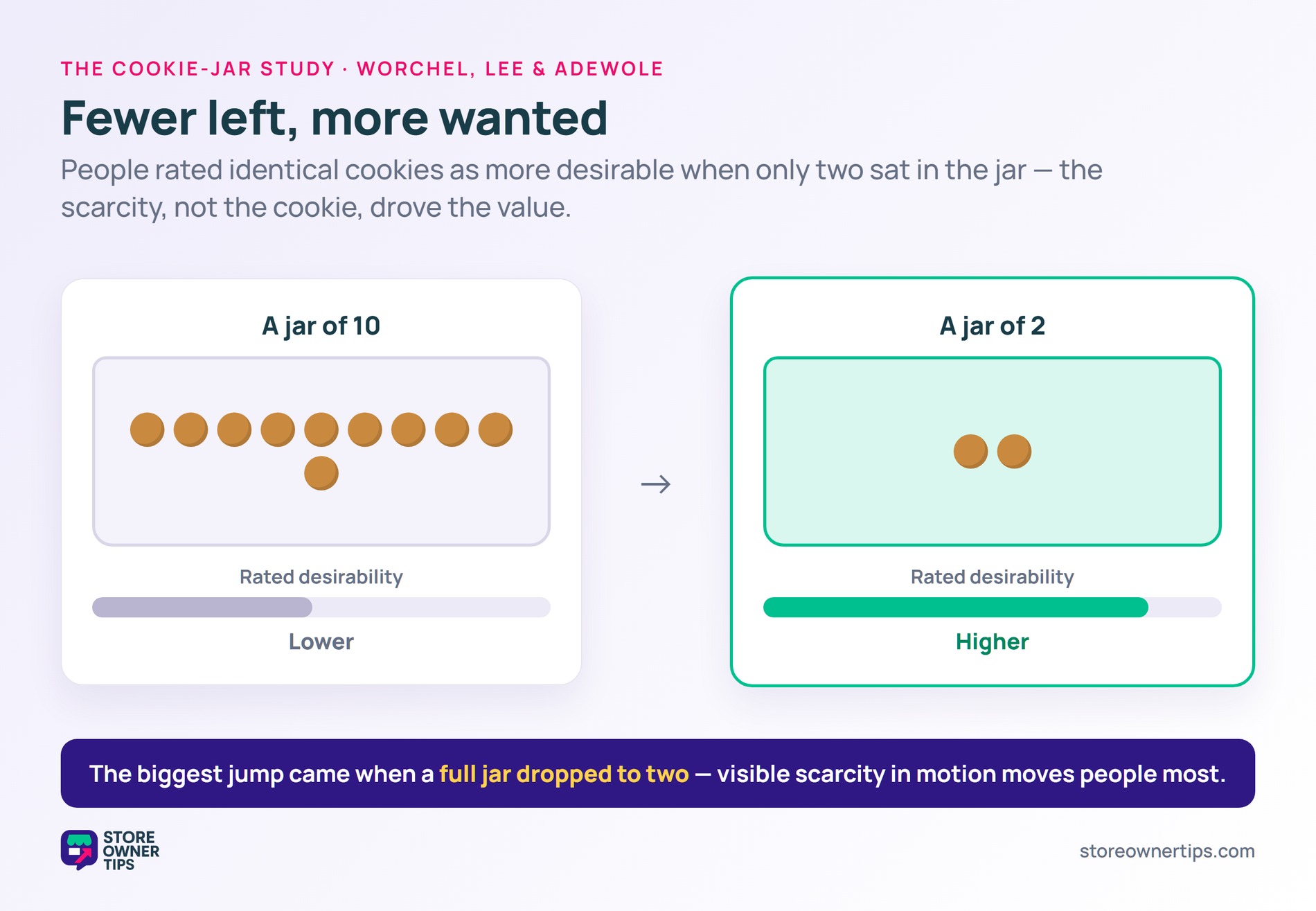
A classic study by Worchel, Lee, and Adewole asked people to rate the same cookies. Some got a jar with ten, others a jar with only two. The two-cookie group rated them as more desirable, even though the cookies were identical. The biggest jump came when the jar started full and then dropped to two.
Think of scarcity like a closing elevator door. An open door, however, doesn’t focus anyone. A door about to shut suddenly forces a choice. That’s the same nudge happening when a product page whispers, “only 3 left.”
The pull connects directly to loss aversion. People feel losses about two and a half times more strongly than equal gains. So “miss this deal” lands harder than “save a few bucks.” Scarcity frames the choice as a loss, which gets people moving.
There’s also a deeper explanation called commodity theory. Psychologist Timothy Brock proposed in 1968 that anything restricted in availability becomes more valued. The restriction itself sends a signal. If something is scarce, the assumption is that other people want it too, which makes it feel worth wanting.
In practice, online stores apply scarcity through a handful of patterns, often paired with a wider urgency playbook. First, low-stock counters are the most common.
WooCommerce includes this out of the box through its Stock Display Format setting under Settings, Products, Inventory. Pick “Only show stock when low” and the product page reveals “Only 2 left in stock.” That message appears once inventory dips under your threshold.
The same pattern shows up on Shopify, either natively or through apps. Either platform can also run time-bound promos. A 24-hour flash sale tied to a coupon code is a classic move. Pair it with a visible countdown on the checkout page.
The third pattern is access scarcity. Think early-bird drops, members-only collections, or invite-only product launches. Here the limit isn’t inventory or time, it’s permission. The shopper has to qualify to even see the offer.
A fourth pattern worth knowing is the “recently sold” or “X people are viewing this” notification. These flip scarcity from a feature of the inventory to a feature of the moment. The shopper sees that demand is real and active, which compresses the decision window further. Used with restraint, this layered urgency lifts conversion without pushing into pressure tactics.
Ultimately, behind all four patterns sits the same lever. The store signals that the chance to buy won’t last forever. That converts hesitation into action.
Scarcity isn’t a guaranteed win. The same research tradition that proved the upside also tracked the failure modes. Reactance theory says that pressure beyond a point pushes people in the opposite direction. Heavy-handed countdowns and pop-ups can trigger that backlash.
There’s also a credibility tax. Shoppers compare notes online. A “selling fast” badge on a product that’s been “selling fast” for six months becomes a meme. It stops being a motivator.
Stores that overuse the lever blunt their own messaging and train customers to ignore it. The fix is calibration. Use scarcity where it’s verifiably true, and not anywhere else.
A real low-stock warning on a real low-stock product carries serious weight. A hundred fake urgency cues across the catalog do not.
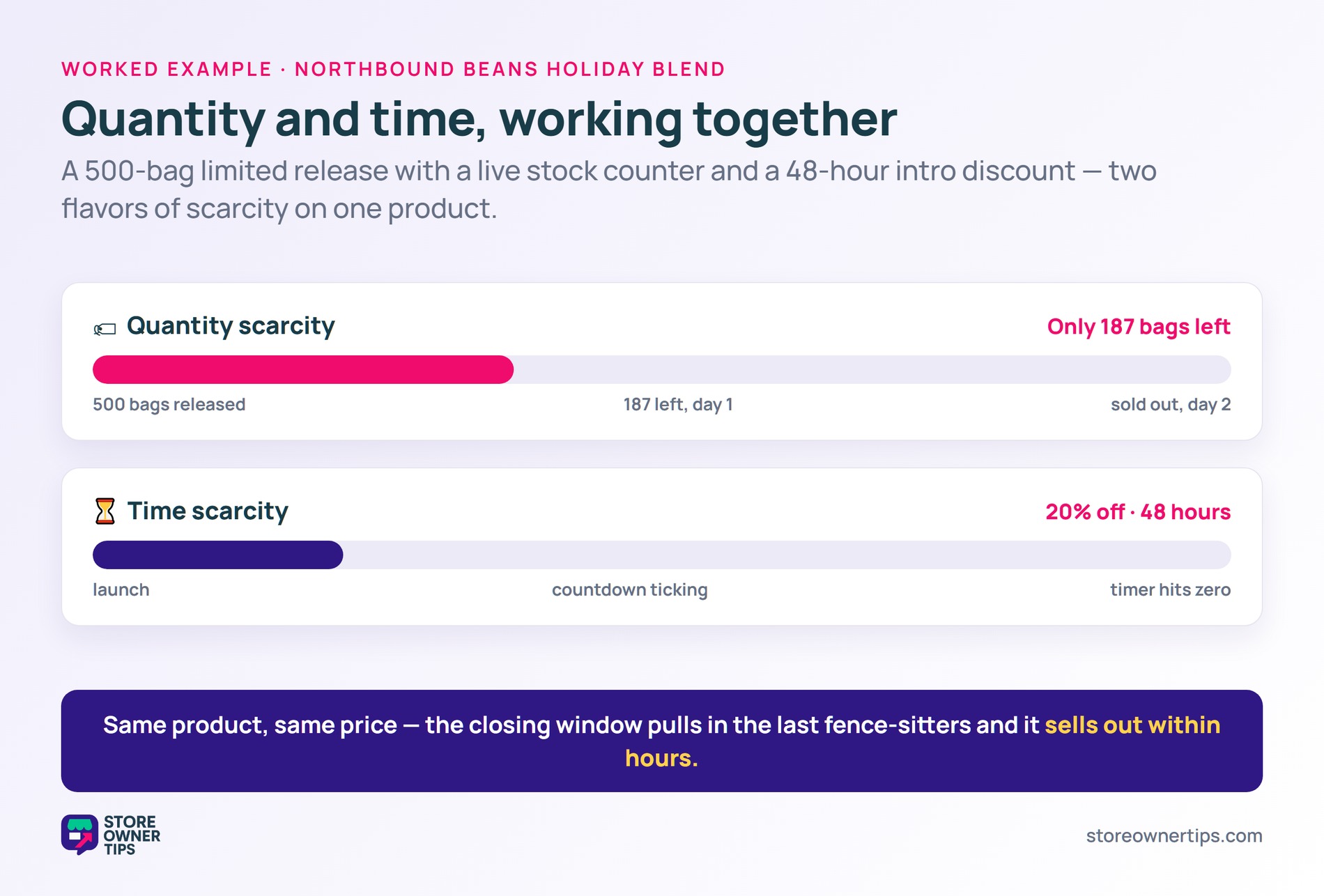
Picture a mid-sized specialty coffee roaster called Northbound Beans. They release a limited holiday blend at 500 bags only. The product page shows a live stock counter, plus a 20% intro discount that runs out after 48 hours.
The setup uses both flavors of scarcity at once: quantity (“only 500 bags”) and time (“48 hours left”). Normally Northbound sees about 70.22% cart abandonment, in line with the average across ecommerce. In short, that number anchors what’s possible to claw back.
Within the first day, shoppers see “Only 187 bags left” near the add-to-cart button. The product page traffic stays the same, but checkouts go up. Each abandoned cart now feels like a bigger personal loss, because shoppers feel losses more strongly than equivalent gains.
As a result, many shoppers who would have left without buying finish checkout before the timer runs out. The store recovers a meaningful share of what would normally slip into cart abandonment. The discount keeps margins reasonable, and the scarcity does the real lifting.
The kicker arrives on day two. The countdown hits zero. The remaining bags sell out within hours, because the closing window pulls in the last fence-sitters. Same product, same price, sharper urgency.
The opposite of scarcity is abundance messaging. That’s the “always in stock, always ready to ship” promise built by big-box stores and big marketplaces. It calms anxiety in
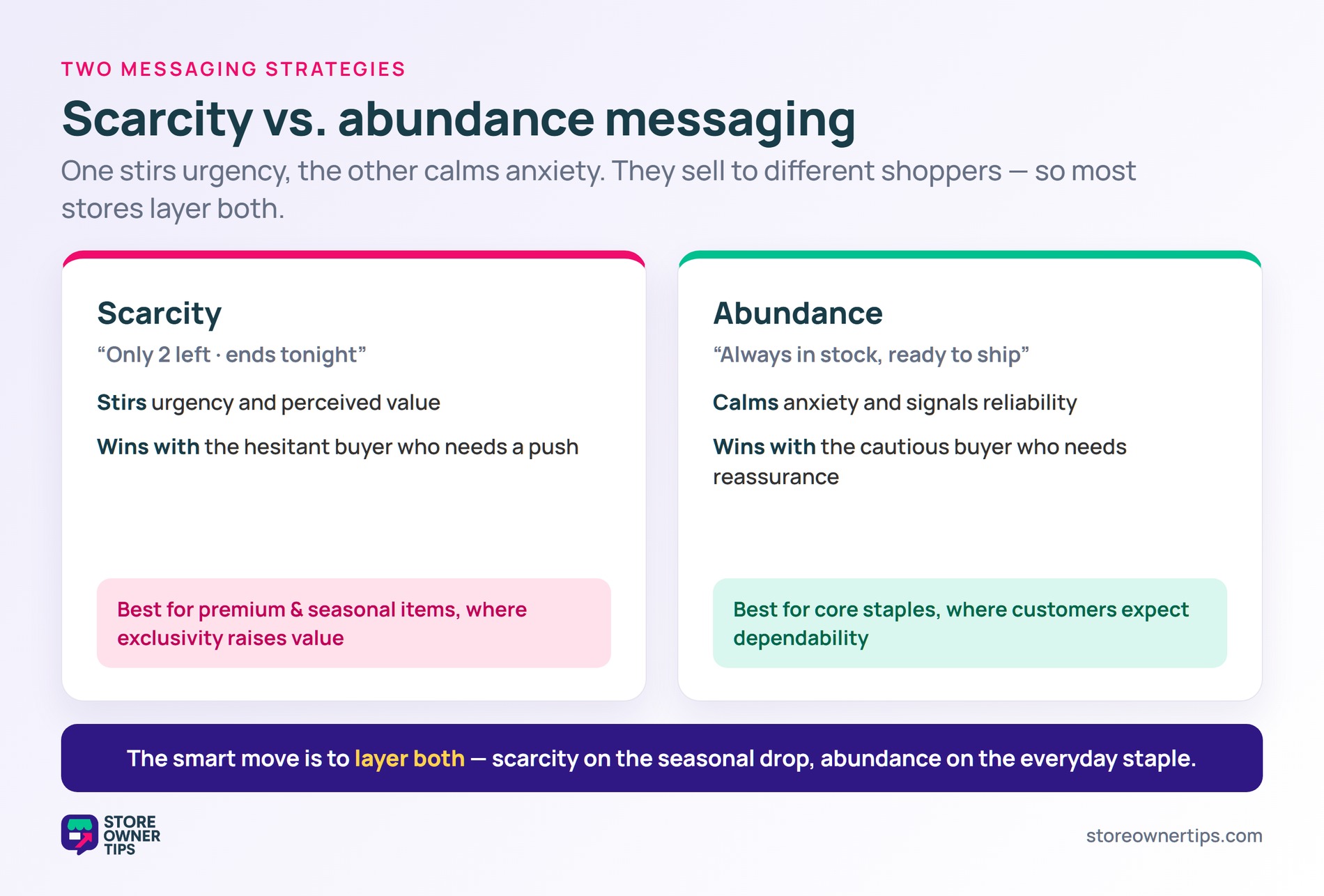
Both approaches sell, but they work on different shoppers. Scarcity wins with the hesitant buyer, the one who needs a push to decide. Abundance wins with the cautious one, the one who needs reliability before they’ll commit.
Still, most stores can’t choose just one. The smart move is layering both. Use scarcity on premium or seasonal items, where exclusivity raises perceived value. Use abundance on core staples, where customers expect reliability above all.
It can be, when the limit is real. Genuine low stock, real expiration dates, and true exclusivity all qualify as ethical scarcity. The line gets crossed when stores invent the limit to pressure shoppers.
Fake countdowns that restart, “selling fast” badges on full inventory, or expiring offers that never actually expire all damage trust. Once shoppers catch on, the cue stops working and the store loses credibility.
Go to WooCommerce, then Settings, Products, Inventory. Turn on Manage stock at the store level. Then on each product, set a Low stock threshold under the Inventory tab.
Back in the store-wide Inventory settings, pick “Only show stock when low” under Stock Display Format. WooCommerce will display “Only X left in stock” once a product dips under your threshold. No extra plugin needed.
Often yes, especially when the limit is genuine. A peer-reviewed 2011 study in the Journal of Advertising found that limited-quantity messages drive purchase intent more than limited-time ones. Scarcity also keeps margins intact, because you’re not actually discounting the product.
A price cut works on the wallet, but scarcity works on the brain. In short, used together, they often outperform either tactic on its own.
The scarcity principle is one of the steadiest persuasion levers in commerce. When the limits are real, it sharpens decisions and lifts conversions without dropping price. Used carelessly, it burns trust and damages the brand. Ultimately, treat it as a precision tool, not a default setting.
Copyright © StoreOwnerTips.com. All Rights Reserved.
